




Category: Penile Size
Core Research Direction: How childhood vs adult adiposity relate to measured adult penile dimensions, and what measured penile length, dissatisfaction and enhancement interventions actually support
Search Intent: Does being overweight (in childhood or adulthood) really make the penis smaller, and what do measurements and evidence say about normal size and 'gaining' length?
Platform: SANYUN Science Center
Evidence reviewed through: 2026-11-13
Executive Summary
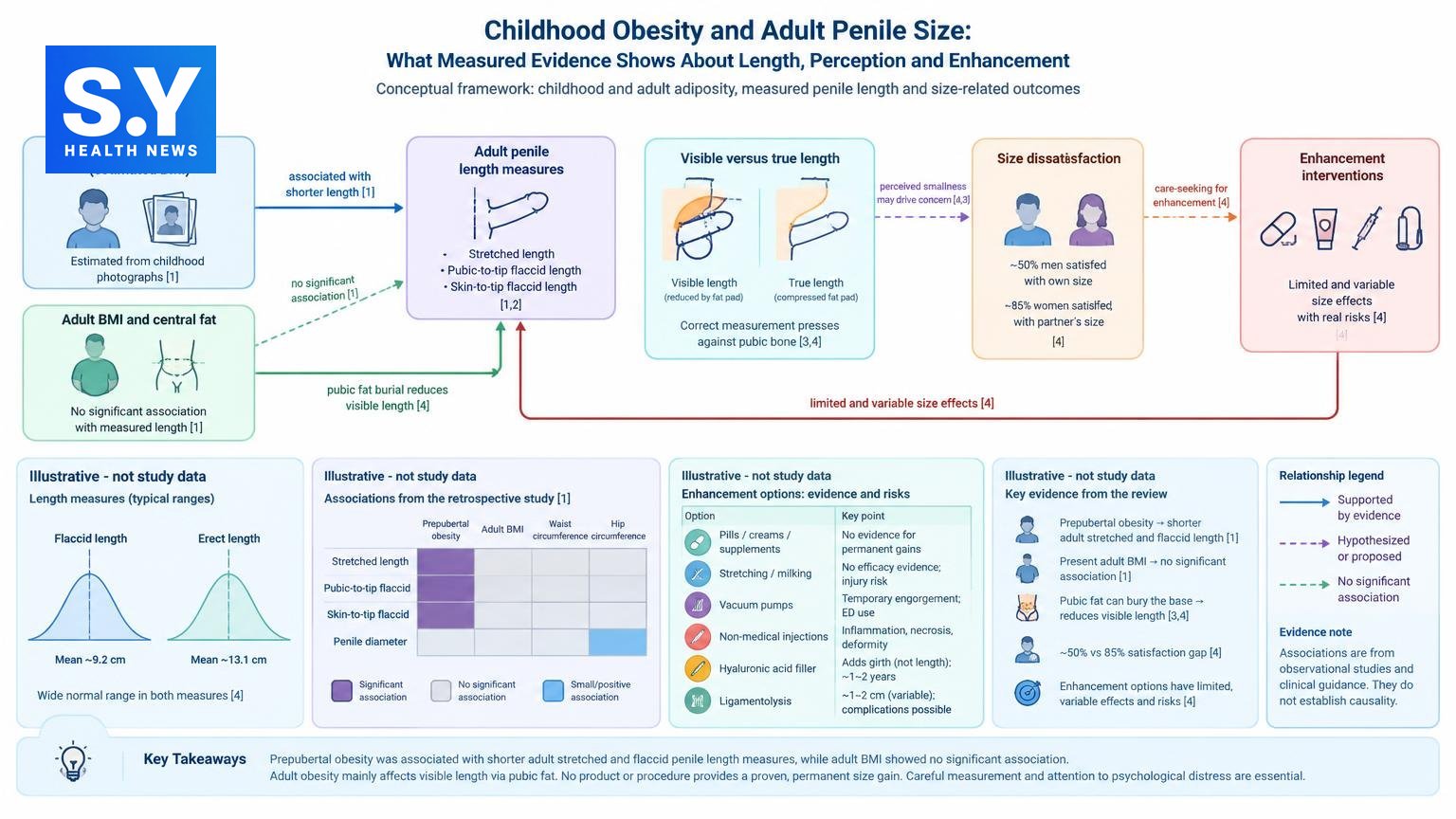
Whether excess body weight makes the penis smaller is one of the most common questions in men's health clinics, and the answer depends on which weight period, which measurement and which comparison is being discussed. A retrospective observational study of 290 men attending reproductive health checks at a Hanoi hospital between June 2023 and July 2024 examined this question by estimating each participant's prepubertal body mass index from childhood photographs and measuring penile dimensions under standardized protocols. Prepubertal obesity was significantly associated with shorter adult stretched, pubic-to-tip and skin-to-tip flaccid lengths, whereas present adult BMI showed no significant association with penile dimensions in multivariate models.[1][2]
The study's framing is that childhood obesity appears to influence penile growth, while adult obesity influences the appearance of the penis rather than its actual size. This distinction matters because adult pubic fat can bury the penile base and reduce visible length without changing cavernosal tissue, and because the childhood finding rests on reconstructed exposure data rather than long-term follow-up. The authors themselves noted that 3D reconstruction from childhood photographs may introduce recall bias and systematic errors.[3]
Separately, benchmark data from a systematic review of clinician-measured values in up to 15,521 men place mean erect length around 13.1 cm and mean flaccid length around 9.2 cm, with a wide normal range. Most men who seek lengthening surgery measure within that normal range. No pill, cream or supplement has evidence for permanent size gains, and surgical or filler options carry real limitations and risks. The clinical task is therefore accurate measurement, honest expectation-setting and attention to the distress that drives many requests.[4]
Why This Matters
Penile size anxiety is common and often disproportionate to measured size. In a large survey of more than 50,000 adults, only about half of men were satisfied with their own size, while 85% of women were satisfied with their partner's size. That gap suggests the problem for many men is perceptual and psychological rather than anatomical, and it explains why clinicians increasingly treat size concerns as a body-image issue that deserves care in its own right.
The childhood-obesity hypothesis adds a preventable dimension. If prepubertal adiposity truly constrains penile growth, then early weight intervention could have long-term reproductive-health benefits. However, that implication is currently an interpretation of observational associations, not a demonstrated causal pathway, and it should not be translated into alarm for parents or into promises that weight loss will restore length.
How Fat Could Affect Penile Size: Two Different Mechanisms
The first mechanism is anatomical and visual. Adult corpus cavernosum length is largely set by innate development and pubertal hormones, and added fat does not shorten the cavernosal tissue itself. What changes is the suprapubic fat pad, which can bury the penile base and make less of the shaft visible, a presentation sometimes described as a buried or concealed penis. Correct measurement presses the ruler against the pubic bone to compress the fat pad rather than measuring only the exposed portion. This is why weight loss can increase visible length without changing true penile size.
The second mechanism is developmental and remains hypothetical. Prepubertal obesity could plausibly influence penile growth through hormonal or metabolic pathways, but the retrospective study cannot establish that pathway. It is also important to distinguish buried penis from concealed penis related to congenital development or local anatomical abnormality, which is a different clinical entity requiring separate evaluation. Flaccid size varies substantially with temperature and circumstances and does not predict erect size, so visual comparisons and self-estimates are unreliable.[5]
What the Evidence Shows
| Exposure or benchmark | Reported result | Interpretation and limitation |
|---|---|---|
| Prepubertal obesity and adult stretched length | β ‒1.201; p=0.05 | Significant association in retrospective observational study; borderline p-value and reconstructed childhood BMI |
| Prepubertal obesity and pubic-to-tip flaccid length | β ‒1.899; p<0.01 | Significant association; observational, not causal |
| Prepubertal obesity and skin-to-tip flaccid length | β ‒1.868; p<0.01 | Significant association; skin-to-tip may be more sensitive to fat burial |
| Present adult BMI and penile dimensions | No significant association in multivariate linear regression | Null result for adult BMI; does not exclude an effect on visible length via fat pad |
| Waist circumference and skin-to-tip flaccid length | β ‒0.047; p=0.02 | Small effect size; observational association |
| Hip circumference and pubic-to-tip stretched length | β 0.047; p=0.04 | Small positive association; interpretation uncertain |
| Sample mean flaccid and stretched length | 8.9 cm; 14.4 cm | Single-center sample means; not population norms |
| Systematic review mean erect and flaccid length | 13.1 cm; 9.2 cm | Pooled clinician-measured data in up to 15,521 men; wide normal range |
The retrospective study reports that prepubertal circumcision also had an effect on stretched length in the model, with a beta of 0.683 and p=0.05. The direction of this effect is inconsistently worded in the available reporting, and the borderline p-value means it should be treated as a hypothesis-generating finding rather than a reliable estimate. The study also noted that obese adults had slightly larger penile diameter than overweight men but not compared with healthy-weight men, a secondary observation that does not support a simple shrinking narrative.
Normal Size and the Dissatisfaction Gap
Understanding the childhood-obesity finding requires a benchmark for normal size. The systematic review by Veale and colleagues, as summarized in a clinic guide, pooled clinician-measured data from up to 15,521 men and found mean erect length of about 13.1 cm and mean flaccid length of about 9.2 cm, with a wide normal range for both. The same guide notes that most men who request lengthening procedures measure within the normal range, a finding attributed to Mondaini and colleagues in 2002 and repeated in subsequent work.
The dissatisfaction data are equally important. In the Lever survey of more than 50,000 adults, only about half of men were satisfied with their own size while 85% of women were satisfied with their partner's size. This mismatch is consistent with the clinical observation that size anxiety often persists despite normal measurements, and it argues for addressing perception and expectation rather than offering procedures to men whose measured size is normal.
What Enhancement Interventions Can and Cannot Do
The evidence for non-medical enhancement is weak to absent. No pill, cream or supplement has evidence for permanent size gains, and online-shared stretching or milking techniques have no efficacy evidence but have documented injuries including capillary rupture, fibrosis and penile curvature. Vacuum pumps produce temporary engorgement and have a role in erectile dysfunction management but do not permanently increase size. Injections of non-medical substances such as liquid silicone or oils are particularly dangerous and have been associated with chronic inflammation, tissue necrosis and permanent deformity.
Medical options are limited and should be presented with explicit caveats. Hyaluronic acid filler temporarily adds girth but not length, typically lasting about one to two years. Ligamentolysis increases visible flaccid length, with published averages around 1 to 2 cm, but results vary widely and some men show little or no change. A systematic review by Marra and colleagues in 2020 concluded that in men with normal size, many enhancement procedures have high complication rates and uncertain satisfaction. Weight loss does not increase true penile size but can make more of the penis visible in men with substantial abdominal fat.
Interpretation and Limitations
The central limitation of the childhood-obesity evidence is its design. It is a single-center retrospective observational study of 290 men, with childhood BMI estimated from photographs rather than measured prospectively. The authors acknowledged that 3D reconstruction enhances feasibility but may introduce recall bias and systematic errors. The study also measured adults at a single time point, so it cannot separate the effect of prepubertal obesity from later growth, pubertal timing, socioeconomic factors or other unmeasured confounders.
Statistical significance in this context should not be read as clinical importance. The beta coefficients describe associations in centimeters or model units, and the study does not report whether the differences were perceptible to men or their partners. A p-value of 0.05 for the stretched-length association is borderline and would not survive a strict correction for multiple comparisons. The null finding for adult BMI does not contradict the well-described visual effect of pubic fat, because the study's penile measurements may not fully capture buried length under standardized conditions.
The educational and clinic sources used for context are not primary research. They summarize mechanisms and benchmarks that are broadly consistent with the literature, but their claims about weight loss improving visible length, testosterone and erectile function are presented without effect sizes or citations in the available text. They should be treated as clinical guidance rather than as evidence of a specific magnitude of benefit. The suggestion that early intervention could mitigate long-term effects on penile development is an authorial implication, not a tested outcome.[6]
Research Outlook
Progress requires prospective cohorts with measured childhood anthropometry, standardized penile measurement including compressed pubic fat, and pubertal staging. Such studies could clarify whether the association is specific to a developmental window, whether it is mediated by insulin resistance or sex-hormone changes, and whether it persists after adjustment for adult fat distribution. Research should also test whether early weight intervention changes penile outcomes, and should include patient-reported outcomes rather than relying only on linear dimensions.
On the intervention side, the field needs better-defined outcomes and harm reporting for enhancement procedures, including satisfaction and regret. The gap between male dissatisfaction and partner satisfaction suggests that psychological and educational interventions deserve rigorous evaluation alongside surgical options. Until such data exist, clinicians should measure carefully, explain the difference between true length and visible length, and avoid implying that weight loss or any product will produce a predictable size gain.
Key Takeaways
- Prepubertal obesity was associated with shorter adult stretched and flaccid penile length measures in a 290-man retrospective study, while present adult BMI showed no significant association with penile dimensions.
- Adult obesity is thought to affect visible length mainly by burying the penile base in pubic fat rather than by shrinking cavernosal tissue, so weight loss may increase visible but not true length.
- Mean erect length in pooled clinician-measured data is about 13.1 cm with a wide normal range, and most men requesting lengthening surgery measure within normal limits.
- Only about half of men are satisfied with their own size while 85% of women are satisfied with their partner's size, pointing to perception as a major driver of concern.
- No pill, cream or supplement has evidence for permanent size gains; fillers and surgery offer limited, variable results with real risks, and many enhancement procedures in normal-sized men have high complication rates and uncertain satisfaction.
Questions and Answers
Does childhood obesity affect adult penile length?
A retrospective study of 290 men found that prepubertal obesity was significantly associated with shorter adult stretched, pubic-to-tip and skin-to-tip flaccid penile lengths. The betas were ‒1.201 for stretched length, ‒1.899 for pubic-to-tip and ‒1.868 for skin-to-tip flaccid length. However, childhood BMI was estimated from photographs, so recall bias and systematic error are possible and causation is not established.
Does adult obesity make the penis smaller?
The evidence suggests adult obesity mainly affects appearance rather than actual penile size. A retrospective study found no significant association between present adult BMI and penile dimensions. Pubic fat can bury the penile base and reduce visible length, so weight loss may make more of the penis visible, but it does not increase true cavernosal length. Distinguishing visible from true length is essential.
What is the average penile size and normal range?
A systematic review of clinician-measured data from up to 15,521 men reported a mean erect length of about 13.1 cm and a mean flaccid length of about 9.2 cm, with a wide normal range for both. Most men who seek lengthening surgery measure within the normal range. Self-measurement and visual comparison are unreliable because flaccid size varies with temperature and circumstances.
Do pills, creams or supplements increase penis size permanently?
No. According to the available clinical guidance, no pill, cream or supplement has evidence for permanent penile size gains. Some products have been found to contain undeclared prescription drugs, which can be dangerous. Stretching and milking techniques also lack efficacy evidence and have been associated with injuries including capillary rupture, fibrosis and penile curvature. These products should not be presented as effective.
What are the risks and limits of penile enhancement surgery or fillers?
Hyaluronic acid filler temporarily adds girth but not length, typically lasting one to two years. Ligamentolysis increases visible flaccid length by a published average of about 1 to 2 cm, but results vary widely and some men see little change. A systematic review concluded that in men with normal size, many enhancement procedures have high complication rates and uncertain satisfaction. These are not risk-free or predictable options.
Why do so many men worry about penis size despite normal measurements?
In a survey of more than 50,000 adults, only about half of men were satisfied with their own size, while 85% of women were satisfied with their partner's size. This gap suggests that perception, comparison with selected media images and anxiety distort self-assessment. Persistent distress about a normal-sized penis deserves psychological support and an honest clinical conversation rather than an unnecessary procedure.
Conceptual framework: Conceptual framework. Arrows summarize relationships reported in a retrospective observational study of 290 men and contextual clinical guidance. Adult BMI showed no significant association with measured penile dimensions, whereas prepubertal obesity was associated with shorter adult length measures; visible length can be reduced by pubic fat burial. Enhancement pathways are limited and variable. This framework is explanatory, not a tested causal model.
Academic References & Evidence
- Childhood obesity may affect penis size. 2025
- Sophie Raffin. L’obésité dans l’enfance a un effet surprenant sur le pénis. Journal of Sexual Medicine
- 肥胖影响阴茎长度?别再被误导,真相和你想的不一样. 2026
- Veale D; Miles S; Bramley S; Muir G; Hodsoll J; Mondaini N; Ponchietti R; Gontero P; Marra G; Drury A; Tran L; Veale D; Muir GH; Lever J; Frederick DA; Peplau LA. เพิ่มขนาดน้องชาย: ขนาดปกติ อะไรได้ผลจริง ความเสี่ยง. BJU Int. 2015 115(6):978-986
- 体重影响有多大?胖了会使阴茎短小吗要科学看待. 2026
- 过度肥胖导致阴茎短小?减重后可能有所改善. 2026
SANYUN Science Center explains published research on men's reproductive and sexual health, connecting scientific evidence with everyday questions while making sources and limitations clear.
Disclaimer: This article is for scientific education and research communication only. It does not provide medical advice, diagnosis, or individualized treatment recommendations, and does not endorse any medication, supplement, device, penile enlargement procedure, or other intervention. Decisions about sexual and reproductive health should be made in consultation with a qualified healthcare professional. Do not delay seeking professional care because of information in this article.
Original Content & Copyright Notice
- This article is prepared for SANYUN Science Center, drawing on published research and publicly available academic literature on men’s sexual and reproductive health. Its editorial explanations and presentation are developed for this platform.
- Copyright in the original editorial content, selection, and arrangement is reserved by SANYUN Science Center to the extent protected by applicable law. Referenced research, quotations, and third-party materials remain subject to the rights of their respective owners. This notice does not claim ownership of scientific facts or third-party research.
- Except where permitted by applicable law or an applicable license, prior written permission is required to reproduce, republish, translate, adapt, redistribute, or commercially reuse protected content. Attribution alone does not grant permission for such reuse.
- For permitted quotation or authorized reuse, clearly identify the source and retain a link to the original article.
- Source: SANYUN Science Center
- Original URL: Retain the original article URL on science.san-yun.com.
- Copyright Holder: SANYUN Science Center, for its own protected editorial content.
- Quotation, excerpts, or authorized reuse must not distort the scientific meaning, omit material limitations or disclaimers, or imply unverified medical claims, product efficacy, or endorsement by SANYUN Science Center.



