




Category: Clinical Insights
Core Research Direction: Understanding how chronic prostatitis/chronic pelvic pain syndrome (CP/CPPS) is evaluated, what its pathophysiologic and genetic underpinnings are, and how to judge the strength of systematic reviews and guidelines used to guide management.
Search Intent: What does the 2025 AUA male chronic pelvic pain guideline conclude about evaluating CP/CPPS, and what does current genetic and methodological evidence add or fail to establish?
Platform: SANYUN Science Center
Evidence reviewed through: 2026-11-25
Executive Summary
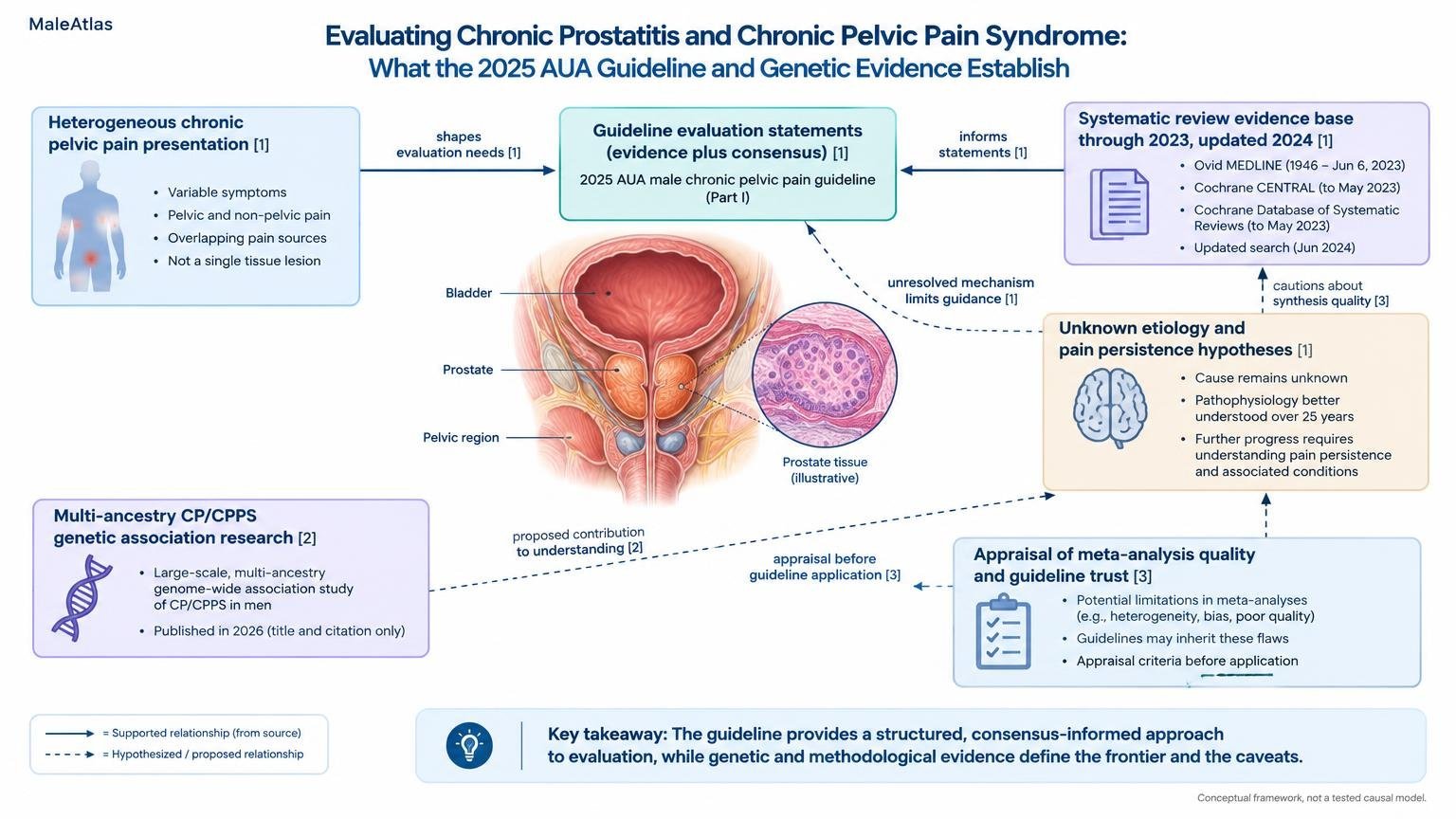
Chronic prostatitis and chronic pelvic pain syndrome (CP/CPPS) is difficult to evaluate partly because the clinical picture is not uniform. The 2025 American Urological Association (AUA) male chronic pelvic pain guideline is the first part of a three-part series and focuses on evaluation of men who present with chronic pelvic pain, including those in whom CP/CPPS or chronic scrotal content pain is suspected. The panel's statements are described as both evidence-based and consensus-based, which matters when judging how firmly any single recommendation rests on trial data.[1]
Two complementary sources frame the limits. A large-scale multi-ancestry genome-wide association study of CP/CPPS in men was published in 2026, indicating that genetic architecture is being actively investigated; however, the available record contains only the study's title and citation, so no association, heritability estimate or sample size can be reported here. Separately, a methodological commentary on systematic reviews and guidelines argues that meta-analyses in perioperative analgesia frequently carry limitations that can make conclusions clinically uncertain, and that guidelines built on them may inherit those flaws. That commentary concerns perioperative pain rather than CP/CPPS, so it is best read as a transferable caution about evidence appraisal, not as a finding about CP/CPPS.[2][3]
The practical implication is a two-track reading of the evidence. The guideline offers a structured, consensus-informed approach to a condition whose cause remains unknown, while the genetic and methodological literature describes the frontier and the caveats. Neither source establishes a diagnostic biomarker, a proven mechanistic pathway or a validated genetic risk score for CP/CPPS.
Why CP/CPPS Evaluation Is Difficult
The guideline explicitly notes that presentation among these men is widely variable and that pain may occur in many body areas outside the pelvis in addition to pelvic pain. This is not a cosmetic detail. When a syndrome is defined by symptoms rather than by a single tissue lesion, evaluation has to distinguish overlapping pain sources, track spatial spread, and avoid anchoring on the prostate simply because the historical label includes prostatitis. The panel acknowledged that the etiology of chronic pelvic pain is unknown while asserting that understanding of its pathophysiology has improved substantially over the past 25 years. That combination of unknown cause and partial mechanistic insight is exactly the setting in which consensus fills gaps left by evidence.
The panel's forward-looking conclusion is that further progress in diagnosing and evaluating suspected CP/CPPS and chronic scrotal content pain will require a better understanding of what causes pain to persist, alongside investigation of associated conditions. This is framed as a research requirement, not as an accomplished finding, and should be read that way.
What the Guideline's Evidence Base Actually Contains
The guideline's systematic review was based on searches in Ovid MEDLINE from 1946 to June 6, 2023, the Cochrane Central Register of Controlled Trials through May 2023, and the Cochrane Database of Systematic Reviews through May 2023, with an updated search conducted in June 2024. These dates define the evidence horizon: literature published after the June 2024 update is not represented in the statements as described. Readers comparing the guideline with newer genetic or mechanistic papers should therefore not assume the guideline panel weighed those papers.
The panel developed statements to guide diagnosis and evaluation that are described as evidence- and consensus-based. Consensus-based components are not a defect in themselves, particularly for a heterogeneous pain syndrome, but they change the interpretation. A recommendation may reflect the best available evidence, expert judgment about how to apply it, or both, and the abstract does not separate the two for individual statements. Clinicians and readers should treat the guideline as a structured framework rather than as a set of effect sizes.
Genetic Research on CP/CPPS: What Is and Is Not Known
The 2026 publication is described as a large-scale multi-ancestry genome-wide association study of CP/CPPS in men, published in Nature Communications volume 17, article 343. The multi-ancestry design is relevant in principle because genetic association findings can differ across ancestral populations, and studies restricted to one ancestry may not transfer. However, the supplied text does not include sample size, the number of cases and controls, the specific variants examined, heritability estimates, replication status or any association result.
This gap is not a minor omission; it determines what can be claimed. A genome-wide association study can identify statistical associations between common variants and a condition, but associations of that kind do not establish causation, do not by themselves explain pain persistence, and do not create a clinical test. The appropriate conclusion from the available record is that CP/CPPS genetic architecture is an active research area with a large multi-ancestry study now published, and that its findings cannot be summarized from the supplied material.
How Much Should Guidelines Trust Meta-Analyses?
The methodological commentary makes an argument that travels beyond its own specialty. Its authors assert that most systematic reviews and meta-analyses assessing perioperative analgesic interventions have critical limitations that may produce flawed conclusions and clinical uncertainty. The specific concerns listed include weak inclusion and exclusion criteria, failure to critically assess study quality, heterogeneity across included studies, bias and poor study quality, the use of basic analgesics, absence of dynamic pain scores, inadequate follow-up, fragility, spin and inaccurate interpretation. None of these concerns is quantified in the supplied text, and the commentary is author opinion rather than a formal review of reviews.
The commentary's central claim is that guidelines based on such meta-analyses may be inaccurate because sophisticated statistical methods cannot compensate for inherent flaws or heterogeneity. That is presented as an argument, not as a validated comparison of guideline accuracy. Its proposed standard for a properly conducted meta-analysis includes a meticulous systematic review, inclusion of homogeneous randomized trials, and critical appraisal of clinical relevance, with attention to functional pain and recovery and to clinically relevant reductions in pain and opioid use. Those criteria were written for perioperative analgesia and do not map directly onto CP/CPPS outcomes, which are discussed in the guideline but not specified in the abstract.
The transferable principle is disciplined appraisal before a synthesis is used in a guideline or in routine practice. For CP/CPPS, that means asking whether a review's included studies were homogeneous, whether outcome definitions matched the clinical question, whether follow-up was adequate for a chronic pain condition, and whether reported differences were clinically meaningful rather than merely statistically present. The commentary does not supply CP/CPPS-specific numbers, so these remain appraisal questions rather than answers.
Reading the Evidence Together: A Comparison of Source Contributions
| What it contributes | Population or scope | Key limitation |
|---|---|---|
| Evidence- and consensus-based statements on diagnosis and evaluation; systematic review through June 2023 with a June 2024 update | Men presenting with chronic pelvic pain, including suspected CP/CPPS and chronic scrotal content pain | Statements mix evidence and consensus; the abstract does not report effect sizes or separate the two for individual recommendations |
| Identifies genetic architecture as an active research direction in CP/CPPS | Men, multi-ancestry design | Supplied record contains title and citation only; no sample size, variants or results available |
| Lists recurring limitations in meta-analyses and argues guidelines may inherit them; proposes appraisal criteria | Systematic reviews and meta-analyses of perioperative analgesic interventions | Commentary without quantified data; perioperative analgesia context may not generalize to CP/CPPS |
Clinical Interpretation and Limitations
For clinicians, the guideline supports a careful, phenotype-aware evaluation of men with chronic pelvic pain rather than a reflex prostate-focused workup, and it explicitly notes that pain may extend beyond the pelvis. That framing is consistent with a syndrome in which the cause is unknown and central or regional pain persistence is a plausible contributor, although the guideline abstract does not specify mechanisms. The genetic study, whatever its eventual findings, should not currently be used to counsel individual patients about inherited risk, because no result is available to interpret and no validated risk model exists in these sources.
Several limitations deserve emphasis. First, the guideline statements combine evidence and consensus, and the search horizon ends in mid-2023 with a 2024 update, so newer literature is outside its synthesized base. Second, the genome-wide association study record is bibliographic rather than substantive, so any claim about specific genes, heritability or predictive value would be unsupported. Third, the methodological commentary concerns perioperative analgesia, and its assertions about meta-analysis quality are not a review of CP/CPPS evidence; importing its criticisms wholesale would overstate what is known about CP/CPPS reviews specifically. Fourth, none of the sources supplies diagnostic accuracy data, so statements about evaluation should be understood as process guidance rather than validated test performance.
Research Outlook
The most informative near-term developments would be full reporting of the multi-ancestry CP/CPPS association results, including replication in independent cohorts and explicit ancestry-specific analyses, and mechanistic work addressing why pain persists rather than only which tissues are inflamed. The guideline panel's own conclusion points in that direction by calling for better understanding of persistence mechanisms and associated conditions. On the methods side, the commentary's critique suggests that future CP/CPPS reviews should pre-specify inclusion criteria, appraise study quality, address heterogeneity and define clinically meaningful outcomes before their results inform guidelines.
Key Takeaways
- The 2025 AUA guideline, Part I of a three-part series, focuses on evaluating men with chronic pelvic pain and offers evidence- and consensus-based statements, informed by a systematic review through June 2023 with a June 2024 update.
- Presentation is heterogeneous and pain may extend outside the pelvis, while the underlying cause of chronic pelvic pain remains unknown despite two and a half decades of pathophysiologic research.
- A 2026 multi-ancestry genome-wide association study of CP/CPPS has been published, but the supplied record provides no sample size or results, so no genetic conclusion can be drawn here.
- A methodological commentary argues that flawed meta-analyses can produce clinically uncertain conclusions and potentially inaccurate guidelines; its context is perioperative analgesia, so it functions as a caution about appraisal, not a CP/CPPS finding.
- Better diagnosis of suspected CP/CPPS will require understanding pain persistence and associated conditions, a research goal rather than an established mechanism.
Questions and Answers
What is chronic prostatitis and chronic pelvic pain syndrome, and why is it hard to evaluate?
CP/CPPS is a chronic pelvic pain syndrome in men that has historically been labeled prostatitis. The 2025 AUA guideline notes that presentation is widely variable and that pain may occur in many areas outside the pelvis as well as within it. Because the cause of chronic pelvic pain remains unknown, evaluation relies on a structured clinical approach informed by both evidence and expert consensus rather than on a single confirmatory test.
What does the 2025 AUA male chronic pelvic pain guideline conclude about evaluation?
Part I of the three-part guideline provides evidence- and consensus-based statements to guide diagnosis and evaluation of men with chronic pelvic pain, including suspected CP/CPPS and chronic scrotal content pain. Its systematic review searched Ovid MEDLINE from 1946 to June 6, 2023 and Cochrane sources through May 2023, with a June 2024 update. The panel concluded that the cause remains unknown and that better understanding of pain persistence is needed.
Does the 2026 genome-wide association study prove a genetic cause of CP/CPPS?
No. The study is described as a large-scale multi-ancestry genome-wide association study of CP/CPPS in men, published in Nature Communications in 2026, but the supplied record contains only the title and citation. Without sample size, variants, effect estimates or replication data, no causal or predictive claim can be made. Genome-wide association signals, even when reported, indicate statistical association rather than proven causation.
How strong is the evidence behind CP/CPPS guideline recommendations?
The guideline statements are described as evidence- and consensus-based, meaning some reflect available data and others reflect expert judgment. The underlying systematic review covers literature through mid-2023 with a June 2024 update, so later studies are not represented. The abstract does not report effect sizes or grade individual recommendations, so strength should be judged statement by statement rather than assumed uniform.
Why do methodological critics warn that guidelines based on meta-analyses may be inaccurate?
A commentary on perioperative analgesic reviews argues that many meta-analyses have weak inclusion criteria, poor quality appraisal, heterogeneous studies and biases, and that guidelines built on them may be inaccurate. The authors state that sophisticated statistics cannot compensate for such flaws. This is a methodological argument in a different clinical field, not a quantified finding about CP/CPPS evidence, and should be applied as a caution rather than a conclusion.
What should patients and clinicians take from this evidence on chronic pelvic pain evaluation?
Evaluation should account for variable and sometimes widespread pain rather than focusing only on the prostate, and it should be understood as structured guidance informed partly by consensus. Genetic testing is not supported for CP/CPPS by these sources, since no interpretable association results are provided. Claims of proven mechanism or validated prediction should be treated cautiously while research on pain persistence continues.
Conceptual framework: Conceptual framework, not a tested causal model. It summarizes how the 2025 AUA guideline's evidence- and consensus-based evaluation statements relate to variable chronic pelvic pain presentation, a systematic review base through mid-2023 with a June 2024 update, unresolved etiologic questions, a 2026 multi-ancestry CP/CPPS genome-wide association study reported here only bibliographically, and methodological cautions about meta-analysis quality. Dashed conceptual links indicate proposed rather than demonstrated relationships; the figure does not depict a biological pathway or clinical algorithm.
Academic References & Evidence
- Lai HH; Pontari MA; Argoff CE; Bresler L; Breyer BN; Chou R; Clemens JQ; De EJB; Doiron RC; Johnson D; Kirkby E; MacDonald SM; Osborne JH; Parekattil SJ; Shelly B. Medline ® Abstract for Reference 49 of 'Chronic prostatitis and chronic pelvic pain syndrome'. J Urol. 2025 214(2):116 PMID: 40243110.
- Sara Brin Rosenthal; Adam X. Maihofer; Caroline M. Nievergelt; Daniel Dochtermann; Armand Gerstenberger; Thomas Whisenant; Saiju Pyarajan; Kristina Allen-Brady; John N. Krieger; Million Veteran Program; Niloofar Afari; Marianna Gasperi. A large-scale multi-ancestry genome-wide association study of chronic prostatitis/chronic pelvic pain syndrome in men. Nat Commun. 2026 17:343 DOI: 10.1038/s41467-025-64954-2.
- Joshi, Girish P; Lobo, Dileep N; Kehlet, Henrik. Challenges in interpretaion of randomised clinical trials included in systematic reviews and clinical guidelines. British Journal of Anaesthesia
SANYUN Science Center explains published research on men's reproductive and sexual health, connecting scientific evidence with everyday questions while making sources and limitations clear.
Disclaimer: This article is for scientific education and research communication only. It does not provide medical advice, diagnosis, or individualized treatment recommendations, and does not endorse any medication, supplement, device, penile enlargement procedure, or other intervention. Decisions about sexual and reproductive health should be made in consultation with a qualified healthcare professional. Do not delay seeking professional care because of information in this article.
Original Content & Copyright Notice
- This article is prepared for SANYUN Science Center, drawing on published research and publicly available academic literature on men’s sexual and reproductive health. Its editorial explanations and presentation are developed for this platform.
- Copyright in the original editorial content, selection, and arrangement is reserved by SANYUN Science Center to the extent protected by applicable law. Referenced research, quotations, and third-party materials remain subject to the rights of their respective owners. This notice does not claim ownership of scientific facts or third-party research.
- Except where permitted by applicable law or an applicable license, prior written permission is required to reproduce, republish, translate, adapt, redistribute, or commercially reuse protected content. Attribution alone does not grant permission for such reuse.
- For permitted quotation or authorized reuse, clearly identify the source and retain a link to the original article.
- Source: SANYUN Science Center
- Original URL: Retain the original article URL on science.san-yun.com.
- Copyright Holder: SANYUN Science Center, for its own protected editorial content.
- Quotation, excerpts, or authorized reuse must not distort the scientific meaning, omit material limitations or disclaimers, or imply unverified medical claims, product efficacy, or endorsement by SANYUN Science Center.



