




Category: Premature Ejaculation
Core Research Direction: Association between chronic prostatitis/prostate symptoms and premature ejaculation in adult men: prevalence, self-reported measures, and whether the relationship is causal or comorbid
Search Intent: In adult men, is chronic prostatitis or prostate-related pelvic pain associated with a higher prevalence of premature ejaculation, and how strong and well-established is that link?
Platform: SANYUN Science Center
Evidence reviewed through: 2026-11-06
Executive Summary
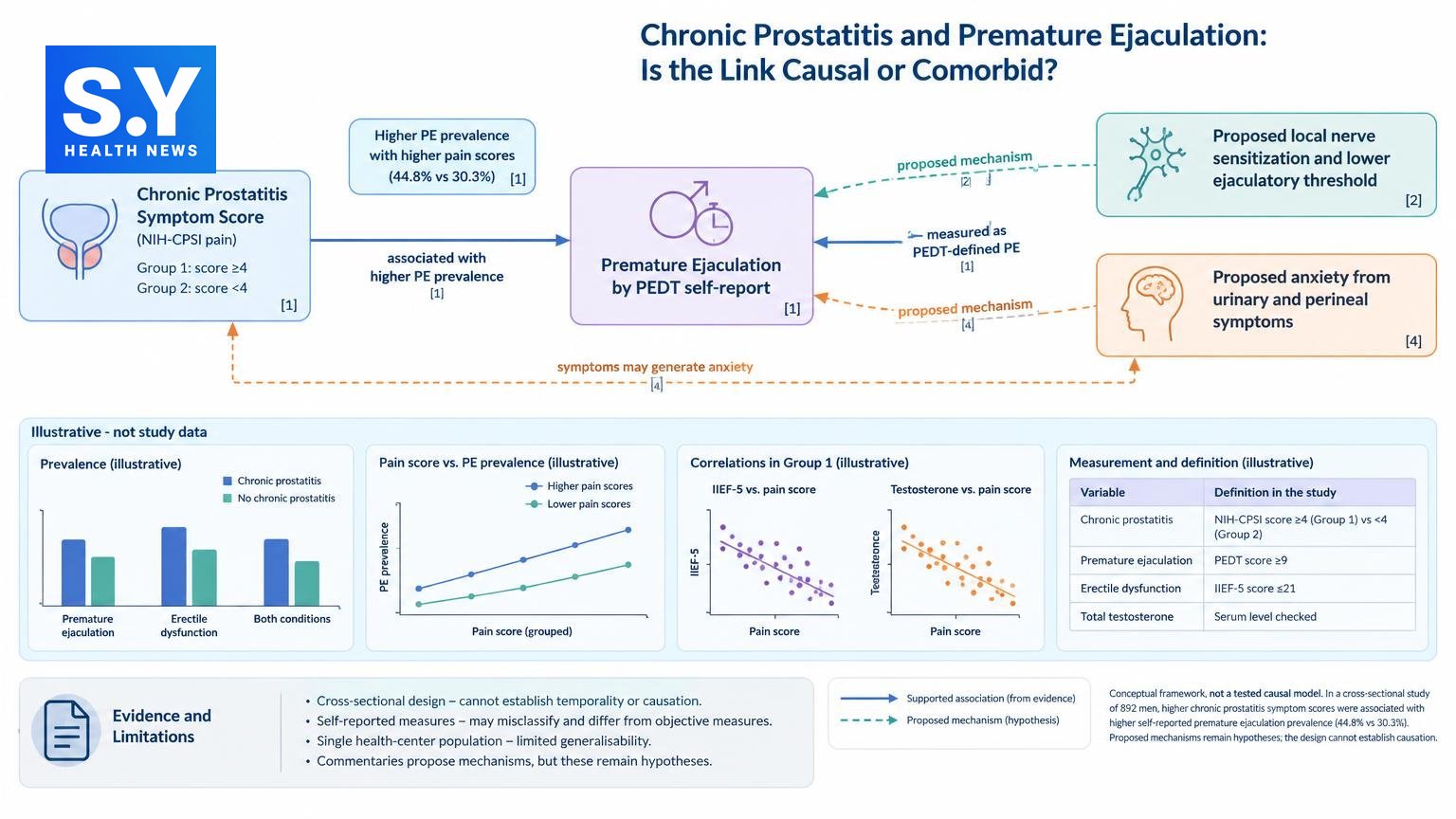
Men with chronic prostatitis symptoms appear more likely to also report premature ejaculation, but the available evidence supports comorbidity rather than a settled causal pathway. The strongest primary dataset in this review is a cross-sectional study of 892 men attending a health care center: premature ejaculation, defined by a Premature Ejaculation Diagnostic Tool score of 9 or higher, affected 32.5% overall, and was more prevalent in men with higher chronic prostatitis pain scores (44.8% versus 30.3%).[1]
That difference was statistically significant, but the design cannot establish whether prostate inflammation shortens ejaculatory latency, whether distress from pelvic symptoms worsens ejaculatory control, or whether both reflect shared psychological or pelvic-floor factors. Consumer and clinician-authored commentaries describe plausible mechanisms and note that not all prostate disease causes premature ejaculation and not all men with premature ejaculation have prostate disease. Those commentaries are not primary evidence, and several mechanistic claims remain hypotheses.[2][3][4][5]
Why This Matters
Ejaculatory disorders are common and carry a substantial impact on quality of life and relationships, according to an international consensus review prepared for the Fifth International Consultation on Sexual Medicine. That review addresses definition, classification, and treatment of premature and delayed ejaculation, and its framing matters because premature ejaculation is often discussed in clinic alongside urinary and pelvic symptoms.[6]
For clinicians and patients, the practical question is not whether the prostate is the sole cause of premature ejaculation. It is whether men presenting with chronic prostatitis symptoms should be asked about ejaculatory function, and whether men presenting with premature ejaculation should be screened for pelvic pain and urinary symptoms. The cross-sectional authors argue that screening men with chronic prostatitis for erectile dysfunction and premature ejaculation is useful for early detection of comorbidities, but that recommendation has not been tested prospectively in the supplied evidence.
Definitions and Measurement
The main study defined chronic prostatitis group status using the National Institutes of Health Chronic Prostatitis Symptom Index pain score: men with a score of 4 or higher were placed in Group 1, and men with a score below 4 in Group 2. This is a symptom-based grouping, not a microbiological or histopathological diagnosis, and it mixes men with different underlying causes of pelvic pain.
Sexual outcomes were self-reported. Participants completed the Intravaginal Ejaculation Latency Time item, the Premature Ejaculation Diagnostic Tool, the Male Sexual Health Questionnaire-ejaculation, the International Index of Erectile Function, and the IIEF-5. Total testosterone was also checked. The absence of objective latency measurement is a meaningful limitation, because self-reported ejaculation latency and questionnaire-based premature ejaculation classification can diverge from stopwatch-measured values.
| Variable | Definition in the study | Interpretation |
|---|---|---|
| Chronic prostatitis grouping | NIH Chronic Prostatitis Symptom Index pain score ≥4 (Group 1) versus <4 (Group 2) | Symptom-based classification; not a confirmed etiologic diagnosis |
| Premature ejaculation | Premature Ejaculation Diagnostic Tool score ≥9 | Self-reported questionnaire threshold; not objective latency |
| Erectile dysfunction | IIEF-5 score ≤21 | Self-reported erectile function; relevant comorbid outcome |
| Total testosterone | Serum level checked in participants | Correlated with pain score in Group 1; cross-sectional only |
What the Evidence Shows
In the 892 men, mean age was 52.8 plus or minus 7.3 years, and 136 men, or 15.2%, met the study's criteria for chronic prostatitis. Erectile dysfunction affected 508 men (56.3%) and premature ejaculation affected 290 men (32.5%). These are prevalence figures from a health-center population, not from a general community sample, and the high erectile dysfunction figure suggests a population with substantial sexual and urinary comorbidity.
The central comparison was between pain-score groups. Men in Group 1 had a higher prevalence of erectile dysfunction, 71.3% versus 53.6%, with a reported p value below 0.001, and a higher prevalence of premature ejaculation, 44.8% versus 30.3%, with a reported p value of 0.001. The authors concluded that the prevalence and severity of both conditions were higher in men with greater chronic prostatitis symptom scores.
Correlation analysis within Group 1 found that IIEF-5 score correlated with the chronic prostatitis pain score at r equals -0.208, p equals 0.015, and total testosterone correlated with the pain score at r equals -0.331, p equals 0.011. These coefficients are modest, and the negative direction for IIEF-5 means worse erectile function tracked with worse pain. The testosterone correlation is hypothesis-generating only; a single cross-sectional measurement cannot show that pain lowers testosterone or that low testosterone worsens pain.
A separate study listed in a research news search aimed to assess histopathologically confirmed asymptomatic inflammatory prostatitis, also called NIH type IV prostatitis, in relation to premature ejaculation among men undergoing transurethral resection of the prostate for benign prostatic obstruction. That study planned to include 218 men. Only the abstract snippet was available, with no results reported in the supplied text, so it cannot yet confirm or refute the association.[7]
Another indexed study compared neutrophil-to-lymphocyte and platelet-to-lymphocyte ratios between primary and secondary premature ejaculation to explore inflammatory markers in subtyping. This is a proposed line of inquiry rather than established evidence in the supplied material; no complete methods, sample size, or results are available here.
Biological and Clinical Mechanisms
Several explanations are offered for why prostate-related pelvic symptoms and premature ejaculation might cluster. Clinician commentary proposes that inflammation in the prostate region sensitizes local nerve endings and lowers the ejaculatory threshold, making ejaculation easier to trigger. This is presented as a proposed mechanism rather than a demonstrated one, and it has not been tested with objective neurophysiological measures in the supplied evidence.
A second proposed pathway is psychological. Urinary frequency, dysuria, and perineal discomfort may generate anxiety and stress, and anxiety is described as an important trigger for premature ejaculation. This mechanism would make the relationship bidirectional: pelvic symptoms worsen ejaculatory anxiety, and anxiety worsens ejaculatory control, without either being the primary cause of the other.
A third possibility is shared pelvic-floor dysfunction. Consumer explainers describe chronic prostatitis and chronic pelvic pain syndrome as multifactorial, involving prolonged sitting, holding urine, stress, and pelvic-floor tension, and note that these patients often have premature ejaculation, ejaculatory pain, or erectile decline. If pelvic-floor tension contributes to both symptom clusters, the association could arise from a common neuromuscular factor rather than from prostate inflammation itself.
Finally, the association may be partly non-specific. Premature ejaculation has multiple contributors, including psychological, relational, sensitivity, hormonal, thyroid, and genetic factors, and prostate problems are neither necessary nor sufficient. This is important for interpretation: a higher prevalence in men with pelvic pain does not mean prostate disease explains most premature ejaculation.
Interpretation and Limitations
The central limitation is design. A cross-sectional study measures exposure and outcome at one time and cannot determine temporal order. The data cannot show whether chronic prostatitis symptoms preceded premature ejaculation, whether premature ejaculation and its associated distress worsened pelvic symptoms, or whether a third factor such as anxiety, sleep disruption, or relationship strain influenced both. The authors describe the findings as a basis for screening and comorbidity detection, not as proof of causation.
Measurement is a second constraint. Both chronic prostatitis grouping and premature ejaculation classification relied on self-report questionnaires, with premature ejaculation defined by a diagnostic tool score of 9 or higher rather than by stopwatch-measured intravaginal ejaculation latency. Questionnaire thresholds are useful for screening but can misclassify men, and self-reported latency is subject to recall and expectation effects.
Generalisability is a third constraint. Participants were men visiting a health care center, with a mean age of 52.8 years, not a community sample of younger men. The 15.2% chronic prostatitis prevalence and the 56.3% erectile dysfunction prevalence suggest a selected population with substantial health concerns. Associations observed there may be weaker or stronger in primary care or in younger men.
The supporting commentaries are best read as clinical and educational context, not as independent evidence. One article states that prostate disease may cause premature ejaculation and lists prostatitis, benign prostatic hyperplasia, and prostate surgery as associated factors, but provides no study design or citation. Another reports that approximately 30% to 70% of patients experience ejaculatory control problems after radical prostatectomy, a very wide range without a cited source. These claims should not be treated as precise effect estimates.
It is also worth noting the distinction between co-occurrence and causation in clinical experience. One commentary observes that some patients report longer intercourse time after prostate treatment improves urinary symptoms, while many others still have premature ejaculation after prostate symptoms resolve. That variability argues against a simple one-directional causal model and is consistent with a heterogeneous, multifactorial relationship.
Clinical and Practical Implications
For clinical practice, the reasonable implication is bidirectional screening rather than causal assumption. Men who present with chronic prostatitis symptoms could be asked about ejaculatory function, and men who present with premature ejaculation could be asked about pelvic pain, urinary symptoms, and ejaculatory pain. The cross-sectional authors support screening men with chronic prostatitis for erectile dysfunction and premature ejaculation, but whether screening improves outcomes has not been demonstrated in the supplied evidence.
The definition of premature ejaculation should not be reduced to a stopwatch number. One commentary states that evaluation is warranted when ejaculation always or almost always occurs about one minute after penetration, or when it clearly affects both partners' satisfaction and persists. Distress and persistence matter, and occasional rapid ejaculation is not the same as a disorder.
The relationship is also not deterministic in either direction. Men with prostatitis do not all develop premature ejaculation, and men with premature ejaculation do not all have prostate disease. Treating one condition may or may not improve the other, and the variable response described in clinical commentary suggests that clinicians should evaluate both domains rather than assume that resolving pelvic symptoms will resolve ejaculatory concerns.
Research Outlook
The most informative next step would be longitudinal research that measures pelvic symptoms and ejaculatory function repeatedly over time, ideally with objective latency assessment alongside validated questionnaires. Such designs could clarify temporal order and help distinguish a direct effect of prostate inflammation from effects of anxiety, pelvic-floor tension, or relationship factors.
Studies of specific prostatitis subtypes could also sharpen the picture. The planned study of histopathologically confirmed asymptomatic inflammatory prostatitis in men undergoing transurethral resection of the prostate, with 218 men planned, may help separate inflammatory from non-inflammatory mechanisms. Its results were not available in the supplied material, and its surgical population will limit generalisability to men without bladder outlet obstruction.
Inflammatory biomarker research, such as comparing neutrophil-to-lymphocyte and platelet-to-lymphocyte ratios across premature ejaculation subtypes, is another proposed direction. At present this remains a hypothesis-generating line of inquiry rather than a validated clinical tool, and it requires full peer-reviewed methods and replication before it can inform practice.
The international consensus review provides a framework for definition, classification, and treatment, but it does not resolve the specific question of whether chronic prostatitis causes premature ejaculation. Its emphasis on evidence-based recommendations for premature and delayed ejaculation is a reminder that the field still needs condition-specific, well-powered studies rather than extrapolation from general sexual medicine guidance.
Key Takeaways
- In a cross-sectional study of 892 men, premature ejaculation affected 32.5% overall and was more common in men with higher chronic prostatitis pain scores (44.8% versus 30.3%).
- The association is real within this sample but does not establish causation, because exposure and outcome were measured at the same time and both relied on self-report.
- Proposed mechanisms include local nerve sensitization, anxiety related to pelvic symptoms, and shared pelvic-floor dysfunction, but these remain hypotheses rather than demonstrated pathways.
- Premature ejaculation has multiple contributors, and prostate problems are neither necessary nor sufficient; the relationship is better described as comorbid and variable than as a simple cause-and-effect link.
- Screening men with chronic prostatitis for sexual dysfunction is a reasonable clinical consideration supported by the cross-sectional authors, but its benefit has not been prospectively tested in the supplied evidence.
Questions and Answers
What is the association between chronic prostatitis and premature ejaculation?
In a cross-sectional study of 892 men, those with higher chronic prostatitis pain scores had a higher prevalence of premature ejaculation, 44.8% versus 30.3%. This is an association within one health-center sample, measured at a single time point with self-reported questionnaires. It indicates comorbidity, not proof that prostatitis causes premature ejaculation.
How common was premature ejaculation in the chronic prostatitis study?
Among all 892 participants, 290 men, or 32.5%, met the questionnaire threshold for premature ejaculation, defined as a Premature Ejaculation Diagnostic Tool score of 9 or higher. The prevalence was higher in the group with greater chronic prostatitis pain scores. These figures come from a health-center population and may not reflect community rates.
Does the evidence prove that prostatitis causes premature ejaculation?
No. The main study was cross-sectional, so it cannot establish temporal order or rule out shared causes such as anxiety, pelvic-floor dysfunction, or relationship strain. The authors present the findings as support for screening and comorbidity detection. Consumer commentaries similarly describe the relationship as co-occurrence or possible aggravation rather than simple causation.
What mechanisms might link prostate symptoms and premature ejaculation?
Proposed explanations include sensitization of local nerve endings by inflammation, anxiety and stress caused by urinary and perineal symptoms, and shared pelvic-floor tension. These are hypotheses drawn from clinical commentary, not demonstrated pathways. Premature ejaculation also has multiple other contributors, including psychological, hormonal, and genetic factors.
What are the limitations of the chronic prostatitis and premature ejaculation evidence?
Key limitations are the cross-sectional design, self-reported questionnaires instead of objective latency measurement, and a selected health-center population with a mean age of 52.8 years. Several supporting commentaries provide no citations or study designs, and one planned surgical study of 218 men had no results in the supplied material.
Should men with chronic prostatitis be screened for sexual dysfunction?
The cross-sectional authors suggest screening men with chronic prostatitis for erectile dysfunction and premature ejaculation to detect comorbidities early. This is a reasonable clinical consideration, but it has not been prospectively tested in the supplied evidence. Screening should be paired with evaluation of pelvic symptoms, urinary function, and psychological factors rather than assuming one condition causes the other.
Conceptual framework: Conceptual framework, not a tested causal model. In a cross-sectional study of 892 men, higher chronic prostatitis symptom scores were associated with higher self-reported premature ejaculation prevalence (44.8% versus 30.3%). Proposed mechanisms involving local nerve sensitization and symptom-related anxiety remain hypotheses; the design cannot establish causation.
Academic References & Evidence
- Min Ho Lee; Deok Ha Seo; Chun Woo Lee; Jae Hwi Choi; Seong Uk Jeh; Sin Woo Lee; See Min Choi; Jeong Seok Hwa; Jae Seog Hyun; Ky Hyun Chung; Sung Chul Kam. Association of erectile dysfunction and premature ejaculation in men with chronic prostatitis. Journal of Men's Health. 2020 16(SpecialIssue1):e13-e22 DOI: 10.15586/JOMH.V16ISP1.185.
- 前列腺会不会导致早泄?两者之间确实有关联. 39健康网. 2026
- 前列腺会不会引起早泄?答案没那么简单. 39健康网. 2026
- 前列腺问题会导致早泄吗?答案没那么简单. 39健康网. 2026
- 张兆发. 前列腺可导致早泄吗.
- Contemporary consensus and emerging directions in premature and delayed ejaculation: recommendations from the 5th International Consultation on Sexual Medicine.. Sexual medicine reviews PMID: 42855438.
- 生物通文章搜索.
SANYUN Science Center explains published research on men's reproductive and sexual health, connecting scientific evidence with everyday questions while making sources and limitations clear.
Disclaimer: This article is for scientific education and research communication only. It does not provide medical advice, diagnosis, or individualized treatment recommendations, and does not endorse any medication, supplement, device, penile enlargement procedure, or other intervention. Decisions about sexual and reproductive health should be made in consultation with a qualified healthcare professional. Do not delay seeking professional care because of information in this article.
Original Content & Copyright Notice
- This article is prepared for SANYUN Science Center, drawing on published research and publicly available academic literature on men’s sexual and reproductive health. Its editorial explanations and presentation are developed for this platform.
- Copyright in the original editorial content, selection, and arrangement is reserved by SANYUN Science Center to the extent protected by applicable law. Referenced research, quotations, and third-party materials remain subject to the rights of their respective owners. This notice does not claim ownership of scientific facts or third-party research.
- Except where permitted by applicable law or an applicable license, prior written permission is required to reproduce, republish, translate, adapt, redistribute, or commercially reuse protected content. Attribution alone does not grant permission for such reuse.
- For permitted quotation or authorized reuse, clearly identify the source and retain a link to the original article.
- Source: SANYUN Science Center
- Original URL: Retain the original article URL on science.san-yun.com.
- Copyright Holder: SANYUN Science Center, for its own protected editorial content.
- Quotation, excerpts, or authorized reuse must not distort the scientific meaning, omit material limitations or disclaimers, or imply unverified medical claims, product efficacy, or endorsement by SANYUN Science Center.



