




Category: Health Academy
Core Research Direction: What comprehensive sexuality education is (a curriculum-based child-protection and health-promotion framework covering bodies, boundaries, consent, safety and relationships), which reader questions it addresses for parents, and what the available source can and cannot evidence about outcomes.
Search Intent: What is comprehensive sexuality education, and what does the available source actually claim—versus prove—about its content, age-appropriateness, and effects on children's sexual behaviour?
Platform: SANYUN Science Center
Evidence reviewed through: 2026-11-10
Executive Summary
Comprehensive sexuality education (CSE) is described in a UNFPA-partnered parent guide as a structured, curriculum-based educational process focused on self-care, safety and empowerment rather than on sexualizing children. The same guide presents CSE as a child-protection and health-promotion framework covering bodily autonomy, boundaries, consent, relationships, emotional wellbeing, online safety and violence prevention.[1]
The guide is an advocacy and educational document, not a peer-reviewed study. It asserts that children who lack information about bodies, boundaries, safety, consent and help-seeking face higher risks of violence, exploitation, risk-taking, unintended pregnancy, early or forced marriage, online abuse and trauma, and that age-appropriate sexuality education is associated with reduced risk-taking. Within the supplied text, no studies, sample sizes, designs or effect estimates are provided for these claims.
For parents, the practical content of the guide is concrete: what to teach, roughly when, and example wording for conversations with a five-year-old and a ten-year-old. The evidence question is separate. The source can describe a curriculum philosophy and offer conversation scripts; it cannot, on its own, demonstrate that those scripts change children's safety outcomes or sexual behaviour.
Why This Matters
Parents searching for guidance on sexuality education meet two opposing anxieties. One is that such teaching intrudes on childhood; the other is that silence leaves children unprotected. The guide addresses both directly, arguing that the term "sexuality" in its regional context often triggers moral concern or the false belief that education forces premature maturation, and that in reality CSE is about self-care, safety and empowerment.
The guide also names a common parental misconception: that children are "too young", that it is "too early", or that talking about these topics will make them curious. It counters that children ask questions when their developmental stage requires answers and will otherwise seek information from peers, the internet or inaccurate content. That counter-argument is presented as reasoning rather than as a cited finding.
These are consequential framing choices. The document's provenance matters for reading it. It was prepared in partnership with UNFPA within the UN Joint Programme for Gender Equality with Swedish government funding, and it explicitly disclaims that its content reflects those funders' views. That provenance signals institutional context, not the strength of the underlying evidence.
What the Framework Covers
The guide attributes to the World Health Organization the position that CSE delivers age-appropriate, scientifically grounded and culturally relevant content that addresses misconceptions and myths. It then lists topic areas: bodily autonomy and personal boundaries; consent, healthy relationships and emotional wellbeing; and violence prevention, stigma reduction and help-seeking strategies. No specific WHO document is cited in the body text.
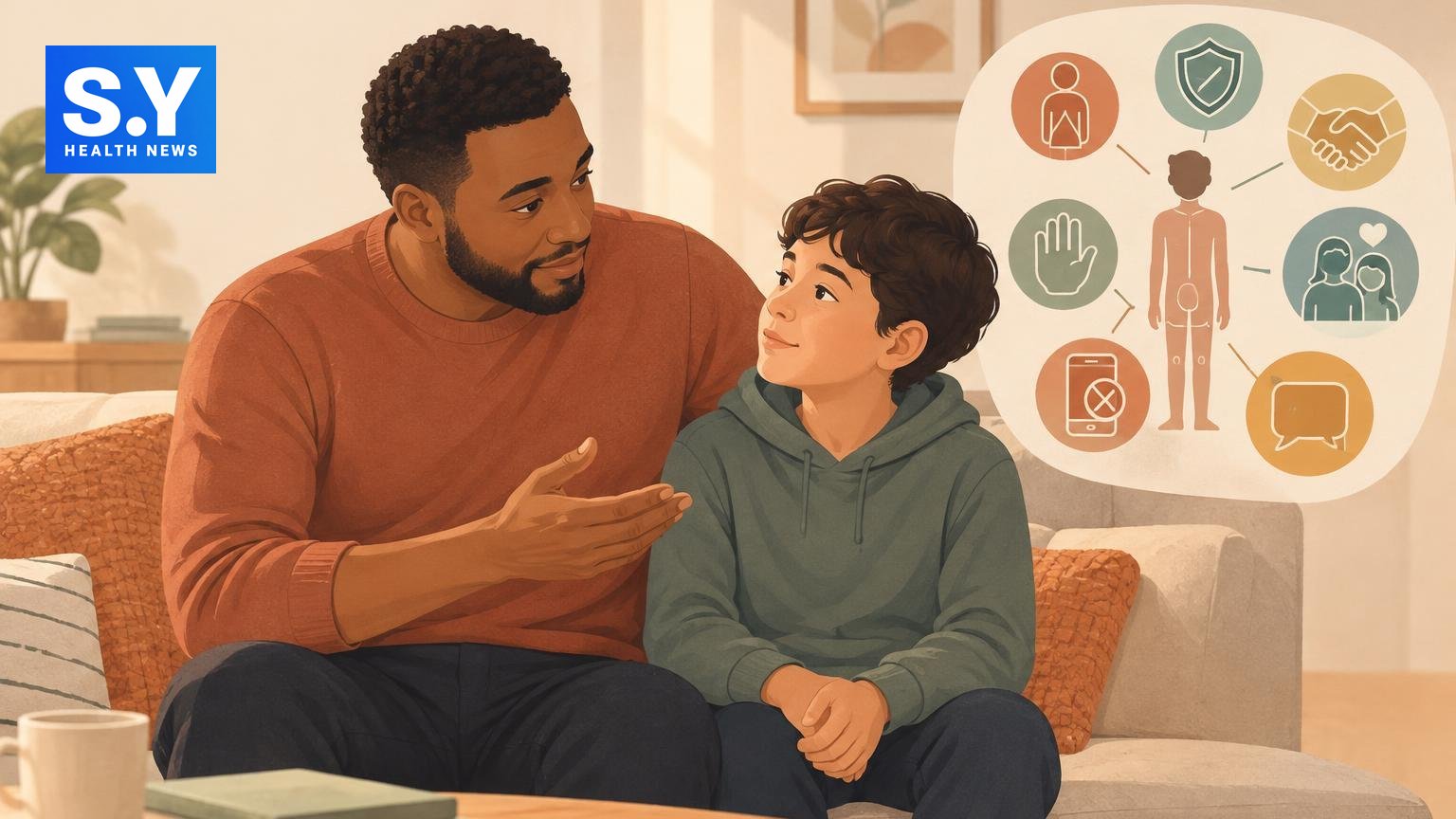
The child-level content is narrower than the label might suggest. The guide lists what children need to know for their safety: the correct names for body parts, what personal space means, the difference between safe and unsafe touch, the distinction between a surprise and a harmful secret, whom to approach for help, and the right to disclose being frightened, confused, manipulated or pressured to a trusted adult.
The guide also fixes terminology. Sexual harassment is defined as any unwanted behaviour of a sexual nature causing discomfort, fear or intimidation, with the unwanted nature identified as the key element. Sexual violence is defined as any sexual act occurring through force, coercion, deception, or where informed consent cannot be given, and the guide states that any sexual activity involving a child constitutes sexual abuse because children cannot give legally or developmentally valid consent.
Suggested Ages and Example Wording
On timing, the guide says these conversations initially focus not on sex but on the body, and that from approximately three to four years of age children can begin learning body-part names, personal space, safe versus unsafe touch, and how to say no. It repeats that information should always be age-appropriate.
For five-year-olds, the guide reasons that children think in concrete terms and need simple, clear and safe language rather than lengthy explanation. Its example phrasing teaches that the child's body belongs to them, that they can refuse a kind of touch they do not like, and that they can tell the parent if someone hurts them or makes them uncomfortable, with the promise that the parent will listen.
For ten-year-olds, the guide holds that children can better understand boundaries, consent, pressure and coercion, online risks and emotional discomfort, so conversations can become more detailed. Example wording defines consent as both people feeling comfortable and safe, marks pressuring or forcing someone as unacceptable, and warns that not everyone online is who they claim to be, asking children to report requests for personal photos, uncomfortable messages or intimidation.
The guide also proposes a developmental mechanism for consent: that it is shaped in childhood through everyday interactions, that children who learn their own "no" matters learn bodily autonomy and boundaries, and that children who learn to respect others' "no" develop empathy, accountability and respect. This is offered as a rationale, not as a tested pathway.
What the Evidence Can and Cannot Show
| Claim in the guide | What is actually provided | How to read it |
|---|---|---|
| CSE is a structured, curriculum-based process focused on self-care, safety and empowerment | A definitional statement framing the term against sexualization concerns | Useful as a description of the framework's stated aims, not as an outcome finding |
| Children lacking information face higher risks of violence, exploitation, unintended pregnancy, forced marriage and online abuse | A directional claim with no cited studies, samples, designs or effect sizes in the supplied text | A stated rationale for the curriculum, not a quantified risk estimate |
| Age-appropriate sexuality education does not increase early sexual activity and is associated with reduced risk-taking | An assertion that international evidence consistently shows this, without citations or estimates | Association language, not proof of causation; the underlying studies cannot be inspected here |
| Children should start learning body-part names, personal space and safe touch from about three to four years | A developmental recommendation with an approximate age range and no cited evidence | Practical guidance to discuss with a clinician or educator, not an established optimum |
| Example scripts for five- and ten-year-olds on boundaries, consent and online safety | Illustrative wording tied to claimed developmental stages | Usable as conversation starters; effectiveness has not been evaluated here |
The most important distinction is between describing a curriculum and demonstrating its effects. The guide states that contemporary research and international evidence consistently demonstrate its risk claims, but within the supplied text it names no study, no comparison group, no follow-up period and no effect size. A reader cannot verify which outcomes were measured, in which populations, or whether the findings were consistent across settings.
Its outcome claim about behaviour is carefully worded in one respect and loose in another. It says age-appropriate sexuality education does not increase early sexual activity and is associated with reduced risk-taking behaviours and more responsible decisions. The word "associated" correctly signals correlation, but the surrounding phrase "research consistently demonstrates the opposite" implies a firmer conclusion than association alone supports.
Several other statements are proposals rather than findings. The argument that children will seek answers elsewhere if parents do not provide them, and that consent understanding is built through everyday childhood interactions, are presented as reasoning about development. They are plausible and influential in the field, but the supplied source does not test them or cite tests of them.
Interpretation and Limitations
This guide is best read as a values-and-practice document. Its definitions of harassment, violence and child sexual abuse are clear and internally consistent, but legal definitions vary by jurisdiction, and the guide's framing should not be treated as legal advice. Its developmental ages are recommendations, not thresholds established by measurement.
The document has a conflict-of-interest structure typical of advocacy materials: institutional partnership and funding are disclosed, and responsibility for content is assigned to the author. That transparency is a point in its favour, but it does not substitute for citations. Readers who want to evaluate the behavioural claims should look for the systematic reviews and trials behind the assertion that age-appropriate education does not increase early sexual activity, which this text does not supply.
There is also a scope limitation. The guide is written for parents in a particular regional context and addresses conversations between parents and children. It does not describe how school curricula are designed, delivered or evaluated, so it cannot answer questions about classroom implementation, teacher training or programme fidelity.
Research Outlook
The questions this document raises are empirical and answerable in principle: whether parent-delivered boundary and consent conversations improve disclosure of unsafe situations; whether they reduce risk-taking behaviour; and whether the timing proposed here matches children's actual comprehension. The supplied source offers a rationale and scripts, not data on any of these endpoints.
For parents, the reasonable position is to use the guide's practical content while keeping its evidentiary status in view. The scripts for refusing unwanted touch, distinguishing surprises from harmful secrets, and reporting online requests are concrete and low-risk to discuss. The claims about population-level risk reduction and behavioural change should be treated as claims awaiting verification rather than settled facts.
Key Takeaways
- The source defines CSE as a structured, curriculum-based process focused on self-care, safety and empowerment, covering boundaries, consent, relationships, emotional wellbeing, violence prevention, stigma reduction and help-seeking.
- Its child-level content is concrete: anatomical names, personal space, safe versus unsafe touch, surprise versus harmful secret, sources of help, and the right to disclose pressure or manipulation to a trusted adult.
- The guide suggests beginning body-focused learning at approximately three to four years of age, with age-appropriate language, and gives example wording for five- and ten-year-old children.
- It asserts that children lacking this information face higher risks, and that age-appropriate education does not increase early sexual activity, but it supplies no citations, study designs or effect estimates for these claims.
- The document is an advocacy and educational guide produced with UNFPA partnership and Swedish funding, with a disclaimer that funders' views are not necessarily reflected; it is not peer-reviewed research.
Questions and Answers
What is comprehensive sexuality education, according to the UNFPA-partnered parent guide?
The guide defines comprehensive sexuality education as a structured, curriculum-based educational process focused on self-care, safety and empowerment. It covers bodily autonomy and boundaries, consent, healthy relationships, emotional wellbeing, violence prevention, stigma reduction and help-seeking. The guide explicitly rejects the idea that CSE sexualizes children, framing it instead as a child-protection and health-promotion approach.
Does comprehensive sexuality education increase early sexual activity?
The guide says international evidence shows that age-appropriate sexuality education does not increase early sexual activity and is associated with reduced risk-taking behaviours and more responsible decisions. However, the supplied text provides no citations, study designs, samples or effect estimates, and the association language does not establish causation. The claim should be read as the guide's assertion rather than verified evidence here.
At what age does the guide suggest starting conversations about bodies, boundaries and consent?
The guide says these conversations initially focus not on sex but on the body, and that from approximately three to four years of age children can begin learning body-part names, personal space, safe versus unsafe touch, and how to say no. It stresses that information should always be age-appropriate. This is a developmental recommendation without cited evidence, not an established optimum age.
What evidence does the parent guide provide for its claims about child safety outcomes?
Very little that a reader can inspect. It states that contemporary research and international evidence consistently demonstrate its risk claims, and lists increased risks for children lacking information, but the supplied text names no studies, comparison groups, follow-up periods or effect sizes. The safety-outcome statements are therefore assertions and rationale rather than demonstrated findings.
Is the UNFPA-partnered CSE parent guide peer-reviewed research?
No. It is an advocacy and educational guide prepared in partnership with UNFPA under the UN Joint Programme for Gender Equality with Swedish government funding, and it disclaims that its content reflects those funders' views. It offers definitions, developmental guidance and example conversation scripts. Its behavioural and risk claims lack citations in the supplied text, so it cannot substitute for reviewing the underlying studies.
How does the guide define sexual harassment and sexual violence in relation to children?
Sexual harassment is defined as any unwanted behaviour of a sexual nature causing discomfort, fear or intimidation, with the unwanted nature as the key element. Sexual violence is any sexual act through force, coercion, deception, or where informed consent cannot be given. The guide states that any sexual activity involving a child is sexual abuse because children cannot give valid consent. Legal definitions may differ by jurisdiction.
Sources and References
SANYUN Science Center explains published research on men's reproductive and sexual health, connecting scientific evidence with everyday questions while making sources and limitations clear.
Disclaimer: This article is for scientific education and research communication only. It does not provide medical advice, diagnosis, or individualized treatment recommendations, and does not endorse any medication, supplement, device, penile enlargement procedure, or other intervention. Decisions about sexual and reproductive health should be made in consultation with a qualified healthcare professional. Do not delay seeking professional care because of information in this article.
Original Content & Copyright Notice
- This article is prepared for SANYUN Science Center, drawing on published research and publicly available academic literature on men’s sexual and reproductive health. Its editorial explanations and presentation are developed for this platform.
- Copyright in the original editorial content, selection, and arrangement is reserved by SANYUN Science Center to the extent protected by applicable law. Referenced research, quotations, and third-party materials remain subject to the rights of their respective owners. This notice does not claim ownership of scientific facts or third-party research.
- Except where permitted by applicable law or an applicable license, prior written permission is required to reproduce, republish, translate, adapt, redistribute, or commercially reuse protected content. Attribution alone does not grant permission for such reuse.
- For permitted quotation or authorized reuse, clearly identify the source and retain a link to the original article.
- Source: SANYUN Science Center
- Original URL: Retain the original article URL on science.san-yun.com.
- Copyright Holder: SANYUN Science Center, for its own protected editorial content.
- Quotation, excerpts, or authorized reuse must not distort the scientific meaning, omit material limitations or disclaimers, or imply unverified medical claims, product efficacy, or endorsement by SANYUN Science Center.



