




Category: Penis Enlargement
Core Research Direction: Evidence, complications, and patient selection for cosmetic penile enhancement procedures, framed by the SMSNA position statement and the ICSM 2024 recommendations
Search Intent: What does current professional guidance say about the safety, effectiveness, and appropriate candidacy for cosmetic penis-enlargement procedures?
Platform: SANYUN Science Center
Evidence reviewed through: 2026-11-11
Executive Summary
Cosmetic penile enhancement describes procedures intended to increase penile length or girth, ranging from filler injections to open surgery. Mainstream sexual medicine societies generally do not recommend these procedures because published data on their safety and efficacy are lacking, and none of the current techniques has undergone rigorous testing comparable to that required of approved devices and medications.[1]
The Sexual Medicine Society of North America has issued a position statement that separates procedures by invasiveness and evidence quality rather than treating them as one category. Temporarily effective girth fillers with moderate safety sit at one end; permanent fillers, graft-and-flap techniques, silicone sleeves and sliding/slicing procedures sit at the other, where the SMSNA either advises against use outside research or calls for investigational oversight.
A recurring theme across both professional documents is selection. Studies of average penile size indicate most men seeking these procedures have normal-sized penises, and many may have conditions such as body dysmorphic disorder. ICSM 2024 recommendations emphasise distinguishing micropenis, adult-acquired buried penis and penile dysmorphic disorder, and understanding motivation, before cosmetic intervention is considered.[2]
The central limitation is informational as much as clinical: without high-quality studies, true risks and benefits are hard to characterise, informed consent is constrained, and some treatments must be regarded as experimental. The SMSNA has called for multicentre long-term complication tracking and for regulators to re-evaluate some of these treatments as experimental.
Why This Matters
Penile size concerns are common and often distressing, and the commercial market responds to that distress faster than the evidence base does. Men may encounter advertisements for penile growth medications that are not approved by the U.S. Food and Drug Administration on questionable websites making exaggerated promises, while clinics market fillers and implants with varying regulatory status and complication profiles.
For clinicians, the practical problem is that a request for enhancement is rarely only about anatomy. It may reflect a normal variant perceived as deficient, a diagnosable body-image disorder, a buried penis after weight change, a congenital micropenis, or a concurrent condition such as Peyronie's disease that needs separate treatment. Each of these has a different appropriate pathway, and the guidance is explicit that cosmetic intervention may not be appropriate for every patient.
The stakes are asymmetric. Benefits are largely aesthetic and partly temporary, whereas harms can include infection, tissue necrosis, erectile dysfunction and penile instability — outcomes that are difficult to reverse and, for some techniques, poorly quantified.
Defining the Procedures and the Selection Problem
The SMSNA position statement frames enhancement as interventions intended to increase length and girth in both flaccid and erect states. The categories are clinically distinct: injectable fillers, suspensory ligament division, graft-and-flap procedures, silicone sleeve implants, and sliding/slicing techniques used during prosthesis implantation. The second professional document adds context on fat transfer, silicone implants and the Penuma device, and notes that injectable fillers are the most common off-label FDA-approved options.
Before any of these is discussed, ICSM 2024 recommends a diagnostic separation. Micropenis is a congenital condition; adult-acquired buried penis is an anatomical problem, often with a different surgical logic; penile dysmorphic disorder is a psychological condition in which perceived size or appearance defects dominate. Penile dysmorphic disorder specifically is associated with unlikely benefit from augmentation or girth enhancement, and referral for psychological evaluation and treatment is recommended before cosmetic intervention is considered.
| Procedure | Reported outcome in source | Main complications noted | Professional stance |
|---|---|---|---|
| Hyaluronic acid or polylactic acid fillers | Temporary girth increase of 2-2.5 cm, may reduce over time | Pain and inflammation, usually self-resolving; infection and migration reported | Moderate safety; more safety and efficacy studies urged |
| Permanent fillers (silicone, paraffin) | Not quantified | Severe long-term complications; complex surgical removal | Strongly discouraged |
| Suspensory ligament division | Average 2.5 cm flaccid and 1.9 cm stretched increase | Infection, pain, penile instability | Reasonable for select, informed patients with experienced surgeons after psychological assessment |
| Graft-and-flap procedures | Girth increase of 1.5-5 cm | Scarring, infection, variable satisfaction | Advised against outside research settings |
| Silicone sleeve implants | Initial size increase and satisfaction reported | Infection, erosion, erectile dysfunction | Investigational, under research oversight |
| Sliding/slicing techniques | Length increase during prosthesis implantation | Severe complications such as glanular necrosis | Experimental; experienced surgeons under research protocols |
Biological and Clinical Mechanism
The mechanisms differ enough that outcomes should never be pooled. Fillers work by adding volume beneath the penile skin; their effect is therefore space-occupying and reversible in proportion to material degradation, which is why hyaluronic acid and polylactic acid girth gains are described as temporary and may reduce over time. Foreign-material behaviour matters: polylactic acid may be rejected more easily, and polymethylmethacrylate, a material primarily used as a bone glue, may also react poorly.
Suspensory ligament division works on a different principle. Because the suspensory ligament anchors the penis to the pubic bone, dividing it allows the flaccid penis to sit lower and appear longer; a silicone spacer may be placed to prevent the ligament reattaching. The trade-off is structural: the same release that lengthens can compromise stability, which is consistent with penile instability appearing among the listed complications.
Girth surgery and sleeve implants add tissue or a prosthetic envelope around the shaft. Graft-and-flap methods import various tissues, introducing risks of scarring and infection and variable satisfaction; sleeve implants place a silicone structure under the skin, where erosion and infection become the characteristic failure modes and erectile dysfunction is a severe long-term concern. Sliding/slicing techniques, used with a prosthesis, lengthen by redistributing tissue within the shaft and can, in the worst case, compromise blood supply to the glans.
These are plausible mechanical explanations for the complication patterns reported in the guidance, not established causal pathways tested in controlled studies. That distinction matters: the mechanism story is coherent, but the evidence behind it is largely case experience rather than comparative trial data.
What the Evidence Shows
The most defensible statements concern magnitude and persistence of effect. For injectable hyaluronic acid and polylactic acid, studies report girth increases of 2-2.5 cm, with reduction over time and mild adverse effects such as pain and inflammation that usually resolve on their own. Recipients of hyaluronic acid have reported satisfaction with both aesthetic and sexual function results. Among fillers, hyaluronic acid is described as the safest, with a relatively low complication rate, although rates are not quantified.
For suspensory ligament division, results show an average length increase of 2.5 cm flaccid and 1.9 cm stretched. These are reported averages rather than planned or protocol-defined targets, and the source does not cite the underlying studies or sample sizes, so durability, patient-reported satisfaction and the proportion experiencing instability cannot be judged from the available summary.
Graft-and-flap procedures show girth increases of 1.5-5 cm, a wide range that itself signals heterogeneous techniques and heterogeneous data. Satisfaction is described as variable, and scarring and infection are recognised risks. The SMSNA advises against these procedures outside research settings.
Silicone sleeve implants have initial results showing satisfaction and size increases, but the complication list — infection, erosion and severe long-term issues such as erectile dysfunction — explains why the society treats them as investigational. The Penuma device is described as the only FDA-approved silicone penile implant in the second document, with higher rates of post-operative penile curvature and deformation, yet recipients have also reported satisfaction with appearance and function. Those two statements can both be true: satisfaction and complication are separate outcome domains and should be reported separately.
Fat transfer and silicone implants are practised across North America but are typically not FDA-approved and are not recommended by the American Urological Association, owing to many accounts of infection and risk of necrosis. Here the evidence is explicitly anecdotal in character, which limits any numerical interpretation.
Interpretation and Limitations
The evidence base is best described as a patchwork of small series, technique reports and expert synthesis. No current enhancement procedure has undergone rigorous safety and efficacy testing like that required for approved devices and medications, and the lack of high-quality studies means the true risks and benefits remain uncertain. That uncertainty is not a neutral gap; it directly limits what informed consent can honestly promise.
Several specific interpretive cautions follow. First, reported centimetre gains are group averages from heterogeneous studies without cited sample sizes, so an individual's outcome may differ substantially, and the source does not describe measurement standardisation. Second, satisfaction reports and complication reports often come from different populations and time horizons, so they should not be merged into a single net-benefit statement. Third, the wide girth range for graft-and-flap procedures reflects diverse data rather than a dependable effect size.
There is also a definitional limitation. The documents distinguish micropenis, adult-acquired buried penis and penile dysmorphic disorder, but the available summaries do not provide prevalence estimates for these categories among men seeking enhancement, nor the proportion of normal-sized men in clinic populations beyond the general statement that most have normal-sized penises.
Finally, permanent fillers such as silicone and paraffin are strongly discouraged because of severe long-term complications that can require complex surgical removal. Because these substances cannot be expected to degrade, any adverse event is effectively long-term, and the guidance treats this as a categorical safety concern rather than a matter of degree.
Patient Selection and Counselling
The SMSNA advises careful consideration and psychological assessment before these treatments, and the ICSM 2024 recommendations place motivation at the centre of evaluation. In practice, this means asking why a patient is seeking enhancement, what outcome he expects, how he would feel if the change were smaller or differently shaped than hoped, and whether appearance preoccupation or distress disproportionate to the physical finding is present.
Counselling should also anticipate the less obvious outcomes. The shape may not be what was desired, length or girth may only increase by a few inches, and sexual dysfunction is a possible complication of several options. Patients should be asked directly about procedures or substances they have found online, including self-injected DIY filler, which can cause infection.
For the clinician, the practical hierarchy implied by the guidance is: exclude or treat medical and psychological conditions first; consider whether the patient's anatomy falls within normal variation; discuss the specific procedure's regulatory status and evidence quality; and, where surgery is contemplated, ensure it is performed by experienced surgeons with explicit acknowledgement of the risks. Suspensory ligament division is the one technique the SMSNA characterises as reasonable for select, properly informed patients in experienced hands, which is not the same as routine endorsement.
Research Outlook
The guidance is unusually specific about what is missing. The SMSNA recommends multicentre, long-term studies to track complications of cosmetic penile enhancement, and suggests that the FDA re-evaluate some of these treatments as experimental given their potential for severe long-term issues. This is a planned or recommended research and regulatory agenda, not a description of work already completed.
Several study-design features would materially strengthen the field: standardised measurement of length and girth, prespecified follow-up intervals long enough to capture erosion, device removal and erectile function, separate reporting of satisfaction and adverse events, and psychological phenotyping so that outcomes in men with penile dysmorphic disorder are not diluted by mixing them with anatomical indications. The existing call for research under approved protocols points in the same direction.
Key Takeaways
- Cosmetic penile enhancement spans fillers to surgery, and mainstream societies generally do not recommend it because published safety and efficacy data are lacking.
- No current procedure has been rigorously tested to the standard required of approved devices and medications, so several must be considered experimental.
- Hyaluronic acid and polylactic acid fillers temporarily increase girth by 2-2.5 cm with mild, usually self-resolving effects; permanent fillers are strongly discouraged.
- Suspensory ligament division is associated with average increases of 2.5 cm flaccid and 1.9 cm stretched, with risks including infection, pain and penile instability, and is considered reasonable only for select, informed patients in experienced hands.
- Most men seeking enhancement have normal-sized penises, and penile dysmorphic disorder should prompt psychological evaluation before any cosmetic intervention is considered.
Questions and Answers
What is cosmetic penile enhancement and which procedures does it include?
It covers interventions intended to increase penile length or girth in flaccid and erect states. Options range from injectable fillers such as hyaluronic acid, polylactic acid and polymethylmethacrylate, through suspensory ligament division, graft-and-flap girth procedures and silicone sleeve implants, to sliding/slicing techniques used during prosthesis implantation. Evidence quality, regulatory status and complication rates vary widely between them.
How much girth increase do penile fillers produce and how long does it last?
Studies report that hyaluronic acid and polylactic acid fillers can increase girth by 2-2.5 cm, but the effect is temporary and may reduce over time. Mild adverse effects such as pain and inflammation usually resolve on their own. Data remain limited, and hyaluronic acid is described as the safest of the common fillers with a relatively low complication rate that is not quantified in the guidance.
What are the risks of permanent penile fillers such as silicone or paraffin?
Professional guidance strongly discourages permanent fillers including silicone and paraffin because of severe long-term complications that may require complex surgical removal. Unlike temporary agents, these materials are not expected to degrade, so adverse effects can persist indefinitely. Injectable fillers more generally carry risks of infection and migration, and self-injected DIY filler can cause infection.
How strong is the evidence behind cosmetic penile enhancement procedures?
It is weak overall. No current procedure has undergone rigorous safety and efficacy testing comparable to that required for approved devices and medications, and the lack of high-quality studies makes true risks and benefits difficult to establish. Reported outcomes often come from technique reports without cited sample sizes, so gains and satisfaction figures should be read as uncertain group estimates rather than dependable individual expectations.
Who is an appropriate candidate for penile enhancement and who should be referred for psychological assessment?
Guidance recommends distinguishing micropenis, adult-acquired buried penis and penile dysmorphic disorder, and understanding the patient's motivation. Patients with penile dysmorphic disorder are unlikely to benefit from augmentation or girth enhancement and should receive psychological evaluation and treatment before cosmetic intervention is considered. Most men seeking these procedures have normal-sized penises, and careful consideration plus psychological assessment is advised before treatment.
What complications are reported with penile implant and lengthening surgery?
Silicone sleeve implants carry risks of infection, erosion and severe long-term issues such as erectile dysfunction. Suspensory ligament division can cause infection, pain and penile instability. Sliding/slicing techniques can cause severe complications such as glanular necrosis. Fat transfer and silicone implants are not recommended by the American Urological Association owing to accounts of infection and risk of necrosis, and long-term data remain inadequate.
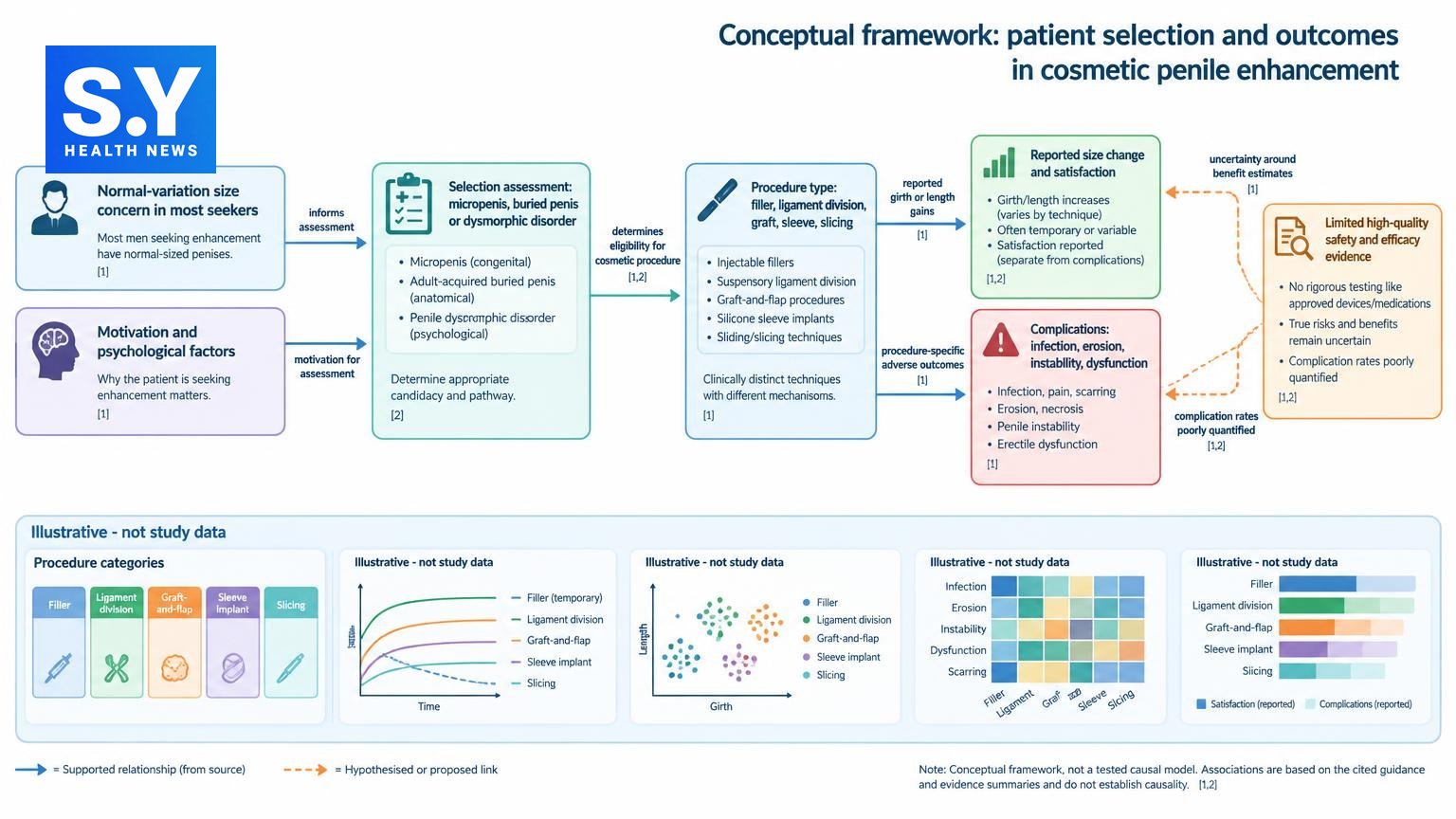
Conceptual framework: Conceptual framework, not a tested causal model. The figure organises the variables discussed in this evidence review: selection assessment distinguishing micropenis, adult-acquired buried penis and penile dysmorphic disorder; the finding that most men seeking enhancement have normal-sized penises; procedure categories; reported size change and satisfaction; complications; and the limited quality of safety and efficacy evidence. Arrows show reported associations and proposed clinical reasoning, not proven causal effects.
Academic References & Evidence
- Trost, L.; Watter, D. N.; Carrier, S.; Khera, M.; Yafi, F. A.; Bernie, H. L.; Ziegelmann, M.; Köhler, T.. The SMSNA’s Position on Cosmetic Penile Enhancement Procedures. The Journal of Sexual Medicine. 2024 21(6):573-578 DOI: 10.1093/jsxmed/qdae045.
- Chung, E.; Jenkins, L.; Moon, Du G.; Ziegelmann, M.; Deveci, S.; Lin, H. C.; Broderick, G.; Seyam, R.; Morey, A.; Levine, L.. What Your Patients Should Know About Penile Enhancement. Sexual Medicine Reviews. 2025 14(1) DOI: 10.1093/sxmrev/qeaf067.
SANYUN Science Center explains published research on men's reproductive and sexual health, connecting scientific evidence with everyday questions while making sources and limitations clear.
Disclaimer: This article is for scientific education and research communication only. It does not provide medical advice, diagnosis, or individualized treatment recommendations, and does not endorse any medication, supplement, device, penile enlargement procedure, or other intervention. Decisions about sexual and reproductive health should be made in consultation with a qualified healthcare professional. Do not delay seeking professional care because of information in this article.
Original Content & Copyright Notice
- This article is prepared for SANYUN Science Center, drawing on published research and publicly available academic literature on men’s sexual and reproductive health. Its editorial explanations and presentation are developed for this platform.
- Copyright in the original editorial content, selection, and arrangement is reserved by SANYUN Science Center to the extent protected by applicable law. Referenced research, quotations, and third-party materials remain subject to the rights of their respective owners. This notice does not claim ownership of scientific facts or third-party research.
- Except where permitted by applicable law or an applicable license, prior written permission is required to reproduce, republish, translate, adapt, redistribute, or commercially reuse protected content. Attribution alone does not grant permission for such reuse.
- For permitted quotation or authorized reuse, clearly identify the source and retain a link to the original article.
- Source: SANYUN Science Center
- Original URL: Retain the original article URL on science.san-yun.com.
- Copyright Holder: SANYUN Science Center, for its own protected editorial content.
- Quotation, excerpts, or authorized reuse must not distort the scientific meaning, omit material limitations or disclaimers, or imply unverified medical claims, product efficacy, or endorsement by SANYUN Science Center.



