




Category: Penis Enlargement
Core Research Direction: Evidence and safety of cosmetic penile enhancement procedures (fillers, ligament division, grafting, implants, and lengthening techniques), including who is an appropriate candidate and the limits of current evidence
Search Intent: What does the available evidence support about the safety, efficacy, and appropriate candidates for cosmetic penile enhancement procedures, and why do medical societies urge caution or research-only use?
Platform: SANYUN Science Center
Evidence reviewed through: 2026-11-14
Executive Summary
Cosmetic penile enhancement describes procedures intended to increase penile length or girth in men who do not have a medically defined penile condition. Mainstream medical societies such as the International Society for Sexual Medicine generally do not recommend these procedures because published data on their safety and efficacy are lacking, and purely cosmetic procedures are judged by stricter standards than treatments for disease.[1]
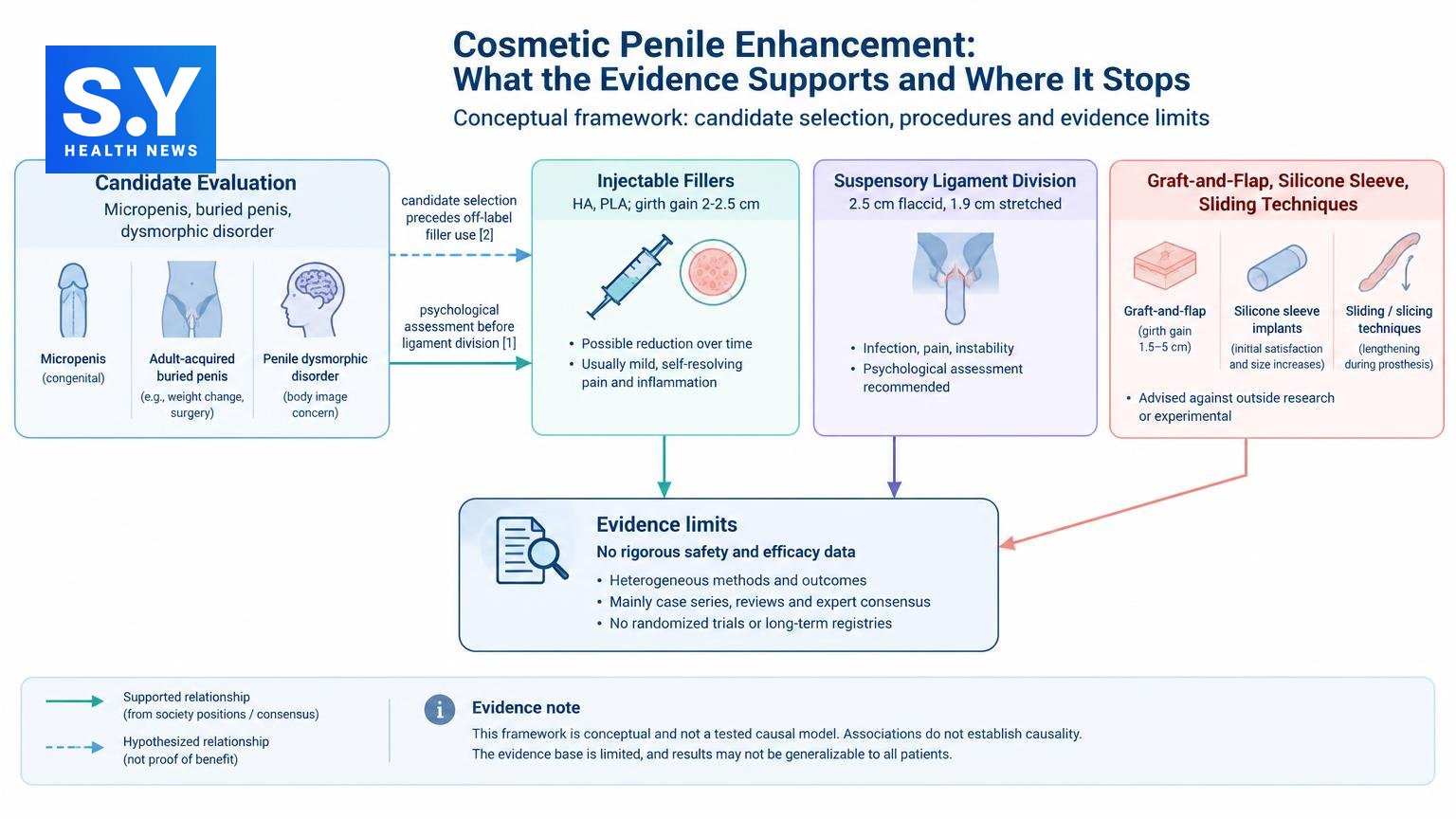
The evidence base is uneven. Injectable fillers such as hyaluronic acid and polylactic acid have reported average girth increases of 2-2.5 cm, with gains that may diminish and usually mild, self-resolving pain and inflammation; permanent fillers are strongly discouraged. Suspensory ligament division has reported average flaccid length increases of 2.5 cm and stretched length increases of 1.9 cm, and one society considers it reasonable for properly informed, selected patients when performed by experienced surgeons. Graft-and-flap procedures report girth increases of 1.5-5 cm but are advised against outside research, while silicone sleeve implants and sliding or slicing lengthening techniques carry serious long-term or catastrophic risks and are treated as investigational or experimental.
Two observations reframe the clinical question. Studies of average penile size indicate that most men seeking these procedures have normally sized penises, and many may have psychological conditions such as body dysmorphic disorder. Consensus recommendations therefore emphasize distinguishing micropenis, adult-acquired buried penis and penile dysmorphic disorder before any cosmetic intervention, because patients with penile dysmorphic disorder are unlikely to benefit and should be referred for psychological evaluation and treatment first.[2]
Why This Matters
The demand for penile enhancement is driven less by documented anatomical deficiency than by dissatisfaction with perceived size and appearance. That gap matters because consumer-facing advertising can promise outcomes far beyond what peer-reviewed data support, and because the procedures sit at an unusual regulatory boundary: many use materials or devices approved for other purposes, or are performed off-label.
For clinicians, the practical task is not simply to offer or refuse a procedure. It is to identify the occasional patient with a genuine structural diagnosis, to recognize body image concerns that surgery will not resolve, and to communicate honestly about what a procedure can and cannot achieve. Counseling should cover procedure-specific complications, including possible sexual dysfunction, and should set realistic expectations about aesthetic outcome, since shape may not match what is desired and any gain may be limited.
The stakes are highest for irreversible interventions. Permanent fillers can cause severe long-term complications, silicone sleeve implants have been associated with erosion and severe long-term issues such as erectile dysfunction, and sliding or slicing lengthening techniques can cause glanular necrosis. These are not hypothetical aesthetic shortfalls; they are structural or functional harms that can be difficult or impossible to reverse.
Definitions and Candidate Selection
The evaluation begins with a differential diagnosis rather than a product menu. Micropenis is a congenital condition in which the stretched penile length is abnormally short; adult-acquired buried penis occurs when the penile shaft is concealed by surrounding tissue, often after weight change or surgery; and penile dysmorphic disorder is a body image disorder in which a man is preoccupied with a perceived size defect despite normal anatomy. Consensus recommendations emphasize that these are different problems with different treatments, and that conflating them can lead to the wrong operation.
Motivation is part of the assessment. Patients with penile dysmorphic disorder are unlikely to benefit from penile augmentation or girth enhancement and should be referred for appropriate psychological evaluation and treatment before any cosmetic intervention is considered. For the broader group of men with normal-sized anatomy and dissatisfaction, the conversation should include what the procedure is unlikely to change: sexual function, relationship concerns and self-image.
| Procedure | Reported outcome or effect | Key procedural risks | Society position |
|---|---|---|---|
| Hyaluronic acid or polylactic acid fillers | Average girth increase of 2-2.5 cm; gains may reduce over time. HA described as the safest filler, with relatively low complication rate. | Mild pain and inflammation that usually resolve; infection and migration reported. | Use is off-label. More safety and efficacy studies urged under approved research protocols. |
| Permanent fillers (silicone, paraffin) | Severe long-term complications, sometimes requiring complex surgical removal. | Strongly discouraged. | |
| Suspensory ligament division | Average flaccid length increase of 2.5 cm and stretched length increase of 1.9 cm. | Infection, pain and penile instability. | Considered reasonable for selected, properly informed patients when offered by experienced surgeons; psychological assessment recommended before surgery. |
| Graft-and-flap procedures | Girth increases of 1.5-5 cm; variable satisfaction. | Scarring and infection. | Advised against outside research settings because data are limited and diverse. |
| Silicone sleeve implants | Initial satisfaction and size increases reported. | Infection, erosion and severe long-term issues such as erectile dysfunction; the Penuma implant has been associated with higher rates of penile curvature and deformation. | Recommended as investigational procedures under research oversight because long-term risks are unclear. |
| Sliding or slicing techniques | Effective at increasing length during prosthesis implantation. | Glanular necrosis and other severe complications. | Considered experimental; to be performed only by experienced surgeons under research protocols. |
Mechanism and Reported Effects by Procedure
Each procedure works through a different physical mechanism, and the mechanism determines both the size change and the risk profile. Injectable fillers add volume mechanically; hyaluronic acid, polylactic acid and polymethylmethacrylate are the most commonly used fillers, and their use is off-label. Because the material remains in a highly mobile, socially and surgically sensitive anatomical area, migration and infection are the recurring concerns. Among the injectable options, hyaluronic acid is described as the safest and has a relatively low complication rate, and patients receiving it have reported satisfaction with aesthetic and sexual function results.
The reported gains from fillers are modest and may be temporary. Studies report that hyaluronic acid and polylactic acid can increase girth by 2-2.5 cm, but the effect may reduce over time, and some men experience mild adverse effects such as pain and inflammation that usually resolve on their own. These figures should not be read as guaranteed individual outcomes: the source statement does not provide the underlying study designs, sample sizes or follow-up durations.
In contrast, permanent fillers such as silicone and paraffin are strongly discouraged due to severe long-term complications. The core problem is irreversibility: a permanent material that migrates, granulomas or becomes infected cannot simply be allowed to reabsorb, and removal can be complex.
Suspensory ligament division takes a different approach. The suspensory ligament holds the penis close to the pubic bone; dividing it allows the organ to sit lower and further forward, which primarily increases visible flaccid length. Results show an average length increase of 2.5 cm when flaccid and 1.9 cm when stretched. The procedure does not add tissue. Potential complications include infection, pain and penile instability. Some surgeons place a silicone spacer to prevent the ligament from reattaching, but that detail does not change the fundamental limitation: the procedure changes position, not mass.
Graft-and-flap procedures add tissue to increase girth. They show girth increases of 1.5-5 cm but carry risks such as scarring, infection and variable satisfaction, and their data are described as limited and diverse. Silicone sleeve implants similarly add girth and some length; initial results show satisfaction and size increases, but complications include infection, erosion and severe long-term issues such as erectile dysfunction. The Penuma device is the only FDA-approved silicone penile implant and has been associated with higher rates of post-operative penile curvature and deformation.
Sliding or slicing techniques are used during prosthesis implantation to lengthen the penis. They are effective at increasing length but can cause severe complications such as glanular necrosis. This is the clearest example of a procedure whose worst complication is catastrophic rather than cosmetic, which explains why it is classified as experimental.
What the Evidence Shows
The evidence consists mainly of case series, narrative reviews and expert consensus rather than controlled trials. The 2024 SMSNA position statement is a society position, not original trial data, and the 2024 International Consultation on Sexual Medicine recommendations are consensus guidance. Both describe a literature that is heterogeneous in technique, outcome definition and follow-up. This is why the strongest conclusion in the field is negative: mainstream medical societies generally do not recommend these procedures because published safety and efficacy data are lacking.
- Fillers: hyaluronic acid and polylactic acid report average girth gains of 2-2.5 cm, with possible reduction over time and usually mild, self-resolving pain and inflammation.
- Ligament division: average flaccid length increase of 2.5 cm and stretched length increase of 1.9 cm; potential infection, pain and penile instability.
- Graft-and-flap: girth increase of 1.5-5 cm with scarring, infection and variable satisfaction; advised against outside research.
- Silicone sleeve implants: initial satisfaction and size increases, but infection, erosion and severe long-term issues such as erectile dysfunction; investigational status.
- Sliding or slicing: effective lengthening during prosthesis implantation, but can cause glanular necrosis; experimental status.
One tempting interpretation is that the reported centimeter gains represent clinically meaningful benefit. The evidence does not establish that. A measured increase in girth or length is not the same as improved sexual function, satisfaction or quality of life, and the statement on fillers explicitly notes possible reduction over time. Satisfaction data are described in some reports, but without validated instruments, comparative groups or long-term follow-up. The reported size changes are therefore best treated as short-term anatomical observations in selected series, not as proven patient benefit.
Interpretation and Limitations
The central limitation is the absence of high-quality comparative evidence. The source statements do not provide randomized trials, standardized outcome measures or long-term complication registries. Case series tend to be performed by experienced surgeons in selected patients, which makes favorable results difficult to generalize and may undercount complications that present to other clinicians. The field also lacks agreed definitions of success: an increase in flaccid length is not equivalent to an increase in erect length, and neither is automatically equivalent to satisfaction.
A second limitation concerns the population. Studies of average penile size suggest most men seeking enhancement have normal-sized penises, and many may have psychological conditions such as body dysmorphic disorder; the proportion is not quantified in these sources. This selection pattern makes it difficult to disentangle procedure effects from baseline psychological distress. If dissatisfaction is driven by a body image disorder rather than by anatomy, a physical intervention may produce a measurable size change without resolving the underlying concern.
A third limitation is regulatory and commercial. Many products are used off-label, advertising can outpace evidence, and patients may present after self-administered or unapproved procedures. Clinicians should ask about procedures patients have found online, because complications from self-injected substances and unapproved devices may not appear in the published literature.
Research Outlook
The most concrete research recommendation is for multicenter, long-term studies to track complications of cosmetic penile enhancement procedures. Such studies would need standardized outcome definitions, validated patient-reported measures and follow-up long enough to capture late failures such as implant erosion, filler migration and delayed dissatisfaction. The SMSNA has also suggested that the FDA re-evaluate some of these treatments as experimental because of their potential for severe long-term issues.
Until that evidence exists, informed consent remains constrained. When outcomes are uncertain and complications can be irreversible, the ethical standard is not merely to disclose risk but to ensure the patient's goals are realistic and that non-surgical explanations have been considered. Better data would help patients and doctors make informed decisions, but it would not by itself resolve the tension between a technically feasible procedure and a patient who may not benefit from it.
Key Takeaways
- Cosmetic penile enhancement is not generally recommended by mainstream medical societies because rigorous safety and efficacy data are lacking.
- Most men seeking enhancement have normal-sized penises, and many may have body dysmorphic disorder; psychological assessment is part of appropriate candidate selection.
- Injectable fillers offer modest, possibly temporary girth gains of 2-2.5 cm; hyaluronic acid is described as the safest filler, while permanent fillers are strongly discouraged.
- Suspensory ligament division has reported average flaccid and stretched length gains of 2.5 cm and 1.9 cm, and is considered reasonable only for selected, informed patients under experienced surgeons.
- Graft-and-flap, silicone sleeve implant and sliding or slicing procedures are advised against outside research or are considered investigational or experimental because of serious complications.
- Multicenter long-term complication studies are the priority; until then, claims of benefit should be interpreted cautiously and realistic expectations set.
Questions and Answers
What is cosmetic penile enhancement and why do medical societies not recommend it?
Cosmetic penile enhancement includes injections, ligament division, grafting, implants and lengthening techniques intended to increase penile length or girth in men without a medical condition. Mainstream societies such as the International Society for Sexual Medicine generally do not recommend it because published data on safety and efficacy are lacking, and cosmetic procedures are held to stricter standards than disease treatments.
How much girth can hyaluronic acid or polylactic acid fillers add and what are the risks?
Studies report that hyaluronic acid and polylactic acid fillers can increase girth by 2-2.5 cm, but gains may reduce over time. Some men experience mild pain and inflammation that usually resolves on its own. Hyaluronic acid is described as the safest injectable filler, with a relatively low complication rate, but infection and filler migration are recognized risks and data remain limited.
How effective is suspensory ligament division for penis lengthening?
Reported results show an average length increase of 2.5 cm when flaccid and 1.9 cm when stretched. The procedure changes penile position rather than adding tissue. Potential complications include infection, pain and penile instability. One society considers it reasonable when performed by experienced surgeons in properly informed, selected patients and recommends psychological assessment before surgery.
Why are silicone implants and graft-and-flap penile enhancement considered risky?
Graft-and-flap procedures report girth increases of 1.5-5 cm but carry risks of scarring, infection and variable satisfaction, and the data are limited and diverse, so societies advise against them outside research. Silicone sleeve implants have been associated with infection, erosion and severe long-term issues such as erectile dysfunction, and the Penuma implant has higher rates of post-operative curvature and deformation.
Who is an appropriate candidate for cosmetic penile enhancement?
Candidate selection requires distinguishing micropenis, adult-acquired buried penis and penile dysmorphic disorder. Patients with penile dysmorphic disorder are unlikely to benefit from augmentation or girth enhancement and should receive psychological evaluation and treatment before cosmetic intervention is considered. Studies of average penile size indicate most men seeking these procedures have normally sized penises, and motivation should be carefully assessed.
What are the main limitations of research on penile enhancement procedures?
The evidence consists mainly of case series, narrative reviews and expert consensus rather than controlled trials, with inconsistent techniques and outcome definitions. The sources do not provide randomized comparisons or long-term complication registries. Societies have called for multicenter, long-term studies to track complications, and some have suggested regulators re-evaluate certain procedures as experimental because of severe long-term risks.
Conceptual framework: Conceptual framework, not a tested causal model. It shows how candidate assessment relates to procedure categories and to the central evidence gap. Supported edges reflect society positions; the candidate-to-filler edge is a proposed clinical sequence, not proof of benefit.
Academic References & Evidence
- Trost, L.; Watter, D. N.; Carrier, S.; Khera, M.; Yafi, F. A.; Bernie, H. L.; Ziegelmann, M.; Köhler, T.. The SMSNA’s Position on Cosmetic Penile Enhancement Procedures. The Journal of Sexual Medicine. 2024 21(6):573-578 DOI: 10.1093/jsxmed/qdae045.
- Chung, E.; Jenkins, L.; Moon, Du G.; Ziegelmann, M.; Deveci, S.; Lin, H. C.; Broderick, G.; Seyam, R.; Morey, A.; Levine, L.. What Your Patients Should Know About Penile Enhancement. Sexual Medicine Reviews. 2025 14(1) DOI: 10.1093/sxmrev/qeaf067.
SANYUN Science Center explains published research on men's reproductive and sexual health, connecting scientific evidence with everyday questions while making sources and limitations clear.
Disclaimer: This article is for scientific education and research communication only. It does not provide medical advice, diagnosis, or individualized treatment recommendations, and does not endorse any medication, supplement, device, penile enlargement procedure, or other intervention. Decisions about sexual and reproductive health should be made in consultation with a qualified healthcare professional. Do not delay seeking professional care because of information in this article.
Original Content & Copyright Notice
- This article is prepared for SANYUN Science Center, drawing on published research and publicly available academic literature on men’s sexual and reproductive health. Its editorial explanations and presentation are developed for this platform.
- Copyright in the original editorial content, selection, and arrangement is reserved by SANYUN Science Center to the extent protected by applicable law. Referenced research, quotations, and third-party materials remain subject to the rights of their respective owners. This notice does not claim ownership of scientific facts or third-party research.
- Except where permitted by applicable law or an applicable license, prior written permission is required to reproduce, republish, translate, adapt, redistribute, or commercially reuse protected content. Attribution alone does not grant permission for such reuse.
- For permitted quotation or authorized reuse, clearly identify the source and retain a link to the original article.
- Source: SANYUN Science Center
- Original URL: Retain the original article URL on science.san-yun.com.
- Copyright Holder: SANYUN Science Center, for its own protected editorial content.
- Quotation, excerpts, or authorized reuse must not distort the scientific meaning, omit material limitations or disclaimers, or imply unverified medical claims, product efficacy, or endorsement by SANYUN Science Center.



