




Category: Clinical Insights
Core Research Direction: Evidence on non-pharmacological, nutritional and physical-modality adjuncts for chronic prostatitis/chronic pelvic pain syndrome (CP/CPPS) in men: what randomized and controlled human evidence supports, what remains preliminary or hypothesis-generating, and how study design limits clinical interpretation
Search Intent: What does current human evidence actually support for adjunctive nutritional, biofeedback/electrical-stimulation, and shock-wave approaches to pain and urinary symptoms in men with chronic prostatitis/chronic pelvic pain syndrome, and what can it not establish?
Platform: SANYUN Science Center
Evidence reviewed through: 2026-11-07
Executive Summary
Chronic prostatitis/chronic pelvic pain syndrome (CP/CPPS) is a symptom-defined condition: research guidelines describe chronic pelvic pain lasting at least three months within the prior six months without another identified cause, often accompanied by urinary symptoms and/or sexual dysfunction. Despite the name, how closely these symptoms map to the prostate itself remains unclear, and the inflammatory versus non-inflammatory split is generally applied only in research because the subgroups have not been shown to differ in symptoms or treatment response.[1]
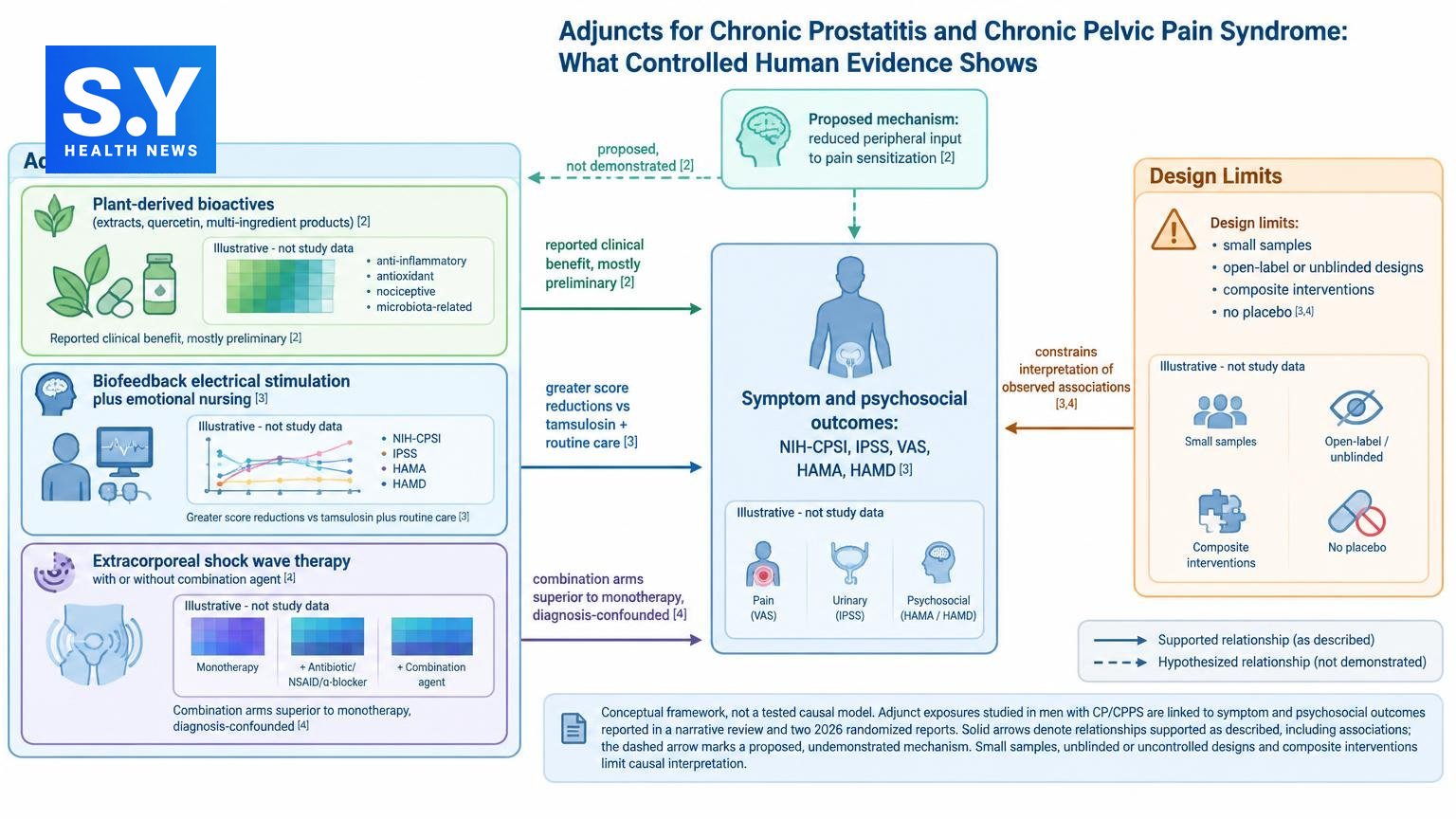
Against that background, three adjunct families are frequently discussed: plant-derived nutritional products, biofeedback electrical stimulation, and extracorporeal shock wave therapy (ESWT). The controlled human evidence is thin and uneven. A 2026 narrative review reports that selected standardized plant extracts have shown clinical benefit, but quercetin rests on one small placebo-controlled trial, curcumin and antioxidant products have mostly been tested in multi-ingredient formulations, and several other compounds remain experimental or adjacent-condition evidence.[2]
Two 2026 randomized reports address physical modalities. One small single-center trial combined biofeedback electrical stimulation with traditional Chinese medicine emotional nursing and reported greater improvements in symptom and anxiety scores than tamsulosin plus routine care, without a significant quality-of-life difference. One open-label, placebo-uncontrolled shock-wave study reported symptom advantages for combination arms over shock-wave monotherapy, but its groups differed by diagnosis and the design cannot isolate the effect of shock waves.[3][4]
Why This Matters
CP/CPPS is clinically frustrating precisely because it is heterogeneous and treatment responses are inconsistent. That inconsistency has pushed mechanistic thinking beyond the prostate toward peripheral nociceptor sensitization, spinal amplification and altered central pain processing. This reframing matters for adjunct research: if pain is partly sustained by sensitized neural pathways rather than by a single prostatic lesion, then approaches aimed at inflammation, oxidative stress, pelvic floor function or stress responses become biologically plausible even without eradicating an infection.
Plausibility, however, is not efficacy. Men with persistent pelvic pain often try nutritional supplements, physical therapies and electrical devices alongside or instead of standard care, and the marketing of such products routinely outruns the trial base. A clear-eyed reading of the evidence helps clinicians and patients distinguish a reasonable trial of an adjunct from an established treatment. The central question is not whether these modalities are interesting, but whether randomized human data show benefits that exceed placebo, nonspecific care and regression to the mean.
Biological and Clinical Mechanism
The nutritional rationale is built on overlapping pathways. Plant foods and botanicals contain polyphenols, terpenes, carotenoids, alkaloids and isothiocyanates that can influence inflammatory, redox, nociceptive and microbiota-related processes. The reviewed model proposes that such bioactives may reduce the peripheral inputs that sustain pain sensitization, which would in principle translate into less pelvic pain and fewer urinary symptoms.
That mechanistic story is explicitly a proposed model rather than a demonstrated clinical mechanism, and translation depends on formulation, bioavailability and safety. In other words, a compound showing anti-inflammatory activity in a laboratory setting may not reach relevant tissue concentrations when taken as a capsule, and a multi-ingredient product cannot tell us which component, if any, is responsible for an observed change.
Biofeedback electrical stimulation has a different rationale. It targets pelvic floor muscle function and neuromuscular control, and the trial discussed below paired it with a psychological-emotional nursing component, implicitly acknowledging that anxiety and depression are part of the symptom experience in many men. Shock wave therapy is hypothesized to act on fibrotic tissue, calcifications and prostatic microcirculation; the 2026 shock-wave study measured morphofunctional prostate parameters alongside symptom scores, which is consistent with that hypothesis but does not prove it.
What the Evidence Shows
| Adjunct and design | Population and exposure | Key reported finding | Main interpretive limit |
|---|---|---|---|
| Plant-derived bioactives; targeted narrative review of controlled and prospective human studies | Men with CP/CPPS; standardized extracts, concentrated supplements, fixed nutraceutical formulations | Selected standardized extracts reported clinical benefits; quercetin supported by one small placebo-controlled trial; curcumin and antioxidants mostly tested in multi-ingredient products | Narrative, not systematic, synthesis; single small trial for quercetin; formulation and bioavailability unresolved |
| β-Caryophyllene, berberine, sulforaphane; review-level evidence | Experimental models or adjacent conditions rather than CP/CPPS trials | Emerging evidence only | Not direct clinical evidence in CP/CPPS |
| Biofeedback electrical stimulation plus emotional nursing; randomized trial, 70 patients (35 per group) | CP/CPPS; stimulation three times weekly for 8 weeks plus tamsulosin and routine care in both arms | Greater reductions in total NIH-CPSI, pain subscore, IPSS and HAMA at weeks 4 and 8; urination subscore and HAMD better at week 8; quality-of-life subscore not significantly different | Single center; composite intervention bundles device and nursing; short 8-week follow-up; quality-of-life null result |
| Combined intervention group satisfaction and efficacy; same randomized trial | Combined-intervention arm after 8 weeks | Nursing satisfaction 97.05% and overall efficacy 91.18%, both higher than the conventional group | Denominators and efficacy definition not stated in the abstract; satisfaction is not a clinical outcome |
| ESWT with or without bovhyaluronidase azoximer; open-label randomized, placebo-uncontrolled study, 116 men | CP II (37, 32%), CP/CPPS IIIA (39, 33.6%), CP/CPPS IIIB (40, 34.4%); perineal ESWT 2000–4000 impulses twice weekly for 12 sessions | Groups 1 and 3 superior to ESWT monotherapy on NIH-CPSI, IPSS and VAS (p<0.05); no significant difference between Groups 1 and 3; erectile function improved in IIIB on IIEF-5 | Groups defined by different diagnoses; no placebo; open-label; conference abstract without full peer review detail |
Interpretation and Limitations
The nutritional evidence is best described as hypothesis-generating. The 2026 review searched PubMed, Web of Science Core Collection and Scopus through 8 August 2026 with priority given to controlled and prospective human CP/CPPS studies, but it is a targeted narrative review rather than a systematic review with a reported selection process. The distinction matters: narrative reviews can synthesize useful biology and clinical context, yet they do not quantify pooled effects, assess risk of bias uniformly or exclude selective citation. Readers should treat phrases such as "selected standardized extracts have shown clinical benefits" as a signpost toward the primary trials, not as a pooled estimate.
The quercetin signal is the most concrete nutritional claim in the packet, and it is deliberately modest: preliminary evidence from one small placebo-controlled trial. A single small trial is vulnerable to imprecise effect estimates, chance findings and publication bias, and it cannot establish durability or generalize across CP/CPPS subtypes. For curcumin and antioxidant products, the multi-ingredient formulation problem is a direct threat to causal inference, because any observed benefit could reflect one active component, synergy, or simply the broader behavioral package of taking a daily supplement.
The biofeedback trial has a cleaner randomized structure but a confounded intervention. Both arms received tamsulosin and routine care; only the combined arm received biofeedback plus emotional nursing. The statistically significant advantages in NIH-CPSI total and pain scores, IPSS and HAMA at weeks 4 and 8 are encouraging as a package, but the design cannot separate the device effect from the added attention, structured nursing contact and psychological support. The absence of a significant quality-of-life difference at week 8 is an important counterweight: symptom scores moved while a patient-centered global measure did not. The reported nursing satisfaction of 97.05% and overall efficacy of 91.18% should be read cautiously, since the abstract does not state the denominators or define overall efficacy.
The shock-wave study is the weakest of the three for causal inference despite its randomized label. It was open-label and placebo-uncontrolled, and the three groups were defined by diagnosis rather than by random allocation to a common population: Group 1 had chronic bacterial prostatitis and received ESWT with antibiotic, NSAID and alpha-blocker therapy, Group 2 had CP/CPPS IIIA–IIIB and received ESWT alone, and Group 3 had CP/CPPS IIIA–IIIB and received ESWT plus bovhyaluronidase azoximer. Superiority of Groups 1 and 3 over Group 2 therefore mixes diagnostic differences, adjunctive drugs and the combination product. The reported p-values (p<0.05 for superiority, p>0.05 for Group 1 versus Group 3) come from an abstract without effect sizes or confidence intervals, and subgroup findings such as improved erectile function in IIIB should be treated as exploratory.
Safety reporting is also limited. The shock-wave study states that all patients completed treatment without adverse effects, which is reassuring at a surface level but was collected in an unblinded design in which ascertainment may be biased. The biofeedback trial abstract does not report adverse events. For nutritional products, the review flags safety as central to translation but the packet provides no quantitative safety data. None of this suggests the modalities are unsafe; it means the evidence base cannot yet characterize risk with precision.
Research Outlook
The most direct research need is larger randomized trials that test single, well-characterized interventions against credible controls. For nutritional bioactives, that means standardized products with documented bioavailability and placebo comparators, rather than multi-ingredient formulations that cannot attribute effect. The review's own conclusion points the same way: larger randomized trials should evaluate clinical benefits and test the proposed links to pain sensitization. Mechanistic substudies measuring sensitization would strengthen causal interpretation if they are pre-specified and adequately powered.
For physical modalities, the priorities are blinding or sham controls, separation of device effects from co-interventions, longer follow-up and patient-centered outcomes such as quality of life and function. The biofeedback question would be sharpened by an arm receiving equivalent attention without stimulation. The shock-wave question would be sharpened by randomizing a single diagnostic population to active versus sham ESWT, with the combination product tested separately. Until such trials exist, adjuncts are best framed as shared decisions with explicit uncertainty, not as established therapy.
Key Takeaways
- CP/CPPS is defined by chronic pelvic pain lasting at least three months within the prior six months without another identified cause; the inflammatory versus non-inflammatory distinction has not been shown to predict treatment response.
- A 2026 narrative review reports benefits for selected standardized plant extracts, but quercetin rests on one small placebo-controlled trial, curcumin and antioxidants have mostly been tested in multi-ingredient products, and several compounds remain experimental or adjacent-condition evidence.
- A small randomized trial found that biofeedback electrical stimulation plus emotional nursing improved NIH-CPSI, IPSS and anxiety scores versus tamsulosin plus routine care, but the composite intervention prevents isolating the device and quality-of-life scores did not differ significantly.
- An open-label, placebo-uncontrolled shock-wave study reported symptom advantages for combination arms over ESWT monotherapy, but diagnostic differences between groups and the absence of blinding limit interpretation.
- Mechanistic models linking plant bioactives to reduced peripheral pain input are proposed, not demonstrated; formulation, bioavailability and safety remain central translational questions.
Questions and Answers
What is chronic prostatitis/chronic pelvic pain syndrome and how is it defined?
Research guidelines define CP/CPPS as chronic pelvic pain lasting at least three months within the prior six months without another identified cause, often with urinary symptoms and/or sexual dysfunction. The name is partly misleading: how strongly symptoms relate to the prostate remains unclear, and the inflammatory versus non-inflammatory split is generally used only in research because the subgroups have not been shown to differ in symptoms or treatment response.
Does quercetin or curcumin have proven benefit in chronic pelvic pain syndrome?
Not proven. A 2026 narrative review describes quercetin as supported by preliminary evidence from one small placebo-controlled trial, which is insufficient to establish efficacy. Curcumin and antioxidant products have mostly been tested as multi-ingredient formulations, so any observed benefit cannot be attributed to a single compound. Several other plant compounds remain experimental or adjacent-condition evidence. Larger randomized trials with standardized, bioavailable products are needed.
What did the randomized trial of biofeedback electrical stimulation for CP/CPPS find?
In 70 patients randomized to 35 per group, adding biofeedback electrical stimulation (three times weekly for 8 weeks) plus emotional nursing to tamsulosin and routine care produced greater reductions in total NIH-CPSI, pain subscore, IPSS and HAMA at weeks 4 and 8. Urination and HAMD scores improved by week 8. However, the NIH-CPSI quality-of-life subscore did not differ significantly between groups.
Is extracorporeal shock wave therapy effective for chronic prostatitis symptoms?
The evidence is limited. A 2026 open-label, placebo-uncontrolled study of 116 men reported that ESWT plus standard therapy and ESWT plus bovhyaluronidase azoximer were superior to ESWT alone on NIH-CPSI, IPSS and VAS (p<0.05), with no significant difference between the two combination arms. Because groups differed by diagnosis and there was no sham control, the specific effect of shock waves cannot be isolated.
How strong is the overall evidence for non-drug adjuncts in CP/CPPS?
Moderate to low, depending on the adjunct. The nutritional evidence comes largely from a narrative review with one small placebo-controlled trial for quercetin. The biofeedback trial is randomized but bundles a device with emotional nursing in 70 patients over 8 weeks. The shock-wave study is randomized but open-label, uncontrolled and stratified by diagnosis. None provides the large, blinded, sham-controlled data needed to establish clinical efficacy.
What should men with CP/CPPS understand before trying supplements or physical adjuncts?
These approaches are plausible but unproven. Mechanistic models, such as plant bioactives reducing peripheral pain input, are proposed rather than demonstrated, and formulation, bioavailability and safety remain unresolved. Physical modalities may help some men, but trials have not separated device effects from added attention and co-treatment. Discuss adjuncts with a clinician as shared decisions with explicit uncertainty, and do not substitute them for evaluated care.
Conceptual framework: Conceptual framework, not a tested causal model. Adjunct exposures studied in men with CP/CPPS are linked to symptom and psychosocial outcomes reported in a narrative review and two 2026 randomized reports. Solid arrows denote relationships supported as described, including associations; the dashed arrow marks a proposed, undemonstrated mechanism. Small samples, unblinded or uncontrolled designs and composite interventions limit causal interpretation.
Academic References & Evidence
- Michel Pontari; Joann G Elmore; Han Li. 慢性前列腺炎和慢性盆腔疼痛综合征.
- Xue Liu. Plant-derived bioactives and nutraceuticals in chronic prostatitis/chronic pelvic pain syndrome: clinical evidence, pain-sensitization mechanisms and nutritional translation – PubMed. Front Nutr. 2026 13:1966858 DOI: 10.3389/fnut.2026.1966858. PMID: 42978860.
- 唐雪; 吴悔; 宁港. 中华男科学杂志. 中华男科学杂志. 2026 32(04):330-336 DOI: 10.13263/j.cnki.nja.2026.04.008.
- Epifanova M; Slavkina E; Artemenko S; Kostin A. Combined Extracorporeal Shock Wave Therapy and Bovinized Hyaluronidase Azoximer in the Long-Term Treatment of Chronic Prostatitis/Chronic Pelvic Pain Syndrome. 2026
SANYUN Science Center explains published research on men's reproductive and sexual health, connecting scientific evidence with everyday questions while making sources and limitations clear.
Disclaimer: This article is for scientific education and research communication only. It does not provide medical advice, diagnosis, or individualized treatment recommendations, and does not endorse any medication, supplement, device, penile enlargement procedure, or other intervention. Decisions about sexual and reproductive health should be made in consultation with a qualified healthcare professional. Do not delay seeking professional care because of information in this article.
Original Content & Copyright Notice
- This article is prepared for SANYUN Science Center, drawing on published research and publicly available academic literature on men’s sexual and reproductive health. Its editorial explanations and presentation are developed for this platform.
- Copyright in the original editorial content, selection, and arrangement is reserved by SANYUN Science Center to the extent protected by applicable law. Referenced research, quotations, and third-party materials remain subject to the rights of their respective owners. This notice does not claim ownership of scientific facts or third-party research.
- Except where permitted by applicable law or an applicable license, prior written permission is required to reproduce, republish, translate, adapt, redistribute, or commercially reuse protected content. Attribution alone does not grant permission for such reuse.
- For permitted quotation or authorized reuse, clearly identify the source and retain a link to the original article.
- Source: SANYUN Science Center
- Original URL: Retain the original article URL on science.san-yun.com.
- Copyright Holder: SANYUN Science Center, for its own protected editorial content.
- Quotation, excerpts, or authorized reuse must not distort the scientific meaning, omit material limitations or disclaimers, or imply unverified medical claims, product efficacy, or endorsement by SANYUN Science Center.



