




Category: Erectile Dysfunction
Core Research Direction: Whether treating obstructive sleep apnoea (OSA) with CPAP improves erectile dysfunction (ED) severity in men with coexisting OSA and ED, and how strong that evidence is against the broader ED treatment evidence base
Search Intent: In men who have both obstructive sleep apnoea and erectile dysfunction, does CPAP treatment actually improve erectile function, and how reliable is the evidence?
Platform: SANYUN Science Center
Evidence reviewed through: 2026-11-08
Executive Summary
Obstructive sleep apnoea (OSA) and erectile dysfunction (ED) frequently coexist. A 2026 systematic review searched MEDLINE, PubMed and Embase for studies published between January 2000 and January 2022, using narrative synthesis because the included studies differed in design, methods and population size.[1]
Eighteen studies met inclusion criteria: five randomized controlled trials, eleven prospective studies and two cross-sectional studies. The literature reported ED prevalence of up to 82% in men with OSA, and studies of continuous positive airway pressure (CPAP) showed results varying from no significant effect to complete resolution of ED.
The review's authors concluded that CPAP is a safe treatment likely to improve OSA symptoms, does not appear to harm erectile function, and is most likely to offer some degree of improvement, while the degree of effect on ED remains unclear. Set against a broader ED evidence base that an umbrella review rates as predominantly low or very low quality, CPAP should be understood as an OSA treatment with possible sexual-health benefits, not a validated ED therapy.[2]
Why This Matters
ED is common in men with OSA and appears more frequent as OSA severity increases. In one prospective series, ED affected 47% of OSA patients overall, with prevalence of 24%, 48% and 60% in mild, moderate and severe OSA respectively. In a separate cohort of 94 men with severe OSA defined by an apnoea-hypopnoea index above 30 per hour, 68% also had ED as defined by an IIEF-5 score below 21.
Other included studies reported similarly high figures: 63% of a 55-patient OSA cohort had concomitant ED, and one study found 82% of men with OSA had severe ED, including 11 who had already undergone penile prosthesis insertion.
These numbers matter clinically because OSA is treatable. If a shared mechanism drives both conditions, effective OSA treatment could improve sexual function as well as sleep, cardiovascular and metabolic health. The open question is how much of the ED burden CPAP actually reverses.
Proposed Biological Mechanisms
The review describes several pathways that could link OSA to ED. Intermittent hypoxia is proposed to reduce prostaglandin E1, which ordinarily inhibits pro-fibrotic cytokines. The resulting increase in collagen deposition is hypothesised to reduce penile elasticity and erectile quality.
A structural consequence is described: greater collagen content in the corpus cavernosa may impair compression of the subtunical veins, producing veno-occlusive dysfunction and incomplete tumescence. This is a mechanistic hypothesis rather than a relationship directly tested in the human outcome data synthesised by the review.
Hormonal pathways are also implicated. Men with OSA have been reported to have lower testosterone, and severe OSA has been associated with lower testosterone than simple snoring (14.06 versus 17.02, units not stated in the source quote). Nerve involvement appears in the data too: 68% of men with OSA in one study had an altered bulbocavernosus reflex, and those patients had higher apnoea-hypopnoea indices, more sleep time below 90% oxygen saturation and lower daytime oxygen pressure.
These mechanisms are plausible and overlapping, which is one reason causal inference is difficult. Hypoxia, hormonal suppression, nerve dysfunction, obesity and shared metabolic risk factors may all contribute, and CPAP addresses only the intermittent hypoxia component directly.
What the Evidence Shows
Results for CPAP on erectile function are genuinely mixed. In a 12-week randomized trial of 30 men with OSA and ED, sildenafil and CPAP were compared: successful intercourse occurred in 54% versus 24%, IIEF scores increased by 62% versus 26%, and overall satisfaction reached 53% versus 20%. Sildenafil clearly outperformed CPAP on these endpoints.
A larger 3-month randomized comparison in severe OSA and ED pointed the same way. CPAP (n=41) versus sildenafil (n=41) produced successful intercourse in 30% versus 58% and post-intervention IIEF changes of 58% versus 135%.
A third randomized trial compared CPAP with a PDE5 inhibitor for 12 weeks. CPAP produced a non-significant 11% improvement in IIEF scores, but increased nocturnal erections from 2.7 to 4.1 and improved arterial stiffness from 13.7 to 7.3. Neither treatment changed testosterone, luteinizing hormone or follicle-stimulating hormone.
Prospective studies are more encouraging but less controlled. Among 80 patients treated with CPAP for 3 months, 23% were reclassified as normal, and the proportion with more than 80% nocturnal penile rigidity rose from 14% to 40%. In 32 men with severe OSA, one month of CPAP was followed by a 35% IIEF improvement alongside changes in follicle-stimulating hormone (4.8–11.7 IU/L) and testosterone (4.5–12.1 nmol/L). Another 28-patient cohort recorded a 26% IIEF increase after 3 months.
Null findings are equally important. In 27 men with type 2 diabetes and OSA completing 3 months of CPAP, 84% had some form of ED, and there was no change in total or free testosterone or SHIM score. In 207 men stratified by OSA severity, 3 months of CPAP did not significantly change serum testosterone. And in pooled data from two randomized trials, two weeks of CPAP withdrawal increased DHEA alone (0.17 to 1.35), with other hormones unaffected.
| Study design and population | Intervention and duration | Erectile or hormonal outcome | Interpretation |
|---|---|---|---|
| Randomized trial, 30 men with OSA and ED | Sildenafil versus CPAP for 12 weeks | Successful intercourse 54% versus 24%; IIEF increase 62% versus 26%; satisfaction 53% versus 20% | Sildenafil outperformed CPAP on all reported endpoints |
| Randomized study, 82 men with severe OSA and ED | CPAP (n=41) versus sildenafil (n=41) for 3 months | Successful intercourse 30% versus 58%; IIEF change 58% versus 135% | Sildenafil showed the larger effect |
| Randomized trial, men with OSA and ED | CPAP versus PDE5 inhibitor for 12 weeks | Non-significant 11% IIEF improvement with CPAP; nocturnal erections 2.7 to 4.1; arterial stiffness 13.7 to 7.3 | Mixed: erectile score not significant, vascular and nocturnal measures improved |
| Prospective study, 80 patients with OSA and ED | CPAP for 3 months | 23% reclassified as normal; rigidity above 80% rose from 14% to 40% | Improvement, but uncontrolled design |
| Prospective study, 32 men with severe OSA | CPAP for 1 month | IIEF improvement of 35%; FSH 4.8–11.7 IU/L; testosterone 4.5–12.1 nmol/L | Short follow-up and no control group |
| Prospective study, 27 men with type 2 diabetes and OSA | CPAP for 3 months | No change in total or free testosterone or SHIM score; 84% had some ED | Null result in a comorbid subgroup |
| Prospective study, 207 men stratified by OSA severity | CPAP for 3 months | No significant change in serum testosterone; severe OSA testosterone 14.06 versus 17.02 in simple snoring | Hormonal benefit not demonstrated |
| Pooled data from two randomized trials, 70 patients | Continued CPAP (n=35) versus withdrawal (n=35) for 2 weeks | DHEA increased alone (0.17 to 1.35); other hormones unaffected | Short withdrawal; units not stated |
How Strong Is the Broader ED Evidence Base?
The CPAP literature sits inside a wider ED treatment literature whose quality has been formally assessed. An umbrella review searched PubMed, Web of Science, the Cochrane Library and Embase for studies published up to October 2025. From 1191 studies, 23 published meta-analyses were extracted, yielding 42 summary effects covering 36 interventions across the IIEF, IIEF-5, IIEF-EF and erectile hardness score.
Methodological quality was poor. On AMSTAR-2, 13 meta-analyses (56.5%) were rated critically low, 7 (30.5%) low, 2 (8.7%) moderate and 1 (4.3%) high quality. Of the 42 summary effects, only two were rated high or moderate quality, while 20 (47.6%) were low and 20 (47.6%) very low.
The umbrella review concluded that the ED evidence base is predominantly low or very low quality, and that statistically significant improvements with pharmacological and nonpharmacological interventions should be interpreted cautiously because of limited patient numbers and subjective outcome indicators. More than half (57.1%) of summary effect estimates showed high heterogeneity, and among the few meta-analyses that assessed publication bias, a high proportion showed significant bias.[3]
Two caveats apply. The umbrella review focused only on four patient-reported outcomes, excluding objective physiological measures, and reliance on self-report may amplify between-study differences. It also evaluated ED treatments generally rather than CPAP specifically, so it calibrates expectations rather than settling the CPAP question.
Interpretation and Limitations
The central difficulty is that the CPAP evidence is heterogeneous in design, population and follow-up. The systematic review used narrative synthesis precisely because pooling was inappropriate, so no single quantitative estimate of CPAP's effect on erectile function exists. Quality was appraised with the mixed methods appraisal tool, and no study was discarded on quality grounds, which broadens coverage but limits certainty.
Several specific limitations deserve emphasis. Sample sizes are small, from 27 to 82 patients in the studies summarised above, and follow-up is often only one to three months. Some populations are narrow, such as men with type 2 diabetes, in whom CPAP did not change SHIM scores. Comparator choices differ: some trials compare CPAP with sildenafil or another PDE5 inhibitor rather than with sham CPAP, which answers a different question from whether CPAP itself works.
Statistical significance also needs care. An 11% IIEF improvement described as non-significant is not the same as a proven absence of benefit, particularly in a small trial. Conversely, a 35% IIEF improvement in an uncontrolled cohort could reflect regression to the mean, adherence-linked behaviour or natural fluctuation rather than a CPAP effect.
The search window ends in January 2022, so the systematic review does not capture subsequent randomized trials. The umbrella review, published later, addresses general ED treatments rather than CPAP in OSA. Neither source establishes that treating OSA reverses underlying penile fibrosis or neuropathy; the mechanistic proposals remain hypotheses.
Research Outlook
The systematic review's authors call for further randomized controlled trials evaluating CPAP's efficacy on ED in men with OSA. The umbrella review's authors recommend better-designed studies of single treatments and high-quality meta-analyses comparing treatments directly, noting that the treatment landscape is diverse but evidence reliability is poor.
- Trials should use sham CPAP or usual care comparators, prespecified IIEF or IIEF-EF endpoints, and follow-up long enough to distinguish early vascular changes from structural remodeling.
- Stratification by OSA severity, baseline testosterone, diabetes status and baseline ED severity would clarify which subgroups are most likely to benefit.
- Combining objective measures such as nocturnal penile tumescence and arterial stiffness with patient-reported scores could reduce reliance on subjective endpoints.
Key Takeaways
- ED is common in men with OSA, with reported prevalence up to 82% and higher rates in more severe OSA.
- A 2026 systematic review of 18 studies found CPAP results ranging from no significant effect to complete resolution of ED, with narrative synthesis rather than pooled estimates.
- Randomized comparisons generally favour PDE5 inhibitors over CPAP for erectile outcomes, while CPAP improves some physiological measures such as nocturnal erections and arterial stiffness.
- Hormonal effects are inconsistent; several studies found no significant testosterone change with CPAP.
- The broader ED treatment evidence base is predominantly low or very low quality, so all efficacy claims warrant caution.
- CPAP remains a safe and appropriate treatment for OSA itself and is not expected to worsen erectile function, but it is not established as an ED therapy.
Questions and Answers
How does obstructive sleep apnoea contribute to erectile dysfunction?
OSA causes intermittent hypoxia, which is proposed to lower prostaglandin E1, increase collagen deposition in the penis and impair elasticity and veno-occlusive function. Lower testosterone, nerve dysfunction and shared metabolic risk factors may also contribute. These are mechanistic hypotheses described in a systematic review rather than relationships directly confirmed in human outcome trials.
Does CPAP improve erectile dysfunction in men with sleep apnoea?
Evidence is inconsistent. A 2026 systematic review of 18 studies found CPAP results ranging from no significant effect to complete resolution of ED. Some prospective studies reported IIEF improvements of 26% to 35%, while randomized trials generally showed smaller or non-significant erectile gains and favoured PDE5 inhibitors. CPAP most likely offers some benefit without guaranteeing meaningful improvement.
How strong is the evidence that CPAP treats erectile dysfunction?
Weak to moderate at best. The systematic review used narrative synthesis because studies were too heterogeneous to pool, included small samples with short follow-up, and did not exclude studies on quality grounds. The wider ED literature is also rated predominantly low or very low quality, with only two of 42 summary effects rated high or moderate quality.
Which men with OSA and ED are most likely to benefit from CPAP?
Subgroup evidence is limited. ED prevalence rises with OSA severity, and some severe OSA cohorts showed erectile improvement after CPAP, whereas men with type 2 diabetes showed no change in SHIM scores. Baseline testosterone, diabetes status and OSA severity are plausible modifiers, but no trial has established a reliable predictor of erectile response to CPAP.
What are the limitations of studies on CPAP and erectile function?
Key limitations include small samples, follow-up often of one to three months, heterogeneous designs, and comparators such as sildenafil rather than sham CPAP. Hormonal outcomes are inconsistent, and the systematic review's search ended in January 2022. Mechanistic explanations such as penile fibrosis remain hypotheses rather than confirmed causal pathways.
Should CPAP be used specifically to treat erectile dysfunction?
CPAP is established as a safe treatment for OSA and is not expected to worsen erectile function, but current evidence does not support prescribing it primarily to reverse ED. Men with both conditions should discuss OSA treatment and ED options, including PDE5 inhibitors, with a clinician rather than relying on CPAP alone for sexual function.
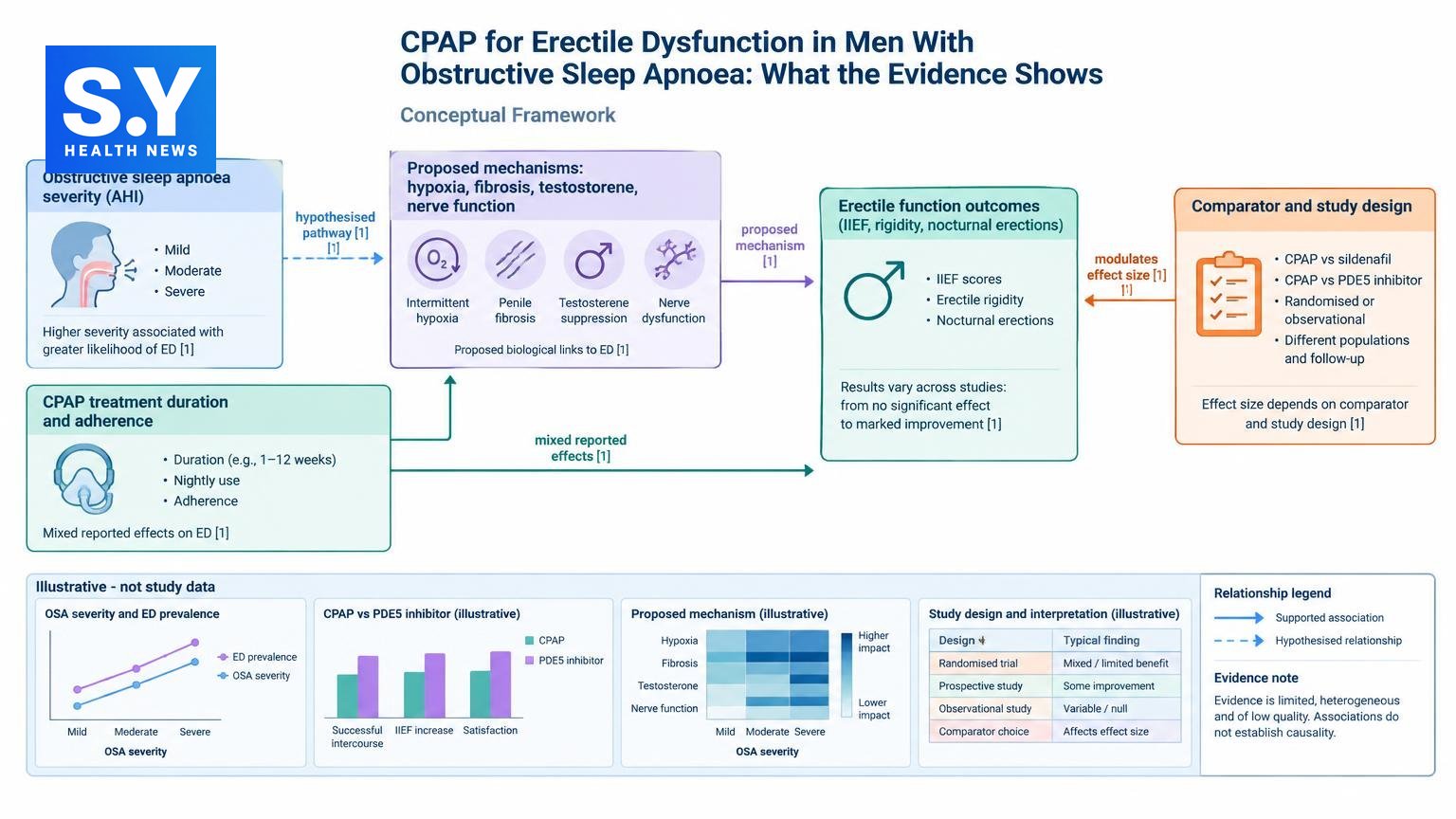
Conceptual framework: Conceptual framework for CPAP and erectile dysfunction in men with obstructive sleep apnoea. The figure organises study variables from a narrative systematic review: OSA severity, CPAP exposure, proposed mechanisms and erectile outcomes. Solid relations reflect reported associations; the mechanism pathway is a hypothesis. Evidence quality is low, so this is not a tested causal model.
Academic References & Evidence
- Zain Ahmed Siddiqui; Daniel Peter McNicholas; Adam Spacey; Ian Pearce; Vaibhav Modgil. The Relationship between Erectile Dysfunction and Obstructive Sleep Apnoea and the Impact on Severity of ED following Treatment of OSA: A Systematic Review. Urol Int. 2026 110(2):176–185 DOI: 10.1159/000546690. PMID: 40784340.
- Current treatment for erectile dysfunction: an umbrella review of systematic reviews and meta-analyses. 2026 DOI: 10.6084/m9.figshare.31562993.v1.
- 勃起功能障碍(ED)治疗方案疗效证据的总体评估:一项伞状综述的系统回顾与元分析. The Aging Male. 2026
SANYUN Science Center explains published research on men's reproductive and sexual health, connecting scientific evidence with everyday questions while making sources and limitations clear.
Disclaimer: This article is for scientific education and research communication only. It does not provide medical advice, diagnosis, or individualized treatment recommendations, and does not endorse any medication, supplement, device, penile enlargement procedure, or other intervention. Decisions about sexual and reproductive health should be made in consultation with a qualified healthcare professional. Do not delay seeking professional care because of information in this article.
Original Content & Copyright Notice
- This article is prepared for SANYUN Science Center, drawing on published research and publicly available academic literature on men’s sexual and reproductive health. Its editorial explanations and presentation are developed for this platform.
- Copyright in the original editorial content, selection, and arrangement is reserved by SANYUN Science Center to the extent protected by applicable law. Referenced research, quotations, and third-party materials remain subject to the rights of their respective owners. This notice does not claim ownership of scientific facts or third-party research.
- Except where permitted by applicable law or an applicable license, prior written permission is required to reproduce, republish, translate, adapt, redistribute, or commercially reuse protected content. Attribution alone does not grant permission for such reuse.
- For permitted quotation or authorized reuse, clearly identify the source and retain a link to the original article.
- Source: SANYUN Science Center
- Original URL: Retain the original article URL on science.san-yun.com.
- Copyright Holder: SANYUN Science Center, for its own protected editorial content.
- Quotation, excerpts, or authorized reuse must not distort the scientific meaning, omit material limitations or disclaimers, or imply unverified medical claims, product efficacy, or endorsement by SANYUN Science Center.



