




Category: Erectile Dysfunction
Core Research Direction: Penile rehabilitation after nerve-sparing radical prostatectomy for prostate cancer: comparing a 12-month program of daily sildenafil (75/100 mg) plus vacuum erection device therapy five times weekly versus on-demand sildenafil (≤3 times weekly) with respect to return of good spontaneous, unassisted erections at 24 months follow-up
Search Intent: In men who have undergone nerve-sparing radical prostatectomy, does a 12-month regimen of daily sildenafil combined with frequent vacuum erection device use improve the return of adequate spontaneous erections at 24 months compared with on-demand sildenafil alone?
Platform: SANYUN Science Center
Evidence reviewed through: 2026-10-30
Executive Summary
Men who undergo nerve-sparing radical prostatectomy for prostate cancer often lose erectile function, and urology has long debated whether structured penile rehabilitation can improve long-term recovery. The PEHAB-II registration describes a multicenter randomized trial designed to compare two 12-month programs: daily sildenafil at 75/100 mg plus vacuum erection device therapy five times weekly, versus sildenafil 75/100 mg taken on demand at most three times weekly. The stated primary objective is to determine the difference between these arms in the percentage of patients who achieve good spontaneous erections after 24 months of follow-up. The registered planned enrollment is 220 participants, and the registration status is recruitment stopped. No outcome results, effect estimates or comparative conclusions appear in the supplied registration text. This review therefore explains the clinical question, the proposed mechanisms, the planned endpoints and the important limits on interpretation; it does not report a trial result.[1]
Why This Question Matters
Erectile dysfunction after prostatectomy is not a cosmetic concern. The cavernous nerves that run alongside the prostate mediate the nitric oxide signaling on which erection depends, and surgery can injure them even when nerve-sparing technique is used. Recovery is often slow and incomplete, and the uncertainty of that recovery is one of the most distressing aspects of treatment for many men and their partners. A rehabilitation strategy that could reliably shorten recovery or increase the proportion of men who regain unassisted erections would change counseling and postoperative care. The PEHAB-II registration reflects that ambition: it is built around a patient-relevant functional endpoint, spontaneous unassisted erections, rather than a laboratory measure or a drug-response measure alone. That choice matters because a man who can achieve an erection only with a tablet or a device has not necessarily recovered the function he had before surgery.[2]
Biological and Clinical Rationale
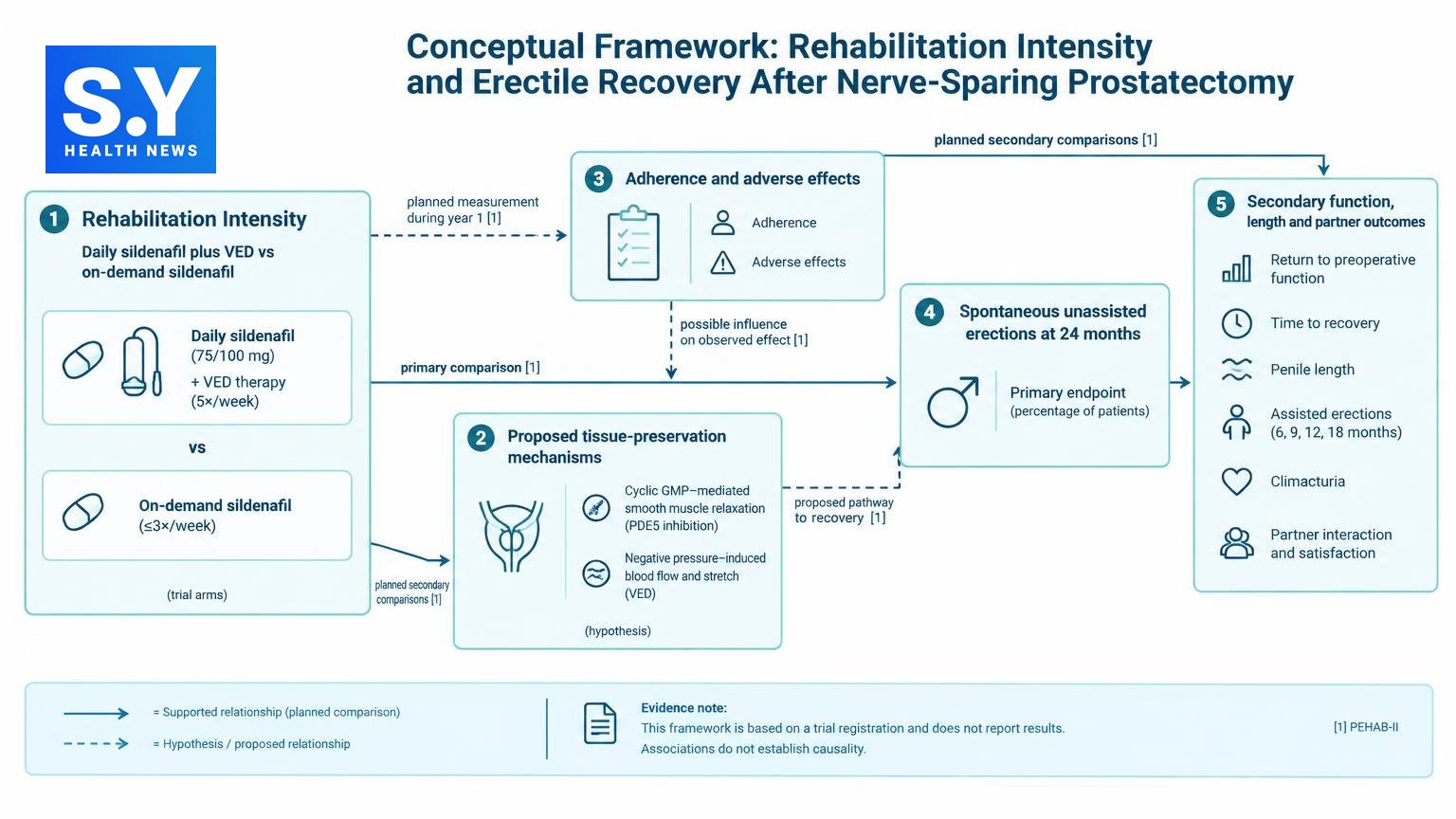
The rationale for early, structured rehabilitation rests on the biology of penile tissue after nerve injury. When nocturnal and sexual erections are absent for prolonged periods, penile smooth muscle and endothelial tissue can become hypoxic and undergo structural change, a process sometimes described as cavernosal fibrosis. The hypothesis behind daily PDE5 inhibition is that maintaining regular cyclic GMP–mediated smooth-muscle relaxation preserves tissue oxygenation and endothelial health while the cavernous nerves recover. The hypothesis behind frequent vacuum erection device use is related but mechanical: negative pressure draws blood into the corpora cavernosa and produces a stretch stimulus, which is proposed to limit tissue contraction and preserve penile length and elasticity. Combining a pharmacological and a mechanical stimulus is therefore a plausible strategy, but it remains a hypothesis. The registration does not demonstrate that either mechanism explains any future observed difference between arms.
Sildenafil is a phosphodiesterase type 5 inhibitor; it blocks the enzyme that breaks down cyclic GMP and amplifies the natural erectile signal, but it does not create an erection without sexual stimulation. That pharmacology has two implications for rehabilitation. First, daily dosing is intended to provide continuous background exposure rather than episodic support at the time of intercourse. Second, a trial comparing daily with on-demand dosing must separate the effect of dosing schedule from the effect of the added device therapy, because the two arms differ on both dimensions. The PEHAB-II design does not appear to include a device-only or no-treatment arm in the supplied registration, so any difference observed would not by itself identify which component produced it.
What the Evidence Shows So Far
At the time of this review, the supplied evidence consists of a trial registration, not a results paper. The registration states the primary objective as determining the difference between the two 12-month programs in the percentage of patients achieving good spontaneous erections after 24 months of follow-up, and lists the same construct as the primary outcome measure. It also lists secondary erectile-function endpoints: return to preoperative erectile function at 24 months, time to recovery, the percentage with good unassisted erections at 18 months, the percentage with good assisted erections at 6, 9, 12 and 18 months, and stretched penile length shortly after surgery compared with 12 months. Additional planned endpoints cover adherence and adverse effects during the first 12 months, climacturia, partner interaction and partner satisfaction. These are planned measurements; none is a reported finding.
The registration also defines a selected population. Participants were to be older than 18 and younger than 75 years, have non-metastatic disease, be scheduled for radical prostatectomy with at least unilateral nerve sparing or an FP score of ≥5, and report preoperative erections adequate for intercourse, operationalized as a preoperative IIEF-EF score of ≥22 with or without a PDE5 inhibitor. Testosterone had to be at least >9 nmol/L, and adjuvant radiotherapy or hormonal therapy was excluded. These criteria describe men with good baseline function and localized disease, which is exactly the group in which nerve-sparing surgery and rehabilitation are most often discussed—but also a group whose recovery may not generalize to men with poorer baseline function, more extensive nerve sacrifice or planned adjuvant treatment.
| Measure / finding | Result | Population / follow-up | Limitations |
|---|---|---|---|
| difference in percentage of patients with good spontaneous erections | adult men after nerve-sparing radical prostatectomy for prostate cancer; 24 months follow-up after 12-month intervention | This is a stated trial objective from a registration, not an observed result. | |
| percentage returning to sufficient spontaneous unassisted erections | men after nerve-sparing radical prostatectomy; 24 months after surgery | Registration outcome description; no results reported in the supplied text. | |
| number of subjects | 220 participants | men after nerve-sparing radical prostatectomy for prostate cancer; n=220 | This is the registered (planned) enrollment number, not a reported analyzed sample. |
| recruitment status | recruitment stopped | Registration status only; no results, analyses or publication of outcomes are provided in the supplied text. | |
| baseline IIEF-EF | ≥22 IIEF-EF points | men before radical prostatectomy; preoperative | Eligibility criterion; limits applicability to men with good baseline erectile function. |
| baseline testosterone threshold | >9 nmol/L | men before/after radical prostatectomy; before or after surgery | Eligibility criterion; excludes men with lower testosterone, narrowing applicability. |
Interpreting the Design and Its Limits
Several features of the registration limit what can be concluded even after publication. The registered planned enrollment is 220 participants across multiple Dutch centers, and the status is recruitment stopped. A stopped recruitment status does not tell us whether the trial met its target, whether it was halted for futility, or whether follow-up is complete; those details are absent from the supplied text. The registration's fields for allocation, blinding and control are marked unknown, so the supplied material does not establish whether outcome assessment was blinded or how the on-demand arm was managed. Adherence is a planned endpoint assessed partly by self-designed questionnaires, which introduces recall and social-desirability bias. Partner and climacturia endpoints likewise rely on self-designed instruments, and the registration does not report their validation.
Safety exclusions are also informative. The trial excluded men using nitroglycerine for coronary disease, men with left ventricular outflow obstruction or severely impaired autonomic blood-pressure control, and men with prior pelvic radiotherapy or androgen deprivation. Alpha-blocker users could be included after stopping the drug. These criteria are consistent with the known vasodilatory effects of sildenafil and with the nitrate contraindication, but they mean the trial population is healthier and more selected than the full spectrum of men seen after prostatectomy. A reader should not treat a future PEHAB-II result as automatically applicable to men with cardiac disease, prior radiation or hormone therapy, or baseline testosterone below the trial threshold.
Research Outlook
The key unanswered questions are empirical. Does a 12-month program of daily sildenafil plus five-times-weekly vacuum device therapy increase the proportion of men with good spontaneous unassisted erections at 24 months compared with on-demand sildenafil? Does any difference persist after accounting for adherence, baseline function and nerve-sparing extent? Are there differences in time to recovery, assisted erections, stretched penile length, climacturia or partner satisfaction? And are adverse effects and treatment burden acceptable enough that men would sustain daily dosing and frequent device use for a year? Until results are reported, clinicians and patients should treat penile rehabilitation as a strategy with a plausible rationale and an unresolved evidence base, not as a proven intervention. The registration itself is a roadmap for the questions, not an answer to them.
Key Takeaways
- PEHAB-II is registered as a multicenter randomized trial comparing 12 months of daily sildenafil 75/100 mg plus vacuum erection device therapy five times weekly with on-demand sildenafil 75/100 mg at most three times weekly after nerve-sparing radical prostatectomy.
- The primary endpoint is the percentage of men achieving good spontaneous erections at 24 months, a patient-relevant functional outcome rather than a drug-response measure alone.
- The registration reports a planned enrollment of 220 participants and a recruitment status of stopped; it does not report results, effect sizes or comparative conclusions.
- Eligibility restricted the study to men with good preoperative erectile function (IIEF-EF ≥22), testosterone >9 nmol/L and localized disease, so findings will apply best to that selected group.
- The two arms differ in both dosing schedule and device use, so a future difference would not by itself identify which component drives the effect.
Questions and Answers
What exactly is being compared in the PEHAB-II trial?
The registration describes two 12-month penile rehabilitation programs after nerve-sparing radical prostatectomy: daily sildenafil at 75/100 mg plus vacuum erection device therapy five times per week, versus sildenafil at 75/100 mg taken on demand at most three times per week. The primary objective is to determine the difference between these programs in the percentage of patients achieving good spontaneous erections after 24 months of follow-up.
What is the proposed mechanism behind daily sildenafil plus device therapy?
The rationale is that regular PDE5 inhibition maintains cyclic GMP–mediated smooth-muscle relaxation and tissue oxygenation while injured cavernous nerves recover, and that frequent vacuum device use provides mechanical stretch and blood inflow that may limit tissue contraction and penile shortening. These are proposed mechanisms, not demonstrated trial findings. The registration does not show that either mechanism explains any observed difference between the two programs.
What outcomes does the trial plan to measure?
The primary outcome is the percentage of men with good spontaneous unassisted erections at 24 months. Planned secondary outcomes include return to preoperative erectile function at 24 months, time to recovery, good unassisted erections at 18 months, good assisted erections at 6, 9, 12 and 18 months, stretched penile length at 12 months, adherence and adverse effects during the first 12 months, climacturia, partner interaction and partner satisfaction.
How strong is the evidence at this point?
It is preliminary in the sense that the available document is a trial registration, not a results report. The registration describes a planned randomized comparison, but the supplied text contains no outcome data, no effect estimate and no comparative conclusion. The status is recruitment stopped, which does not by itself establish whether the target was met or what the trial found. The evidence should be described as a planned trial with an unresolved result.
Who might the results apply to, and who was excluded?
Participants were to be 18–75 years old with non-metastatic prostate cancer, at least unilateral nerve sparing or an FP score of ≥5, preoperative IIEF-EF ≥22 and testosterone >9 nmol/L. Adjuvant radiotherapy or hormonal therapy, nitroglycerine use, left ventricular outflow obstruction and severe autonomic blood-pressure problems were excluded. Findings therefore may not generalize to men with poorer baseline function, prior pelvic radiation, androgen deprivation or significant cardiac disease.
What should patients and clinicians take from this registration now?
Penile rehabilitation after prostatectomy is a plausible strategy with an unresolved evidence base. The trial asks whether more intensive daily drug plus device therapy improves spontaneous erections at 24 months compared with on-demand sildenafil, but no result is yet available. Patients considering rehabilitation should discuss the rationale, the burden of daily dosing and frequent device use, and the safety exclusions with their clinician, without assuming the intensive program is proven superior.
Conceptual framework: Conceptual framework for the PEHAB-II rehabilitation question. The figure shows the planned comparison between daily sildenafil plus vacuum device therapy and on-demand sildenafil, the proposed tissue-preservation rationale, the primary endpoint of spontaneous unassisted erections at 24 months, and planned secondary and adherence outcomes. Solid links indicate planned comparisons; the biological pathway is a hypothesis, not a demonstrated mechanism. The framework is based on a trial registration and does not report results.
Academic References & Evidence
SANYUN Science Center explains published research on men's reproductive and sexual health, connecting scientific evidence with everyday questions while making sources and limitations clear.
Disclaimer: This article is for scientific education and research communication only. It does not provide medical advice, diagnosis, or individualized treatment recommendations, and does not endorse any medication, supplement, device, penile enlargement procedure, or other intervention. Decisions about sexual and reproductive health should be made in consultation with a qualified healthcare professional. Do not delay seeking professional care because of information in this article.
Original Content & Copyright Notice
- This article is prepared for SANYUN Science Center, drawing on published research and publicly available academic literature on men’s sexual and reproductive health. Its editorial explanations and presentation are developed for this platform.
- Copyright in the original editorial content, selection, and arrangement is reserved by SANYUN Science Center to the extent protected by applicable law. Referenced research, quotations, and third-party materials remain subject to the rights of their respective owners. This notice does not claim ownership of scientific facts or third-party research.
- Except where permitted by applicable law or an applicable license, prior written permission is required to reproduce, republish, translate, adapt, redistribute, or commercially reuse protected content. Attribution alone does not grant permission for such reuse.
- For permitted quotation or authorized reuse, clearly identify the source and retain a link to the original article.
- Source: SANYUN Science Center
- Original URL: Retain the original article URL on science.san-yun.com.
- Copyright Holder: SANYUN Science Center, for its own protected editorial content.
- Quotation, excerpts, or authorized reuse must not distort the scientific meaning, omit material limitations or disclaimers, or imply unverified medical claims, product efficacy, or endorsement by SANYUN Science Center.



