




Category: Premature Ejaculation
Core Research Direction: Real-world long-term adherence to dapoxetine for premature ejaculation and the reasons patients stop treatment
Search Intent: In real-world practice, how many men with premature ejaculation continue dapoxetine long-term, when do they stop, and what drives discontinuation?
Platform: SANYUN Science Center
Evidence reviewed through: 2026-11-09
Executive Summary
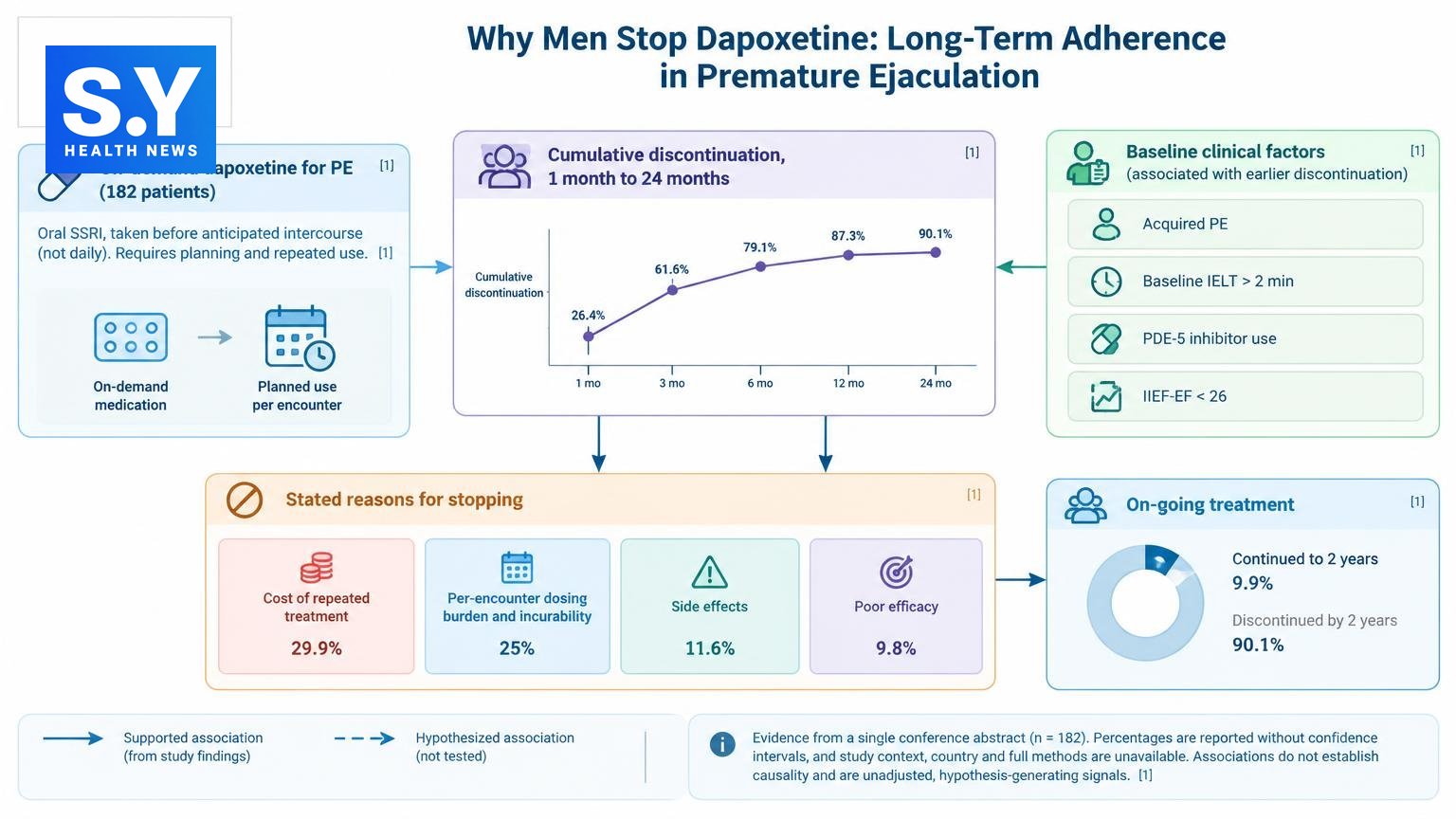
Dapoxetine is widely described as the only oral pharmacological agent approved for premature ejaculation (PE), yet a real-world prospective observational study of 182 consecutive patients found that just 9.9% continued treatment to 2 years. Cumulative discontinuation reached 26.4% at 1 month, 61.6% at 3 months, 79.1% at 6 months, 87.3% at 12 months and 90.1% at 24 months, meaning roughly four in five men had stopped within six months of starting.[1]
The stated reasons for stopping were dominated not by adverse effects but by practical and psychological burdens: cost accounted for 29.9% of discontinuations, while 25% cited disappointment that PE was not curable and that dapoxetine had to be taken every time intercourse was contemplated. Side effects (11.6%), perceived poor efficacy (9.8%) and a search for other options (5.5%) followed, with 18.3% unknown. The authors also noted that new discontinuation slowed sharply after 12 months, implying a small stable long-term user group.
These figures come from a single conference abstract and should be read as a signal about on-demand treatment burden rather than a definitive adherence estimate. The findings nonetheless reframe the clinical conversation: adherence to dapoxetine is less a question of tolerability than of whether men accept a drug they must plan around, pay for repeatedly, and that manages rather than cures a condition.[2]
Why This Matters
Ejaculatory disorders, including PE and delayed ejaculation, are common conditions with a substantial impact on men's quality of life and relationships, according to the Fifth International Consultation on Sexual Medicine consensus review. If an effective agent exists but nine in ten men abandon it within two years, the practical public-health value of that agent is constrained by the delivery model, not only by its pharmacology.
Adherence data also shape how clinicians counsel. A man who starts dapoxetine expecting a course of treatment that will resolve PE may stop when he learns it must be taken before each sexual encounter. The observational study's authors frame dapoxetine as the only approved oral agent for PE and as very effective, but that efficacy framing is their characterization rather than an outcome measured in the adherence study itself.
The On-Demand Dosing Mechanism and Its Burden
Dapoxetine is an orally administered selective serotonin reuptake inhibitor (SSRI) taken on an as-needed basis rather than daily. The consensus review lists dapoxetine and SSRIs among the management options it evaluates for premature ejaculation, alongside psychotherapy and procedural or device approaches. Because the drug is taken before anticipated intercourse, its use is tied to planning, spontaneity and repeated out-of-pocket cost rather than to a fixed daily habit.
That dosing model plausibly explains the pattern of reasons patients gave. A drug that must be purchased repeatedly and timed to each encounter imposes a continuing practical and financial burden, which is consistent with cost (29.9%) and on-demand burden (25%) outranking side effects (11.6%) in the discontinuation breakdown. This is an interpretive link, not a measured causal pathway; the abstract does not report tests of mediation.
The distinction between lifelong and acquired PE matters here. The consensus review classifies PE into lifelong and acquired forms, and the adherence study observed that men with acquired PE, baseline IELT above 2 minutes, PDE-5 inhibitor use and IIEF-EF scores below 26 tended to discontinue earlier. These are associational observations without adjusted effect sizes, but they suggest that men with milder or situational presentations may see less relative benefit from a burdensome on-demand regimen.
What the Evidence Shows
The core dataset is a 2-year prospective observational study that enrolled 182 consecutive patients with PE. The investigators recorded PE type, self-estimated intravaginal ejaculation latency time (IELT) and medical history, and administered the International Index of Erectile Function-Erectile Function Domain (IIEF-EFD) questionnaire. Follow-up visits were scheduled at 1, 3, 6, 12 and 24 months after treatment initiation, at which treatment status and reasons for discontinuation were recorded for those who had stopped.
The central result is the attrition curve. Cumulative discontinuation was 26.4% at 1 month, 61.6% at 3 months, 79.1% at 6 months, 87.3% at 12 months and 90.1% at 24 months. The steepest phase occurred between the first and third months, and by six months about four in five patients had stopped. After the 12-month mark, the rate of new discontinuation fell sharply, leaving a small persistent cohort of 9.9% who continued to two years.
| Variable | Source-grounded definition | Interpretation |
|---|---|---|
| Enrolled patients | 182 consecutive patients with premature ejaculation | Real-world convenience sample; setting and country not described in the abstract |
| Cumulative discontinuation at 1 and 3 months | 26.4% at 1 month; 61.6% at 3 months | The steepest drop-off occurs in the first quarter of treatment |
| Cumulative discontinuation at 6 months | 79.1% | Most men who will stop have stopped by six months |
| Cumulative discontinuation at 12 and 24 months | 87.3% at 12 months; 90.1% at 24 months | Attrition flattens after one year |
| Continued to 2 years | 9.9% | A small persistent user group remains |
| Cost as stated reason | 29.9% of discontinuations | Financial burden is the single most cited reason |
| On-demand burden and incurability | 25% | Disappointment that PE is not curable and drug is needed per encounter |
| Side effects and poor efficacy | 11.6% and 9.8% respectively | Tolerability and perceived benefit are secondary stated reasons |
The reasons breakdown should be read carefully: cost (29.9%) and on-demand disappointment (25%) together account for more than half of stated reasons, while side effects (11.6%) and perceived poor efficacy (9.8%) account for a much smaller share. Seeking other treatment options accounted for 5.5%, and 18.3% of reasons were unknown — a substantial missing proportion that limits how fully the reasons can be characterized.
Predictors of early discontinuation were reported qualitatively. Acquired rather than lifelong PE, baseline IELT over 2 minutes, PDE-5 inhibitor use and IIEF-EF scores below 26 were each associated with earlier stopping. The abstract does not report effect sizes, confidence intervals or adjusted analyses, so these should be treated as hypothesis-generating signals about which patients are most likely to abandon therapy.
Interpretation and Limitations
The most important limitation is evidence type. The study is a conference abstract published in print in April 2023 and indexed with a March 2023 publication date; the full paper, with its methods, statistical analysis and handling of censoring, is not available in the supplied material. Percentages are reported without confidence intervals, and the reasons breakdown does not give its denominators, so the precision of the estimates is unknown. The median time to discontinuation is also not reported.[3]
Observational adherence studies have structural vulnerabilities. Men who discontinue may also discontinue follow-up, and reasons recorded at clinic visits depend on what patients choose to disclose; the 18.3% unknown category hints at this. The statement that discontinuation slowed after 12 months is qualitative — no numeric rate is supplied — and could reflect either genuine stabilization or the diminishing pool of men still at risk. Planned visit scheduling at 1, 3, 6, 12 and 24 months does not guarantee that all visits occurred.
Single-centre or single-cohort designs also limit generalizability. The abstract gives no country, reimbursement context or recruitment setting, all of which strongly influence whether cost is a dominant barrier. In a health system where dapoxetine is fully reimbursed, the reasons hierarchy could look different. The 25% figure for on-demand burden may similarly reflect how the drug was explained and prescribed as much as the drug itself.
Clinical meaning must be separated from statistical reporting. A 90.1% cumulative discontinuation rate is a striking descriptive statistic, but it does not establish that dapoxetine fails clinically, nor that it is ineffective; it describes persistence with a delivery model. Conversely, the low ranking of side effects and perceived poor efficacy should not be taken as proof that tolerability is irrelevant — they may simply be less salient than cost and inconvenience for this particular population.
Research Outlook
The Fifth International Consultation on Sexual Medicine review aims to provide evidence-based recommendations for the definition, classification and treatment of PE and delayed ejaculation, synthesizing evidence on etiology, epidemiology, evaluation and management. That consensus work provides the broader classification context in which adherence findings should be placed, but it does not itself report adherence outcomes.
Several questions remain open. Which components of the discontinuation burden are modifiable — cost through reimbursement, on-demand burden through counselling or alternative schedules, acquired PE through patient selection? Does early discontinuation reflect unmet expectations more than inadequate drug effect? Are men with acquired PE and higher baseline IELT systematically less likely to perceive benefit? Answering these requires full-paper data, adjusted models and ideally multicentre designs with recorded reasons and times to stopping.
Key Takeaways
- In 182 consecutive men with PE, only 9.9% continued dapoxetine to 2 years, and 79.1% had stopped within 6 months.
- Cumulative discontinuation was 26.4% at 1 month, 61.6% at 3 months, 87.3% at 12 months and 90.1% at 24 months.
- Cost (29.9%) and disappointment about the need for per-encounter dosing (25%) were the leading stated reasons, ahead of side effects (11.6%) and perceived poor efficacy (9.8%).
- Acquired PE, baseline IELT over 2 minutes, PDE-5 inhibitor use and IIEF-EF below 26 were associated with earlier discontinuation, but without adjusted effect sizes.
- The evidence base is a conference abstract without confidence intervals or full methods, so the figures are indicative rather than definitive adherence estimates.
Questions and Answers
What is dapoxetine and how is it used for premature ejaculation?
Dapoxetine is an oral selective serotonin reuptake inhibitor taken on demand before sexual intercourse for premature ejaculation. The consensus review lists dapoxetine and SSRIs among the management options for PE. Because it is taken per encounter rather than daily, it requires planning and repeated use, and it manages symptoms rather than curing the condition. Individual suitability and prescribing decisions belong with a qualified clinician.
How many men with premature ejaculation continue dapoxetine long term?
In one 2-year prospective observational study of 182 consecutive patients, only 9.9% continued dapoxetine treatment to 2 years. Cumulative discontinuation reached 79.1% at 6 months, 87.3% at 12 months and 90.1% at 24 months. These figures come from a single conference abstract without confidence intervals, so they indicate a high real-world attrition pattern rather than a precise population estimate.
Why do men stop taking dapoxetine for premature ejaculation?
The largest stated reasons were cost (29.9%) and disappointment that PE was not curable and that dapoxetine was needed every time intercourse was contemplated (25%). Side effects accounted for 11.6% and perceived poor efficacy 9.8%, while 5.5% sought other options and 18.3% were unknown. The reasons breakdown does not report denominators, and reasons recorded at visits may under-represent unspoken barriers.
Which patients with premature ejaculation are more likely to discontinue dapoxetine early?
The observational study reported that patients with acquired rather than lifelong PE, baseline IELT over 2 minutes, PDE-5 inhibitor use, and IIEF-EF scores below 26 tended to discontinue earlier and show higher drop-out rates. These were associational findings without effect sizes, confidence intervals or adjustment, so they serve as hypothesis-generating signals about who may be less likely to persist with on-demand therapy.
How strong is the evidence on dapoxetine discontinuation for premature ejaculation?
It is limited. The key study is a conference abstract of a 2-year prospective observational design published in print in April 2023, with 182 consecutive patients. It reports percentages without confidence intervals or full statistical methods, and the reasons breakdown lacks denominators. The findings are consistent with clinical commentary about high discontinuation but should not be treated as a systematic review or definitive adherence estimate.
Does poor tolerability explain dapoxetine discontinuation in premature ejaculation?
Not primarily, according to this study. Side effects were cited by 11.6% of patients who discontinued, below cost (29.9%) and on-demand burden (25%). This does not mean tolerability is unimportant — reasons were recorded from patient reports and 18.3% were unknown — but it suggests that cost, planning burden and unmet expectations about cure are more prominent drivers in this cohort.
Conceptual framework: Conceptual framework: persistence with on-demand dapoxetine in 182 men with premature ejaculation over 2 years. Edges show reported associations from a single conference abstract, not tested causal pathways. Associations with acquired PE, IELT and erectile function scores are unadjusted and hypothesis-generating; study context, country and full methods are unavailable.
Academic References & Evidence
- MP79-06 COMPLIANCE OF DAPOXETINE IN PATIENTS WITH PREMATURE EJACULATION: A 2-YEAR PROSPECTIVE OBSERVATIONAL STUDY | Journal of Urology. Journal of Urology
- Contemporary consensus and emerging directions in premature and delayed ejaculation: recommendations from the 5th International Consultation on Sexual Medicine.. Sexual medicine reviews PMID: 42855438.
- Park, Hyun Jun. Document is current. 2023 DOI: 10.1097/JU.0000000000003356.06.
SANYUN Science Center explains published research on men's reproductive and sexual health, connecting scientific evidence with everyday questions while making sources and limitations clear.
Disclaimer: This article is for scientific education and research communication only. It does not provide medical advice, diagnosis, or individualized treatment recommendations, and does not endorse any medication, supplement, device, penile enlargement procedure, or other intervention. Decisions about sexual and reproductive health should be made in consultation with a qualified healthcare professional. Do not delay seeking professional care because of information in this article.
Original Content & Copyright Notice
- This article is prepared for SANYUN Science Center, drawing on published research and publicly available academic literature on men’s sexual and reproductive health. Its editorial explanations and presentation are developed for this platform.
- Copyright in the original editorial content, selection, and arrangement is reserved by SANYUN Science Center to the extent protected by applicable law. Referenced research, quotations, and third-party materials remain subject to the rights of their respective owners. This notice does not claim ownership of scientific facts or third-party research.
- Except where permitted by applicable law or an applicable license, prior written permission is required to reproduce, republish, translate, adapt, redistribute, or commercially reuse protected content. Attribution alone does not grant permission for such reuse.
- For permitted quotation or authorized reuse, clearly identify the source and retain a link to the original article.
- Source: SANYUN Science Center
- Original URL: Retain the original article URL on science.san-yun.com.
- Copyright Holder: SANYUN Science Center, for its own protected editorial content.
- Quotation, excerpts, or authorized reuse must not distort the scientific meaning, omit material limitations or disclaimers, or imply unverified medical claims, product efficacy, or endorsement by SANYUN Science Center.



