




Category: Premature Ejaculation
Core Research Direction: Real-world durability of dapoxetine and comparative effectiveness of pharmacological versus non-pharmacological (physiotherapy) and emerging adjunctive treatments for premature ejaculation, framed by contemporary consensus and guideline recommendations
Search Intent: How effective and tolerable are dapoxetine and alternative (physiotherapy, PDE5 inhibitor, combination) treatments for premature ejaculation in real-world and comparative settings, and what does current guidance recommend?
Platform: SANYUN Science Center
Evidence reviewed through: 2026-11-25
Executive Summary
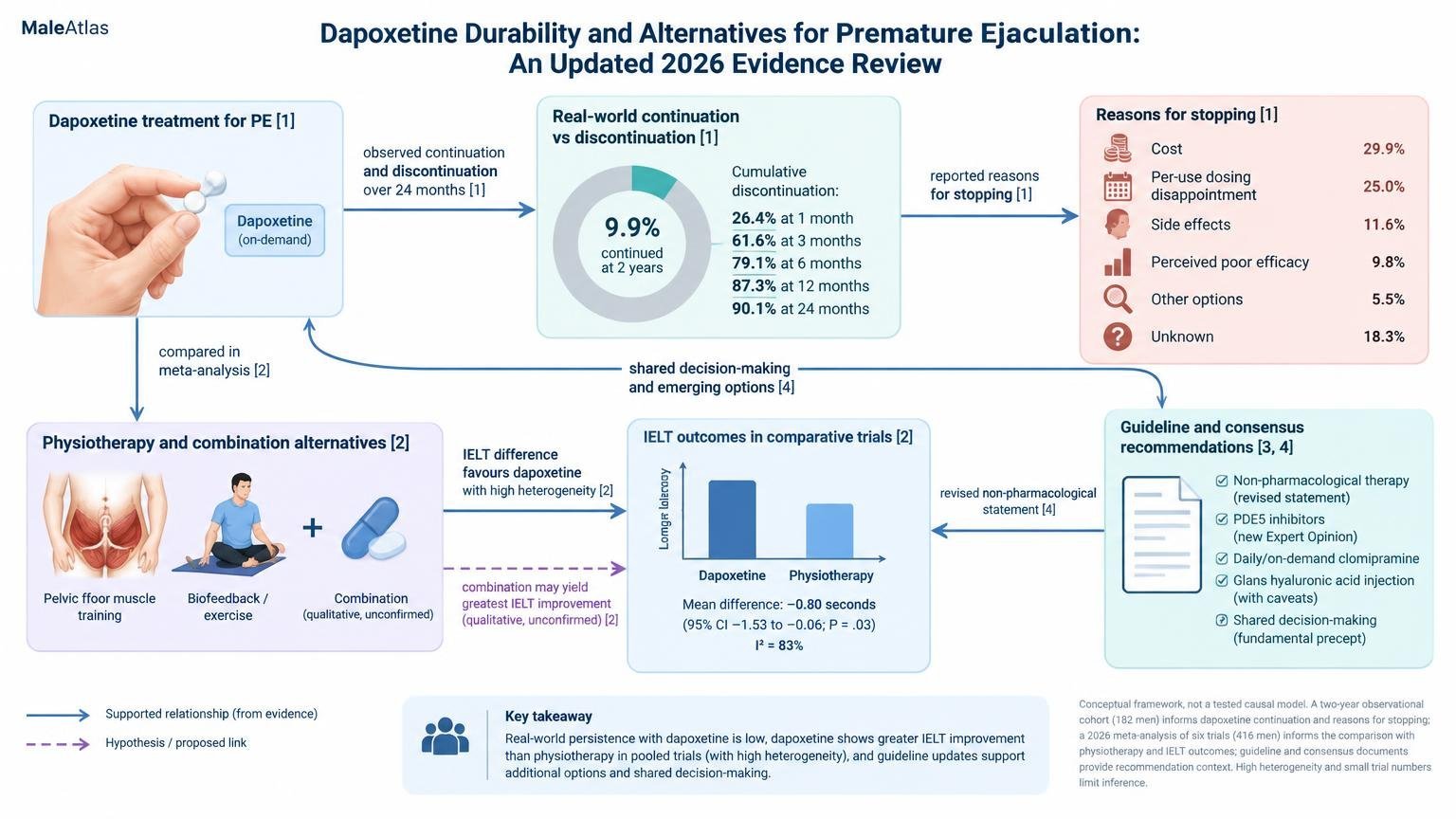
A two-year prospective observational cohort of 182 consecutive men with premature ejaculation found that only 9.9% continued dapoxetine treatment to two years. Cumulative discontinuation was 26.4% at one month, 61.6% at three months, 79.1% at six months, 87.3% at 12 months and 90.1% at 24 months, meaning most attrition happened early. The leading reported reasons for stopping were cost (29.9%) and disappointment that the drug was required every time intercourse was contemplated (25%), ahead of side effects (11.6%) and perceived poor efficacy (9.8%). These are single-cohort observational data without a control group, so they describe real-world persistence rather than prove why individual men stop.[1]
Against this persistence picture, a 2026 systematic review and meta-analysis of six trials with 416 participants compared physiotherapy with pharmacological treatment, predominantly dapoxetine. The pooled effect was statistically significant and favoured dapoxetine, reported as a mean difference in intravaginal ejaculatory latency time of −0.80 seconds (95% CI −1.53 to −0.06; P = .03) with high heterogeneity (I2 = 83%). The authors concluded that dapoxetine 30 mg is significantly more effective than physiotherapy for prolonging latency in men with lifelong premature ejaculation, described physiotherapy as a promising alternative for men intolerant of medication, and suggested qualitatively that combined approaches may yield the greatest improvements.[2]
The 2027 AUA/SMSNA guideline amendment revised its non-pharmacological therapy statement to reflect new evidence that some such therapies may be effective, added a new Expert Opinion statement on PDE5 inhibitors for premature ejaculation, and supported new statements on daily or on-demand clomipramine and glans hyaluronic acid injection with caveats about informed consent and trained-clinician use. It names shared decision-making as the fundamental precept in managing ejaculatory disorders. The 5th International Consultation on Sexual Medicine consensus provides evidence-based recommendations on definition, classification and treatment, framing premature ejaculation as a common condition with substantial impact on quality of life and relationships.[3][4]
Why Durability Matters in Premature Ejaculation
Premature ejaculation is defined by the International Society for Sexual Medicine as ejaculation that always or nearly always occurs before or within about one minute of vaginal penetration from the first sexual experience, or a clinically significant reduction in latency, often three minutes or less, that causes dissatisfaction and affects the quality of life of both the man and his partner. Lifelong and acquired forms are distinguished, and the acquired form may be associated with physical, psychological or comorbid sexual disorders. Some operational definitions use a simpler threshold of one minute or less. These definitions matter because treatment comparisons depend on which population is studied.
Controlled trials answer whether a treatment can work under specified conditions. They do not answer whether men will keep using it in ordinary life. A two-year cohort tracked dapoxetine continuation at scheduled visits at 1, 3, 6, 12 and 24 months and recorded reasons for stopping, capturing a dimension that often diverges from trial efficacy. Discontinuation has practical consequences: men who stop may return to baseline distress and may not seek further care. The reported pattern suggests that adherence is shaped by the treatment model itself, including cost, situational dosing and expectations, not only by adverse effects. That interpretation is clinical commentary rather than a measured outcome in the cohort.
What the Two-Year Dapoxetine Cohort Found
The cohort enrolled 182 consecutive men and characterised them by premature ejaculation type, self-estimated intravaginal ejaculatory latency time, medical history and erectile function domain scores. Visits were scheduled at 1, 3, 6, 12 and 24 months after starting dapoxetine. Retention fell steeply and early: cumulative discontinuation was 26.4% at one month, 61.6% at three months, 79.1% at six months, 87.3% at 12 months and 90.1% at 24 months. Put plainly, roughly four in five men had stopped within six months, and only 9.9% remained at two years. The authors noted that discontinuation slowed after 12 months, so the small remaining group was relatively stable, but most attrition had already occurred. This was an observational cohort without a control group, and the reported rates describe experience rather than compare treatment strategies.
Reported reasons were cost (29.9%), disappointment that premature ejaculation was not curable and that dapoxetine was required every time intercourse was contemplated (25%), side effects (11.6%), perceived poor efficacy (9.8%), seeking other treatment options (5.5%) and unknown (18.3%). The 11.6% side-effect figure is lower than one might expect from reviews that emphasise nausea and dizziness, suggesting that in this cohort the per-use dosing model and cost were more decisive. The authors concluded that discontinuation was very high and mainly driven by cost and the need for situational dosing. Because reasons were patient-reported and the unknown category was substantial, the proportions should be read as descriptive rather than definitive.
The cohort also identified signals for early discontinuation: acquired rather than lifelong premature ejaculation, baseline latency above two minutes, PDE5 inhibitor use and erectile function domain scores below 26. These are associations in one observational cohort, not causal findings. They are clinically plausible: men with less severe latency impairment or coexisting erectile difficulties may have different expectations, and situational dosing may fit poorly with their sexual patterns. Because the study had no control group and reasons for discontinuation relied on patient report, these patterns should inform conversations rather than predict individual outcomes.
Dapoxetine Versus Physiotherapy: The 2026 Meta-Analysis
A 2026 systematic review and meta-analysis followed PRISMA and was registered in PROSPERO (CRD42024613802). Its objective was to assess physiotherapy versus pharmacological treatment for increasing intravaginal ejaculatory latency time in men with premature ejaculation. Six clinical trials with 416 participants met inclusion, published between 2014 and 2024. Physiotherapy modalities were heterogeneous and included pelvic floor muscle strengthening, biofeedback, electrostimulation, acupuncture, yoga and general exercise. Pharmacological comparators were mostly dapoxetine 30 mg, with some 60 mg arms and one fluoxetine study. The pooled comparison therefore reflects mixed doses and a fluoxetine comparator, not solely dapoxetine 30 mg. A related evidence review of physiotherapy versus dapoxetine examines how these trial designs shape interpretation.
The pooled analysis found a statistically significant effect favouring dapoxetine over physiotherapy, reported as a mean difference in latency of −0.80 seconds (95% CI −1.53 to −0.06; P = .03) with high heterogeneity (I2 = 83%). A negative difference here means dapoxetine produced a longer latency than physiotherapy. The authors also reported a pooled standardised mean difference of −0.80 (95% CI −1.53 to −0.06), described using Cohen’s criteria as a large effect. The two metrics coincidentally share a value in the source, but they mean different things: the standardised figure expresses effect relative to variability across trials with different scales, while the absolute difference is expressed in seconds. Neither is a promise of a large gain in everyday minutes, and the small absolute difference should be interpreted alongside the marked heterogeneity.
The qualitative synthesis suggested that combined pharmacological plus physiotherapy approaches produced the most significant latency improvements, but this was not confirmed by the meta-analysis. Individual trial results illustrate why pooling is difficult. In one trial, dapoxetine 30 mg increased latency from about 37.2 seconds to a mean of 168.2 seconds at six weeks, and 60 mg to 193.2 seconds, with 62.5% and 72% of patients respectively exceeding 180 seconds at 12 weeks. Another trial reported latency rising to 127.52 seconds with dapoxetine 60 mg, 103.21 seconds with 30 mg and 87.21 seconds with acupuncture at four weeks, versus 63.43 seconds with placebo. A further trial found moderate physical activity increased latency from 39.3 to 188.6 seconds, comparable to dapoxetine’s rise from 36.8 to 181.7 seconds. These are individual small trials with different designs and should not be pooled impressionistically.
The authors themselves cautioned that scarcity and heterogeneity of studies comparing physiotherapy with drugs limit definitive conclusions. They concluded that dapoxetine 30 mg is significantly more effective than physiotherapy for prolonging latency in men with lifelong premature ejaculation, while positioning physiotherapy as a safe and beneficial alternative for those intolerant of medication, and noted that combination may offer the greatest improvements. The review’s safety claim for physiotherapy reflects an absence of drug-type adverse effects in small trials rather than a formal tolerability meta-analysis.
| Comparison | What was reported | Population and time frame | Interpretation |
|---|---|---|---|
| Dapoxetine continuation to 2 years | 9.9% continued; cumulative discontinuation 90.1% | 182 men with premature ejaculation; 24 months | Very low long-term persistence in one observational cohort |
| Early discontinuation | 79.1% stopped within 6 months | 182 men with premature ejaculation; 6 months | Most attrition occurs early; a small stable group remains later |
| Leading discontinuation reasons | Cost 29.9%; per-intercourse dosing disappointment 25%; side effects 11.6%; poor efficacy 9.8%; other options 5.5%; unknown 18.3% | 182 men with premature ejaculation; 24 months | Practical and expectation-related factors outweighed reported adverse effects |
| Dapoxetine versus physiotherapy for latency | Mean difference −0.80 seconds (95% CI −1.53 to −0.06; P = .03); I2 = 83% | 6 trials; 416 men with premature ejaculation; studies 2014-2024 | Statistically significant but small absolute pooled difference with high heterogeneity |
| Combination therapy (qualitative, hypothesis-generating only) | Qualitative review suggested greatest latency improvements with combined approach; not confirmed by meta-analysis | 6 trials; 416 men with premature ejaculation | Hypothesis-generating observation, not an established superior standard |
Guideline and Consensus Context
The 2027 AUA/SMSNA guideline amendment searched Ovid MEDLINE and Embase for studies published between January 1, 2020 and December 19, 2024. It identified 727 abstracts, with 89 meeting inclusion criteria, and evidence quality was assessed on 25 studies in 2025 to inform statement updates. The amendment revised the non-pharmacological therapy statement to reflect new evidence that some such therapies may be effective. It added a new Expert Opinion statement on the potential use of PDE5 inhibitors for premature ejaculation. It also found evidence to support new statements on daily or on-demand clomipramine and glans hyaluronic acid injection, while emphasising that these should be used with patient informed consent and at the behest of a trained clinician. The Panel concluded that shared decision-making should be the fundamental precept in managing ejaculatory disorders regardless of treatment choice. Elsewhere, a review of the 2027 amendment and 5th ICSM consensus explores what the updated guidance means in practice.
The 5th International Consultation on Sexual Medicine consensus review aimed to present evidence-based recommendations for the definition, classification and treatment of premature and delayed ejaculation. It describes these as common conditions with substantial impact on quality of life and relationships. The supplied text does not detail its full methodology, so it should be read as consensus guidance rather than as a new empirical study. Together, the guideline amendment and consensus signal a shift: pharmacotherapy remains central, but non-pharmacological options, situational trade-offs and patient preference are now explicitly part of the evidence conversation.
Limits of the Evidence
Several limitations temper strong conclusions. The durability cohort was observational, without a control group as described in the supplied report, and relied on self-estimated latency and patient-reported reasons. It cannot establish that dapoxetine causes discontinuation or that a different dosing model would retain more men. The meta-analysis included only six trials with 416 participants, with heterogeneous physiotherapy modalities, varying dapoxetine doses, inconsistent latency measurement and high statistical heterogeneity. Its pooled mean difference of −0.80 seconds is statistically significant, but it should not be read as a clinically large advantage in everyday minutes, despite a standardised effect described as large. The qualitative finding favouring combination therapy was not confirmed by quantitative synthesis.
The guideline amendment is constrained by its search window and by the small number of studies informing some statements. The PDE5 inhibitor statement is explicitly Expert Opinion, and the clomipramine and hyaluronic acid statements carry caveats about informed consent and trained-clinician use. The consensus review is a narrative synthesis. None of these sources establishes a single best treatment for all men with premature ejaculation; the evidence supports a menu of options with different trade-offs in efficacy, tolerability, cost, practicality and invasiveness. Individual clinical decisions should account for these trade-offs with a qualified clinician.
Open Questions for Future Trials
The most pressing gap is head-to-head evidence with adequate sample sizes and consistent latency measurement, including stopwatch-based assessment and validated patient-reported outcomes. Trials should report discontinuation and reasons prospectively, not only efficacy at fixed endpoints. Combination strategies, including dapoxetine plus pelvic floor training, deserve adequately powered comparative designs rather than qualitative impressions. The emerging options noted by the guideline panel, including PDE5 inhibitors, clomipramine and glans hyaluronic acid injection, require independent replication and clear safety reporting before they can be placed confidently in routine care. For now, the evidence supports informed, shared decisions that weigh a modest average latency benefit against the real-world likelihood of stopping treatment.
Key Takeaways
- In a two-year prospective cohort of 182 men, only 9.9% continued dapoxetine, and 79.1% had discontinued within six months.
- Cost (29.9%) and disappointment about per-intercourse dosing (25%) were the leading reported reasons for stopping, ahead of side effects (11.6%) and perceived poor efficacy (9.8%).
- A 2026 meta-analysis of six trials and 416 men found dapoxetine statistically superior to physiotherapy for latency, with a mean difference of −0.80 seconds and high heterogeneity.
- The qualitative review suggested combination therapy may produce the greatest latency improvements, but this was not confirmed by meta-analysis.
- The 2027 AUA/SMSNA amendment revised non-pharmacological statements, added an Expert Opinion on PDE5 inhibitors, and emphasised shared decision-making.
Questions and Answers
What is dapoxetine and how is it used for premature ejaculation?
Dapoxetine is a short-acting selective serotonin reuptake inhibitor and the only oral pharmacological agent approved for premature ejaculation in several regions, though not in the United States. It is taken on demand before anticipated intercourse rather than daily. Trials show it can prolong intravaginal ejaculatory latency time and improve perceived control, but it does not cure the condition. Adherence is a separate question addressed by real-world continuation data.
How long do men actually stay on dapoxetine for premature ejaculation?
In a two-year prospective cohort of 182 men, only 9.9% continued dapoxetine to two years. Cumulative discontinuation was 26.4% at one month, 61.6% at three months, 79.1% at six months, 87.3% at 12 months and 90.1% at 24 months. Most men stopped early, and attrition slowed after 12 months among the small remaining group. This is observational data from one cohort and may not generalise.
Is dapoxetine more effective than physiotherapy for premature ejaculation?
A 2026 systematic review and meta-analysis of six trials with 416 men found a statistically significant difference favouring dapoxetine over physiotherapy for prolonging latency, with a mean difference of −0.80 seconds (95% CI −1.53 to −0.06) and high heterogeneity (I2 = 83%). The standardised effect was described as large, but the absolute difference is small and the evidence base is limited. Physiotherapy was described as a safe alternative for men who cannot tolerate medication.
What reasons do men give for stopping dapoxetine treatment?
Reported reasons in the two-year cohort were cost (29.9%), disappointment that premature ejaculation was not curable and that dapoxetine was needed every time intercourse was contemplated (25%), side effects (11.6%), perceived poor efficacy (9.8%), seeking other options (5.5%) and unknown (18.3%). The authors noted that practical and expectation-related factors accounted for more discontinuation than adverse effects alone. These are patient-reported proportions from a single observational cohort.
What does current guideline and consensus guidance recommend for premature ejaculation?
The 2027 AUA/SMSNA amendment revised its non-pharmacological therapy statement to reflect new evidence that some such therapies may be effective, added an Expert Opinion on PDE5 inhibitors, and supported new statements on clomipramine and glans hyaluronic acid injection with caveats about informed consent and trained-clinician use. It recommends shared decision-making as the fundamental precept. The 5th ICSM consensus provides evidence-based recommendations on definition, classification and treatment, though the supplied text does not detail its full methodology.
How strong is the evidence for combining dapoxetine with physiotherapy?
The 2026 meta-analysis suggested qualitatively that combined pharmacological and physiotherapy approaches produced the greatest latency improvements, but this was not confirmed by quantitative synthesis. The included trials were few, small and heterogeneous, with varying physiotherapy modalities and dapoxetine doses. The authors cautioned that scarcity and heterogeneity limit definitive conclusions. Combination therapy is therefore a hypothesis-generating observation rather than an established superior standard.
Conceptual framework: Conceptual framework, not a tested causal model. A two-year observational cohort (182 men) informs dapoxetine continuation and reasons for stopping; a 2026 meta-analysis of six trials (416 men) informs the comparison with physiotherapy and IELT outcomes; guideline and consensus documents provide recommendation context. Supported arrows reflect reported associations or comparisons; the proposed combination advantage is hypothesis-generating only. High heterogeneity and small trial numbers limit inference.
Academic References & Evidence
- MP79-06 COMPLIANCE OF DAPOXETINE IN PATIENTS WITH PREMATURE EJACULATION: A 2-YEAR PROSPECTIVE OBSERVATIONAL STUDY | Journal of Urology. Journal of Urology. 2023 DOI: 10.1097/JU.0000000000003356.06.
- Esther M Medrano-Sánchez; Ana López-del-Castillo; Maud Boisseau; Juan C Fernández-Domínguez; Esther Díaz-Mohedo. Effectiveness of physiotherapy in male premature… : The Journal of Sexual Medicine. The Journal of Sexual Medicine. 2026 23(5) DOI: 10.1093/jsxmed/qdag096.
- Contemporary consensus and emerging directions in premature and delayed ejaculation: recommendations from the 5th International Consultation on Sexual Medicine.. Sexual medicine reviews PMID: 42855438.
- Disorders of Ejaculation: AUA/SMSNA Guideline (2027) | Journal of Urology. Journal of Urology DOI: 10.1097/JU.0000000000005378.
SANYUN Science Center explains published research on men's reproductive and sexual health, connecting scientific evidence with everyday questions while making sources and limitations clear.
Disclaimer: This article is for scientific education and research communication only. It does not provide medical advice, diagnosis, or individualized treatment recommendations, and does not endorse any medication, supplement, device, penile enlargement procedure, or other intervention. Decisions about sexual and reproductive health should be made in consultation with a qualified healthcare professional. Do not delay seeking professional care because of information in this article.
Original Content & Copyright Notice
- This article is prepared for SANYUN Science Center, drawing on published research and publicly available academic literature on men’s sexual and reproductive health. Its editorial explanations and presentation are developed for this platform.
- Copyright in the original editorial content, selection, and arrangement is reserved by SANYUN Science Center to the extent protected by applicable law. Referenced research, quotations, and third-party materials remain subject to the rights of their respective owners. This notice does not claim ownership of scientific facts or third-party research.
- Except where permitted by applicable law or an applicable license, prior written permission is required to reproduce, republish, translate, adapt, redistribute, or commercially reuse protected content. Attribution alone does not grant permission for such reuse.
- For permitted quotation or authorized reuse, clearly identify the source and retain a link to the original article.
- Source: SANYUN Science Center
- Original URL: Retain the original article URL on science.san-yun.com.
- Copyright Holder: SANYUN Science Center, for its own protected editorial content.
- Quotation, excerpts, or authorized reuse must not distort the scientific meaning, omit material limitations or disclaimers, or imply unverified medical claims, product efficacy, or endorsement by SANYUN Science Center.



