




Category: Premature Ejaculation
Core Research Direction: Comparative effectiveness of dapoxetine combined with nonpharmacological or physiotherapeutic interventions versus monotherapy for lifelong premature ejaculation, with attention to IELT, patient-reported outcomes, evidence certainty and heterogeneity
Search Intent: For men with lifelong premature ejaculation, does combining dapoxetine with nonpharmacological or physiotherapy interventions improve intravaginal ejaculatory latency time and self-reported ejaculatory control more than dapoxetine alone, and how strong and consistent is that evidence?
Platform: SANYUN Science Center
Evidence reviewed through: 2026-11-26
Executive Summary
Adding nonpharmacological or physiotherapeutic strategies to dapoxetine appears to improve ejaculatory latency and self-reported control more than dapoxetine alone in men with lifelong premature ejaculation, according to a systematic review of randomized trials that searched six databases from inception to October 2024 and pooled eight trials with 656 participants.[1]
In that pooled analysis, combination therapy improved intravaginal ejaculatory latency time (IELT) versus dapoxetine monotherapy with a standardized mean difference of 1.6 (95% confidence interval 0.5 to 2.8; p=0.01), and improved Premature Ejaculation Diagnostic Tool (PEDT) scores with a standardized mean difference of 0.9 (95% confidence interval 0.4 to 1.4; p<0.001). Premature Ejaculation Profile (PEP) subscales also favoured combination therapy, and the authors graded the evidence as moderate certainty.
A separate 2026 systematic review asked a narrower question: physiotherapy versus pharmacological treatment. Across six trials and 416 participants it found dapoxetine 30 mg significantly more effective than physiotherapy for prolonging IELT, with a reported mean difference of -0.80 s (95% confidence interval -1.53 to -0.06; p=0.03) and high heterogeneity (I2=83%). Its qualitative synthesis nevertheless suggested that combined treatment produced the largest latency improvements.[2][3]
The two reviews are complementary rather than contradictory: one compares combination therapy with drug monotherapy, the other compares physiotherapy with drug therapy. Moderate certainty means the combination signal is plausible but not secure, and the high heterogeneity in the head-to-head comparison means its pooled estimate should not be read as a uniform effect. Neither review establishes a universally preferred package.
Why This Matters for Men With Lifelong Premature Ejaculation
Lifelong premature ejaculation is defined as ejaculation that occurs prematurely from the first sexual experiences, in nearly all instances of vaginal penetration; the International Society for Sexual Medicine definition cited in the 2026 review uses an IELT of about one minute or less. Acquired premature ejaculation instead develops after a period of normal function and is often linked to physical, psychological or comorbid sexual disorders.
The same review states that approximately 75% of men will experience premature ejaculation at some point in their lives. That figure should be read with caution: it is far above many commonly cited estimates and depends heavily on how premature ejaculation is defined and ascertained, so it is best treated as a broad statement about how common the symptom experience is rather than a precise population parameter.
The practical stakes are captured by the 5th International Consultation on Sexual Medicine, which characterises ejaculatory disorders as common conditions with a substantial impact on quality of life and relationships and aims to provide evidence-based recommendations for definition, classification and treatment.[4]
Adherence is the other reason the combination question matters. The 2026 review notes that selective serotonin reuptake inhibitor therapy is limited by adverse effects such as nausea and dizziness and by discontinuation rates of 70.6% to 89.6% after the first year of treatment. Whether adding a nonpharmacological component improves persistence is a reasonable hypothesis, but it is not a demonstrated adherence benefit in the supplied evidence.
Mechanism: Two Different Targets
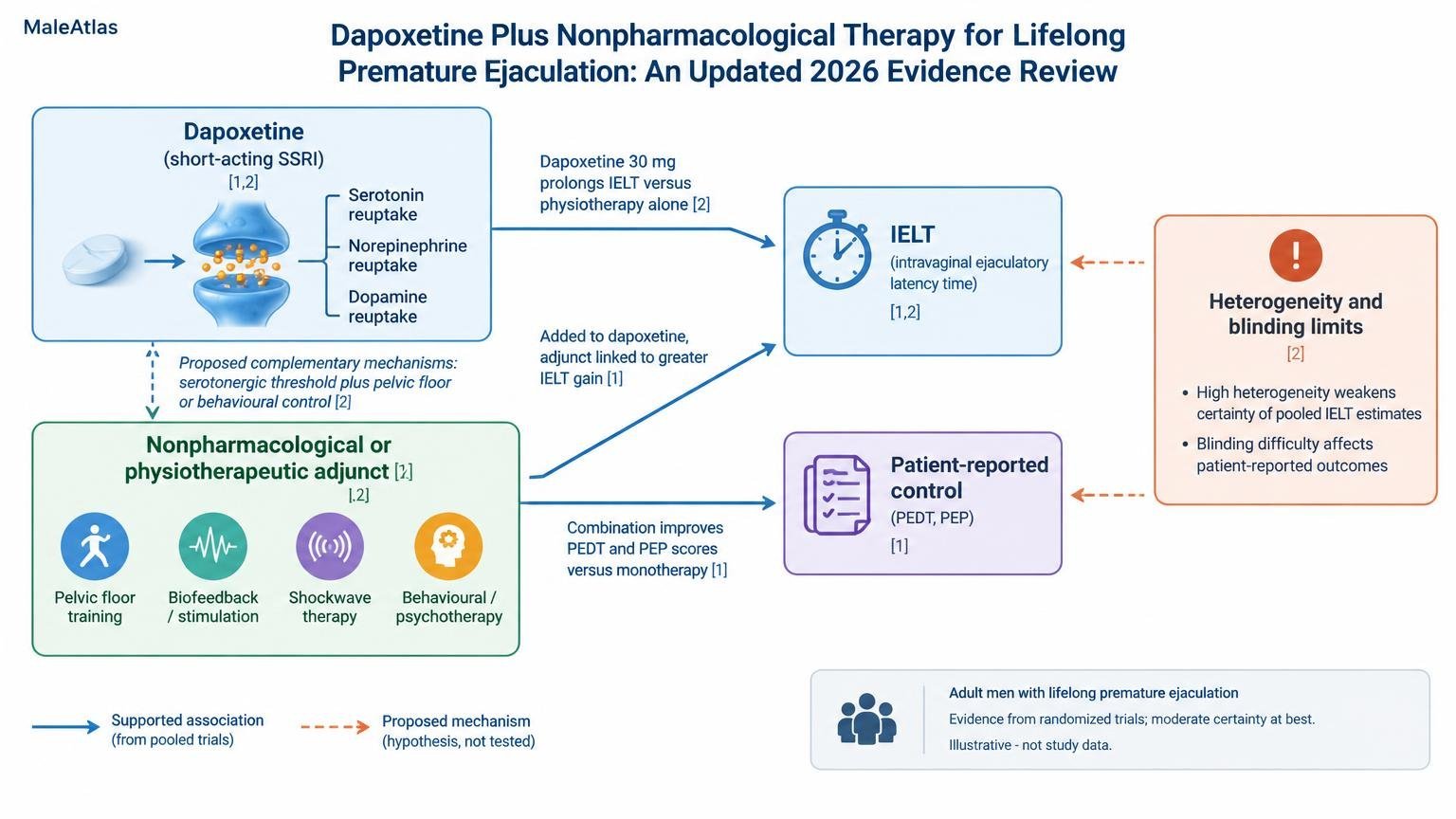
Dapoxetine is a short-acting selective serotonin reuptake inhibitor, approved in Europe but not the United States for premature ejaculation, and the review notes that it also interacts with norepinephrine and dopamine reuptake transporters. The idea that enhanced serotonergic signalling raises the ejaculatory threshold and delays the ejaculatory reflex is a proposed mechanism rather than something the pooled trials directly tested.
Physiotherapeutic approaches target a different domain. The 2026 review proposes that pelvic floor muscle weakness or hypertonicity may contribute to ejaculatory disorder and that strengthening these muscles may increase IELT without drug side effects. That mechanism is stated with explicit uncertainty and was not directly tested in the included trials.
Nonpharmacological adjuncts in the 2025 review were heterogeneous: shockwave therapy, biofeedback, electric stimulation, pelvic floor muscle training, desensitization techniques, psychotherapy and behavioural therapy. These plausibly act on muscular control, attention, anxiety and the timing of ejaculation, but pooling them means the combined estimate reflects a mixture of mechanisms rather than one.
An additive or synergistic model, with drug raising the threshold while training improves muscular and attentional control, is biologically plausible but remains a hypothesis. No included trial was designed to isolate which component drives any combination advantage.
How Dapoxetine Plus Nonpharmacological Therapy Compares With Dapoxetine Alone
The 2025 combination-versus-monotherapy review is the most direct test of the central question. Its pooled IELT effect size of 1.6 standardized mean units is large by conventional thresholds, and its PEDT effect of 0.9 indicates a meaningful shift in a patient-reported diagnostic measure. The PEP subscales also favoured combination therapy. The authors concluded that combination therapy is more effective than dapoxetine monotherapy for functional outcomes and self-perception, supported by moderate certainty.
One interpretive caution matters here. A standardized mean difference combines trials that used different instruments; it does not translate directly into added seconds or minutes of latency, and clinical relevance depends on baseline severity, partner factors and what change a man or couple considers meaningful.
Head-to-Head: Dapoxetine 30 mg Versus Physiotherapy
The 2026 physiotherapy review adds a direct comparison in the opposite direction. Across six trials and 416 participants, dapoxetine 30 mg outperformed physiotherapy for IELT, but heterogeneity was high and the authors cautioned that the scarcity and heterogeneity of the trials preclude a definitive conclusion. Pooling was limited to dapoxetine 30 mg because only two studies used 60 mg and only one studied fluoxetine.
The reported pooled mean difference of -0.80 s is best read as the review's own pooled latency scale result, reported alongside trial-level changes measured in tens or hundreds of seconds. Read literally in seconds against the individual trial values, it looks implausibly small; the review's discussion also describes the same comparison using a standardized mean difference and a large effect size. That internal inconsistency is a reason for caution, not a basis for confident dose or treatment ranking.
Individual trials illustrate both the promise and the variability. In the Pastore et al. trial, mean IELT began at 37.2 s and rose at six weeks to 168.2 ± 36.6 s with dapoxetine 30 mg and 193.2 ± 43.8 s with 60 mg. In Sahin et al., baseline IELT of about 44 to 45 s rose after four weeks to 127.52 s (SD ±3.9) with dapoxetine 60 mg, 103.21 s (SD ±3.20) with 30 mg and 87.21 s (SD ±15.78) with acupuncture, while the sham control reached no more than 63.43 s (SD ±17.74).
Kilinc et al. reported that moderate physical activity raised IELT from 39.3 s (SD ±8.8) to 188.6 s (SD ±82.9), whereas minimal activity raised it only from 33.8 s (SD ±14.7) to 50.3 s (SD ±19.1). The intensity and content of the nonpharmacological component therefore appear to matter substantially, which is one reason pooling heterogeneous adjuncts produces wide uncertainty.
Mantovani et al. reported improvement in 75% of participants at three months and 25% at six months with dapoxetine, 25% at both timepoints with pelvic floor training alone, and 75% at three months and 50% at six months with the combined approach. That trial was excluded from the meta-analysis because IELT was self-reported and standard deviations were unavailable.
| Comparison | Evidence base | Reported result | Certainty and caveats |
|---|---|---|---|
| Dapoxetine plus nonpharmacological therapy vs dapoxetine monotherapy (IELT) | Eight randomized trials, 656 participants with lifelong PE; search to October 2024 | Standardized mean difference 1.6 (95% CI 0.5 to 2.8; p=0.01) | Moderate GRADE certainty; adjuncts heterogeneous |
| Dapoxetine plus nonpharmacological therapy vs monotherapy (PEDT) | Same pooled analysis | Standardized mean difference 0.9 (95% CI 0.4 to 1.4; p<0.001) | Moderate certainty; patient-reported outcome |
| Dapoxetine 30 mg vs physiotherapy (IELT) | Six clinical trials, 416 participants; trials published 2014 to 2024 | Mean difference -0.80 s (95% CI -1.53 to -0.06; p=0.03) favouring dapoxetine | High heterogeneity (I2=83%); authors urge caution; paper also reports this as a large standardized effect |
| Combined physiotherapy plus drug (qualitative only) | Qualitative synthesis of included trials | Combined approach yielded the largest IELT improvements | Not a pooled combination-vs-monotherapy estimate; hypothesis-generating |
| Dapoxetine dose coverage in pooled comparison | Trials using dapoxetine 30 mg, 60 mg or fluoxetine | Pooling limited to dapoxetine 30 mg; 60 mg (two studies) and fluoxetine (one study) could not be pooled | Result applies to 30 mg comparison only |
What Limits Confidence in These Results
Both pooled analyses rest on small trials with substantial heterogeneity in intervention type, dose, duration and outcome measurement. The 2026 review explicitly warns that scarcity and heterogeneity prevent a definitive conclusion, and its high I2 signals that the pooled estimate should not be treated as a uniform effect.
Blinding is a structural weakness. The review notes that blinding patients, physiotherapists and assessors is very difficult given the nature of the intervention, and included studies scored lowest on those items. Expectation and performance effects therefore cannot be excluded, which matters most for patient-reported outcomes such as PEDT and PEP scores.
The 2025 combination review is known here through a news summary; its full risk-of-bias detail was not available in the supplied material, and its moderate certainty grade is not high certainty. The precise trial-level doses, durations and adjunct types behind the pooled estimate are not given in that summary.
There are also internal inconsistencies worth naming. The 2026 review reports 416 participants in its abstract and repository record but describes a qualitative sample of 466 men elsewhere, and it presents the same comparison both as a sub-second mean difference and as a large standardized effect. These are editorial and reporting issues rather than evidence that the direction of the drug-versus-physiotherapy comparison is wrong, but they limit precision.
Finally, the two reviews answer adjacent but non-identical questions. Showing that drug plus adjunct beats drug alone does not show that drug alone beats adjunct alone in the same trials, and vice versa. The qualitative signal favouring combined therapy across both reviews is encouraging but should be treated as hypothesis-generating rather than confirmatory.
Guideline Direction and Research Outlook
Guideline bodies are moving in broadly the same direction. The AUA/SMSNA guideline amendment searched Ovid MEDLINE and Embase for studies published between January 1, 2020 and December 19, 2024, identified 727 abstracts, with 89 meeting inclusion criteria, and assessed the quality of evidence on 25 studies to inform statement updates.[5]
That amendment revised its statement on nonpharmacological therapies for premature ejaculation to reflect new evidence that some may be effective. It added an Expert Opinion statement on PDE5 inhibitors and evidence-supported statements on daily or on-demand clomipramine and glans hyaluronic acid injection, the latter two with emphasis on informed consent and use by a trained clinician. The panel recommends shared decision-making as the fundamental precept regardless of treatment chosen.
These developments should not be read as endorsing a specific combination protocol for lifelong premature ejaculation. They indicate that nonpharmacological options now have a legitimate place in the discussion, which makes the combination-versus-monotherapy question more relevant.
What would strengthen the evidence? Trials that standardise the adjunct, specify dose and timing, measure IELT with a stopwatch rather than self-report, report partner outcomes, and follow participants long enough to capture the adherence problem that undermines selective serotonin reuptake inhibitor therapy. The discontinuation range of 70.6% to 89.6% after the first year means trial efficacy may not translate into real-world benefit.
For now, the most defensible reading is that adding a structured nonpharmacological or physiotherapeutic component to dapoxetine is associated with better IELT and patient-reported outcomes than dapoxetine alone, with moderate certainty, while dapoxetine 30 mg is more effective than physiotherapy alone for IELT in the trials reviewed. These are population-level signals to discuss with a clinician, not guaranteed individual outcomes.
Key Takeaways
- A systematic review of eight randomized trials with 656 participants found dapoxetine plus nonpharmacological therapy improved IELT versus dapoxetine alone (standardized mean difference 1.6; 95% CI 0.5 to 2.8; p=0.01) and PEDT scores (standardized mean difference 0.9; 95% CI 0.4 to 1.4; p<0.001), graded moderate certainty.
- A separate 2026 review of six trials with 416 participants found dapoxetine 30 mg more effective than physiotherapy for IELT (mean difference -0.80 s; 95% CI -1.53 to -0.06; p=0.03) with high heterogeneity (I2=83%).
- That review's qualitative synthesis suggested combined physiotherapy plus drug produced the largest IELT improvements, consistent with the 2025 combination finding but not a pooled comparison.
- Nonpharmacological adjuncts pooled in the 2025 review included shockwave therapy, biofeedback, electric stimulation, pelvic floor muscle training, desensitization techniques, psychotherapy and behavioural therapy, a deliberately heterogeneous group.
- Blinding difficulty, small samples, high heterogeneity and SSRI discontinuation rates of 70.6% to 89.6% after the first year limit how confidently these findings apply to individual decisions.
- The AUA/SMSNA amendment accepts that some nonpharmacological therapies may be effective and recommends shared decision-making as the fundamental precept, without specifying a single preferred combination.
Questions and Answers
What is intravaginal ejaculatory latency time (IELT) in premature ejaculation research?
IELT is the time from vaginal intromission to intravaginal ejaculation. It is the standard primary outcome in premature ejaculation trials because it is comparatively objective and comparable across studies. Lifelong premature ejaculation is often defined as ejaculation within about one minute of penetration from the first sexual experiences, while acquired premature ejaculation develops later and is often linked to other physical or psychological factors.
Does combining dapoxetine with physiotherapy or behavioural therapy improve IELT more than dapoxetine alone?
A systematic review of eight randomized trials with 656 participants reported that dapoxetine plus nonpharmacological therapy improved IELT versus dapoxetine monotherapy, with a standardized mean difference of 1.6 (95% CI 0.5 to 2.8; p=0.01) and moderate certainty. PEDT scores also improved. The adjuncts varied widely, and the result is a population-level estimate, not a guarantee for any individual.
How strong is the evidence that dapoxetine plus nonpharmacological treatment beats dapoxetine alone?
It is graded moderate certainty, not high. The finding comes from eight randomized trials with 656 participants and a search to October 2024, with substantial variation in adjunct type, dose and duration. Consistency and statistical precision are reasonable, but patient-reported outcomes are vulnerable to expectation effects and blinding is difficult in physiotherapy trials, so the result is supportive rather than definitive.
Is dapoxetine 30 mg more effective than physiotherapy alone for lifelong premature ejaculation?
A 2026 systematic review of six trials with 416 participants found dapoxetine 30 mg significantly more effective than physiotherapy for prolonging IELT, with a reported mean difference of -0.80 s (95% CI -1.53 to -0.06; p=0.03). Heterogeneity was high (I2=83%), and the authors cautioned that few small, heterogeneous trials prevent a definitive conclusion; the paper also describes the same contrast as a large standardized effect.
What are the main limitations of the dapoxetine combination and physiotherapy meta-analyses?
Both rest on small trials with heterogeneous interventions and outcomes. Blinding of patients, therapists and assessors is difficult in physiotherapy studies, raising performance and detection bias concerns. Pooling was limited to dapoxetine 30 mg in the head-to-head comparison, and SSRI discontinuation rates of 70.6% to 89.6% after the first year mean trial efficacy may not reflect real-world persistence.
What do current guidelines say about nonpharmacological therapy and shared decision-making for premature ejaculation?
The AUA/SMSNA guideline amendment revised its statement on nonpharmacological therapies to reflect new evidence that some may be effective. It added an Expert Opinion statement on PDE5 inhibitors and evidence-supported statements on clomipramine and glans hyaluronic acid injection, the latter two with emphasis on informed consent and clinician involvement. The panel recommends shared decision-making as the fundamental precept regardless of treatment option.
Conceptual framework: Conceptual framework: how dapoxetine and nonpharmacological or physiotherapeutic adjuncts relate to IELT and patient-reported outcomes in lifelong premature ejaculation. Solid relations reflect pooled associations from randomized trials in adults with lifelong PE; the proposed mechanistic link is a hypothesis, not a tested pathway. Heterogeneity, small samples and blinding difficulty limit certainty. Illustrative – not study data.
Academic References & Evidence
- Dapoxetine plus nonpharmacological approach improves lifelong premature ejaculation. 2025
- Esther M Medrano-Sánchez; Ana López-del-Castillo; Maud Boisseau; Juan C Fernández-Domínguez; Esther Díaz-Mohedo. Effectiveness of physiotherapy in male premature… : The Journal of Sexual Medicine. The Journal of Sexual Medicine. 2026 23(5) DOI: 10.1093/jsxmed/qdag096.
- Effectiveness of physiotherapy in male premature ejaculation. A systematic review and metaanalysis. 2026
- Contemporary consensus and emerging directions in premature and delayed ejaculation: recommendations from the 5th International Consultation on Sexual Medicine.. Sexual medicine reviews PMID: 42855438.
- Disorders of Ejaculation: AUA/SMSNA Guideline (2027) | Journal of Urology. Journal of Urology DOI: 10.1097/JU.0000000000005378.
SANYUN Science Center explains published research on men's reproductive and sexual health, connecting scientific evidence with everyday questions while making sources and limitations clear.
Disclaimer: This article is for scientific education and research communication only. It does not provide medical advice, diagnosis, or individualized treatment recommendations, and does not endorse any medication, supplement, device, penile enlargement procedure, or other intervention. Decisions about sexual and reproductive health should be made in consultation with a qualified healthcare professional. Do not delay seeking professional care because of information in this article.
Original Content & Copyright Notice
- This article is prepared for SANYUN Science Center, drawing on published research and publicly available academic literature on men’s sexual and reproductive health. Its editorial explanations and presentation are developed for this platform.
- Copyright in the original editorial content, selection, and arrangement is reserved by SANYUN Science Center to the extent protected by applicable law. Referenced research, quotations, and third-party materials remain subject to the rights of their respective owners. This notice does not claim ownership of scientific facts or third-party research.
- Except where permitted by applicable law or an applicable license, prior written permission is required to reproduce, republish, translate, adapt, redistribute, or commercially reuse protected content. Attribution alone does not grant permission for such reuse.
- For permitted quotation or authorized reuse, clearly identify the source and retain a link to the original article.
- Source: SANYUN Science Center
- Original URL: Retain the original article URL on science.san-yun.com.
- Copyright Holder: SANYUN Science Center, for its own protected editorial content.
- Quotation, excerpts, or authorized reuse must not distort the scientific meaning, omit material limitations or disclaimers, or imply unverified medical claims, product efficacy, or endorsement by SANYUN Science Center.



