




Category: Penis Enlargement
Core Research Direction: Dermal filler penile augmentation: what an 8,000/2,000-case conference review reports about outcomes and complications and what it cannot establish
Search Intent: What does the largest presented case series on dermal filler penile augmentation actually report about girth gain, satisfaction and complications, and why is that evidence still weak?
Platform: SANYUN Science Center
Evidence reviewed through: 2026-11-13
Executive Summary
A presentation recorded at the IMCAS World Congress 2026 and published on 28 April 2026 describes a retrospective review of 2,000 penile augmentation procedures using hyaluronic acid and other CE-approved dermal fillers. The presenting author reports high patient satisfaction, an average girth increase maintained over 12–18 months depending on filler type, common side effects described as mild and self-limiting such as swelling and bruising, and less common complications including nodules, asymmetry and migration that were managed with massage, hyaluronidase or minor revisions.[1][2]
The same abstract states that the work covers over 2,000 clinical cases in its objectives but its front matter also carries an inconsistent title referring to 8,000 cases. No girth measurements in millimetres, satisfaction instrument, complication frequencies, denominators, comparator group or follow-up methodology appear in the available text. The conclusion that the procedure has been proven safe, effective and repeatable is therefore an author interpretation, not a finding the design can support.
Why This Matters
Penile enlargement is a high-demand, low-evidence area. The author himself frames the field as long characterized by controversy, misinformation and inconsistent outcomes, which is precisely why claims of a minimally invasive gold standard deserve careful reading rather than repetition. Men considering filler augmentation need to understand that a large case count is not the same as a controlled trial, and that a conference abstract is not a peer-reviewed publication.
The practical stakes are not trivial. Filler in the penis involves permanent anatomical risk if material migrates or clumps, and dissatisfaction in a psychologically sensitive domain can have lasting consequences. The abstract's own inclusion of psychological screening, informed consent and aftercare in its protocol signals that patient selection, not injection alone, is central to reported outcomes.
Study Design and What Was Actually Reported
The evidence is a conference presentation, not a journal article. Its method is described as a retrospective review of 2,000 penile augmentation procedures using hyaluronic acid and other CE-approved fillers, within a structured clinical protocol covering screening, informed consent, psychological evaluation, procedural technique and aftercare. The author states that filler types, volumes, injection planes and cannula versus needle techniques were compared to determine best practices and complication trends.
That description matters because "compared" in a retrospective series usually means clinical impressions grouped by product or technique, not a randomized head-to-head trial. The abstract provides no statistical methods, no effect sizes and no adjustment for differences between patients who received one filler versus another. Any best-practice claim drawn from such comparisons is hypothesis-generating.
| Reported domain | What the abstract states | What is missing |
|---|---|---|
| Sample | Retrospective review of 2,000 procedures; objectives also say over 2,000 clinical cases; front matter cites an 8,000-case title | Consistent final case count, patient-level eligibility, follow-up completeness |
| Girth outcome | Average girth increase maintained over 12–18 months depending on filler type | Absolute girth change in millimetres, measurement method, baseline girth, per-filler breakdown |
| Satisfaction | Described as high | Validated questionnaire, score, timing of assessment, response rate |
| Common adverse effects | Mild and self-limiting swelling or bruising | Incidence rates, denominators, duration, whether intervention was needed |
| Less common complications | Nodules, asymmetry and migration managed with massage, hyaluronidase or minor revisions | Frequency, severity grading, timing, whether revisions were surgical, residual sequelae |
| Psychological screening | Credited with preventing dissatisfaction and significantly reducing medico-legal risk | Screening instrument, comparison group, medico-legal case data, definition of dissatisfaction |
Mechanism and Clinical Rationale
Dermal fillers add volume mechanically. In the penis, material placed in subcutaneous or fascial planes increases circumferential girth rather than true erectile tissue length, and durability depends on the filler's degradation profile. The abstract's statement that average girth increase was maintained over 12–18 months depending on filler type is consistent with the known residence times of hyaluronic acid versus longer-lasting CE-approved products, but the presentation does not report the actual measured change for any product.
The complication profile described also fits the mechanics of injected volume: nodules from uneven deposition, asymmetry from unequal distribution or tissue response, and migration of material away from the intended plane. The reported rescue strategies, massage, hyaluronidase for hyaluronic acid and minor revisions, are standard salvage options rather than evidence of a low complication rate.
How Strong Is the Evidence?
This is among the weaker forms of clinical evidence: a single-author, single-center retrospective case series, presented at an aesthetic congress, with no comparator and no peer review reported in the available record. Case series can describe what happened in one practice, but they cannot separate the procedure's effect from patient selection, operator skill, natural variation in body perception, or placebo and expectancy effects, which are likely to be substantial in a cosmetic intervention.
The internal inconsistency in case count is a concrete caution. The same abstract refers to 2,000 procedures in its methods, over 2,000 cases in its objectives, and an 8,000-case title in its front matter. This may reflect draft material, combined series or a typographical error, but it means even the headline sample size should be treated as uncertain until a full methods report appears.
- Outcome measurement: girth durability is described only as a range across filler types, without per-product or per-patient values.
- Safety reporting: common effects are described qualitatively as mild, and uncommon complications as manageable, with no frequencies.
- Causal claims: psychological screening is credited with preventing dissatisfaction and reducing medico-legal risk without a comparison group or supporting data.
- Independence: the author declares no funding and no competing financial relationships, which is a disclosure rather than a methodological safeguard.
Interpretation and Limitations
The abstract's conclusion that dermal filler penile augmentation has proven safe, effective and repeatable under strict protocols overstates what an uncontrolled series can show. "Proven" implies confirmatory evidence from controlled designs with prespecified outcomes; this presentation offers clinical impressions from one practice. The claim that fillers are becoming the gold standard is similarly an assertion, not a finding supported by guidelines or comparative data in the available text.
The emphasis on a structured protocol, including psychological evaluation and realistic expectation-setting, is arguably the presentation's most transferable message. In cosmetic genital procedures, dissatisfaction often reflects unmet expectations or underlying body-image concerns rather than technical failure, and screening may plausibly reduce both. But this abstract does not demonstrate that effect; it reports the author's belief that screening helped.
Open Questions and Research Outlook
Several questions remain unanswered by the available material. What was the mean and range of girth change, measured how and by whom? What proportion of patients experienced nodules, asymmetry or migration, and how many required hyaluronidase or surgical revision? How many patients were lost to follow-up over the 12–18 month window? How were satisfaction and dissatisfaction defined and measured? And how did outcomes differ across filler types, volumes and injection techniques once patient factors were accounted for?
Answering these questions requires prospective designs with standardized measurement, validated patient-reported outcomes, independent follow-up and transparent reporting of adverse events. Until such data exist in peer-reviewed form, clinicians and patients should treat conference case series as useful for technique discussion and hypothesis generation, not as proof of safety or efficacy.
Key Takeaways
- A 2026 IMCAS presentation reports a retrospective review of 2,000 dermal filler penile augmentation procedures with high satisfaction and girth increase maintained 12–18 months, but no numerical outcomes are given.
- Reported complications include swelling and bruising as common, and nodules, asymmetry and migration as less common, managed with massage, hyaluronidase or minor revisions.
- The abstract contains inconsistent case counts, 2,000 versus an 8,000-case title, which limits confidence in the sample description.
- The design is an uncontrolled single-presenter retrospective series, so claims of proven safety, effectiveness and gold-standard status are not supported.
- Structured patient screening, informed consent, psychological evaluation and aftercare are described as protocol components and are reasonable areas for further study.
Questions and Answers
What is dermal filler penile augmentation and how does it work?
It is a non-surgical procedure in which hyaluronic acid or other CE-approved dermal fillers are injected to increase penile girth. The filler adds volume mechanically rather than lengthening erectile tissue. In the reviewed series, average girth increase was reported as maintained over 12–18 months depending on filler type, but no measured values in millimetres were provided.
What did the 2,000-case dermal filler penile augmentation review find?
The presenter reported high patient satisfaction, girth increase maintained 12–18 months depending on filler, common side effects described as mild and self-limiting such as swelling and bruising, and less common nodules, asymmetry and migration managed with massage, hyaluronidase or minor revisions. No satisfaction scores or complication rates were reported.
How strong is the evidence from this IMCAS conference presentation?
It is weak by conventional standards: an uncontrolled, single-presenter retrospective case series presented at a congress, with no comparator and no peer-reviewed full report available. It can describe one practice's experience but cannot establish causal effectiveness or accurate complication rates, and its case count is internally inconsistent, citing both 2,000 and 8,000.
Who might this evidence apply to, and who should be cautious?
The series describes men who underwent filler augmentation within a protocol that included screening, informed consent and psychological evaluation, so findings apply to selected, psychologically screened patients in a specialized practice. Men with unrealistic expectations, body dysmorphic concerns, or those seeking length rather than girth should be especially cautious, as the abstract does not report outcomes for these groups.
What complications and limitations are reported with penile filler augmentation?
Swelling and bruising are described as common and self-limiting, while nodules, asymmetry and filler migration are described as less common and manageable with massage, hyaluronidase or minor revisions. The abstract does not give frequencies, severity grading, or follow-up completeness, and the author's conclusion that the procedure is proven safe is not supported by this design.
Why is psychological screening emphasized in penile augmentation?
The presenter states that screening helped prevent dissatisfaction and significantly reduced medico-legal risk. This is plausible because cosmetic genital procedures can attract patients with unmet body-image expectations, but the abstract provides no screening tool, comparison group or case data, so the claim is a hypothesis rather than a demonstrated effect.
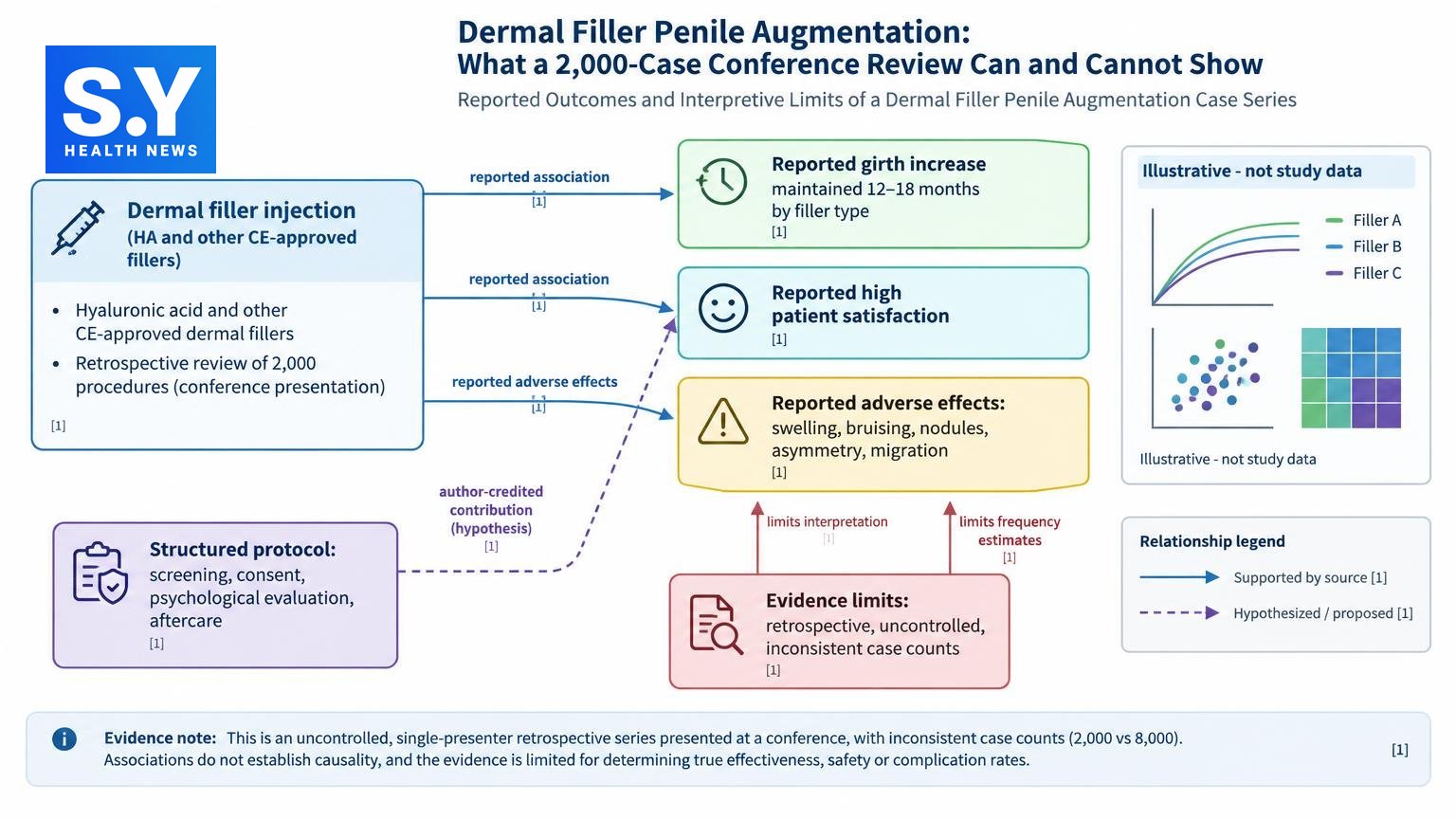
Conceptual framework: Conceptual framework. A single-presenter retrospective review of 2,000 dermal filler penile augmentation procedures reports girth increase maintained 12–18 months, high satisfaction and manageable complications; structured screening is credited with improving satisfaction. These are reported associations in an uncontrolled series, not causal effects, and inconsistent case counts limit interpretation. Illustrative – not study data.
Academic References & Evidence
- Sherif EL WAKIL. Penis augmentation: a focused review on dermal filler technique. 2026
- Sherif EL WAKIL. Penis augmentation: a focused review on dermal filler technique. 2026
SANYUN Science Center explains published research on men's reproductive and sexual health, connecting scientific evidence with everyday questions while making sources and limitations clear.
Disclaimer: This article is for scientific education and research communication only. It does not provide medical advice, diagnosis, or individualized treatment recommendations, and does not endorse any medication, supplement, device, penile enlargement procedure, or other intervention. Decisions about sexual and reproductive health should be made in consultation with a qualified healthcare professional. Do not delay seeking professional care because of information in this article.
Original Content & Copyright Notice
- This article is prepared for SANYUN Science Center, drawing on published research and publicly available academic literature on men’s sexual and reproductive health. Its editorial explanations and presentation are developed for this platform.
- Copyright in the original editorial content, selection, and arrangement is reserved by SANYUN Science Center to the extent protected by applicable law. Referenced research, quotations, and third-party materials remain subject to the rights of their respective owners. This notice does not claim ownership of scientific facts or third-party research.
- Except where permitted by applicable law or an applicable license, prior written permission is required to reproduce, republish, translate, adapt, redistribute, or commercially reuse protected content. Attribution alone does not grant permission for such reuse.
- For permitted quotation or authorized reuse, clearly identify the source and retain a link to the original article.
- Source: SANYUN Science Center
- Original URL: Retain the original article URL on science.san-yun.com.
- Copyright Holder: SANYUN Science Center, for its own protected editorial content.
- Quotation, excerpts, or authorized reuse must not distort the scientific meaning, omit material limitations or disclaimers, or imply unverified medical claims, product efficacy, or endorsement by SANYUN Science Center.



