




Category: Penis Enlargement
Core Research Direction: Retrospective, non-comparative review of dermal filler penile augmentation technique: reported girth outcomes, complication profile, and the role of psychological screening, as presented in a congress lecture abstract
Search Intent: What does a large single-operator case series of dermal filler penile augmentation report about girth durability, side effects, and the limits of the evidence it provides?
Platform: SANYUN Science Center
Evidence reviewed through: 2026-10-31
Executive Summary
A conference lecture abstract presents a single operator's retrospective review of 2,000 penile augmentation procedures using hyaluronic acid and other CE-approved dermal fillers. The author reports high patient satisfaction, an average girth increase maintained over 12–18 months depending on filler type, common side effects described as mild and self-limiting such as swelling and bruising, and less common complications including nodules, asymmetry and migration managed with massage, hyaluronidase or minor revisions. The abstract also states that psychological screening helped prevent dissatisfaction and significantly reduced medico-legal risk.[1]
The central interpretive problem is evidentiary, not procedural. None of the reported outcomes is accompanied by a measurement method, baseline value, magnitude, frequency, denominator, follow-up completeness figure or statistical analysis. The work is retrospective, uncontrolled and single-operator, and it was delivered as an educational congress lecture rather than a peer-reviewed report. It therefore describes a practitioner's claimed experience and practice philosophy; it cannot establish that filler augmentation is safe, effective or repeatable, however assertively the conclusion is phrased.
Why This Matters
Penile augmentation sits at an unusual intersection of high patient interest, limited high-quality evidence and substantial commercial pressure. Men seeking augmentation frequently report normal anatomy but distress about size, which places the consultation itself at the centre of ethical practice. Against that background, a large case series has intuitive appeal: volume alone feels like credibility. The supplied abstract explicitly frames its purpose as practitioner education based on over 2,000 clinical cases and proposes that minimally invasive filler approaches are becoming the gold standard as global demand grows.
That framing deserves careful reading. A demand trend and a 'gold standard' designation are asserted, not demonstrated with cited data or guideline endorsement, and a surgical specialty's standard of care is a matter for consensus bodies rather than a single lecture. The clinical relevance of this abstract is thus mostly descriptive: it shows how one experienced operator structures consent, screening, injection and aftercare, and which complications that operator considers common enough to plan for. Those are legitimate topics for professional discussion. They are not the same as outcome data, and conflating the two is how weak evidence acquires an undeserved reputation.
The Intervention and Its Biological Rationale
Dermal fillers are injectable gels, most commonly cross-linked hyaluronic acid, placed into tissue to add volume. Applied to the penis, the logic is volumetric rather than physiological: material deposited in the subcutaneous plane increases circumference, and as the gel is gradually degraded by native hyaluronidases and mechanical loading, the added girth diminishes. That rationale predicts the durability pattern the abstract describes — maintenance of average girth over a period of months that varies with filler type — because different formulations have different cross-linking and degradation profiles. The abstract does not present degradation data, imaging, or tissue-level observations; the mechanism is offered here as the standard rationale for the technique, not as something the lecture measured.
Penis size perception is also not purely a tissue phenomenon. Body image concerns, comparison with idealized imagery, partner-related anxiety and performance worry all feed into dissatisfaction, and these factors do not automatically resolve when circumference changes on a measurement or a photograph. This is the clinical reason psychological evaluation is embedded in the described protocol and why the author ties it to dissatisfaction and medico-legal risk. That link is plausible and consistent with broader aesthetic practice, but in this abstract it is an assertion rather than a measured effect.
What the Evidence Shows
The abstract reports a retrospective review of 2,000 procedures. Within that series, filler types, volumes, injection planes and cannula versus needle techniques were compared to determine best practices and complication trends. The existence of these comparisons tells us the operator varied technique deliberately and formed impressions about which choices worked better. It does not tell us how many patients received each approach, whether groups were comparable, what was measured, or whether the differences exceeded what chance and case-mix would produce. Without group sizes and effect estimates, the comparisons function as expert opinion expressed in comparative language.
Outcomes are summarized in three broad claims. First, high patient satisfaction was observed; no instrument, response rate or definition of 'high' is given. Second, average girth increase was maintained over 12–18 months depending on filler type; no baseline circumference, no absolute or relative increase, no measurement technique and no follow-up schedule are reported. Third, common side effects were mild and self-limiting, with swelling and bruising named, while nodules, asymmetry and migration were described as less common and manageable. The direction of these claims is clinically sensible and consistent with what filler practice generally encounters, but the magnitude, frequency and durability are all unquantified in the supplied text.
| Measure / finding | Result | Population / follow-up | Limitations |
|---|---|---|---|
| The presentation is positioned as practitioner education on dermal filler penile enlargement, drawing on a claimed base of over 2,000 clinical cases; it is a congress lecture, not a peer-reviewed report. | n=over 2,000 clinical cases (claimed) | Sample size is asserted in the educational framing; no peer-review, control group or statistical analysis is reported in the supplied text. | |
| The described body of work is a retrospective review of 2,000 penile augmentation procedures using hyaluronic acid and other CE-approved dermal fillers. | 2000 procedures | men undergoing penile augmentation with dermal fillers; n=2000 procedures; retrospective (dates not stated) | Retrospective, single-operator; no comparison group; no response rate or loss to follow-up reported; abstract only. |
| The procedure was delivered within a structured clinical protocol covering patient screening, informed consent, psychological evaluation, injection technique and aftercare. | men undergoing penile augmentation with dermal fillers | Protocol components are listed but not described in detail or independently assessed. | |
| Filler types, volumes, injection planes, and cannula versus needle techniques were compared within the review to identify best practices and complication trends. | men undergoing penile augmentation with dermal fillers; retrospective (dates not stated) | Comparative statements are made without reporting group sizes, statistical methods or effect estimates in the supplied text. | |
| girth increase durability; patient satisfaction | months (12–18) | men undergoing penile augmentation with dermal fillers; 12–18 months | No measurement method, baseline values, magnitude of increase, satisfaction instrument, or follow-up completeness is given; 'average' is not quantified. |
| Common side effects were described as mild and self-limiting, including swelling and bruising. | men undergoing penile augmentation with dermal fillers | No frequencies, denominators or ascertainment method for adverse events are reported. | |
| Less common complications such as nodules, asymmetry and filler migration were reported as managed with massage, hyaluronidase, or minor revisions. | men undergoing penile augmentation with dermal fillers | Incidence of these complications, definition criteria and the proportion requiring each management approach are not provided. | |
| The author asserts that psychological screening prevented dissatisfaction and materially reduced medico-legal risk. | men undergoing penile augmentation with dermal fillers | Assertion without reported data, comparison, instrument, or quantification of 'significantly'; no medico-legal outcome measures described. | |
| The conclusion asserts dermal filler penile augmentation is safe, effective and repeatable under strict medical protocols. | men undergoing penile augmentation with dermal fillers | Efficacy and safety claims rest on an uncontrolled retrospective single-operator series presented as a lecture; no peer-reviewed comparative data support them in the supplied text. | |
| The author claims growing global demand and that filler-based minimally invasive approaches are becoming the gold standard. | Demand trend and 'gold standard' status are asserted without cited data or guideline endorsement. |
Interpreting the Psychological Screening Claim
Of all the abstract's statements, the one about psychological screening is the most consequential for practice and the least supported by reported data. The protocol included patient screening, informed consent, psychological evaluation, procedural technique and aftercare. The author states that screening helped prevent dissatisfaction and reduced medico-legal risk significantly. Both outcomes are inherently difficult to attribute to a single protocol component in an uncontrolled series: dissatisfaction is multidimensional, medico-legal events are rare and confounded by documentation habits, and 'significantly' is used without a statistical test or even a count.
The underlying clinical principle nevertheless merits attention. Aesthetic genital procedures attract a minority of patients with unrealistic expectations, body dysmorphic concerns or external pressure from a partner, and structured assessment is a reasonable safeguard. The abstract's contribution is to place that safeguard inside a routine protocol rather than treating it as an occasional add-on. What remains unknown is which assessment tools were used, what thresholds prompted declining treatment, how often treatment was declined, and whether screened and unscreened patients differed. Future reports could answer these questions cheaply by reporting counts and instruments, and doing so would turn a plausible assertion into usable guidance.
Limitations That Shape the Conclusions
The first limitation is design. A retrospective, single-operator, uncontrolled series cannot separate the procedure's effect from selection, natural variation in anatomy and perception, concomitant treatments, or the operator's own skill and aftercare. There is no comparison group, no blinding and no independent outcome assessment. The second is reporting. The abstract supplies no measurement methods, no adverse-event frequencies, no follow-up duration distribution and no statistical analysis, so statements such as 'maintained over 12–18 months' summarize an impression rather than a dataset. The third is venue. A congress lecture abstract is not peer-reviewed in the way a journal article is, and the supplied text itself notes restricted physician access, so independent readers cannot inspect the underlying data.
The fourth limitation concerns the conclusions drawn. The abstract states that filler augmentation has proven to be safe, effective and repeatable under strict protocols. The word 'proven' is not supported by an uncontrolled series; at most, the series is consistent with acceptable outcomes in one operator's hands. This distinction is not pedantic. Safety in particular is a frequency question, and serious events such as vascular occlusion, infection, granuloma or delayed migration may be rare enough that a single series, however large, cannot exclude them — especially when complications are characterized by example rather than count.
A fifth and often overlooked limitation is definitional. Neither 'girth increase' nor 'satisfaction' is anchored to a clinically meaningful threshold. A statistically detectable change and a change a patient experiences as worthwhile are different constructs, and neither is quantified here. Similarly, the statement that filler approaches are becoming a gold standard reflects the presenter's framing rather than documented guideline consensus; readers should treat it as a hypothesis about the field, not a description of it.
Research Outlook
The most useful next step is not a larger single-operator series but better-instrumented ones. Prospective data collection with standardized circumference measurement at defined anatomical points, validated patient-reported outcome measures, pre-specified follow-up intervals and systematic adverse-event ascertainment would convert impressions into estimates. A comparator could be as simple as a waiting-list or non-treated group, or a comparison between filler types with adequate allocation description. Reporting should include loss to follow-up, since durability claims depend entirely on who remained available to be measured.
The psychological component deserves its own design. Validated screening instruments, documented decision rules for declining or deferring treatment, and follow-up of both accepted and declined patients would allow the field to test whether screening changes satisfaction and complaints rather than assuming it. Registry-based pharmacovigilance for filler complications would address the rarity problem that no single series can solve. Until such data exist, the appropriate stance is that filler augmentation is a plausible, widely performed technique with an encouraging but unquantified single-operator experience behind it — and that patients deserve to hear that uncertainty stated plainly during consent.
Key Takeaways
- The evidence base is a congress lecture abstract describing a single-operator retrospective review of 2,000 procedures, not a peer-reviewed comparative study.
- Reported girth increase was said to be maintained over 12–18 months depending on filler type, but no measurement method, baseline or magnitude is supplied.
- Common effects were described as mild and self-limiting; nodules, asymmetry and migration were reported as less common and manageable, without frequencies.
- Psychological screening is presented as reducing dissatisfaction and medico-legal risk, an assertion the abstract does not quantify or compare.
- The claim that the technique is proven safe, effective and repeatable, or is becoming a gold standard, outruns what an uncontrolled series can demonstrate.
Questions and Answers
What is dermal filler penile augmentation and how is it supposed to work?
It is the injection of gel fillers, most often hyaluronic acid, into penile tissue to increase circumference. The rationale is volumetric: added material enlarges girth until the gel is gradually broken down, which is why durability varies with filler type. The reviewed abstract describes this practice but does not report tissue-level or degradation measurements, so the mechanism is the standard rationale rather than a finding of the series.
What did the 2,000-case review report about outcomes?
It reported high patient satisfaction, an average girth increase maintained over 12–18 months depending on filler type, common side effects described as mild and self-limiting such as swelling and bruising, and less common complications including nodules, asymmetry and migration managed with massage, hyaluronidase or minor revisions. These are narrative summaries without measurement methods, magnitudes or adverse-event rates.
How strong is this evidence?
Weak for causal or safety conclusions. It is a retrospective, uncontrolled, single-operator series presented as a congress lecture abstract, with no comparison group, no statistical analysis and no peer-reviewed detail. It can describe one practitioner's experience and protocol, but it cannot establish efficacy, safety or durability in the way a controlled study or registry could.
Does psychological screening improve results, as the abstract suggests?
The abstract asserts that screening helped prevent dissatisfaction and significantly reduced medico-legal risk, which is clinically plausible and consistent with aesthetic practice. However, no instrument, threshold, decline rate or comparison is reported. The claim should be read as expert opinion awaiting prospective evaluation, not as a demonstrated effect.
What are the main limitations and risks readers should keep in mind?
The design cannot separate the procedure from operator skill, selection or natural variation, and the reporting omits follow-up completeness, complication frequencies and definitions of satisfaction or meaningful girth change. Rare but serious events cannot be excluded by a single series. The conclusion that the procedure is proven safe, effective and repeatable exceeds what the data can support.
How should patients and clinicians use this information?
As a description of a widely performed technique and a structured protocol, not as proof of benefit. Consent discussions should state that durability and complication rates are uncertain, that effects are temporary, and that psychological assessment is part of good practice. Anyone considering the procedure should seek a properly qualified clinician and expect a realistic, non-promotional explanation of what is and is not known.
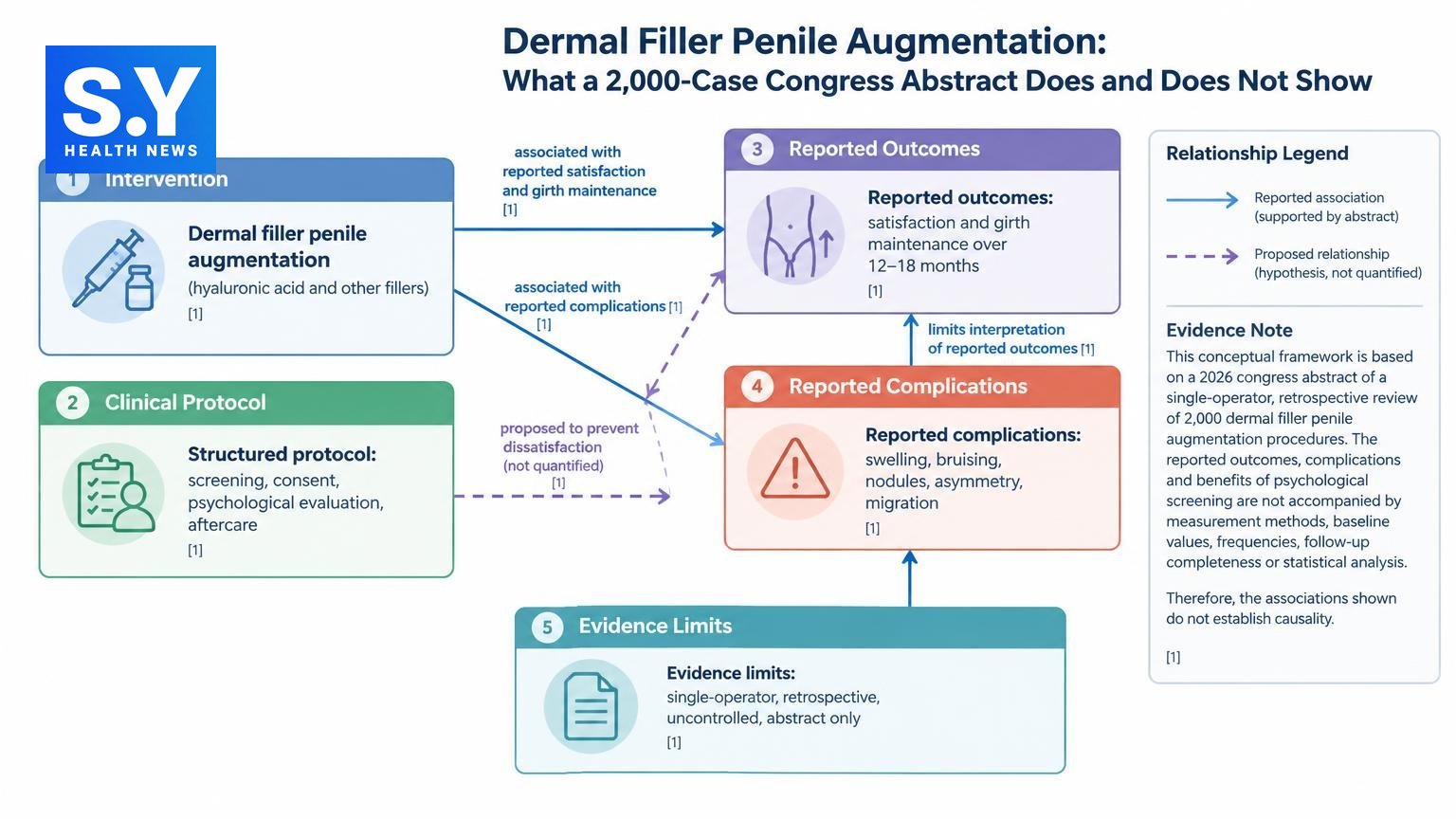
Conceptual framework: Conceptual framework of the reviewed congress abstract. Filler augmentation delivered under a structured protocol is linked to reported satisfaction and girth maintenance over 12–18 months and to reported complications, while single-operator retrospective design and abstract-only reporting constrain interpretation. Arrows show reported associations and one proposed, untested relationship; this is not a causal model.
Academic References & Evidence
- Sherif EL WAKIL. Penis augmentation: a focused review on dermal filler technique.
SANYUN Science Center explains published research on men's reproductive and sexual health, connecting scientific evidence with everyday questions while making sources and limitations clear.
Disclaimer: This article is for scientific education and research communication only. It does not provide medical advice, diagnosis, or individualized treatment recommendations, and does not endorse any medication, supplement, device, penile enlargement procedure, or other intervention. Decisions about sexual and reproductive health should be made in consultation with a qualified healthcare professional. Do not delay seeking professional care because of information in this article.
Original Content & Copyright Notice
- This article is prepared for SANYUN Science Center, drawing on published research and publicly available academic literature on men’s sexual and reproductive health. Its editorial explanations and presentation are developed for this platform.
- Copyright in the original editorial content, selection, and arrangement is reserved by SANYUN Science Center to the extent protected by applicable law. Referenced research, quotations, and third-party materials remain subject to the rights of their respective owners. This notice does not claim ownership of scientific facts or third-party research.
- Except where permitted by applicable law or an applicable license, prior written permission is required to reproduce, republish, translate, adapt, redistribute, or commercially reuse protected content. Attribution alone does not grant permission for such reuse.
- For permitted quotation or authorized reuse, clearly identify the source and retain a link to the original article.
- Source: SANYUN Science Center
- Original URL: Retain the original article URL on science.san-yun.com.
- Copyright Holder: SANYUN Science Center, for its own protected editorial content.
- Quotation, excerpts, or authorized reuse must not distort the scientific meaning, omit material limitations or disclaimers, or imply unverified medical claims, product efficacy, or endorsement by SANYUN Science Center.



