




Category: Clinical Insights
Core Research Direction: Whether measuring hormones beyond total testosterone (DHT, SHBG, free testosterone) improves prediction of mortality and cardiovascular events in aging men compared with total testosterone alone, and what study-design limits constrain causal interpretation
Search Intent: Does total testosterone alone reliably flag mortality and cardiovascular risk in aging men, or do DHT, SHBG and free testosterone add prognostic information that changes clinical assessment?
Platform: SANYUN Science Center
Evidence reviewed through: 2026-11-14
Executive Summary
Whether a single total testosterone measurement is an adequate hormonal marker of mortality and cardiovascular risk in aging men has become a live question. A brief reporting on an epidemiological analysis of over 255,000 person-years of mortality data states that total testosterone was relevant but not the strongest predictor of mortality among five hormonal markers measured in aging men.[1]
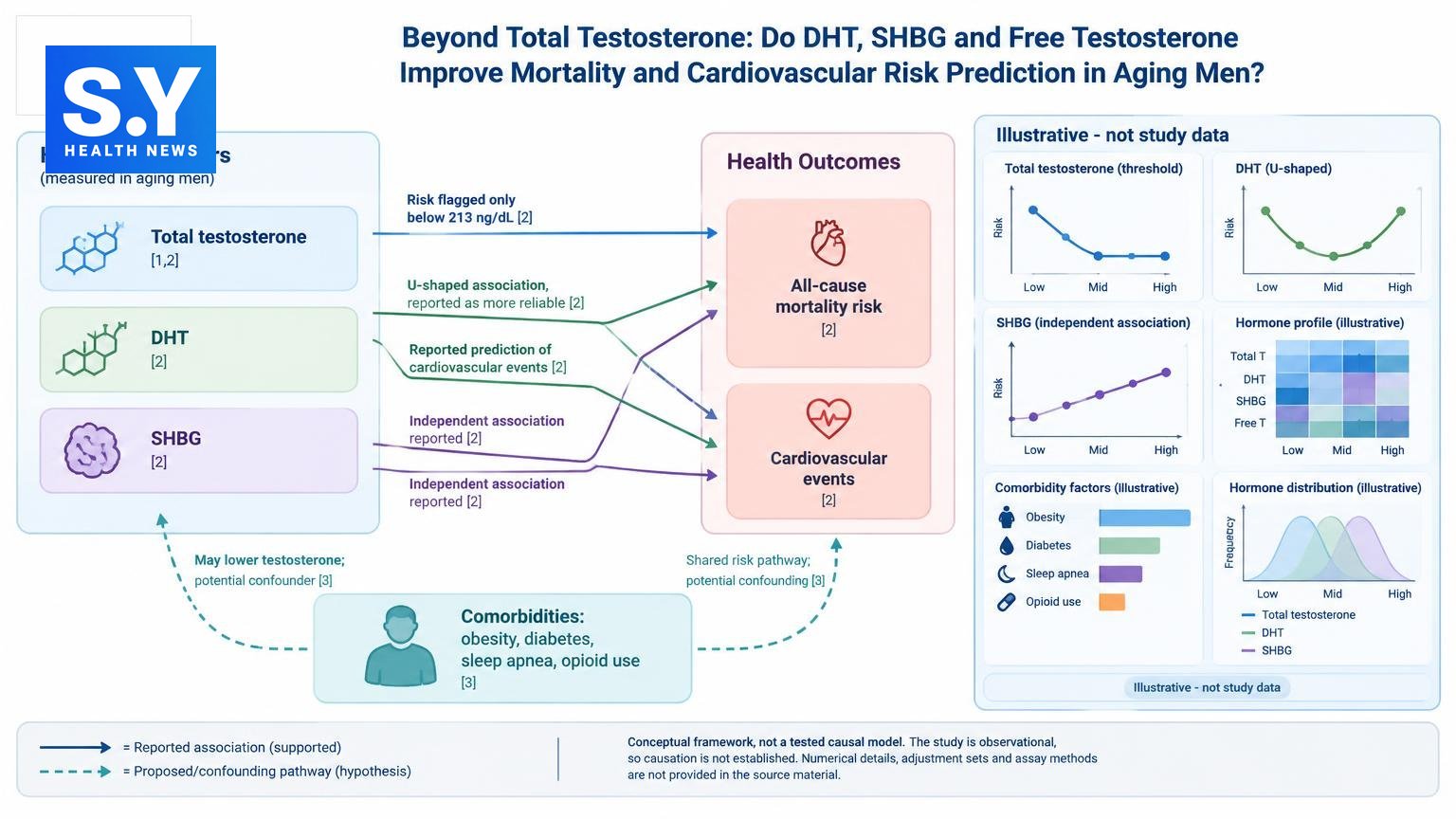
A companion brief describing a pooled analysis of nine prospective cohorts reports that DHT and SHBG consistently predicted mortality and cardiovascular events more reliably than total testosterone alone. In that account, total testosterone flagged risk only at extremely low levels, below 213 ng/dL, while DHT showed a U-shaped risk pattern and SHBG was independently associated with both all-cause and cardiovascular mortality.[2]
These are secondary news summaries, not the primary papers, and they report no hazard ratios, confidence intervals, adjustment sets or absolute risks. The authors of the underlying work are described as concluding that the observational design cannot establish causation. The practical message is therefore narrow: the hypothesis that broader hormone profiling adds prognostic information is plausible and worth rigorous testing, but current evidence does not justify replacing or expanding routine panels on prognostic grounds alone.
Why This Matters
Testosterone is often framed as a broad marker of men's health. A conference presentation summarized in a urology education outlet reviewed associations between low testosterone and cardiovascular disease, increased mortality, osteoporosis, diabetes, obesity, depression, prostate cancer and infertility. That framing is associational, and the same presentation argued against the assumption that testosterone levels inevitably decline with aging, pointing instead to comorbidities such as obesity, diabetes, sleep apnea and opioid use as contributors to deficiency.[3]
If a single hormone captures only part of the relevant biology, clinicians face a genuine question about which measurements earn their place. The stakes are practical: DHT and SHBG are rarely included in routine blood panels, so patients and providers may lack the data needed for risk stratification if those markers truly carry independent prognostic weight.
The question also matters because testosterone measurement is entangled with treatment decisions. The conference summary discusses the TRAVERSE trial and subsequent FDA labeling changes, distinguishing cardiovascular risk associated with testosterone deficiency from the safety of testosterone therapy. Prognostic marker research and therapeutic safety research answer different questions, and conflating them is a common source of overinterpretation.
Biological and Clinical Mechanism
Total testosterone measures circulating hormone bound to proteins plus the small unbound fraction. SHBG is the principal binding protein, so its concentration influences how much testosterone remains free and available to tissue. Because SHBG changes with age, adiposity, insulin resistance, liver function and other states, it can act as a marker of metabolic and general health as much as a determinant of androgen exposure. This is one plausible reason SHBG might associate with mortality independently of total testosterone: it may partly index the very comorbidities that drive risk.
The term free testosterone refers to the fraction not bound to SHBG or albumin, and it is often described as the biologically active portion. Consumer-facing commentary cited in the packet argues that free testosterone is a better correlate of symptoms than total testosterone and should be measured routinely, especially when total values fall in a borderline range.[4]
That commentary is expert opinion published in a commercial blog, not primary outcome data, and it concerns symptom correlation rather than mortality prediction. It is useful for explaining why patients and clinicians care about free hormone measurement; it should not be read as evidence that free testosterone predicts death or cardiovascular events better than total testosterone, because the packet contains no such comparative outcome data for free testosterone.
DHT is a potent androgen produced from testosterone, and the reported U-shaped pattern is biologically interesting because it implies risk at both low and high exposure rather than a simple linear gradient. U-shaped patterns can also arise from reverse causation or from confounding by frailty, weight change or medication use, which is why shape alone cannot identify a causal pathway.
What the Evidence Shows
| Marker or variable | Reported finding | Pattern reported | Key interpretive limit |
|---|---|---|---|
| Total testosterone | Flagged mortality risk only at extremely low levels, below 213 ng/dL | Threshold-like, risk confined to the low extreme | Threshold value reported in a secondary brief; no effect size or adjustment detail |
| DHT | Predicted mortality and cardiovascular events more reliably than total testosterone alone | U-shaped risk pattern | Observational; U-shape may reflect confounding or reverse causation |
| SHBG | Independently associated with all-cause and cardiovascular mortality | Independent association reported | Independence depends on the adjustment model, which the brief does not describe |
| Number of cohorts pooled | Nine prospective cohorts | Pooled analysis | Pooling heterogeneous cohorts can hide differences in assay and population |
| Scale of mortality data | Nearly 256,000 person-years; over 255,000 person-years in a companion brief | Large epidemiological dataset | Person-years are not participants; sample size is not stated |
| Hormonal markers measured | Five distinct markers in aging men | Multiparameter profiling | Only DHT, SHBG and total testosterone are named in the packet |
The central reported result is a ranking: across nine prospective cohorts, DHT and SHBG predicted mortality and cardiovascular events more reliably than total testosterone alone. The companion brief frames the same body of work as showing that total testosterone, while relevant, was not the strongest predictor of mortality among five markers measured in aging men. Both statements point in the same direction but neither supplies the quantitative comparison that would let a reader judge how much better the alternative markers performed.
The threshold finding deserves careful reading. A total testosterone value of 213 ng/dL is described as the point below which risk was flagged. That is a low value by most conventional reference ranges, and it implies that men in the middle of the distribution may look reassuring on total testosterone while carrying risk that other markers capture. However, the packet does not state whether 213 ng/dL was predefined, data-derived or specific to a particular assay, and testosterone assays and reference ranges vary between laboratories.
The SHBG result is reported as an independent association with both all-cause and cardiovascular mortality. Independence is a statistical statement conditional on the covariates included in a model; without knowing which covariates were adjusted for, a reader cannot tell whether SHBG is capturing androgen biology, metabolic dysfunction, liver disease, thyroid status or general frailty. The packet also does not report whether free testosterone was among the five markers or how it performed, which is a notable gap given how often free testosterone is discussed clinically.
Interpretation and Limitations
The most important limitation is design. The source material explicitly states that the study is observational and cannot establish causation. An observational association between a hormone and death may reflect the hormone influencing disease, disease influencing the hormone, or a third factor influencing both. Weight loss, acute illness, inflammation, opioid use and sleep apnea can all alter sex hormone concentrations, and each is also linked to mortality.
A second limitation is the layer of reporting. The available sources are news briefs and a conference summary rather than the primary papers, and they provide no hazard ratios, confidence intervals, follow-up duration, participant counts by cohort, assay methods or competing-risk handling. The characterization of the analysis as the most rigorous evidence to date on sex hormone–mortality associations is the news brief's assessment and has not been independently appraised within this review.
A third limitation concerns clinical action. Even a genuine independent association does not automatically justify routine testing. Prognostic value must be judged against whether the added measurement changes management and improves outcomes, and against cost, access and the risk of downstream testing triggered by abnormal results. The packet notes that DHT and SHBG are rarely ordered routinely, which means any shift toward broader profiling would be a substantial practice change rather than an incremental one.
Finally, the broader testosterone literature in the packet is largely secondary and associational, including claims about target ranges and cutoffs. One consumer article asserts that the 300 ng/dL threshold lacks scientific basis and that AUA guidance moved toward a mid-range target of roughly 450–600 ng/dL. These are unverified characterizations in a commercial article and should be treated as context for why thresholds are contested, not as established guideline facts or study results.
Clinical and Practical Relevance
For clinicians, the reasonable current stance is that total testosterone remains the standard initial measurement in men with symptoms suggesting androgen deficiency, while DHT and SHBG remain research or selected-use measurements. The reported findings raise a hypothesis that a low total testosterone result should prompt evaluation for contributing conditions, consistent with the conference summary's emphasis on obesity, diabetes, sleep apnea and opioid use. That emphasis is compatible with the data without depending on the contested prognostic ranking.
For patients, the practical translation is modest. A normal total testosterone does not by itself prove that hormonal contributors to fatigue, low libido or metabolic risk have been fully characterized, but neither does the available evidence show that ordering DHT and SHBG improves outcomes. Discussions about symptoms, medications, sleep, weight and other conditions remain central.
The packet also contains non-outcome practical points worth separating from the prognostic question. Testosterone replacement is noted to temporarily suppress sperm production, which matters for men considering fertility, and lifestyle factors such as weight, sleep and stress are described as modifiable influences on testosterone. Obesity is characterized as the strongest modifiable risk factor in one commercial commentary, with 5–10% weight loss described as capable of raising levels; that claim is not supported by cited primary data in the packet.
Nothing in the available material supports using these hormone markers as a screening test for cardiovascular disease in asymptomatic men, and nothing supports changing testosterone therapy based on DHT or SHBG values. Those would be extrapolations beyond both the reported associations and the observational design.
Research Outlook
The obvious next steps are methodological rather than promotional. A full primary report would need to show multivariable models with prespecified covariates, assay standardization across cohorts, discrimination metrics such as C-statistic changes and reclassification measures, and calibration. Analyses that separate the contribution of SHBG as a binding protein from its role as a metabolic marker, and that include free testosterone alongside total testosterone and DHT, would directly address the question this review set out to answer.
Causal questions would require different designs: mendelian randomization, within-person repeated measures, or trials in which hormone profiling is used to guide care and patient-relevant outcomes are compared. Until such evidence exists, the finding that DHT and SHBG outperformed total testosterone should be treated as a hypothesis-generating signal, not a new standard of care.
Key Takeaways
- A secondary report of a pooled analysis of nine prospective cohorts states that DHT and SHBG predicted mortality and cardiovascular events more reliably than total testosterone alone in aging men.
- Total testosterone reportedly flagged risk only below 213 ng/dL, while DHT showed a U-shaped pattern and SHBG was independently associated with all-cause and cardiovascular mortality.
- The design is observational and, according to the source material, cannot establish causation; the available reports lack effect sizes and adjustment details.
- DHT and SHBG are rarely part of routine panels, so broader profiling would be a practice change requiring evidence that it improves decisions or outcomes.
- Total testosterone remains the standard initial measurement; the new signal supports research, not routine replacement of current testing.
Questions and Answers
What is the difference between total testosterone, free testosterone, DHT and SHBG?
Total testosterone measures all circulating testosterone, including hormone bound to proteins. Free testosterone is the unbound fraction often described as biologically active. SHBG is the main binding protein and influences how much testosterone stays free. DHT is a more potent androgen made from testosterone. The packet reports outcome associations for total testosterone, DHT and SHBG, but provides no mortality data comparing free testosterone with the others.
Do DHT and SHBG predict mortality better than total testosterone in aging men?
A secondary brief reports that, across nine prospective cohorts, DHT and SHBG consistently predicted mortality and cardiovascular events more reliably than total testosterone alone. Total testosterone reportedly flagged risk only below 213 ng/dL, and DHT showed a U-shaped pattern. However, the reports provide no effect sizes or confidence intervals, so the size of any advantage remains unknown.
How strong is the evidence that SHBG is independently linked to cardiovascular death?
The evidence is observational and secondhand. SHBG is reported as independently associated with all-cause and cardiovascular mortality in a pooled analysis summarized by a news brief, but the adjustment model, effect estimates and assay details are not provided. Independence is statistical and depends on covariates, so confounding by metabolic disease, frailty or other factors cannot be excluded.
Should doctors order DHT and SHBG instead of total testosterone in routine practice?
No. Total testosterone remains the standard initial measurement, and the packet reports no trial showing that adding DHT or SHBG improves clinical decisions or outcomes. DHT and SHBG are rarely part of routine panels, so broader profiling would be a substantial practice change. The reported associations are hypothesis-generating and need confirmation with full multivariable models and discrimination statistics.
What are the main limitations of the sex hormone and mortality cohort analysis?
The design is observational, so associations cannot establish causation. The available sources are news briefs rather than the primary papers and lack hazard ratios, confidence intervals, participant counts, follow-up duration and assay methods. The U-shaped DHT pattern could reflect confounding or reverse causation. The claim that the work is the most rigorous evidence to date is the brief's own assessment, not an independent appraisal.
Does a normal total testosterone level rule out hormonal contributions to poor health in aging men?
Not necessarily, but the evidence does not yet show that extra testing changes outcomes. The pooled analysis reportedly found risk flagged only below 213 ng/dL on total testosterone, implying that mid-range values may miss some risk captured by other markers. However, DHT and SHBG testing has not been shown to improve outcomes, and symptoms and comorbidities still warrant evaluation.
Conceptual framework: Conceptual framework, not a tested causal model. Nodes show the hormonal markers and outcomes discussed in a secondary report of a pooled analysis of nine prospective cohorts of aging men. Solid arrows denote reported associations: total testosterone risk flagged only below 213 ng/dL, DHT showing a U-shaped pattern and SHBG independently associated with all-cause and cardiovascular mortality. Dashed relations are proposed confounding pathways involving obesity, diabetes, sleep apnea and opioid use. The study is observational, so causation is not established.
Academic References & Evidence
- Beyond Testosterone: New Evidence Reshapes Understanding of Male Endocrine Health.
- Beyond Total Testosterone: Why Clinicians Should Measure DHT and SHBG. Annals of Internal Medicine
- Mohit Khera. Testosterone: Best Overall Marker of Men's Health – Testosterone: Best Overall Marker of Men’s Health. Grand Rounds in Urology. 2026
- Rena Malik. Your Testosterone Went From 300 to 500… So Why Do You Still Feel Awful?.
SANYUN Science Center explains published research on men's reproductive and sexual health, connecting scientific evidence with everyday questions while making sources and limitations clear.
Disclaimer: This article is for scientific education and research communication only. It does not provide medical advice, diagnosis, or individualized treatment recommendations, and does not endorse any medication, supplement, device, penile enlargement procedure, or other intervention. Decisions about sexual and reproductive health should be made in consultation with a qualified healthcare professional. Do not delay seeking professional care because of information in this article.
Original Content & Copyright Notice
- This article is prepared for SANYUN Science Center, drawing on published research and publicly available academic literature on men’s sexual and reproductive health. Its editorial explanations and presentation are developed for this platform.
- Copyright in the original editorial content, selection, and arrangement is reserved by SANYUN Science Center to the extent protected by applicable law. Referenced research, quotations, and third-party materials remain subject to the rights of their respective owners. This notice does not claim ownership of scientific facts or third-party research.
- Except where permitted by applicable law or an applicable license, prior written permission is required to reproduce, republish, translate, adapt, redistribute, or commercially reuse protected content. Attribution alone does not grant permission for such reuse.
- For permitted quotation or authorized reuse, clearly identify the source and retain a link to the original article.
- Source: SANYUN Science Center
- Original URL: Retain the original article URL on science.san-yun.com.
- Copyright Holder: SANYUN Science Center, for its own protected editorial content.
- Quotation, excerpts, or authorized reuse must not distort the scientific meaning, omit material limitations or disclaimers, or imply unverified medical claims, product efficacy, or endorsement by SANYUN Science Center.



