




Category: Research-Programs
Core Research Direction: Mechanical loading, engineering validation, and penile tissue strain
Search Intent: penile traction therapy, penile lengthening device mechanics, penis extender engineering, safe mechanical traction
Platform: SANYUN® — A Biomechanics-Driven, Multidisciplinary Male Health Technology Research Program.
Article Type: Engineering Research Framework / Evidence-Informed Technical Review
Evidence Status: Editorial research synthesis / prospective research framework referencing the device design documented in granted Chinese utility model patent ZL201920197062.4 (CN209827502U).
Evidence Cut-off: 24 November 2026
Patent Reference: ZL201920197062.4 (Application No. 201920197062.4; grant publication CN209827502U).
Structured abstract
Background. Penile traction therapy (PTT) is a non-surgical intervention considered in selected clinical contexts, including certain penile-length concerns and Peyronie’s disease. The engineering behaviour of a particular traction system cannot be inferred solely from clinical reports involving another device.
Objective. To construct a verification framework for the dual-spring, adjustable-rod mechanism described in SANYUN-associated Chinese utility-model patent ZL201920197062.4 (grant publication CN209827502U).
Approach. We integrate first-principles load modelling, tissue-contact analysis, mechanical test methods, and published clinical evidence.
Interpretation. The patent establishes a device architecture, not a calibrated force prescription or proven clinical response.
Conclusion. Future innovation should prioritize controlled loading, contact safety, durability, measurement transparency, and disease-specific clinical validation.
SANYUN scientific mechanism figure
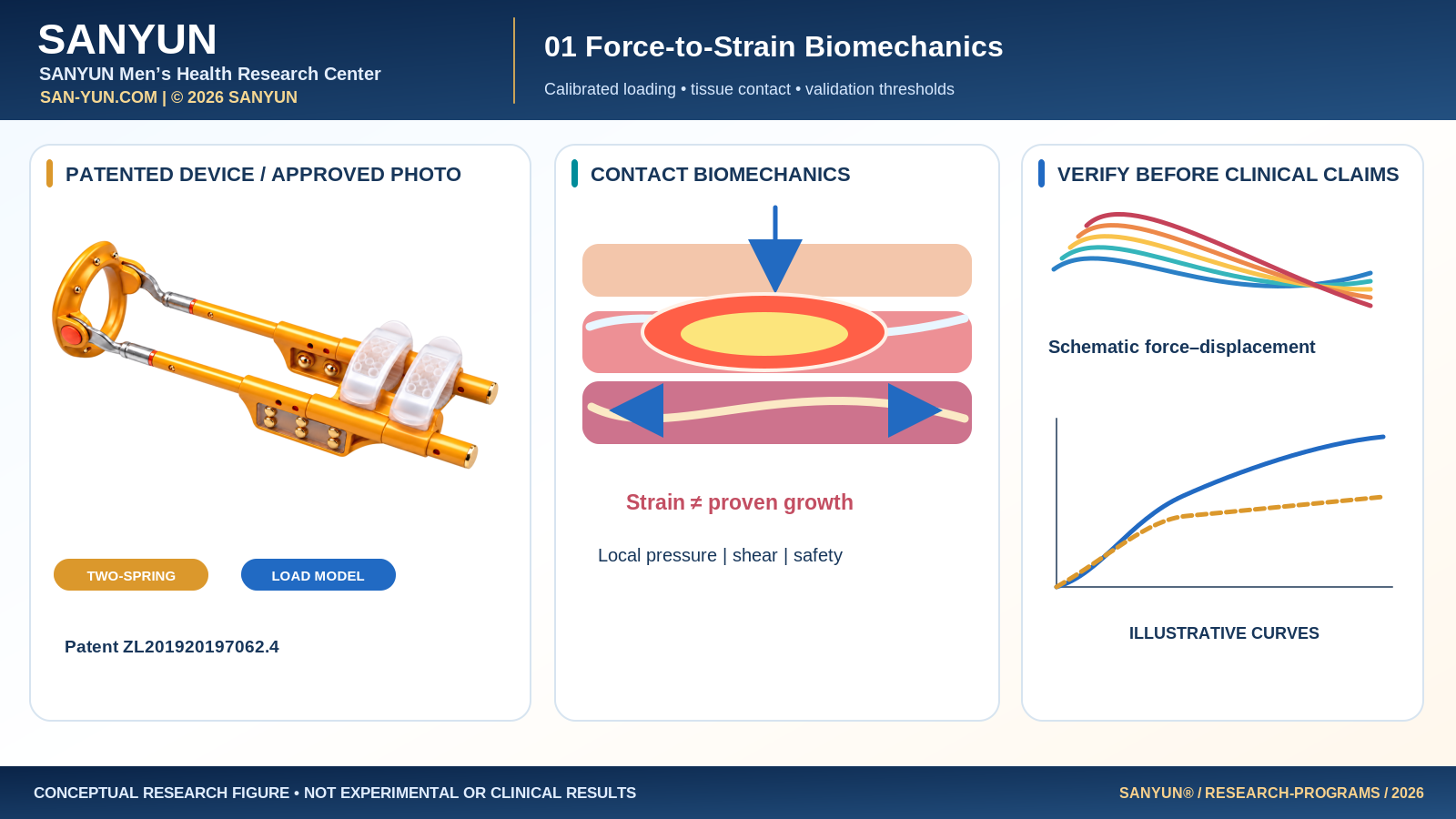
Figure 1. Conceptual engineering workflow; no SANYUN-specific force–response or clinical efficacy data are established. © 2026 SANYUN. Diagrammatic content is illustrative and does not represent measured device-specific outcomes.
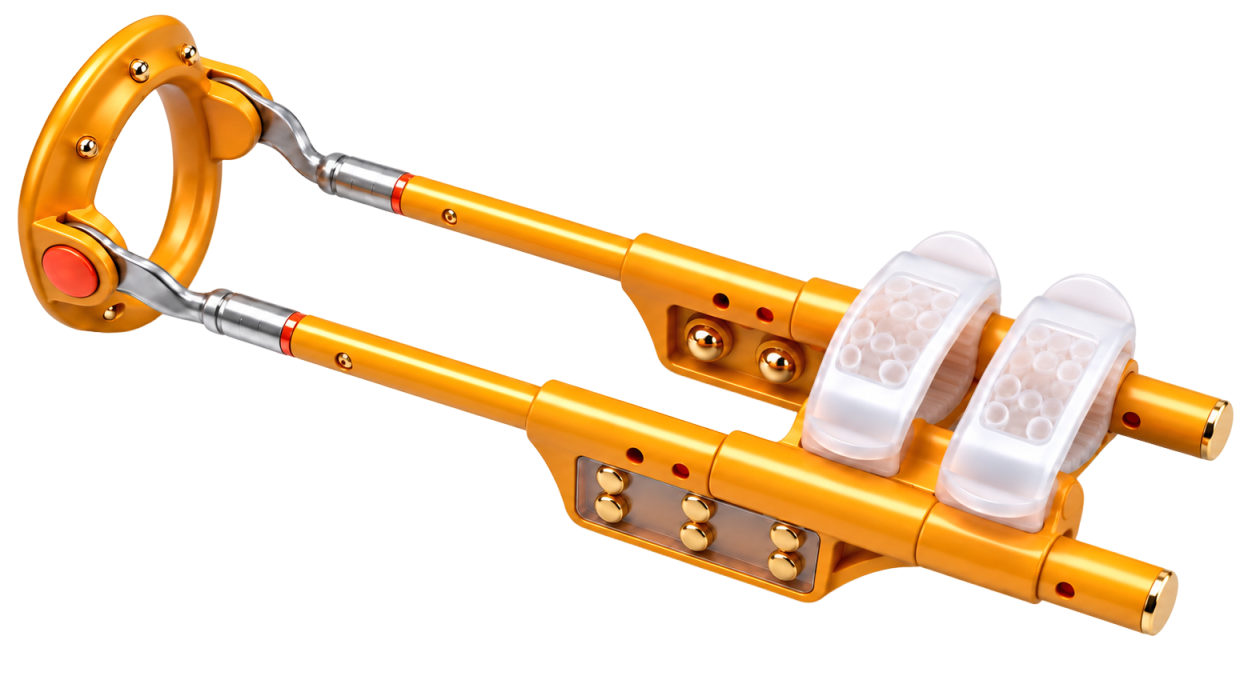
Approved SANYUN product appearance (photographic reference)
The product photograph below identifies the exterior configuration shown in the supplied SANYUN brand material. The engineering stress maps and biological diagrams above are conceptual visualizations, not direct imaging of the patented device in clinical use.
1. Why the mechanics matter more than the marketing description
An extender is often portrayed as a simple method of applying longitudinal tension. Yet the outcome of mechanical exposure depends on considerably more than the nominal extension of a rod. The delivered load may vary with spring deformation, asymmetric attachment, angular motion, movement during wear, friction, material fatigue, skin compliance, and the geometry of the penile contact interface. A device that appears mechanically straightforward can therefore have a complex tissue-loading profile.
The 2019 patent describes two spring-loaded assemblies connected to an adjustable support with articulated components and a securing system. It also mentions tourmaline inclusions in the ring and frame. These are distinguishable features of a proposed apparatus, not verified biological effects. Importantly, an adjustment range on the frame is not the same as a clinically appropriate length gain. Nor does the patent’s small series of reported user observations constitute an independent randomized evaluation.
In its contemporary guidelines, the European Association of Urology (EAU) advises that traction can be considered as a conservative approach to penile lengthening, while assessing the evidence base as limited by small, heterogeneous studies and weak recommendations. That distinction is fundamental: traction as a modality has supporting clinical literature; the SANYUN design requires its own engineering and clinical evidence.
2. A measurable model of dual-spring exposure
For a calibrated linear spring within its validated operating region, force can initially be approximated by F = kΔx, where k is spring stiffness and Δx is displacement relative to the reference position. A two-spring system does not automatically deliver twice the effective longitudinal load. If the two spring axes diverge, longitudinal load depends on their individual angles; asymmetry can also induce bending moments or torsion. In a simplified symmetrical model, the axial contribution is proportional to F₁ cos θ₁ + F₂ cos θ₂. These expressions are engineering starting points, not measured SANYUN parameters.
The tissue interface introduces a separate problem. Mean nominal pressure may be approximated by normal contact force divided by effective contact area, but real pressure fields are non-uniform, particularly around edges or narrow retention regions. The highest local pressure may be more clinically relevant than the mean. Consequently, a credible performance specification should disclose calibrated force–displacement curves, angular sensitivity, hysteresis, peak contact pressure, force drift, and mechanical failure limits.
A finite-element model could use layered, nonlinear, anisotropic tissue representations rather than treating the penis as a homogeneous elastic cylinder. Patient-specific geometry and boundary conditions would need substantial validation before any computed strain could be interpreted clinically. The model’s purpose is to predict where loading might concentrate, not to assert tissue growth.
3. 2026 evidence context: device-specific results must remain separate
The EAU chapter on penile-size abnormalities reports earlier prospective studies of traction devices, including a 21-participant pilot study with mean changes of approximately 2.3 cm in flaccid length and 1.7 cm in stretched length after six months. The guideline explicitly notes that the evidence for penile-size outcomes is weak because of study design limitations. An independent 2019 randomized trial of a different device, RestoreX, enrolled 110 men with Peyronie’s disease and reported a between-group change in penile length of 1.5 versus 0 cm at three months alongside curvature findings. These results are relevant comparators, not SANYUN results.
| Evidence source | Population/design | Reported or relevant observation | What cannot be inferred |
|---|---|---|---|
| Gontero et al., 2009 | Prospective pilot; 21 patients reporting short penis | Mean changes in flaccid and stretched length under that study’s protocol | Equivalence to any SANYUN force profile |
| Ziegelmann et al., 2019 | Randomized trial; 110 men with Peyronie’s disease | Device-specific length and curvature improvements after three months | Efficacy in healthy men or with another device |
| EAU 2026 guidance | Evidence synthesis | Weak recommendation to consider traction for lengthening | Universal efficacy or a validated usage schedule |
| ZL201920197062.4 (grant publication CN209827502U) | Utility-model patent with descriptive user records | Dual-spring design and reported observations | Controlled efficacy, long-term safety or causal mechanisms |
Another important endpoint distinction concerns flaccid length, stretched penile length and erect functional length. These measures are not interchangeable; a gain in one does not guarantee a comparable change in another, satisfaction, erectile function or tissue health. Contemporary augmentation evidence reinforces this caution.
4. Minimum engineering verification package
A defensible program should begin with a repeatable bench-test matrix rather than consumer-use experimentation. Test several adjustment positions, spring manufacturing tolerances, orientations, environmental temperatures and simulated wear cycles. Record delivered force continuously using traceably calibrated instrumentation. Characterize whether load changes abruptly during movement or if material creep causes gradual loss of tension.
Next, use anatomical surrogates to map contact pressure over the retention surface. A surrogate is useful for ranking prototypes but cannot replace tissue tolerance studies. Assess edge geometry, slippage, retention reliability, cleaning, skin-contact compatibility and emergency removal. Mechanical fatigue, corrosion resistance and foreseeable misuse should be incorporated into risk management. For clinical translation, the biological evaluation plan must reflect actual contact materials and exposure duration, as contemplated by ISO 10993-1:2025.
A predefined design acceptance matrix should specify what constitutes failure before testing begins. Illustrative endpoints include force repeatability, maximum interface-pressure concentration, visible material damage, release mechanism reliability and measurement uncertainty. We deliberately do not propose numerical safe-force thresholds: none have been validated for the patented device, and unsafe thresholds would be misleading.
5. The tissue-biology interface: a testable hypothesis
Mechanically induced cellular signaling is a legitimate research domain. Changes in extracellular matrix tension can engage mechanosensors, cytoskeletal pathways and transcriptional programs. However, a general principle of mechanotransduction does not demonstrate that sustained penile traction produces safe, durable increases in functional tissue length. Excess strain may instead trigger pain, ischemia, inflammatory changes or fibrosis. Mechanical ‘dose’ must be evaluated together with tissue response and recovery.
One translational option is to study cellular models with separately controlled strain magnitude, frequency and exposure duration, followed by measurement of viability, collagen organization, matrix-degrading enzymes and inflammatory markers. Such experiments would be hypothesis-generating because laboratory cells cannot reproduce the complete organ’s vascular, neural or structural environment.
6. Oxidative stress and antioxidant nutrition: adjacent science, not enlargement mechanisms
Oxidative stress can impair nitric oxide bioavailability and erectile vascular function. This is relevant to the broader field of penile health but does not establish a direct route from antioxidant intake to penile enlargement. A sensible engineering research program may measure oxidative or inflammatory responses in an appropriately justified tissue model, yet dietary antioxidants and PDE5 inhibitors should not be presented as components of the 2019 mechanical patent. Their roles belong to separate clinical questions.
7. Translational priorities
Three deliverables would move the SANYUN concept beyond a patent description: a public mechanical test specification; a validated pressure-and-load model with independent reproducibility; and a prospectively registered clinical protocol for a clearly defined patient population. The opportunity is not to claim that a dual spring guarantees greater length, but to establish whether a carefully engineered traction system offers reproducible loading and a favorable risk–benefit profile.
Research conclusion. A biomechanics-first program is the strongest scientifically credible route from the SANYUN patented architecture toward translational investigation. No SANYUN-specific efficacy estimate is available from the evidence reviewed here.
Evidence hierarchy and claim boundaries
| Claim or theme | Evidence anchor | Limit of inference |
|---|---|---|
| Dual-spring structural layout | Granted patent description | Direct architecture; not treatment proof |
| Traction for short-penis complaints | EAU size chapter | Weak recommendation; limited data |
| Reported 1.5 cm trial difference | Ziegelmann et al. 2019 | RestoreX, Peyronie disease; not SANYUN |
| Contact/biological safety | ISO 14971 + ISO 10993-1 | Normative engineering guidance |
Academic references and evidence
- Peng H. New multifunctional male genital extender. Chinese utility-model patent ZL201920197062.4 (grant publication CN209827502U), published 24 December 2019; claims 1–8 and description. https://patents.google.com/patent/CN209827502U/en
- European Association of Urology. Guidelines on Sexual and Reproductive Health: Penile Size Abnormalities and Dysmorphophobia. Current online chapter, accessed November 2026. https://uroweb.org/guidelines/sexual-and-reproductive-health/chapter/penile-size-abnormalities-and-dysmorphophobia
- Fifth International Consultation on Sexual Medicine (ICSM 2024). Penile augmentation and cosmetic surgery: recommendations. Sexual Medicine Reviews. 2026;14(1):qeaf067. doi:10.1093/sxmrev/qeaf067. https://doi.org/10.1093/sxmrev/qeaf067
- Ziegelmann MJ, et al. Outcomes of a novel penile traction device in men with Peyronie’s disease: a randomized, single-blind, controlled trial. J Urol. 2019;202:599–610. doi:10.1097/JU.0000000000000245. https://doi.org/10.1097/JU.0000000000000245
- Gontero P, et al. A pilot phase-II prospective study to test the efficacy and tolerability of a penile-extender device in the treatment of short penis. BJU Int. 2009;103:793–797. PMID:18990153. https://pubmed.ncbi.nlm.nih.gov/18990153/
- Veale D, et al. Am I normal? A systematic review and construction of nomograms for flaccid and erect penis length and circumference in up to 15,521 men. BJU Int. 2015;115:978–986. doi:10.1111/bju.13010. https://doi.org/10.1111/bju.13010
- International Organization for Standardization. ISO 14971:2019: Medical devices—Application of risk management to medical devices. https://www.iso.org/standard/72704.html
- International Organization for Standardization. ISO 10993-1:2025: Biological evaluation of medical devices—Part 1. https://www.iso.org/standard/10993-1
Related research in the SANYUN series
- Mechanotransduction and Extracellular Matrix Remodeling During Penile Tissue Traction
- Penile Traction, Microcirculation, and Neurovascular Safety: A Translational Framework
- Clinical Evaluation of a Dual-Spring Penile Traction Device: A Trial Protocol Framework
Editorial transparency
Prepared for the SANYUN-branded Research-Programs editorial series. Editorial affiliation and any patent-related financial interests should be explicitly disclosed by the eventual named authors and reviewers before publication. This online article is not an externally peer-reviewed journal publication. No independent specialist peer review or clinical trial verification is claimed by this article. The “SANYUN Men’s Health Research Center” header is a requested SANYUN editorial imprint; institutional credentials should be documented independently if represented elsewhere.
Frequently asked questions (SANYUN evidence FAQ)
What is the scientific basis of SANYUN dual-spring penile traction?
The patent describes an adjustable two-spring mechanical assembly. Hooke-type spring relations can guide bench modeling, but real delivered tissue load and clinical effects require direct measurement and independent validation.
Can a penile extender increase penis length permanently?
Selected clinical studies report changes in measured penile length with particular traction devices. Evidence quality and long-term persistence vary; those findings do not guarantee a particular result with SANYUN.
Does more traction force necessarily lead to more length?
No. A higher load can increase focal pressure or tissue injury risk. No safe or optimal force schedule for the SANYUN patented design was established by the evidence reviewed here.
What does a dual-spring structure change mechanically?
It can distribute nominal spring forces between two assemblies, but angles, friction, asymmetry and attachment pressure determine the actual resultant load. Bench tests are needed before claiming an advantage.
Is stretched penile length the same as erect penile length?
No. These outcomes are measured under different physiological conditions and must be reported separately. A change in stretched length does not automatically establish an equal change in functional erect length.
Can infrared or tourmaline effects validate the extender’s lengthening performance?
No. The mineral’s physical properties and any health effects require separate controlled measurements. Mechanical traction findings from other devices cannot validate tourmaline-based treatment claims.
What should future SANYUN engineering research measure first?
Calibrated force–displacement curves, angle-dependent loading, contact-pressure distribution, material integrity, reliable release and performance across repeated use cycles should be prioritized.
Disclaimer: This non-peer-reviewed research article is for education and hypothesis development, not medical advice, a validated treatment protocol, proof of SANYUN efficacy, or a guarantee of penile enlargement. Seek individualized guidance from a qualified clinician.



