




Category: Clinical Insights
Core Research Direction: What changed in the 2025–2026 EAU clinical guidelines for male sexual and reproductive health (hypogonadism, erectile dysfunction, ejaculation disorders, Peyronie's disease, priapism), and what guidance they give on diagnosis, treatment and limitations of evidence
Search Intent: What did the 2025–2026 EAU guidelines update recommend for diagnosing and treating hypogonadism, ejaculation disorders, Peyronie's disease and priapism, and how strong is the supporting evidence?
Platform: SANYUN Science Center
Evidence reviewed through: 2026-11-10
Executive Summary
The 2026 European Association of Urology (EAU) document on sexual and reproductive health is explicitly a limited update of the 2025 publication, which itself was first issued in 2020. A structured literature assessment fed 116 updated studies into four sections: hypogonadism, disorders of ejaculation, penile curvature and priapism.[1][2]
The changes are uneven. Hypogonadism received revised supporting text throughout, including prostate cancer guidance and safety monitoring; the ejaculation disorders section was fully rewritten; and Peyronie's disease (penile curvature) saw major revisions to epidemiology, conservative, oral, other and surgical treatment text. Ischaemic priapism diagnosis, second-line surgery and special-situation management were also substantially revised, and the erectile dysfunction treatment recommendations were reorganised for logical flow.[3]
Several recommendation changes matter clinically: morning fasting total testosterone measurement between 07:00 and 10:00 with a reliable assay is a strong recommendation; testosterone therapy must not be used to treat male infertility or in men wishing to be fathers; intralesional platelet-rich plasma for Peyronie's disease carries a strong counselling recommendation that data remain limited; and peno-scrotal decompression may replace distal shunting as a first-line option for ischaemic priapism under a weak recommendation.
Why This Matters
Guidelines shape how clinicians investigate low libido, infertility, curvature and priapism, and how they counsel men about risks. The EAU panel is an international multidisciplinary group of urologists and endocrinologists, and its recommendations are graded by weighing desirable against undesirable consequences, evidence certainty, and patient values and preferences. That grading system is why a strong recommendation can coexist with sparse trial data, and why weak recommendations often flag genuine uncertainty rather than weak clinical importance.[4]
The 2026 document is not a new trial or a systematic review performed for this article. It is a guideline revision whose added studies are counted, not summarised quantitatively in the public summary of changes. Readers should therefore treat section-level revisions as signals of where the panel saw new evidence or rethought its framing, not as proof that practice should change for every patient.
How the Evidence Base Was Assembled
The 2025 male infertility update, a closely related EAU publication, described a structured assessment searching Medline, EMBASE and the Cochrane Libraries, with recommendations prioritising clinically important care decisions. A secondary commentary on the 2025 male sexual health update reported that the panel reviewed research published between 2021 and 2024 on hypogonadism, erectile dysfunction, premature ejaculation and Peyronie's disease, focusing on diagnosis, treatment and follow-up.[5]
Two caveats follow. First, the 2021–2024 search window comes from a secondary commentary, not from the primary guideline text available here, and it describes the 2025 update rather than the 2026 limited revision. Second, the guideline itself stresses that recommendations present the best available evidence but cannot guarantee the best outcome, cannot replace clinical expertise, and are not mandates or a legal standard of care.
| Guideline section | What the 2026 update changed | Recommendation strength where stated |
|---|---|---|
| Hypogonadism | Supporting text revised throughout; diagnostic evaluation and screening for late-onset hypogonadism, testosterone therapy outcome, and safety and monitoring recommendations updated; prostate cancer subsection significantly revised | Morning fasting total testosterone 07:00–10:00 with reliable assay: strong; avoid testosterone for infertility or men wishing to father children: strong; post-surgery prostate cancer restrictions: weak |
| Disorders of ejaculation | Supporting text and references fully updated and revised; the podcast summary notes removal of ineffective treatments and limited high-quality evidence for treatment options | Not specified in the available summary |
| Penile curvature (Peyronie's disease) | Epidemiology, conservative treatment, oral treatment, other treatments and surgical treatment significantly revised; hyaluronic acid introduced as a new option in the podcast summary | Platelet-rich plasma counselling: strong; surgery only when stable and intercourse compromised: strong |
| Priapism | Ischaemic priapism, second-line surgical management and priapism in special situations significantly revised | Corporal blood gas analysis to distinguish ischaemic from non-ischaemic priapism: strong; peno-scrotal decompression as first-line alternative to distal shunting: weak |
| Erectile dysfunction | Recommendations in the treatment summary reorganised for logical flow; no substantive new recommendation highlighted in the summary of changes | Not specified in the available summary |
Hypogonadism: Measurement, Causes and Prostate Cancer Safety
Diagnosis is where the update is most concrete. The guideline strongly recommends measuring total testosterone in the morning, between 07:00 and 10:00 hours, in the fasting state, using a reliable laboratory assay. The accompanying discussion emphasises proper testosterone measurement and the need to distinguish functional from organic causes — a distinction with practical consequences, because functional causes may be reversible and organic causes generally require different management.
For treatment, the strongest new safety signal concerns reproductive plans: testosterone therapy should not be used to treat male infertility or in men wishing to become fathers (strong recommendation). This is a dosing and counselling issue as much as a safety one, since exogenous testosterone suppresses the reproductive axis — a mechanism consistent with, though not spelled out in, the recommendation text.
The prostate cancer subsection was significantly revised, and two recommendations were relocated there because their framework aligned more directly with prostate cancer management. For men after surgery, treatment is restricted to those at low risk of recurrence, beginning after at least one year of follow-up with prostate-specific antigen below 0.01 ng/mL and no evidence of recurrence — a weak recommendation. Men on active surveillance or treated with non-surgical curative intent should be advised that testosterone therapy safety data are unclear, also weak. In prostate-cancer-naïve men, a significant rise or increase in PSA velocity or total PSA should prompt consideration of further diagnostic testing, a strong recommendation, although the excerpt does not numerically define what counts as a significant rise.
Ejaculation Disorders: A Full Rewrite With Thin Evidence
The disorders of ejaculation section received a full update of supporting text and references. The public podcast summary describes removal of ineffective treatments and continued difficulty with limited high-quality evidence for ejaculation disorder treatment options, which places this section among the clearest evidence gaps in the whole document.
The 2025 companion guideline used the International Society for Sexual Medicine definition of premature ejaculation and required subtyping — primary versus secondary, absolute versus relative, ante portas versus intramoenia, and organic, psycho-emotional, lifestyle-linked or mixed aetiology — before treatment planning. As summarised in secondary commentary, pharmacotherapy is considered first-line for primary or lifelong premature ejaculation, whereas secondary or acquired cases should first target the underlying cause. That summary is commentary, not the 2026 text itself, so the subtyping framework should be read as continuity of approach rather than as a newly demonstrated treatment effect.
Penile Curvature: Where Conservative Advice Was Rewritten
Peyronie's disease revisions span epidemiology, conservative management, oral therapy, other treatments and surgery. The podcast summary describes updated conservative management strategies, introduction of new options such as hyaluronic acid, and removal of ineffective treatments — a combined message that the panel is both opening and closing doors in a field with few well-evidenced therapies.
Two recommendations stand out. Patients should be fully counselled that data on intralesional platelet-rich plasma, alone or combined with oral treatment, for reducing pain or penile curvature remain limited (strong recommendation) — strong because the counselling obligation is clear, not because the therapy is proven. Surgery should be performed only when disease is stable and sexual intercourse is compromised by the deformity (strong recommendation). Secondary commentary adds that baseline assessment should separate acute from stable phases, and that penile prosthesis should be offered when erectile dysfunction coexists.
Priapism: Sharper Triage, Broader First-Line Options
In the emergency setting, analysing blood gas parameters from aspirated corporal blood is essential to distinguish ischaemic from non-ischaemic priapism (strong recommendation). This remains the pivotal branch point: the two conditions differ in urgency and management, and misclassification can cost time in a time-sensitive presentation.
For ischaemic priapism, peno-scrotal decompression may be used as a first-line option instead of distal shunting, with or without tunnelling. The weak grade is appropriate: it opens an alternative pathway without claiming superiority over established shunting, and it implies that operator experience and patient factors still guide the choice. Second-line surgical management and priapism in special situations were substantially revised, but the public summary does not describe the specific changes.
Interpretation and Limitations
Three limitations shape how this update should be read. First, it is a limited update, so unchanged sections carry forward 2025 conclusions. Second, the available summaries report which sections changed and the strength of selected recommendations, but not the effect sizes, confidence intervals or trial designs behind them; the count of 116 studies indicates breadth, not quality. Third, some of the most clinically interesting detail — hyaluronic acid for Peyronie's disease, removal of ineffective treatments, revised priapism algorithms — comes from an expert podcast summary without quantitative support.
The pattern of strong and weak grades is itself informative. Strong grades cluster around diagnostic discipline (testosterone timing and assay, corporal blood gas), counselling duties (platelet-rich plasma limitations), and clear harm signals (testosterone in men seeking fatherhood, surgery in unstable disease). Weak grades cluster where evidence is genuinely uncertain: testosterone therapy after prostate cancer treatment, and the choice between decompression and shunting. Guidelines cannot replace clinical judgement, and these grades should be read as calibrated expressions of confidence rather than directives.
Research Outlook
The update points to specific evidence gaps rather than generic calls for more research: high-quality trials of testosterone therapy in prostate cancer survivors, better treatment evidence for ejaculation disorders, and comparative data for conservative and surgical Peyronie's disease interventions including platelet-rich plasma. Until those arrive, clinicians should expect periodic limited updates that refine wording, safety thresholds and counselling obligations more than they introduce proven new therapies.
Key Takeaways
- The 2026 EAU document is a limited update of the 2025 guideline, incorporating 116 updated studies across hypogonadism, ejaculation disorders, penile curvature and priapism.
- Total testosterone should be measured in the morning between 07:00 and 10:00 hours, fasting, with a reliable assay (strong recommendation).
- Testosterone therapy should not be used for male infertility or in men wishing to become fathers (strong recommendation).
- After prostate cancer surgery, testosterone therapy is restricted to low-risk men with PSA below 0.01 ng/mL and at least one year of recurrence-free follow-up (weak recommendation).
- For Peyronie's disease, platelet-rich plasma evidence remains limited and surgery is reserved for stable disease with compromised intercourse (both strong recommendations).
- In ischaemic priapism, corporal blood gas analysis is essential for triage (strong), and peno-scrotal decompression may be used first-line instead of distal shunting (weak).
Questions and Answers
What does the 2026 EAU guideline update change for male hypogonadism diagnosis?
The strongest diagnostic recommendation is to measure total testosterone in the morning between 07:00 and 10:00 hours, in the fasting state, using a reliable laboratory assay. The update also emphasises proper testosterone measurement and distinguishing functional from organic causes of hypogonadism. Supporting text throughout the hypogonadism section, including the prostate cancer subsection, was significantly revised.
Can testosterone therapy be used in men with infertility or previous prostate cancer?
For infertility, the guideline strongly recommends against testosterone therapy in men with male infertility or those wishing to become fathers. After prostate cancer surgery, a weak recommendation restricts treatment to low-risk men who have completed at least one year of follow-up with PSA below 0.01 ng/mL and no recurrence. In men on active surveillance or non-surgical curative treatment, safety data are described as unclear.
What did the EAU 2026 update conclude about Peyronie's disease treatment?
Conservative, oral, other and surgical treatment text was significantly revised, with new options such as hyaluronic acid mentioned in the EAU podcast summary. The guideline strongly recommends counselling that intralesional platelet-rich plasma data remain limited, and strongly recommends surgery only when disease is stable and intercourse is compromised by the deformity. Baseline assessment should separate acute from stable phases.
How does the 2026 EAU guideline approach ischaemic priapism diagnosis and first-line treatment?
Blood gas analysis of aspirated corporal blood is strongly recommended in the emergency setting to distinguish ischaemic from non-ischaemic priapism. For ischaemic priapism, a weak recommendation allows peno-scrotal decompression as a first-line option instead of distal shunting, with or without tunnelling. The weak grade reflects genuine uncertainty rather than a claim that one approach is superior.
How strong is the evidence behind the 2026 EAU sexual and reproductive health recommendations?
Strength varies deliberately. Recommendations are graded by weighing benefits against harms, evidence certainty, and patient values and preferences. Strong grades cover testosterone measurement timing, avoiding testosterone in men seeking fatherhood, platelet-rich plasma counselling and priapism blood gas triage. Weak grades cover testosterone after prostate cancer treatment and decompression versus shunting. The panel explicitly notes limited high-quality evidence for ejaculation disorder treatments.
Is the 2026 EAU sexual and reproductive health guideline a completely new document?
No. The 2026 document is a limited update of the 2025 publication, which was first published in 2020. It incorporated 116 updated studies from a structured literature assessment across hypogonadism, ejaculation disorders, penile curvature and priapism, but sections not revised carry forward earlier conclusions. The guideline also states its recommendations are not mandates and cannot replace clinical expertise.
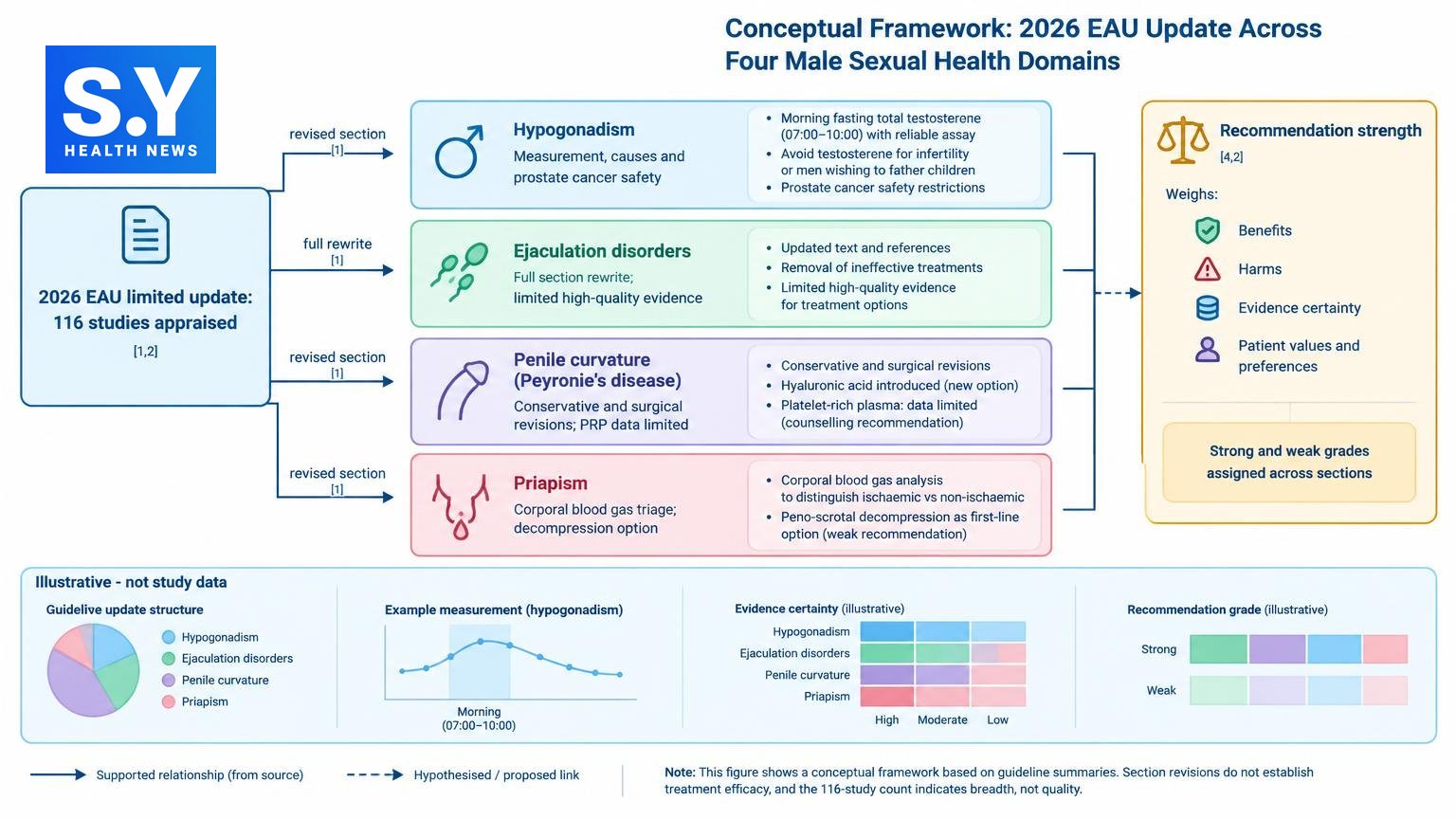
Conceptual framework: Conceptual framework of the 2026 EAU sexual and reproductive health limited update. The diagram maps which sections were revised and how recommendation grading connects evidence certainty and patient values to strong and weak recommendations. Relations are conceptual reading aids drawn from guideline summaries, not a tested causal model; the 116-study count indicates breadth, not quality.
Academic References & Evidence
- EAU Guidelines on Sexual and Reproductive Health – Uroweb. European Association of Urology (Uroweb) guidelines summary
- Introduction – EAU Guidelines on Sexual and Reproductive Health – Uroweb. European Association of Urology (Uroweb) guidelines
- 2026 update on EAU Guidelines for Sexual & Reproductive Health – EAU Podcast. EAU Podcast (European Association of Urology)
- Suks Minhas; Luca Boeri; Paolo Capogrosso; Andrea Cocci; Giovanni Corona; Marij Dinkelman-Smit; Marco Falcone; Christian Fuglesang Jensen; Murat Gül; Arif Kalkanli; Ates Kadioğlu; Juan I Martinez-Salamanca; L Afonso Morgado; Giorgio I Russo; Ege Can Serefoğlu; Paolo Verze; Andrea Salonia. European Association of Urology Guidelines on Male Sexual and Reproductive Health: 2025 Update on Male Infertility. European Urology. 2025 87(5):601-616 DOI: 10.1016/j.eururo.2025.02.026.
- Graziottin A.. Disturbi sessuali e riproduttivi maschili: le linee guida dell'Associazione Europea di Urologia – Disturbi sessuali maschili – Alessandra Graziottin. 2026
SANYUN Science Center explains published research on men's reproductive and sexual health, connecting scientific evidence with everyday questions while making sources and limitations clear.
Disclaimer: This article is for scientific education and research communication only. It does not provide medical advice, diagnosis, or individualized treatment recommendations, and does not endorse any medication, supplement, device, penile enlargement procedure, or other intervention. Decisions about sexual and reproductive health should be made in consultation with a qualified healthcare professional. Do not delay seeking professional care because of information in this article.
Original Content & Copyright Notice
- This article is prepared for SANYUN Science Center, drawing on published research and publicly available academic literature on men’s sexual and reproductive health. Its editorial explanations and presentation are developed for this platform.
- Copyright in the original editorial content, selection, and arrangement is reserved by SANYUN Science Center to the extent protected by applicable law. Referenced research, quotations, and third-party materials remain subject to the rights of their respective owners. This notice does not claim ownership of scientific facts or third-party research.
- Except where permitted by applicable law or an applicable license, prior written permission is required to reproduce, republish, translate, adapt, redistribute, or commercially reuse protected content. Attribution alone does not grant permission for such reuse.
- For permitted quotation or authorized reuse, clearly identify the source and retain a link to the original article.
- Source: SANYUN Science Center
- Original URL: Retain the original article URL on science.san-yun.com.
- Copyright Holder: SANYUN Science Center, for its own protected editorial content.
- Quotation, excerpts, or authorized reuse must not distort the scientific meaning, omit material limitations or disclaimers, or imply unverified medical claims, product efficacy, or endorsement by SANYUN Science Center.



