




Category: Erectile Dysfunction
Core Research Direction: What the 2025–2026 EAU Sexual and Reproductive Health evidence review and guideline recommendations establish about erectile dysfunction (diagnostic work-up, personalized treatment selection, and coexisting conditions), and what they explicitly cannot establish given evidence limitations.
Search Intent: What does the most recent EAU guideline say about how erectile dysfunction should be evaluated and treated, and how certain is that evidence?
Platform: SANYUN Science Center
Evidence reviewed through: 2026-11-21
Executive Summary
The European Association of Urology (EAU) sexual and reproductive health guidelines were first published in 2020. The 2025 update, published in European Urology in July 2025, was built on an updated systematic review of new research published between 2021 and 2024 across Medline, EMBASE and Cochrane Libraries. The 2026 document is explicitly a limited update of the 2025 publication rather than a full revision.[1][2][3]
For erectile dysfunction specifically, the 2026 update did not report new ED efficacy trials. Its ED-related change was the reorganization of the recommendations in the ED treatment section so they flow more logically. The 116 updated studies added in 2026 were concentrated in hypogonadism, disorders of ejaculation, penile curvature and priapism sections, not the ED treatment evidence base.[4]
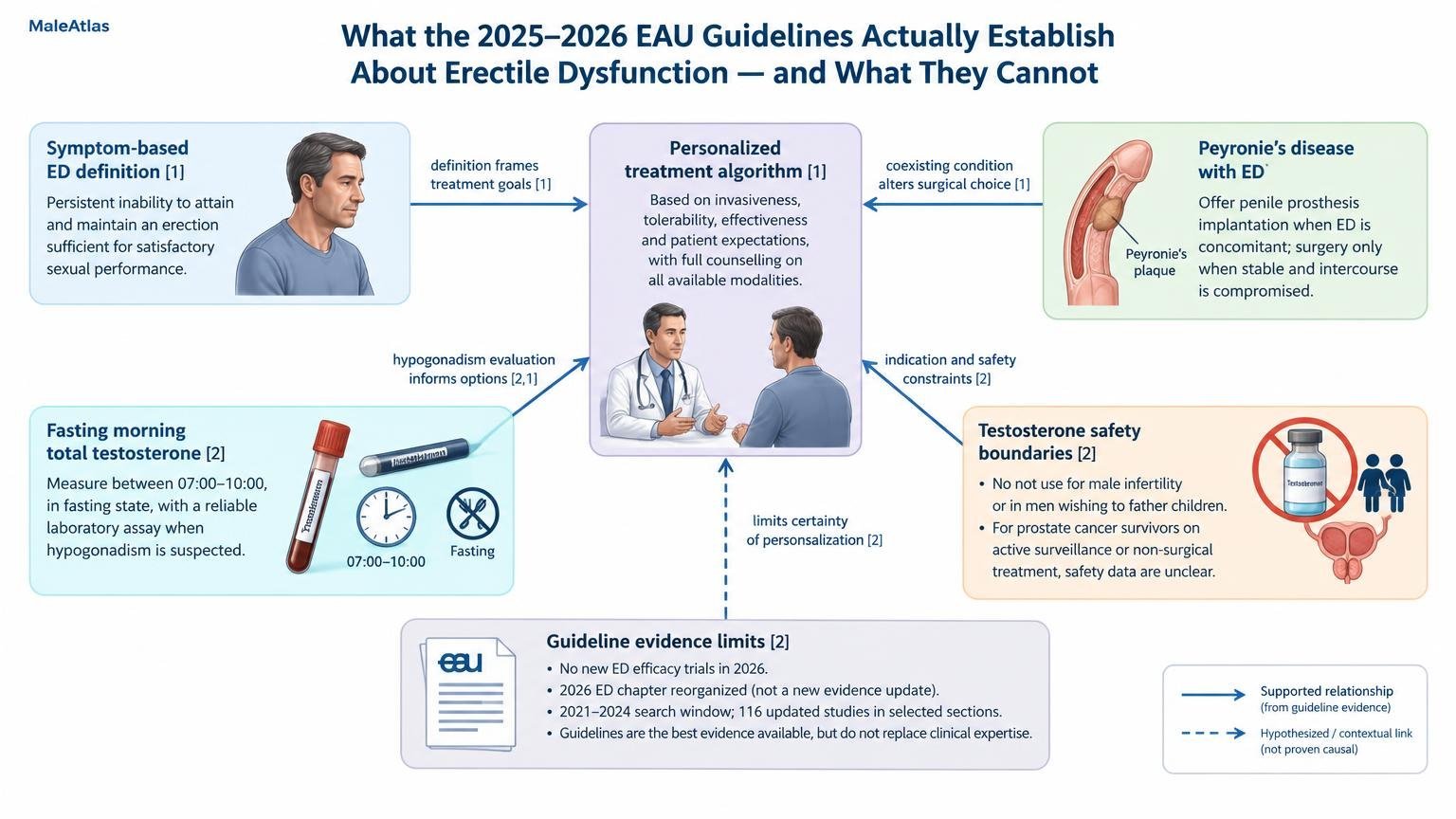
What the guidelines most clearly establish is a framework rather than a new therapy: ED is defined as the persistent inability to attain and maintain an erection sufficient to permit satisfactory sexual performance, and treatment selection is presented as a personalized process driven by invasiveness, tolerability, effectiveness and patient expectations, with full counselling about all available modalities. Testosterone therapy in late-onset hypogonadism is addressed with emphasis on correct indications and follow-up, and Peyronie's disease with concomitant ED is addressed with a specific surgical recommendation.
Why This Matters
Guidelines shape how clinicians sequence diagnostic testing, when they consider testosterone, and how they frame trade-offs to patients. But guideline documents are not clinical trial reports. The EAU states plainly that following its recommendations will not necessarily result in the best outcome, and that guidelines can never replace clinical expertise when making treatment decisions for individual patients.
That matters for interpreting news coverage or patient questions that treat a guideline update as proof that a particular treatment works or that a particular sequence is superior. A reorganization of recommendation text changes how recommendations are read, not what the underlying trials showed. The distinction between a structural update and an evidence update is central to reading the 2026 document honestly.
How the Guidelines Were Built
The 2025 update used a documented methodology. The panel conducted an updated systematic review of 2021–2024 research, and each recommendation's strength was graded on three factors: the trade-offs between benefits and drawbacks of different treatment approaches, the quality and reliability of the available evidence, and the diverse preferences and values of patients. This is a transparent grading philosophy, but it also means recommendation strength reflects value judgments and evidence quality together, not effect size alone.
The 2026 limited update used a structured literature assessment focused on hypogonadism, disorders of ejaculation, penile curvature and priapism, and incorporated 116 updated studies across the guidelines. An EAU podcast episode accompanying the 2026 update describes removal of ineffective treatments, updates to conservative management, and new options such as hyaluronic acid for Peyronie's disease, while emphasizing challenges related to limited high-quality evidence in several areas. These are guideline-process descriptions, not head-to-head efficacy results.[5][6]
The ED Definition and Personalized Treatment Algorithm
The EAU retains a symptom-based definition: ED is the persistent inability to attain and maintain an erection sufficient to permit satisfactory sexual performance. This definition deliberately centers the patient's experience of satisfactory performance rather than a laboratory threshold. It also means the boundary between ED and normal variation is partly subjective, which affects how trial endpoints and guideline recommendations should be interpreted.
The decision-making algorithm is explicitly built to support personalized treatment tailored to individual patients according to the invasiveness, tolerability and effectiveness of the different therapeutic options and patients' expectations. The guidelines further recommend that patients be fully counselled with respect to all available treatment modalities. In practical terms, this is a shared-decision framework, not a single mandatory sequence.
That framing has an important limitation: a personalized algorithm can accommodate many reasonable choices without establishing that any one choice is superior for a given patient. The guidelines do not, in the material summarized here, provide comparative head-to-head efficacy estimates between modalities. Readers should not infer that a personalized algorithm equals proof of comparative effectiveness. For a broader treatment-certainty discussion, see the evidence-quality review of ED comparative effectiveness.
Coexisting Conditions: Hypogonadism and Peyronie's Disease
The guidelines treat ED within a set of coexisting sexual and reproductive conditions rather than in isolation. For late-onset hypogonadism—defined as low circulating testosterone combined with specific symptoms associated with impaired hormone production and/or action in ageing men—key recommendations emphasize appropriate indications and subsequent follow-up for testosterone therapy. Diagnostic evaluation includes a strong recommendation to measure total testosterone in the morning between 07:00 and 10:00 in the fasting state with a reliable laboratory assay.
The guidelines also set clear boundaries around testosterone. A strong recommendation advises against using testosterone therapy for the treatment of male infertility or in men wishing to father children. For men on active surveillance or treated with non-surgical curative intent for prostate cancer, a weak recommendation advises informing them that safety data on testosterone therapy are unclear. These are safety and indication statements; they do not establish that testosterone improves erectile function in men without confirmed hypogonadism.
Peyronie's disease appears alongside ED because the two commonly coexist. The guidelines recommend offering surgical treatment to patients whose penile deformity has a negative impact on sexual function, and specify that patients with concomitant ED should be offered penile prosthesis implantation. In the 2026 update, surgery is recommended only when Peyronie's disease is stable and intercourse is compromised by the deformity—a strong recommendation that adds a timing condition.
| Guideline domain | What is recommended | Strength or status | Interpretive limit |
|---|---|---|---|
| ED definition and treatment framing | Personalized treatment based on invasiveness, tolerability, effectiveness and patient expectations; full counselling on all modalities | Decision-algorithm framing | Does not establish comparative superiority of any modality |
| Total testosterone measurement | Morning (07:00–10:00), fasting, reliable laboratory assay | Strong recommendation | Diagnostic process recommendation; no accuracy data summarized here |
| Testosterone and fertility | Do not use testosterone therapy to treat male infertility or in men wishing to father children | Strong recommendation | Indication and safety boundary, not an ED efficacy claim |
| Testosterone in prostate cancer survivors | Advise that safety data are unclear for men on active surveillance or non-surgical curative treatment | Weak recommendation | Explicitly acknowledges evidence uncertainty |
| Peyronie's disease with ED | Offer penile prosthesis implantation when ED is concomitant | Recommendation | No outcome data summarized in this source body |
| 2026 ED chapter change | ED treatment recommendations reorganized for logical flow | Structural update | Not new ED efficacy evidence |
What the Evidence Shows — and What It Cannot
The strongest claims the guidelines support are procedural and definitional. They support a structured diagnostic approach that includes fasting morning total testosterone measurement when hypogonadism is suspected, and they support counselling patients on the full range of treatment options rather than presenting a single mandatory ladder. They also support specific safety boundaries, such as avoiding testosterone in men pursuing fertility.
The guidelines do not, in the evidence summarized here, quantify how much any ED treatment improves erectile function compared with another. They do not report comparative trial results for first-line versus second-line options, and the 2026 update's ED-related change was organizational. Anyone citing the 2026 EAU update as new proof that a specific ED therapy is more effective would be overstating what the document reports.
The 2025 systematic review was bounded by its search window: new research published 2021–2024. That means the guideline synthesis is current to that window and does not automatically incorporate trials published later. The 2026 limited update added 116 studies in selected sections, but the ED treatment section was not among the sections described as receiving a full evidence refresh. These are structural constraints on currency, not judgments about the quality of individual trials.
A further limitation is the guideline's own explicit epistemics. The EAU states that guidelines present the best evidence available to the experts but that following recommendations will not necessarily produce the best outcome, and that guidelines cannot replace clinical expertise. That is an unusually direct acknowledgment that guideline-concordant care and optimal individual care are not identical. It also means that recommendation strength—strong or weak—describes the panel's confidence and the balance of considerations, not a guaranteed patient-level benefit.
Interpretation and Clinical Relevance
For clinicians, the practical value of the 2025–2026 documents is a disciplined framework: define ED by its effect on satisfactory sexual performance, evaluate for hypogonadism with properly timed fasting morning testosterone when indicated, counsel across all treatment modalities, and integrate coexisting conditions such as Peyronie's disease into surgical decision-making. These are actionable steps that do not depend on new efficacy data.
For patients and readers, the key interpretive skill is distinguishing a recommendation from a result. A strong recommendation about how to measure testosterone is not a claim that correcting testosterone will resolve ED in every man. A recommendation to offer penile prosthesis in Peyronie's disease with concomitant ED is not a report of prosthesis outcomes. The guidelines are a decision aid built from graded evidence plus patient values, and the EAU says as much.
The broader ED evidence base beyond the guideline text—including treatment certainty, cardiovascular context and metabolic contributors—is discussed in a separate review of ED treatment evidence and cardiovascular framing. That context matters because ED frequently coexists with conditions that the sexual health guideline touches only partially.
Research Outlook
Several evidence gaps follow directly from the documents. First, the ED treatment section did not receive a full evidence refresh in 2026, so the next meaningful ED evidence update will likely come with a future full revision rather than the limited update. Second, the panel itself emphasizes limited high-quality evidence in areas such as testosterone therapy in prostate cancer survivors and treatment options for ejaculation disorders, which signals where future trials are most needed.
Third, the personalized-treatment algorithm is a framework for shared decision-making, but the guidelines as summarized do not provide comparative effectiveness estimates to populate it. Future research that directly compares treatment strategies in defined patient subgroups—rather than comparing each therapy to placebo—would strengthen the evidence behind personalization. Until then, the algorithm should be read as a structured conversation tool, not a validated comparative model.
Key Takeaways
- The 2025 EAU update is built on a systematic review of 2021–2024 literature; the 2026 document is a limited update of the 2025 publication, not a full revision.
- The 2026 update added 116 studies across selected sections and reorganized ED treatment recommendations for logical flow; it did not report new ED efficacy trials.
- ED is defined as persistent inability to attain and maintain an erection sufficient for satisfactory sexual performance, and treatment is framed as personalized according to invasiveness, tolerability, effectiveness and patient expectations.
- Total testosterone should be measured in the morning between 07:00 and 10:00 in the fasting state with a reliable assay; testosterone therapy is strongly discouraged in men pursuing fertility.
- For Peyronie's disease with concomitant ED, penile prosthesis implantation should be offered; surgery is recommended when deformity negatively affects sexual function and disease is stable.
- The guidelines explicitly state that following recommendations will not necessarily produce the best outcome and cannot replace clinical expertise, so recommendation strength should not be read as guaranteed individual benefit.
Questions and Answers
What do the 2025–2026 EAU guidelines say about how erectile dysfunction should be defined?
The EAU defines ED as the persistent inability to attain and maintain an erection sufficient to permit satisfactory sexual performance. This symptom-based definition centers the patient's experience rather than a laboratory threshold, which means the boundary between ED and normal variation is partly subjective. The definition underpins the personalized treatment algorithm but does not by itself establish which treatment works best.
Did the 2026 EAU update add new evidence for erectile dysfunction treatments?
No. The 2026 document is a limited update of the 2025 publication. Its ED-related change was reorganizing the treatment recommendations so they flow more logically. The 116 updated studies added in 2026 were concentrated in hypogonadism, ejaculation disorders, penile curvature and priapism sections. The 2025 update's systematic review covered 2021–2024 literature.
How does the EAU guideline recommend selecting an erectile dysfunction treatment?
The EAU decision-making algorithm supports personalized treatment tailored to the individual according to the invasiveness, tolerability and effectiveness of different therapeutic options and the patient's expectations. The guidelines also recommend fully counselling patients on all available treatment modalities. This is a shared-decision framework, but the summarized guideline material does not provide head-to-head comparative efficacy estimates between modalities.
What does the EAU guideline say about testosterone testing in men with erectile dysfunction?
When hypogonadism is suspected, a strong recommendation is to measure total testosterone in the morning between 07:00 and 10:00 in the fasting state using a reliable laboratory assay. Late-onset hypogonadism combines low circulating testosterone with specific symptoms. Testosterone therapy is strongly discouraged in men with male infertility or wishing to father children, and safety data are described as unclear for some prostate cancer survivors.
What are the main limitations of the 2025–2026 EAU erectile dysfunction guideline evidence?
The 2025 review was bounded to 2021–2024 publications, and the 2026 limited update did not fully refresh the ED treatment section. The guidelines themselves state that following recommendations will not necessarily produce the best outcome and cannot replace clinical expertise. Recommendation strength reflects benefit-harm trade-offs, evidence quality and patient values together, so a strong recommendation is not a guarantee of individual patient benefit.
What do the EAU guidelines recommend for Peyronie's disease when erectile dysfunction is also present?
Surgery is recommended for Peyronie's disease patients whose penile deformity negatively affects sexual function, and the 2026 update specifies it should be performed only when disease is stable and intercourse is compromised. For patients with concomitant ED, penile prosthesis implantation should be offered. These are recommendations about surgical indications; the summarized source text does not report prosthesis outcome data.
Conceptual framework: Conceptual framework — not a tested causal model. Constructs reflect EAU 2025–2026 sexual and reproductive health guideline content: symptom-based ED definition, personalized treatment algorithm, fasting morning total testosterone measurement, testosterone safety boundaries, Peyronie's disease with concomitant ED, and explicitly stated evidence limits. Arrows indicate supported conceptual relationships, not proven causal effects; the 2026 ED chapter change was organizational rather than new efficacy evidence.
Academic References & Evidence
- Andrea Salonia; Paolo Capogrosso; Luca Boeri; Andrea Cocci; Giovanni Corona; Marij Dinkelman-Smit; Marco Falcone; Christian Fuglesang Jensen; Murat Gül; Arif Kalkanli; Ates Kadioğlu; Juan I Martinez-Salamanca; L Afonso Morgado; Giorgio I Russo; Ege Can Serefoğlu; Paolo Verze; Suks Minhas. European Association of Urology Guidelines on Male Sexual and Reproductive Health: 2025 Update on Male Hypogonadism, Erectile Dysfunction, Premature Ejaculation, and Peyronie's Disease. European Urology. 2025 88(1):76-102 DOI: 10.1016/j.eururo.2025.04.010.
- Introduction – EAU Guidelines on Sexual and Reproductive Health – Uroweb. 2026
- Graziottin A.. Disturbi sessuali e riproduttivi maschili: le linee guida dell'Associazione Europea di Urologia – Disturbi sessuali maschili – Alessandra Graziottin. 2026 DOI: 10.1016/j.eururo.2025.04.010. PMID: 40340108.
- EAU Guidelines on Sexual and Reproductive Health – Uroweb.
- 2026 update on EAU Guidelines for Sexual & Reproductive Health – EAU Podcast.
- 2026 update on EAU Guidelines for Sexual & Reproductive Health.
SANYUN Science Center explains published research on men's reproductive and sexual health, connecting scientific evidence with everyday questions while making sources and limitations clear.
Disclaimer: This article is for scientific education and research communication only. It does not provide medical advice, diagnosis, or individualized treatment recommendations, and does not endorse any medication, supplement, device, penile enlargement procedure, or other intervention. Decisions about sexual and reproductive health should be made in consultation with a qualified healthcare professional. Do not delay seeking professional care because of information in this article.
Original Content & Copyright Notice
- This article is prepared for SANYUN Science Center, drawing on published research and publicly available academic literature on men’s sexual and reproductive health. Its editorial explanations and presentation are developed for this platform.
- Copyright in the original editorial content, selection, and arrangement is reserved by SANYUN Science Center to the extent protected by applicable law. Referenced research, quotations, and third-party materials remain subject to the rights of their respective owners. This notice does not claim ownership of scientific facts or third-party research.
- Except where permitted by applicable law or an applicable license, prior written permission is required to reproduce, republish, translate, adapt, redistribute, or commercially reuse protected content. Attribution alone does not grant permission for such reuse.
- For permitted quotation or authorized reuse, clearly identify the source and retain a link to the original article.
- Source: SANYUN Science Center
- Original URL: Retain the original article URL on science.san-yun.com.
- Copyright Holder: SANYUN Science Center, for its own protected editorial content.
- Quotation, excerpts, or authorized reuse must not distort the scientific meaning, omit material limitations or disclaimers, or imply unverified medical claims, product efficacy, or endorsement by SANYUN Science Center.



