




Category: Clinical Insights
Core Research Direction: What the 2025–2026 EAU sexual and reproductive health guideline updates change for adult men: diagnosis and management of late-onset hypogonadism, erectile dysfunction, premature ejaculation, Peyronie's disease, male infertility, and priapism, including updated recommendations and areas of limited evidence
Search Intent: What do the latest EAU guideline updates recommend for diagnosing and treating male hypogonadism, erectile dysfunction, ejaculation disorders, Peyronie's disease and priapism, and where is the evidence still weak?
Platform: SANYUN Science Center
Evidence reviewed through: 2026-11-23
Executive Summary
The European Association of Urology (EAU) publishes clinical practice guidelines on male sexual and reproductive health for adult men. The 2025 update covered late-onset hypogonadism, erectile dysfunction, premature ejaculation and Peyronie's disease, and was built on an updated systematic review of research published between 2021 and 2024 in Medline, EMBASE and Cochrane Libraries. A companion 2025 document addressed male infertility using a structured literature assessment across the same databases. The 2026 document is described as a limited update of the 2025 publication, adding 116 appraised studies concentrated in the hypogonadism, ejaculation disorder, penile curvature and priapism sections.[1][2][3]
The most consequential changes are practical rather than dramatic. Testosterone measurement now carries a strong recommendation for morning fasting sampling between 07:00 and 10:00 hours with a reliable assay. Testosterone therapy is strongly discouraged for male infertility and in men wishing to become fathers. Safety monitoring after prostate cancer treatment is addressed with explicit, albeit weak, thresholds and an acknowledgement that data in some survivor groups are unclear. Erectile dysfunction recommendations were reorganised into a more logical sequence around a personalised, stepwise algorithm. Premature ejaculation management is now explicitly subtype-driven. Peyronie's disease care is phase-differentiated, with surgery reserved for stable disease that compromises intercourse. Priapism guidance emphasises corporal blood gas analysis and permits peno-scrotal decompression as an alternative first-line option.
Two themes run through the updates: stronger emphasis on patient selection and counselling, and open acknowledgement of evidence gaps. The EAU panel graded every recommendation on benefit–harm trade-offs, evidence quality and patient values. The 2026 podcast discussion accompanying the revision highlights that high-quality evidence remains limited for testosterone therapy in prostate cancer survivors and for treatment options in ejaculation disorders. This review interprets what the guidelines establish, what they do not, and how clinicians and informed patients should read the strength ratings.[4]
Why This Matters
Male sexual and reproductive health complaints are common, but the evidence base behind many routine decisions is uneven. A guideline update matters less for the number of new recommendations than for the confidence attached to each one. The EAU process makes that confidence visible by attaching strength ratings to recommendations rather than presenting all advice as equally certain. This is particularly important in areas where commercial pressure, patient expectation and diagnostic ambiguity intersect — testosterone prescribing, erectile dysfunction pathways, and unproven Peyronie's therapies.
The guidelines themselves caution that following recommendations will not necessarily produce the best outcome and that guidelines cannot replace clinical expertise. They are framed as decision aids that must account for individual values and circumstances, not as mandates or legal standards of care. For a global readership, this framing matters: access to assays, specialist referral and surgical options varies widely, and the same recommendation may carry different practical implications across health systems.
The 2026 revision also signals which questions the panel considered settled enough to change and which remain open. Removing ineffective treatments and adding options such as hyaluronic acid for Peyronie's disease reflects an active effort to prune low-value care, but the accompanying podcast discussion is candid that several areas still lack robust comparative trials. Understanding that distinction helps patients and clinicians avoid treating guideline silence as endorsement.
How the Guidelines Were Built
The 2025 update was not a new primary study. The panel performed an updated systematic review of research published from 2021 to 2024. This design means the recommendations synthesise existing evidence rather than generate new outcome data, and the strength of any recommendation is bounded by the quality of the underlying literature. The 2025 male infertility update used a comparable structured assessment of Medline, EMBASE and Cochrane Libraries, focusing on diagnosis, treatment and follow-up.
Recommendation strength was not determined by statistical significance alone. The panel weighed the balance between desirable and undesirable consequences of alternative strategies, the quality and reliability of the evidence, and the diversity of patient values and preferences. This explains why some recommendations are strong despite modest effect sizes — when harms are low and preferences are consistent — and why others remain weak even when a treatment plausibly works, because the comparative evidence is thin or the trade-offs are preference-sensitive.
The 2026 document is explicitly a limited update of the 2025 publication. New evidence was identified, collated and appraised for the hypogonadism, ejaculation disorder, penile curvature and priapism sections, producing 116 updated studies across the guidelines. The changes include significant revisions to hypogonadism text, the prostate cancer subsection, the erectile dysfunction treatment summary, the ejaculation disorder section, multiple Peyronie's disease subsections, and the priapism sections covering ischaemic priapism and special situations.
Late-Onset Hypogonadism: Measurement First, Therapy Second
Late-onset hypogonadism is defined in the guideline as a clinical condition in the ageing male combining low levels of circulating testosterone with specific symptoms associated with impaired hormone production or action. That definition sets a high bar: neither a low laboratory value nor symptoms alone is sufficient. The 2025 update emphasised appropriate indications and subsequent follow-up for testosterone therapy, and the 2026 revision made significant changes to the supporting text throughout the hypogonadism section.
The 2026 diagnostic recommendation is unusually specific and carries a strong rating: measure total testosterone in the morning between 07:00 and 10:00 hours, in the fasting state, using a reliable laboratory assay. The rationale is biological and practical. Testosterone concentrations follow a diurnal rhythm and fall after food intake, so sampling outside these conditions can misclassify men. The accompanying podcast discussion highlights proper testosterone measurement and the distinction between functional and organic causes as central diagnostic considerations, implying that reversible functional suppression should be addressed before labelling a man as hypogonadal.
Safety monitoring received substantial attention. One weak recommendation restricts testosterone therapy after prostate cancer surgery to men at low risk of recurrence, starting only after at least one year of follow-up with a prostate-specific antigen level below 0.01 ng/mL and no evidence of recurrence. A second weak recommendation advises men on active surveillance or treated with non-surgical curative intent that safety data are unclear. A strong recommendation supports further diagnostic testing in prostate cancer-naïve men if there is a significant rise or increase in PSA velocity or total PSA.
The weak ratings on the prostate cancer recommendations are themselves informative. They reflect limited and largely observational safety data rather than a demonstrated absence of harm. The guideline's move of two recommendations into the prostate cancer subsection because their clinical implications aligned more directly with cancer management suggests the panel sees testosterone therapy in survivors as a cancer-context decision, not a general endocrine one.
The clearest boundary is fertility. A strong recommendation states that testosterone therapy should not be used for the treatment of male infertility or in men wishing to become fathers. This is consistent with the physiological suppression of spermatogenesis by exogenous testosterone and represents one of the most firmly graded statements in the update. It also creates a practical counselling obligation: men with hypogonadism who want children need a different conversation from men who do not.
Erectile Dysfunction: A Reorganised, Personalised Pathway
The guideline defines erectile dysfunction as the persistent inability to attain and maintain an erection sufficient to permit satisfactory sexual performance. The 2025 update's decision-making algorithm aims to support personalised treatment tailored to the individual according to the invasiveness, tolerability and effectiveness of the available options and the patient's expectations. Patients should be fully counselled about all available treatment modalities.
The 2026 revision did not introduce a new therapeutic class in the erectile dysfunction section. Instead, it reorganised the recommendations in the treatment summary so that they flow in a more logical order. That sounds administrative, but sequence matters in a stepwise pathway: it shapes whether clinicians escalate from less invasive to more invasive options in a coherent way and whether counselling about expectations happens before or after a prescription is written.
The emphasis on invasiveness and tolerability reflects a preference-sensitive decision model rather than a single dominant treatment. Two men with similar symptoms may reasonably choose different paths depending on their priorities, comorbidities and tolerance for risk. The guideline does not claim that one sequence is universally superior; it provides a structure within which the trade-offs can be discussed. This is a meaningful distinction between statistical efficacy and clinical appropriateness.
Premature Ejaculation: Subtype Determines the First Move
The EAU guidelines adopted the International Society for Sexual Medicine definition of premature ejaculation. The 2025 update made subtype-specific management a key theme, and the 2026 revision fully updated the supporting text and references throughout the ejaculation disorder section. After the subtype is defined, patient expectations should be discussed thoroughly.
The therapeutic logic differs by subtype. Pharmacotherapy should be considered first-line for lifelong premature ejaculation, whereas treating the underlying cause is the initial goal in acquired premature ejaculation. This is a clinically important fork: lifelong disease is treated as a persistent condition, while acquired disease prompts a search for contributors such as thyroid disease, prostatitis, erectile dysfunction or psychological factors. Applying the lifelong algorithm to an acquired presentation would miss the diagnostic work-up.
The podcast discussion accompanying the 2026 revision identifies treatment options for ejaculation disorders as an area of limited high-quality evidence. The full revision of the section's text and references therefore reflects an updated evidence map rather than a sudden expansion of proven options. Clinicians should read the subtype-specific recommendation as a decision framework, not as evidence that every pharmacological option has strong comparative support.
Peyronie's Disease: Phase, Function and Realistic Expectations
Peyronie's disease care in the update is explicitly phase-differentiated. Accurate baseline assessment should distinguish the acute from the stable phase. This distinction governs what can reasonably be attempted: conservative measures during active disease, and surgery only once the plaque has stabilised. The 2026 revision significantly revised the epidemiology, conservative treatment, oral treatment, other treatments and surgical treatment subsections, signalling that this is one of the more actively reconsidered areas.
Surgery is tightly framed. A strong recommendation states that surgery should be performed only when Peyronie's disease is stable and sexual intercourse is compromised due to the deformity. The 2025 update adds that men with concomitant erectile dysfunction should be offered penile prosthesis implantation. This prevents two common errors: operating on a still-evolving curvature, and treating a deformation in a man whose sexual function is not actually impaired by it.
Conservative options were revised with candour. A strong recommendation is to counsel patients that data on intralesional platelet-rich plasma, alone or in combination with oral treatment, for reducing pain or penile curvature remain limited. The podcast discussion notes the introduction of new options such as hyaluronic acid for Peyronie's disease alongside the removal of ineffective treatments. The presence of a strong counselling recommendation around limited data is a reminder that strong grading can reflect certainty about uncertainty.
Male Infertility: The Couple and the Broader Health Picture
The 2025 male infertility update emphasises a thorough urological assessment of all men seeking medical help for fertility problems to ensure appropriate treatment. It also stresses parallel investigation of the female partner during the diagnostic and management work-up, to promote shared decision-making about timing and therapeutic strategy. This is a couple-level framing rather than a male-only pathway.
A second emphasis is counselling. The guideline recommends counselling all infertile men and men with abnormal semen parameters on associated health risks. This reflects the recognition that abnormal semen analysis can be a marker of broader health issues rather than an isolated reproductive problem. The 2025 update added two new sections addressing exome sequencing and probiotic treatment, and significantly updated the evidence base and recommendations for the diagnostic work-up.
The addition of exome sequencing is a genuine change in diagnostic ambition, but it should not be read as a universal first-line test. It sits within a structured work-up and is likely to be most relevant where standard evaluation is inconclusive. The probiotic section is newer and less mature; its inclusion signals that the panel considered the topic relevant enough to address, not that probiotic treatment has strong efficacy evidence. The same caution applies as elsewhere: inclusion in a guideline is not a guarantee of benefit.
The male infertility update also intersects with the hypogonadism recommendation against testosterone therapy in men wishing to become fathers. Together, these positions create a coherent reproductive counselling framework: fertility intentions should be established before hormonal treatment decisions are made.
Priapism: Time-Critical Diagnosis and Evolving First-Line Options
Priapism guidance is among the most operationally important parts of the update because ischaemic priapism is a time-sensitive emergency. A strong recommendation states that in the emergency setting, analysis of blood gas parameters from aspirated corporal blood is essential to distinguish ischaemic from non-ischaemic priapism. This is a diagnostic step that changes management immediately: the two conditions have different causes and different treatments.
The 2026 revision significantly revised the ischaemic priapism section, the second-line surgical management subsection and the section on priapism in special situations. One notable change is a weak recommendation that peno-scrotal decompression may be used as a first-line option instead of distal shunting with or without tunnelling. The weak rating reflects a more limited or less certain evidence base than the strong recommendation for blood gas analysis, not necessarily a judgment that the procedure is ineffective.
The distinction between strong and weak recommendations in this section is clinically meaningful. Blood gas analysis is strongly recommended because the diagnostic value is clear and the harms are minimal. Peno-scrotal decompression as an alternative first-line approach is weakly recommended because the comparative evidence against established shunting strategies is less certain and outcomes may depend on operator experience and local context.
Interpretation and Limitations
The most important limitation is structural: these are guidelines, not primary trials. The 2025 update synthesised literature from 2021 to 2024, and the 2026 document added 116 appraised studies across selected sections. Neither represents independent verification of every underlying study, and recommendation strength is partly a judgment about trade-offs and patient values rather than a purely statistical construct. The absence of a recommendation does not mean an intervention is ineffective; it may mean the evidence was insufficient to support a graded statement.
Several areas carry explicitly acknowledged uncertainty. Testosterone therapy in prostate cancer survivors is governed by weak recommendations and unclear safety data for men on active surveillance or non-surgical curative treatment. Treatment options for ejaculation disorders are described as facing limited high-quality evidence. Peyronie's platelet-rich plasma data are described as limited. These are not marginal caveats; they define where shared decision-making carries the most weight.
A secondary limitation is the nature of the available sources for this review. The primary guideline summaries and the official EAU change log are authoritative, but the podcast discussion is an expert commentary rather than peer-reviewed data, and the Italian science news commentary is a secondary summary. Details of individual trial effect sizes, confidence intervals and adverse event rates are not available in these sources, so this article cannot quantify the magnitude of benefit for most recommendations. It describes what the guidelines recommend and how strongly, not how large the average effect is.[5]
Research Outlook
The 2026 update's emphasis on limited high-quality evidence points to specific research priorities. Comparative trials in ejaculation disorders, better-characterised safety cohorts for testosterone therapy in prostate cancer survivors, and higher-quality conservative-treatment studies for Peyronie's disease would directly inform future recommendation strength. The addition of exome sequencing to the male infertility work-up also raises questions about yield, cost-effectiveness and counselling implications that the current evidence base may not fully answer.
For clinicians, the practical implication is to use the strength ratings as a guide to how much uncertainty to discuss with patients. Strong recommendations with clear evidence, such as morning fasting testosterone measurement or avoiding testosterone in men wishing to father children, can be communicated directly. Weak recommendations and explicitly limited evidence areas call for a more deliberative conversation about alternatives, expectations and the limits of current knowledge.
Key Takeaways
- The 2025 EAU update was built on a systematic review of 2021–2024 literature, and the 2026 document is a limited update adding 116 appraised studies across hypogonadism, ejaculation disorders, penile curvature and priapism.
- Testosterone should be measured in the morning between 07:00 and 10:00 hours while fasting with a reliable assay, and testosterone therapy is strongly discouraged in men with male infertility or wishing to become fathers.
- Erectile dysfunction care follows a personalised, stepwise algorithm based on invasiveness, tolerability, effectiveness and patient expectations, with full counselling about all options.
- Premature ejaculation management depends on subtype: pharmacotherapy is first-line for lifelong disease, while treating the underlying cause is the initial goal in acquired disease.
- Peyronie's surgery is strongly recommended only for stable disease with deformity compromising intercourse, and men with concomitant erectile dysfunction should be offered penile prosthesis implantation.
- In ischaemic priapism, corporal blood gas analysis is strongly recommended to distinguish ischaemic from non-ischaemic priapism, while peno-scrotal decompression is a weakly recommended alternative first-line option.
Questions and Answers
How do the 2025–2026 EAU guidelines define late-onset hypogonadism and recommend measuring testosterone?
Late-onset hypogonadism is defined as a condition in ageing men combining low circulating testosterone with specific symptoms of impaired hormone production or action. The 2026 guideline strongly recommends measuring total testosterone in the morning between 07:00 and 10:00 hours, in the fasting state, using a reliable laboratory assay, because diurnal variation and food intake can otherwise misclassify men.
What changed in the 2026 EAU update on erectile dysfunction and premature ejaculation?
The 2026 revision reorganised the erectile dysfunction treatment recommendations into a more logical sequence within a personalised algorithm based on invasiveness, tolerability, effectiveness and patient expectations. It fully updated the text and references for ejaculation disorders, reinforcing subtype-specific care: pharmacotherapy first-line for lifelong premature ejaculation, and treating the underlying cause first in acquired premature ejaculation.
Why do the EAU guidelines strongly advise against testosterone therapy for male infertility?
A strong 2026 recommendation states that testosterone therapy should not be used to treat male infertility or in men wishing to become fathers. Exogenous testosterone suppresses spermatogenesis, so it works against fertility goals even when it corrects low testosterone. Men with hypogonadism who want children need a separate reproductive discussion before any hormonal treatment decision.
When is surgery recommended for Peyronie's disease under the EAU guidelines?
A strong recommendation is to perform surgery only when Peyronie's disease is stable and sexual intercourse is compromised by the deformity. Men with concomitant erectile dysfunction should be offered penile prosthesis implantation. The guidelines also strongly advise counselling patients that intralesional platelet-rich plasma data remain limited, so expectations should be set accordingly.
How strong is the evidence behind the updated EAU recommendations?
Strength varies. Recommendations were graded on benefit–harm trade-offs, evidence quality and patient values. Some are strong, such as morning fasting testosterone measurement and avoiding testosterone in men wishing to father children. Others are weak because data are limited, including testosterone therapy after prostate cancer surgery, peno-scrotal decompression for ischaemic priapism, and treatment options for ejaculation disorders.
How should clinicians interpret the 2026 EAU priapism recommendations?
In the emergency setting, a strong recommendation supports blood gas analysis of aspirated corporal blood to distinguish ischaemic from non-ischaemic priapism. A weak recommendation allows peno-scrotal decompression as a first-line alternative to distal shunting with or without tunnelling. The weak rating signals less certain comparative evidence, not ineffectiveness, so local expertise and context should inform the choice.
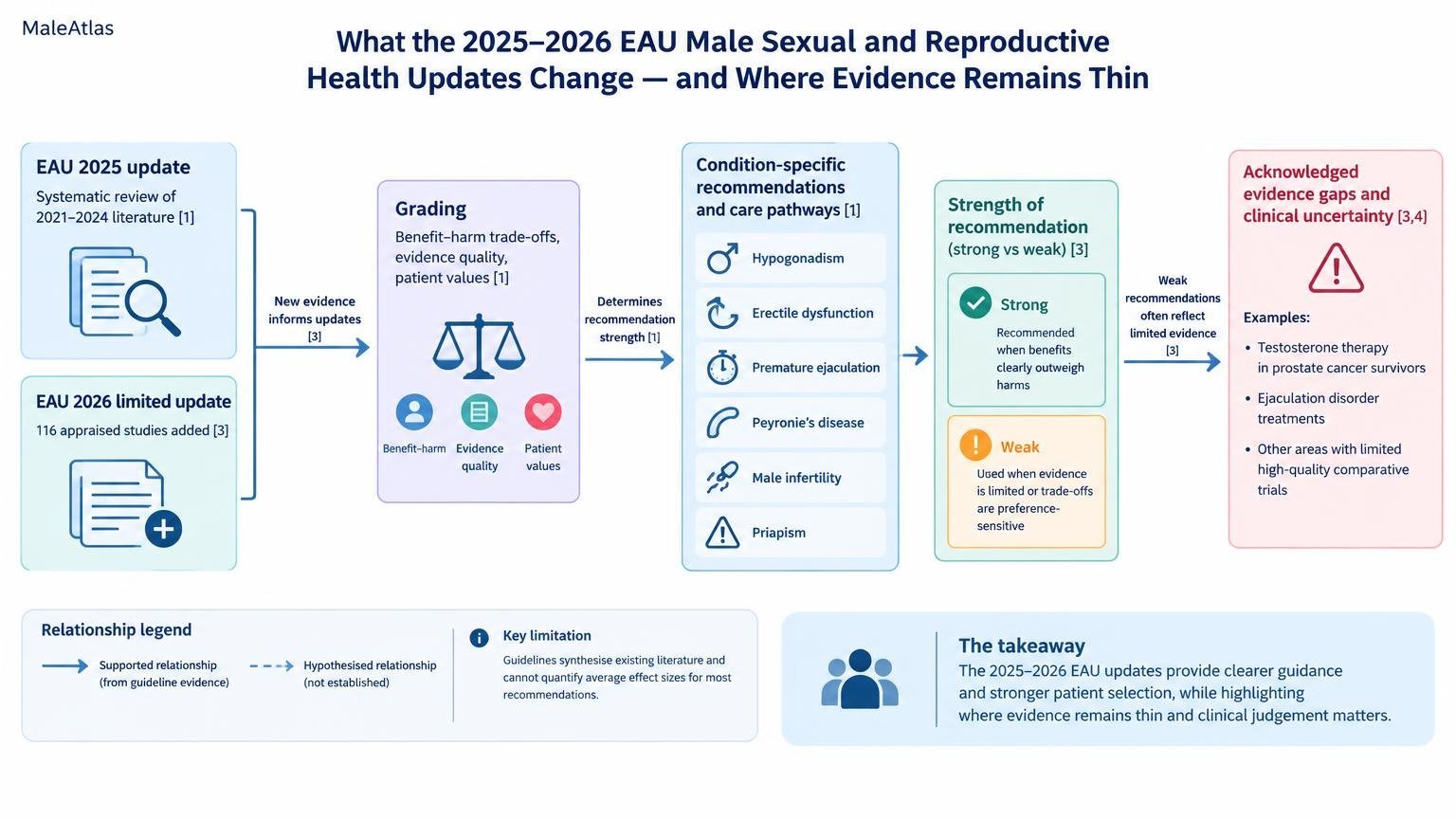
Conceptual framework: Conceptual framework — not a tested causal model. The figure shows how the 2025 EAU systematic review and the 2026 limited update feed into condition-specific recommendations, with recommendation strength reflecting benefit–harm trade-offs, evidence quality and patient values. Weak recommendations and explicit evidence gaps cluster where data are limited, including testosterone therapy in prostate cancer survivors and ejaculation disorder treatments. Population: adult men. Evidence type: clinical practice guideline synthesis.
Academic References & Evidence
- Salonia, Andrea; Capogrosso, Paolo; Boeri, Luca; Cocci, Andrea; Corona, Giovanni; Dinkelman-Smit, Marij; Falcone, Marco; Jensen, Christian Fuglesang; Gül, Murat; Kalkanli, Arif; Kadioğlu, Ates; Martinez-Salamanca, Juan I.; Afonso Morgado, L.; Russo, Giorgio I.; Serefoğlu, Ege Can; Verze, Paolo; Minhas, Suks. European Association of Urology Guidelines on Male Sexual and Reproductive Health: 2025 Update on Male Hypogonadism, Erectile Dysfunction, Premature Ejaculation, and Peyronie's Disease.. European Urology. 2025 88(1):76-102 DOI: 10.1016/j.eururo.2025.04.010.
- Suks Minhas; Luca Boeri; Paolo Capogrosso; Andrea Cocci; Giovanni Corona; Marij Dinkelman-Smit; Marco Falcone; Christian Fuglesang Jensen; Murat Gül; Arif Kalkanli; Ates Kadioğlu; Juan I Martinez-Salamanca; L Afonso Morgado; Giorgio I Russo; Ege Can Serefoğlu; Paolo Verze; Andrea Salonia. European Association of Urology Guidelines on Male Sexual and Reproductive Health: 2025 Update on Male Infertility. European Urology. 2025 87(5):601-616 DOI: 10.1016/j.eururo.2025.02.026.
- Introduction – EAU Guidelines on Sexual and Reproductive Health – Uroweb. European Association of Urology Guidelines (Uroweb). 2026
- 2026 update on EAU Guidelines for Sexual & Reproductive Health – EAU Podcast. EAU Podcast
- Graziottin A.. Disturbi sessuali e riproduttivi maschili: le linee guida dell'Associazione Europea di Urologia – Disturbi sessuali maschili – Alessandra Graziottin. 2026
SANYUN Science Center explains published research on men's reproductive and sexual health, connecting scientific evidence with everyday questions while making sources and limitations clear.
Disclaimer: This article is for scientific education and research communication only. It does not provide medical advice, diagnosis, or individualized treatment recommendations, and does not endorse any medication, supplement, device, penile enlargement procedure, or other intervention. Decisions about sexual and reproductive health should be made in consultation with a qualified healthcare professional. Do not delay seeking professional care because of information in this article.
Original Content & Copyright Notice
- This article is prepared for SANYUN Science Center, drawing on published research and publicly available academic literature on men’s sexual and reproductive health. Its editorial explanations and presentation are developed for this platform.
- Copyright in the original editorial content, selection, and arrangement is reserved by SANYUN Science Center to the extent protected by applicable law. Referenced research, quotations, and third-party materials remain subject to the rights of their respective owners. This notice does not claim ownership of scientific facts or third-party research.
- Except where permitted by applicable law or an applicable license, prior written permission is required to reproduce, republish, translate, adapt, redistribute, or commercially reuse protected content. Attribution alone does not grant permission for such reuse.
- For permitted quotation or authorized reuse, clearly identify the source and retain a link to the original article.
- Source: SANYUN Science Center
- Original URL: Retain the original article URL on science.san-yun.com.
- Copyright Holder: SANYUN Science Center, for its own protected editorial content.
- Quotation, excerpts, or authorized reuse must not distort the scientific meaning, omit material limitations or disclaimers, or imply unverified medical claims, product efficacy, or endorsement by SANYUN Science Center.



