




Category: Clinical Insights
Core Research Direction: The 2025–2026 EAU sexual and reproductive health guideline updates: what changed across male infertility, hypogonadism, ejaculatory disorders, Peyronie's disease and priapism, and how strong the underlying evidence is
Search Intent: What do the latest EAU guideline updates on male sexual and reproductive health actually recommend, what changed, and how certain is the evidence behind those recommendations?
Platform: SANYUN Science Center
Evidence reviewed through: 2026-11-08
Executive Summary
The European Association of Urology (EAU) has issued a 2026 Sexual and Reproductive Health guideline document that its own introduction describes as a limited update of the 2025 publication. The structured literature appraisal for this revision was confined to four areas: hypogonadism, disorders of ejaculation, penile curvature and priapism. That process added 116 updated studies across the guidelines.[1]
The 2026 revision is therefore best read alongside, not instead of, the 2025 male infertility update. That separate publication, summarized in European Urology in May 2025, added sections on exome sequencing and probiotic treatment and substantially revised the diagnostic work-up evidence, while stressing thorough urological assessment, parallel investigation of the female partner and counseling on associated health risks.[2][3]
Recommendation strength in the 2026 document is uneven. Some statements are strongly rated because the balance of benefit, harm, evidence certainty and patient values is clear; others are explicitly weak, reflecting thin or indirect data. Morning fasting total testosterone measurement and the instruction not to use testosterone therapy in men wishing to be fathers are strong. Testosterone therapy in prostate cancer survivors and peno-scrotal decompression as an alternative to distal shunting for ischaemic priapism are weak.
Why This Matters
Guidelines shape referral pathways, insurance decisions and counseling conversations. Yet the EAU document itself states that following its recommendations will not necessarily produce the best outcome for an individual patient, and that guidelines cannot replace clinical expertise or override personal values and circumstances. Readers should treat the update as a structured summary of best available evidence rather than a mandate.
Two practical consequences follow. First, a limited update does not mean every section reflects 2026 evidence; male infertility recommendations rest on the 2025 appraisal. Second, a strong rating signals confidence in the direction of a recommendation, not proof that a treatment works in every subgroup. Areas such as testosterone therapy in prostate cancer survivors and ejaculation disorder treatments remain flagged as lacking high-quality evidence.[4]
How the Guideline Evidence Was Assembled
For the 2025 male infertility update, new evidence was identified, collated and appraised through a structured literature assessment searching Medline, EMBASE and the Cochrane Libraries. A secondary commentary describes an updated systematic review of research published from 2021 to 2024 covering hypogonadism, erectile dysfunction, premature ejaculation and Peyronie's disease; that description comes from a commentary rather than an independent verification of the search conduct.[5]
Recommendation strength was set by balancing desirable and undesirable consequences of alternative strategies, the quality of evidence including certainty of estimates, and the nature and variability of patient values and preferences. This is a deliberative panel judgment, which helps explain why recommendations on the same drug or procedure can differ in strength across clinical contexts.
Hypogonadism: Diagnosis Tightened, Safety Boundaries Drawn
The diagnostic recommendation is unusually specific for a guideline: measure total testosterone in the morning between 07:00 and 10:00 while fasting, using a reliable laboratory assay, with a strong rating. The rationale reflected in the update's discussion is that proper measurement timing and distinguishing functional from organic causes are central diagnostic considerations.
Two safety statements carry strong ratings. Testosterone therapy should not be used to treat male infertility or in men wishing to become fathers. In prostate-cancer-naïve men on testosterone therapy, further diagnostic testing is strongly recommended if there is a significant rise or increase in PSA velocity or total PSA. The guidance does not specify numerical thresholds for what counts as significant in the supplied text.
In prostate cancer survivors the recommendations weaken deliberately. After surgery, testosterone therapy should be restricted to men at low risk of recurrence, starting after at least one year of follow-up with PSA below 0.01 ng/mL and no evidence of recurrence; this is a weak recommendation. Men on active surveillance or treated with non-surgical curative intent should be advised that safety data are unclear, also weak. Those weak ratings reflect absence of robust evidence rather than demonstrated harm.
Ejaculatory Disorders and Penile Curvature
The 2026 update fully revised the supporting text and references for the disorders of ejaculation section, and the panel podcast highlights limited high-quality evidence for ejaculation disorder treatments. According to secondary commentary, the guideline adopts the International Society for Sexual Medicine definition and positions pharmacotherapy as first-line for primary or lifelong premature ejaculation, while treating the underlying cause is the initial aim in secondary or acquired cases. Recommendation strength for these statements is not given in the supplied material.[6]
For Peyronie's disease, the update revised epidemiology and both conservative and surgical treatment sections. Surgery is strongly recommended only when disease is stable and intercourse is compromised by the deformity. Patients should be fully counseled that data on intralesional platelet-rich plasma, alone or with oral treatment, remain limited, also a strong recommendation against overstating benefit.
Secondary commentary adds that surgery should be offered only when deformity negatively affects sexual function, and that a penile prosthesis should be offered when erectile dysfunction coexists. The podcast summary reports removal of ineffective treatments, updated conservative management and introduction of new options such as hyaluronic acid for Peyronie's disease; the supplied text does not identify which treatments were removed or quantify hyaluronic acid efficacy.
Priapism: Diagnosis Strong, Surgical Alternatives Weak
In the emergency setting, analysis of blood gas parameters from aspirated corporal blood is strongly recommended to distinguish ischaemic from non-ischaemic priapism, a distinction that drives the entire management pathway. The 2026 update significantly revised the ischaemic priapism section, second-line surgical management and priapism in special situations.
The most notable new option is peno-scrotal decompression as a first-line alternative to distal shunting with or without tunnelling, rated weak. A weak rating here signals that the panel considered the option reasonable but not firmly established on comparative outcome data; the supplied materials do not report such comparisons.
Recommendation Strength at a Glance
| Clinical area | Recommendation | Strength | Evidence caveat |
|---|---|---|---|
| Hypogonadism diagnosis | Measure total testosterone 07:00–10:00, fasting, reliable assay | Strong | Timing mitigates diurnal and postprandial variation |
| Testosterone and fertility | Do not use testosterone therapy for male infertility or in men wishing to be fathers | Strong | Mechanism not detailed in guideline summary text |
| Testosterone after prostate cancer surgery | Restrict to low recurrence risk; start after ≥1 year with PSA < 0.01 ng/mL and no recurrence | Weak | Limited high-quality safety data |
| Testosterone during active surveillance | Advise that safety data are unclear | Weak | Absence of evidence, not proven harm |
| Peyronie's disease surgery | Operate only when stable and intercourse compromised | Strong | Applies to deformity-related functional impact |
| Intralesional platelet-rich plasma | Counsel that data remain limited | Strong | Recommendation concerns communication, not efficacy |
| Ischaemic priapism diagnosis | Corporal blood gas analysis in the emergency setting | Strong | Distinguishes ischaemic from non-ischaemic priapism |
| Ischaemic priapism first-line surgery | Peno-scrotal decompression as alternative to distal shunting | Weak | Comparative outcome data not supplied |
Interpretation and Limitations
The central interpretive point is that recommendation strength in these guidelines encodes both evidence certainty and value judgments, not efficacy magnitude. A strong recommendation to counsel patients that platelet-rich plasma data are limited does not mean the panel proved ineffectiveness; a weak recommendation permitting peno-scrotal decompression does not mean it outperforms shunting in trials.
Several limits apply to this review. The 2026 document is a limited update, so sections outside hypogonadism, ejaculation disorders, penile curvature and priapism were not necessarily re-appraised. The 116 included studies are not described by design, size or quality in the supplied materials. Much of the practical detail here, particularly premature ejaculation subtyping and prosthesis guidance, comes from secondary commentary or podcast summaries rather than the primary guideline text.
The male infertility update is a separate 2025 publication, not part of the 2026 revision, and its recommendation grades are not reproduced in the abstract-level summary. No head-to-head comparisons or effect sizes underpin the strengths reported here.
Research Outlook
The evidence gaps flagged by the panel point to clear research priorities: adequately powered safety studies of testosterone therapy in prostate cancer survivors, both after surgery and during active surveillance; comparative trials of surgical strategies for ischaemic priapism, including peno-scrotal decompression versus distal shunting; and higher-quality treatment trials for ejaculation disorders. The new exome sequencing and probiotic sections in male infertility will also require prospective evaluation before firm recommendations can follow.
Key Takeaways
- The 2026 EAU sexual and reproductive health document is a limited update of the 2025 publication, with structured appraisal confined to hypogonadism, ejaculation disorders, penile curvature and priapism and 116 updated studies included.
- Strong recommendations include morning fasting total testosterone measurement between 07:00 and 10:00 with a reliable assay, and avoiding testosterone therapy in men with male infertility or wishing to become fathers.
- Testosterone therapy after prostate cancer surgery is restricted to low-recurrence-risk men starting after at least one year with PSA below 0.01 ng/mL and no recurrence, but only weakly recommended because safety data are limited.
- Peno-scrotal decompression is offered as a weak first-line alternative to distal shunting for ischaemic priapism, while corporal blood gas analysis remains a strong diagnostic recommendation.
- For Peyronie's disease, surgery is strongly conditioned on stable disease and compromised intercourse, and clinicians should strongly counsel that platelet-rich plasma data remain limited.
Questions and Answers
What is new in the 2026 EAU sexual and reproductive health guidelines?
The 2026 document is a limited update of the 2025 publication. A structured literature appraisal covered hypogonadism, disorders of ejaculation, penile curvature and priapism, adding 116 updated studies. Key revisions include the hypogonadism diagnostic and safety text, a full revision of the ejaculation disorders section, revised Peyronie's disease conservative and surgical sections, and revised ischaemic priapism diagnosis and treatment. Male infertility was addressed separately in the 2025 update.
How strong is the evidence behind EAU testosterone recommendations?
Strength varies. Morning fasting total testosterone measurement between 07:00 and 10:00 with a reliable assay is strongly recommended, as is avoiding testosterone therapy in men with male infertility or wishing to become fathers. In contrast, testosterone therapy after prostate cancer surgery and during active surveillance carries weak recommendations because high-quality safety data are limited. The guideline itself notes that following recommendations does not guarantee the best individual outcome.
What does the EAU guideline say about testosterone therapy after prostate cancer?
For men after prostate cancer surgery, testosterone therapy should be restricted to those at low risk of recurrence, starting after at least one year of follow-up with PSA below 0.01 ng/mL and no evidence of recurrence; this is a weak recommendation. Men on active surveillance or treated with non-surgical curative intent should be told that safety data are unclear, also weak. These ratings reflect absent evidence rather than proven harm.
How does the EAU guideline approach ischaemic priapism treatment?
In the emergency setting, blood gas analysis of aspirated corporal blood is strongly recommended to distinguish ischaemic from non-ischaemic priapism. For treatment, peno-scrotal decompression may be used as a first-line alternative to distal shunting with or without tunnelling, but this is a weak recommendation. The supplied guideline materials do not report comparative outcome data between these surgical options, so the choice remains a matter of clinical judgment and local expertise.
What changed for Peyronie's disease in the 2026 EAU update?
Epidemiology and both conservative and surgical treatment sections were significantly revised. Surgery is strongly recommended only when disease is stable and intercourse is compromised by deformity. Clinicians should strongly counsel that intralesional platelet-rich plasma data remain limited. Podcast summaries report removal of ineffective treatments and introduction of options such as hyaluronic acid, but the supplied text neither names the removed treatments nor quantifies hyaluronic acid efficacy.
How are premature ejaculation subtypes treated according to EAU guidance?
According to secondary commentary on the guideline, the EAU adopts the International Society for Sexual Medicine definition and classifies premature ejaculation by subtype before treatment. Pharmacotherapy is positioned as first-line for primary or lifelong premature ejaculation, while treating the underlying cause is the initial goal in secondary or acquired cases. The panel podcast notes limited high-quality evidence for ejaculation disorder treatments generally; recommendation strength is not stated in the supplied material.
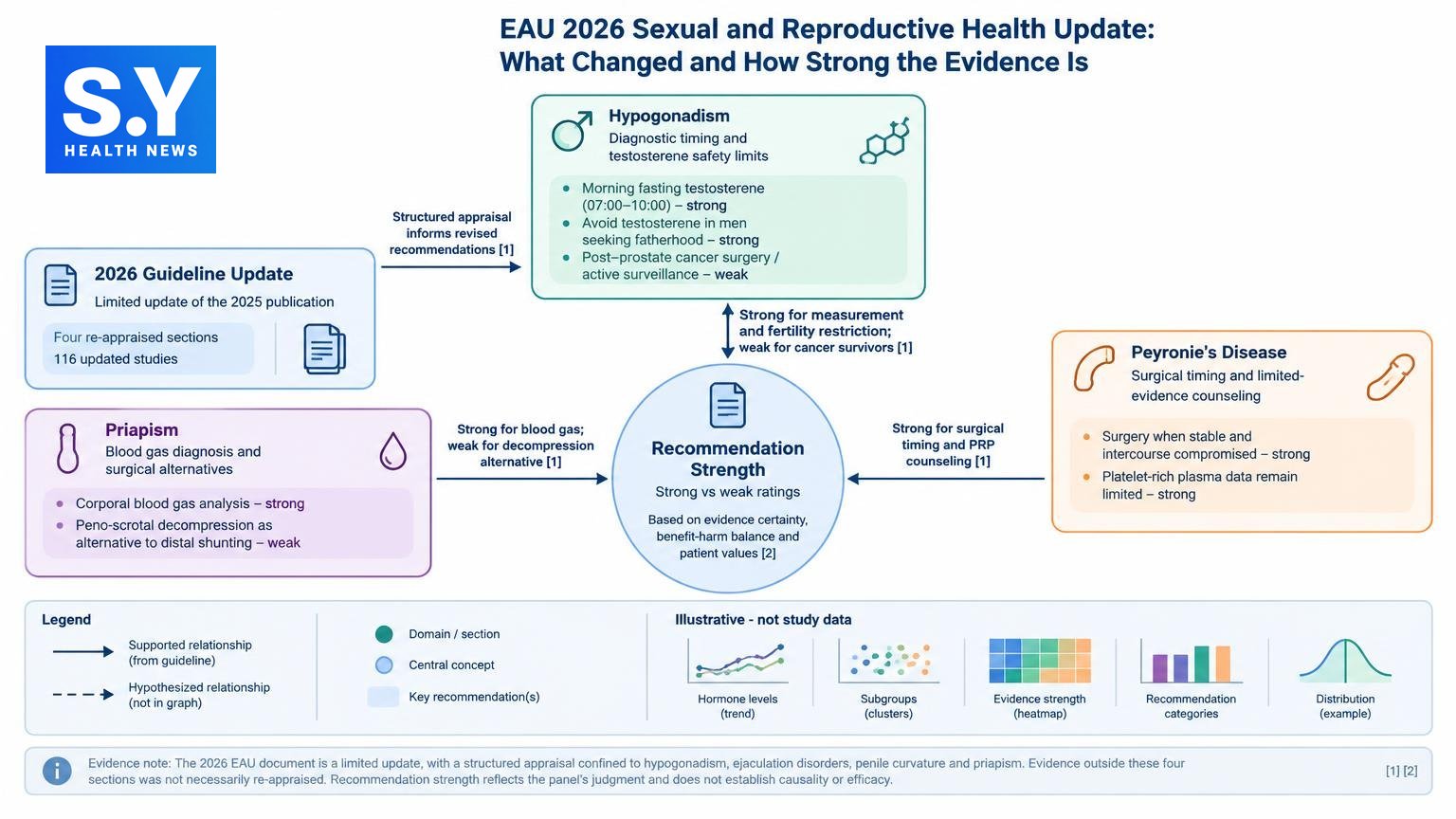
Conceptual framework: Conceptual framework. The 2026 EAU sexual and reproductive health document is a limited update (116 studies across four re-appraised sections). Arrows show how each domain connects to the panel's strong or weak recommendation ratings, which weigh evidence certainty, benefit-harm balance and patient values. This is a conceptual map of guideline structure, not a tested causal model or a biological pathway. Evidence outside these four sections was not necessarily re-appraised.
Academic References & Evidence
- Introduction – EAU Guidelines on Sexual and Reproductive Health – Uroweb.
- European Association of Urology guidelines on male sexual and reproductive health: 2025 update on male infertility. REPRODUCTIVE ENDOCRINOLOGY. 2026 (84):80–84 DOI: 10.18370/2309-4117.2026.84.80-84.
- Suks Minhas; Luca Boeri; Paolo Capogrosso; Andrea Cocci; Giovanni Corona; Marij Dinkelman-Smit; Marco Falcone; Christian Fuglesang Jensen; Murat Gül; Arif Kalkanli; Ates Kadioğlu; Juan I Martinez-Salamanca; L Afonso Morgado; Giorgio I Russo; Ege Can Serefoğlu; Paolo Verze; Andrea Salonia. European Association of Urology Guidelines on Male Sexual and Reproductive Health: 2025 Update on Male Infertility. European Urology. 2025 87(5):601-616 DOI: 10.1016/j.eururo.2025.02.026.
- Paolo Capogrosso; Marij Dinkelman-Smit. 2026 update on EAU Guidelines for Sexual & Reproductive Health.
- Graziottin A.. Disturbi sessuali e riproduttivi maschili: le linee guida dell'Associazione Europea di Urologia – Disturbi sessuali maschili – Alessandra Graziottin. Eur Urol. 2025 88(1):76-102 DOI: 10.1016/j.eururo.2025.04.010. PMID: 40340108.
- EAU Guidelines on Sexual and Reproductive Health – Uroweb.
SANYUN Science Center explains published research on men's reproductive and sexual health, connecting scientific evidence with everyday questions while making sources and limitations clear.
Disclaimer: This article is for scientific education and research communication only. It does not provide medical advice, diagnosis, or individualized treatment recommendations, and does not endorse any medication, supplement, device, penile enlargement procedure, or other intervention. Decisions about sexual and reproductive health should be made in consultation with a qualified healthcare professional. Do not delay seeking professional care because of information in this article.
Original Content & Copyright Notice
- This article is prepared for SANYUN Science Center, drawing on published research and publicly available academic literature on men’s sexual and reproductive health. Its editorial explanations and presentation are developed for this platform.
- Copyright in the original editorial content, selection, and arrangement is reserved by SANYUN Science Center to the extent protected by applicable law. Referenced research, quotations, and third-party materials remain subject to the rights of their respective owners. This notice does not claim ownership of scientific facts or third-party research.
- Except where permitted by applicable law or an applicable license, prior written permission is required to reproduce, republish, translate, adapt, redistribute, or commercially reuse protected content. Attribution alone does not grant permission for such reuse.
- For permitted quotation or authorized reuse, clearly identify the source and retain a link to the original article.
- Source: SANYUN Science Center
- Original URL: Retain the original article URL on science.san-yun.com.
- Copyright Holder: SANYUN Science Center, for its own protected editorial content.
- Quotation, excerpts, or authorized reuse must not distort the scientific meaning, omit material limitations or disclaimers, or imply unverified medical claims, product efficacy, or endorsement by SANYUN Science Center.



