




Category: Latest Research
Core Research Direction: Comparative efficacy and safety of non-pharmacological interventions (electrical stimulation, exercise, Li-ESWT, acupuncture-based therapies, hyperbaric oxygen) for erectile dysfunction, from a 2026 systematic review and network meta-analysis of 31 RCTs
Search Intent: Among non-drug treatments for erectile dysfunction, which approach has the strongest trial evidence for improving erectile function, and how confident can readers be in that ranking?
Platform: SANYUN Science Center
Evidence reviewed through: 2026-10-31
A systematic review and network meta-analysis published in early 2026 pooled 31 randomized controlled trials with 1874 participants to compare five non-pharmacological approaches to erectile dysfunction. On the International Index of Erectile Function-5, electrical stimulation combined with exercise produced the largest improvement versus sham or placebo, with a mean difference of 6.81 points. The authors also describe overall evidence quality as low, and repeated protocol variation limits how far the ranking can be generalized.[1]
Executive Summary
The review compared electrical stimulation, exercise, low-intensity extracorporeal shockwave therapy, acupuncture-based therapies and hyperbaric oxygen therapy. Its stated objective was to evaluate and compare efficacy and safety across these options, a question that matters because many men with erectile dysfunction respond inadequately to phosphodiesterase type 5 inhibitors and non-drug interventions have been proposed as alternatives or adjuncts.
Electrical stimulation alone also improved IIEF-5, with a smaller mean difference of 2.86 points, while low-intensity shockwave therapy showed a mean difference of 0.65 points and a confidence interval touching zero. Hyperbaric oxygen and other modalities ranked lower on efficacy. No serious adverse events were reported; transient muscle strain and headache were the noted minor events, and certainty ratings ranged from low to high across comparisons.
Two cautions temper the headline. The authors state that overall evidence quality remains low because of intervention variability and small sample sizes, which sits awkwardly beside high-certainty ratings for some comparisons. Separately, a commentary published alongside the abstract on a manufacturer-hosted literature page flags as possibly implausible the reported 3.38-point improvement in Erection Hardness Score for electrical stimulation, given that the score is usually measured on a 1 to 4 scale.
Why This Matters
Non-drug options attract interest because not every man with erectile dysfunction obtains an adequate response from standard drug treatment. The review frames these interventions as potential alternatives or adjuncts rather than routine replacements. For readers, the useful question is narrower than a league table: which approaches have the most consistent trial support, and how much confidence does the underlying evidence justify.
Network meta-analysis allows indirect comparison of treatments that have rarely been tested head-to-head. The price is that it inherits the weaknesses of the contributing trials. With 31 trials covering several modalities and their combinations, some comparisons probably rest on few trials or on indirect evidence alone, so the ranking should be read as a summary of what has been tested rather than proof of superiority for an individual patient.
How the Review Was Conducted
The review was registered in PROSPERO, followed PRISMA guidance and searched eight databases for randomized controlled trials through December 2025. Outcomes were IIEF-5, Erection Hardness Score, peak systolic velocity and adverse events, with risk of bias assessed using RoB 2.0 and certainty assessed with CINeMA. The five intervention categories were electrical stimulation, exercise, low-intensity extracorporeal shockwave therapy, acupuncture-based therapies and hyperbaric oxygen therapy.
Thirty-one trials contributed 1874 participants. Protocol registration and pre-specified outcomes are strengths, although registration does not by itself guarantee that every reported analysis matched the protocol in detail. The abstract does not state how many trials contributed to each specific comparison, which limits how far the ranking can be inspected.
Biological and Clinical Rationale
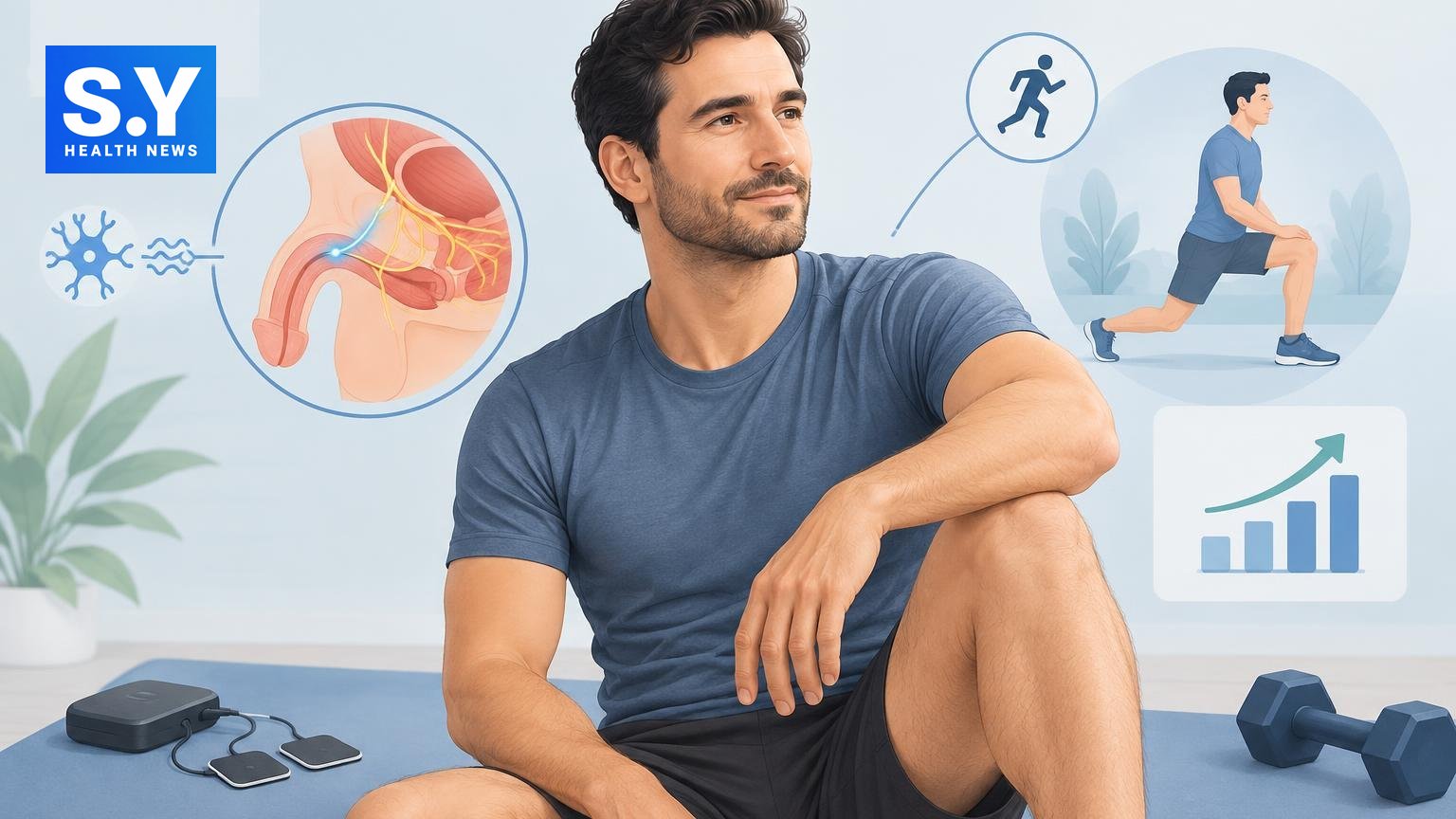
Erection depends on coordinated nerve signalling, pelvic floor muscle function and blood-flow regulation. In this literature, electrical stimulation generally means delivering mild electrical pulses to nerves or pelvic floor muscles involved in erection, with the aim of improving those components. The commentary notes that trials have used transcutaneous, pelvic-floor, penile or perineal, and nerve stimulation approaches, each with different electrode placement, intensity, frequency and schedule.
Exercise programmes in the included trials mainly consisted of aerobic training at 30 to 60 minutes, three to five sessions per week, or structured pelvic floor muscle training, typically over three to six months. Low-intensity shockwave protocols typically used energy flux densities of 0.09 to 0.20 mJ/mm2 and 1500 to 5000 pulses per session, given one to two times weekly over three to ten weeks. That spread illustrates a central interpretive problem: one intervention label can cover substantially different treatments.
What the Evidence Shows
| Measure / finding | Result | Population / follow-up | Limitations |
|---|---|---|---|
| IIEF-5 mean difference vs sham/placebo | 6.81 IIEF-5 points | men with erectile dysfunction in included RCTs; n=1874; trials through December 2025 | Based on a subset of the 31 RCTs; pooled estimate from indirect and direct comparisons with intervention variability; certainty rating for this comparison was disputed in the commentary. |
| IIEF-5 mean difference | 2.86 IIEF-5 points | men with erectile dysfunction in included RCTs; n=1874; trials through December 2025 | Pooled estimate; comparator and trial count for this comparison not specified in the abstract. |
| IIEF-5 mean difference | 0.65 IIEF-5 points | men with erectile dysfunction in included RCTs; n=1874; trials through December 2025 | Effect size near null with borderline confidence interval; may not be clinically meaningful. |
| EHS and PSV mean differences | 3.38; 7.33 EHS points; PSV units (not specified in source) | men with erectile dysfunction in included RCTs; n=1874; trials through December 2025 | No confidence intervals given for these secondary outcomes in the abstract; source commentary flags the EHS difference as possibly implausible on a 1-4 scale. |
| adverse events | men with erectile dysfunction in included RCTs; n=1874; trials through December 2025 | Safety data from a modest total sample and likely short follow-up. | |
| The authors state overall evidence quality remains low due to intervention variability and small samples, and call for larger high-quality trials to confirm long-term efficacy and safety across diverse populations. | men with erectile dysfunction | Conclusion-level judgment; note tension with high-certainty ratings reported for some comparisons. | |
| The source commentary cautions that a 3.38-point EHS mean difference is extremely large for a usual 1-4 scale and may be implausible depending on calculation, recommending verification against the full paper. | men with erectile dysfunction in included RCTs | Critique by a commentator, not a formal re-analysis; reflects a concern to verify, not a confirmed error. |
The largest IIEF-5 signal belonged to electrical stimulation plus exercise, at a mean difference of 6.81 points versus sham or placebo with a confidence interval of 3.50 to 10.12 and a SUCRA of 98.1%. Because IIEF-5 runs from 5 to 25, the commentary suggests that an improvement of roughly 6 to 7 points could be clinically meaningful for many patients, though that is an interpretive benchmark rather than a validated minimal important difference from the study.
Statistical significance and practical importance diverge most clearly for shockwave therapy. Its mean difference of 0.65 points carries a confidence interval from 0.00 to 1.29, a range that includes no effect and sits well below any threshold likely to matter to patients. Electrical stimulation alone sits in between: a smaller gain than the combination, but one whose confidence interval stays above zero.
The secondary outcomes warrant more caution than the primary result. The abstract reports a 3.38-point Erection Hardness Score advantage for electrical stimulation and a peak systolic velocity increase of 7.33 with shockwave therapy plus exercise, without confidence intervals. The commentary questions whether 3.38 is plausible on a scale normally scored 1 to 4, and recommends checking the full paper. These figures should not be used to guide care until that verification is available.
On safety, no serious adverse events were reported. Minor events were transient muscle strain and headache. The commentary judges the interventions generally well tolerated but warns that safety conclusions are constrained by the modest total sample and possibly short follow-up, so uncommon or delayed harms cannot be excluded from a dataset of this size.
Reading the Rankings and the Certainty Message
SUCRA values are often read as a league table, but they express the probability of ranking well within a specific network, not the size of benefit a patient should expect. Rankings can shift when the network is sparse or heterogeneous. A SUCRA of 98.1% means the combination performed strongly in this network; it does not establish that the combination is definitively the best option in practice.
Certainty is described inconsistently. The results report high-certainty evidence for some comparisons, notably electrical stimulation plus exercise, while the conclusion states that overall evidence quality remains low because of intervention variability and small sample sizes. One plausible reading is that these refer to different levels, with certainty assigned per comparison and a broader judgement applied to the evidence base as a whole. Either way, the high-certainty labels should be treated as conditional rather than as an endorsement of the field.
A further limit is definitional. Electrical stimulation is not one standardized treatment, and results from one protocol may not transfer to a commercial device or home-use product. The same caution applies to exercise and shockwave therapy, whose doses and schedules varied across trials, which makes cross-study comparison approximate at best.
Research Outlook
The authors call for larger, high-quality trials to confirm long-term efficacy and safety across diverse patient populations. Useful trials would standardize intervention protocols, report adverse events over adequate follow-up, and include men with varying baseline severity and prior responses to drug treatment. Until such data exist, the network meta-analysis supports a cautious, individualized conversation rather than a firm recommendation of one non-drug approach over another.
Key Takeaways
- Electrical stimulation plus exercise produced the largest IIEF-5 improvement versus sham or placebo, with a mean difference of 6.81 points in a confidence interval of 3.50 to 10.12.
- Electrical stimulation alone also improved IIEF-5, with a mean difference of 2.86 points, while low-intensity shockwave therapy showed a modest 0.65-point effect whose confidence interval touched zero.
- No serious adverse events were reported, but the modest total sample and possibly short follow-up limit safety conclusions.
- The authors describe overall evidence quality as low because of intervention variability and small samples, which sits in tension with high-certainty ratings reported for some comparisons.
- The reported 3.38-point hardness-score improvement for electrical stimulation may be implausible on a 1 to 4 scale and should be verified against the full paper before any clinical use.
- Electrical stimulation covers different devices and protocols, so findings from one trial may not apply to a given commercial or home-use product.
Questions and Answers
What exactly did this review compare, and in what kind of study design?
It was a systematic review and network meta-analysis of randomized controlled trials, registered in PROSPERO and following PRISMA guidance, with searches of eight databases through December 2025. Five intervention categories were compared: electrical stimulation, exercise, low-intensity extracorporeal shockwave therapy, acupuncture-based therapies and hyperbaric oxygen therapy. Outcomes were IIEF-5, Erection Hardness Score, peak systolic velocity and adverse events across 31 trials and 1874 participants.
Which non-drug approach showed the largest improvement in erectile function?
Electrical stimulation combined with exercise showed the largest IIEF-5 improvement versus sham or placebo, with a mean difference of 6.81 points and a confidence interval of 3.50 to 10.12. Electrical stimulation alone also improved IIEF-5, with a mean difference of 2.86 points. Low-intensity shockwave therapy showed only a modest 0.65-point effect whose confidence interval touched zero, which may not be clinically meaningful.
How much confidence does the evidence behind these rankings actually justify?
Less than the ranking suggests. Some comparisons, including electrical stimulation plus exercise, were rated high certainty, yet the authors describe overall evidence quality as low because of intervention variability and small sample sizes. The accompanying commentary also notes that this apparent inconsistency may reflect comparison-level versus overall certainty, and that SUCRA rankings can be unstable when a network is sparse or heterogeneous.
Can these results be applied to any electrical stimulation device or home-use product?
No. The commentary stresses that electrical stimulation is not one standardized treatment: trials varied in electrode placement, intensity, frequency, duration and schedule, so results from one protocol may not generalize to a particular commercial device or home product. Exercise and shockwave protocols varied too, over three to six months and one to two weekly sessions respectively, which further limits direct comparison across studies.
Why does the reported hardness-score result need verification?
The abstract reports a 3.38-point Erection Hardness Score advantage for electrical stimulation, but no confidence interval is given. The commentary notes that the score is usually measured on a 1 to 4 scale, making a difference of that size extremely large and possibly implausible depending on how it was calculated, and recommends checking the full paper. It is a concern to verify, not a confirmed error.
What are the main safety and applicability limits readers should keep in mind?
No serious adverse events were reported, and minor events were transient muscle strain and headache. However, the commentary cautions that tolerability conclusions rest on a modest total sample of 1874 participants and possibly short follow-up, so uncommon or longer-term harms cannot be ruled out. The authors also call for larger trials in more diverse populations before long-term efficacy and safety can be confirmed.
Sources and References
- He X; Li T; Huang W; Liu G; Yang T; Zhang X; Li X; Feng Q. He X. et al., 2026: Comparative efficacy and safety of non-pharmacological interventions for erectile dysfunction:a systematic review and network meta-analysis.. Sex Med Rev. 2026 14(1):qeag004 DOI: 10.1093/sxmrev/qeag004.
SANYUN Science Center explains published research on men's reproductive and sexual health, connecting scientific evidence with everyday questions while making sources and limitations clear.
Disclaimer: This article is for scientific education and research communication only. It does not provide medical advice, diagnosis, or individualized treatment recommendations, and does not endorse any medication, supplement, device, penile enlargement procedure, or other intervention. Decisions about sexual and reproductive health should be made in consultation with a qualified healthcare professional. Do not delay seeking professional care because of information in this article.
Original Content & Copyright Notice
- This article is prepared for SANYUN Science Center, drawing on published research and publicly available academic literature on men’s sexual and reproductive health. Its editorial explanations and presentation are developed for this platform.
- Copyright in the original editorial content, selection, and arrangement is reserved by SANYUN Science Center to the extent protected by applicable law. Referenced research, quotations, and third-party materials remain subject to the rights of their respective owners. This notice does not claim ownership of scientific facts or third-party research.
- Except where permitted by applicable law or an applicable license, prior written permission is required to reproduce, republish, translate, adapt, redistribute, or commercially reuse protected content. Attribution alone does not grant permission for such reuse.
- For permitted quotation or authorized reuse, clearly identify the source and retain a link to the original article.
- Source: SANYUN Science Center
- Original URL: Retain the original article URL on science.san-yun.com.
- Copyright Holder: SANYUN Science Center, for its own protected editorial content.
- Quotation, excerpts, or authorized reuse must not distort the scientific meaning, omit material limitations or disclaimers, or imply unverified medical claims, product efficacy, or endorsement by SANYUN Science Center.



