




Category: Erectile Dysfunction
Core Research Direction: Erectile dysfunction as a vascular and cardiovascular risk marker, and evidence-based management (PDE5 inhibitors, lifestyle/exercise, testosterone in hypogonadism, and investigational or uncertain adjuncts) per the 2025 EAU male sexual and reproductive health guideline
Search Intent: Does erectile dysfunction signal underlying cardiovascular disease, what does the 2025 EAU guideline recommend for its evaluation and treatment, and how strong is the evidence for erectile-dysfunction therapies?
Platform: SANYUN Science Center
Evidence reviewed through: 2026-11-02
Executive Summary
Erectile dysfunction is defined in the 2025 European Association of Urology (EAU) guideline summary as the persistent inability to attain and maintain an erection sufficient for satisfactory sexual performance. The same summary describes an updated systematic review of literature published between 2021 and 2024, with recommendations graded on the balance of benefits and harms, the quality of available evidence, and patient preferences. Treatment is framed as individualised according to invasiveness, tolerability, efficacy and patient expectations rather than as a fixed sequence.[1]
The cardiovascular signal is the most consequential part of the evidence base. A 2023 umbrella review of prior meta-analyses reported that men with erectile dysfunction had higher relative risks of cardiovascular disease, coronary heart disease, cardiovascular mortality, myocardial infarction, stroke and all-cause mortality, all reported at P less than 0.001. These are pooled observational associations: they support erectile dysfunction as a risk marker, not as a proven cause of cardiovascular events. Consensus guidance cited in the same secondary source recommends cardiovascular risk assessment before starting erectile dysfunction treatment.[2]
Treatment evidence is uneven. PDE5 inhibitors are described as effective in roughly 60 to 80 percent of men and remain first-line pharmacotherapy, with an absolute contraindication to nitrates because of severe hypotension risk. Testosterone therapy in hypogonadal men was cardiovascular-neutral for major adverse cardiac events in TRAVERSE (HR 0.96, 95% CI 0.78–1.17 over a mean 21.7 months) but carried higher rates of pulmonary embolism, atrial fibrillation and acute kidney injury. Low-intensity shockwave therapy showed short-term and long-term IIEF-EF improvements versus sham in a 2025 Cochrane review, but with low certainty and investigational status.
Why This Matters
Erectile dysfunction is common, under-discussed in clinical settings, and frequently vascular in origin. The packet's secondary clinical guide states that roughly 70 percent of erectile dysfunction cases have a vascular component. That figure is presented without a denominator or trial context, so it should be read as an approximate descriptor rather than a precise epidemiological estimate. Even so, it aligns with the broader mechanistic framing: penile arteries are small-diameter end-organs that may manifest systemic endothelial and atherosclerotic disease earlier than larger coronary vessels.
The 2025 EAU guideline update is relevant because it consolidates recommendations across hypogonadism, erectile dysfunction, premature ejaculation and Peyronie's disease. Its stated method was an updated systematic review of 2021–2024 publications in Medline, Embase and Cochrane Libraries, with practical recommendations on diagnosis, treatment and follow-up. That design supports a structured review of the field, but the packet supplies only a secondary summary by a commentator, not the full guideline text or its evidence tables. Readers should therefore treat the recommendations as accurately paraphrased rather than independently verified line-by-line.
Biological and Clinical Mechanism
An erection requires coordinated nervous, vascular, hormonal and psychological activity. According to the packet's physiological description, sexual arousal triggers nerve signals that release nitric oxide in the penile arteries. Nitric oxide activates guanylate cyclase, which produces cyclic GMP; cGMP relaxes arterial smooth muscle and allows blood to fill the corpora cavernosa. PDE5 inhibitors act by blocking the enzyme that breaks down cGMP, so they amplify this pathway but do not initiate an erection without sexual stimulation.
The cardiovascular link is usually explained through shared endothelial dysfunction and atherosclerosis. The same processes that narrow coronary arteries can narrow penile arteries, and the smaller calibre of penile vessels is proposed as a reason symptoms may appear earlier. This is a plausible and widely discussed mechanism, but the packet's mechanistic statements are descriptive rather than derived from a dedicated causal experiment. The pooled relative risks in the umbrella review are observational associations; residual confounding by age, smoking, diabetes, hypertension and adiposity cannot be excluded from a secondary summary.
Obstructive sleep apnea provides another candidate mechanism. In a 2018 study of 150 men newly diagnosed with moderate to severe obstructive sleep apnea, erectile dysfunction prevalence was 51 percent. The proposed pathways include intermittent nocturnal hypoxia damaging the vascular endothelium, sleep fragmentation disrupting testosterone production, and chronic sympathetic activation worsening endothelial function. These mechanisms are hypotheses in the packet; the cohort establishes prevalence, not causation.
What the Evidence Shows
The strongest quantitative signal in the packet concerns cardiovascular risk. The 2023 umbrella review reported relative risks of 1.45 for cardiovascular disease (95% CI 1.36–1.54), 1.50 for coronary heart disease, 1.50 for cardiovascular mortality, 1.55 for myocardial infarction, 1.36 for stroke and 1.25 for all-cause mortality, all at P less than 0.001. Relative risks in this range are statistically robust in pooled analyses but do not translate directly into individual absolute risk without baseline risk, age and comorbidity data, which the packet does not supply. The confidence interval for the primary cardiovascular disease estimate is provided; the others are not, which limits precision assessment for those outcomes.
| Therapy or factor | Design or source | Reported result | Evidence interpretation |
|---|---|---|---|
| PDE5 inhibitors | Clinical guide summary of first-line pharmacotherapy | Effective in roughly 60 to 80 percent of men with erectile dysfunction | Widely used first-line option; requires sexual stimulation; absolute contraindication with nitrates |
| Testosterone therapy in hypogonadal men | TRAVERSE trial, 5,246 men, mean 21.7 months | MACE HR 0.96 (95% CI 0.78–1.17); higher pulmonary embolism 0.9 vs 0.5 percent, atrial fibrillation 3.5 vs 2.4 percent, acute kidney injury 2.3 vs 1.5 percent | Cardiovascular-neutral for MACE in this population; absolute increases in specific adverse events require counselling |
| Low-intensity shockwave therapy | 2025 Cochrane review, 21 randomized trials, 1,357 men | Short-term IIEF-EF improvement of roughly 3.9 points; long-term 5.3 points versus sham | Low certainty of evidence; investigational status; short-term and long-term differences should not be read as proven durable benefit |
| Erectile dysfunction as cardiovascular marker | 2023 JACC Advances umbrella review of prior meta-analyses | CVD RR 1.45 (95% CI 1.36–1.54); CHD RR 1.50; CV mortality RR 1.50; MI RR 1.55; stroke RR 1.36; all-cause mortality RR 1.25 | Observational association; supports risk assessment, not causation |
| Obstructive sleep apnea | 2018 cohort, 150 men with moderate to severe OSA | ED prevalence 51 percent | Single cohort; prevalence signal only; mechanism proposed, not tested |
Interpreting the Treatment Landscape
The 2025 EAU algorithm is explicitly patient-centred. It defines erectile dysfunction and personalises treatment according to invasiveness, tolerability, efficacy and patient expectations. Recommendation strength was graded on benefits versus harms, evidence quality and patient values. This framework matters clinically because it resists a rigid stepwise ladder: a man's preferences, cardiovascular status, comorbidity and prior response all influence sequencing. The packet's paraphrase does not list specific drug doses or treatment order, so this review does not reproduce a prescribing protocol.
PDE5 inhibitors remain the pharmacological anchor in the secondary clinical guide, but the often-quoted 60 to 80 percent response range lacks a denominator in the packet. Apparent treatment failure is frequently attributed to incorrect use, inadequate stimulation, food interactions, insufficient trials at optimal dose or unrecognised hypogonadism; these are practical considerations rather than trial-derived predictors in the supplied material. The nitrate contraindication is absolute and potentially fatal, and the packet also flags caution with alpha-blockers and CYP3A4 inhibitors.
Testosterone occupies a narrower role than marketing sometimes implies. The packet describes testosterone replacement as improving libido and augmenting PDE5 inhibitor response in confirmed hypogonadism, but not as standalone erectile dysfunction therapy. TRAVERSE provides the strongest cardiovascular safety signal in the packet: in 5,246 hypogonadal men with elevated cardiovascular risk, transdermal testosterone was non-inferior to placebo for major adverse cardiac events over a mean 21.7 months. The same trial detected small absolute increases in pulmonary embolism, atrial fibrillation and acute kidney injury. A 2026 meta-analysis of 41 randomized trials corroborated the null MACE signal (OR 0.83, 95% CI 0.52–1.32), with a confidence interval crossing 1.0.
Exercise is often presented as a foundational lifestyle intervention. The packet cites a 2023 meta-analysis suggesting aerobic exercise improves IIEF-EF scores by roughly 2.8 points, but this figure appears in the narrative guide rather than as a validated fact entry. Because the packet's factual register does not preserve the surrounding trial details, this review treats the exercise estimate as context rather than a precise effect size. The 2025 EAU summary similarly does not supply exercise effect estimates.
Emerging adjuncts require careful reading. Low-intensity shockwave therapy improved IIEF-EF scores versus sham in a 2025 Cochrane review of 21 trials and 1,357 men, with short-term gains of roughly 3.9 points and long-term gains of 5.3 points, but the certainty of evidence was low. The packet notes that the AUA classifies shockwave therapy as investigational. GLP-1 receptor agonists present a two-sided picture: a 2025 controlled pilot study found tirzepatide improved IIEF-5 and raised testosterone, LH, FSH and SHBG in men with obesity-associated hypogonadism, whereas a 2024 TriNetX database analysis found a higher rate of new erectile dysfunction diagnoses and testosterone deficiency in non-diabetic, non-hypogonadal men taking semaglutide for weight loss, with attenuation after adjustment. These are not interchangeable populations or designs.
Limitations and Conflicting Findings
Several limitations constrain interpretation. First, the EAU 2025 guideline is represented only by a secondary Italian-language commentary; the full recommendations, evidence grades and scope are not in the packet. Second, the clinical guide is a physician-authored narrative source, not a systematic review, and many of its claims are cited second-hand. Third, the cardiovascular relative risks come from an umbrella review of observational meta-analyses: they cannot establish that erectile dysfunction causes cardiovascular disease, and they may reflect shared risk factors. Fourth, the treatment estimates mix trial data, meta-analyses, cohort studies and expert opinion without a common risk-of-bias assessment.
There are also internal tensions worth naming. Testosterone looks cardiovascular-neutral for major adverse cardiac events in TRAVERSE but shows higher rates of specific adverse events, so 'neutral' should not be read as 'risk-free'. Shockwave therapy shows statistically positive score changes against sham but low certainty, so statistical improvement may not equal clinically meaningful or durable benefit for an individual. GLP-1 findings point in different directions depending on baseline metabolic and gonadal status. Penile implant satisfaction above 90 percent is reported but without denominators or trial context, so it cannot be compared head-to-head with medication response rates.
The packet also touches on Peyronie's disease, where baseline assessment should distinguish acute from stable phases and surgery should be reserved for deformity that negatively affects sexual function, with penile prosthesis for concomitant erectile dysfunction. These recommendations are adjacent to the main erectile dysfunction question and are included only to show the guideline's broader scope, not as core evidence for erectile dysfunction management.
Research and Clinical Outlook
The most defensible clinical message is that erectile dysfunction should prompt cardiovascular risk assessment, especially in younger men or those with metabolic risk factors. The 2024 Princeton IV Consensus, as reported in the secondary guide, recommends cardiovascular risk assessment before starting treatment for any man presenting with erectile dysfunction. This is a consensus recommendation rather than a trial-proven pathway, and the packet does not include the primary consensus document.
Future research priorities suggested by the evidence gaps include adequately powered trials with hard cardiovascular endpoints, standardised definitions of clinically meaningful IIEF-EF change, longer follow-up for shockwave therapy, and clearer separation of obesity-mediated versus drug-mediated GLP-1 effects on erectile function. The 2026 meta-analysis of testosterone trials helps stabilise the cardiovascular safety picture, but its confidence interval crosses 1.0 and it is not an erectile dysfunction outcome analysis. The 2025 EAU systematic review window of 2021–2024 means newer primary studies may not be reflected in its recommendations.
Key Takeaways
- Erectile dysfunction is defined as the persistent inability to attain and maintain an erection sufficient for satisfactory sexual performance; the 2025 EAU algorithm individualises treatment by invasiveness, tolerability, efficacy and patient expectations.
- Pooled observational data associate erectile dysfunction with higher relative risks of cardiovascular disease (RR 1.45, 95% CI 1.36–1.54), coronary heart disease (RR 1.50), cardiovascular mortality (RR 1.50), myocardial infarction (RR 1.55), stroke (RR 1.36) and all-cause mortality (RR 1.25); these are associations, not proof of causation.
- PDE5 inhibitors are described as effective in roughly 60 to 80 percent of men and are absolutely contraindicated with nitrates because of severe hypotension risk.
- In TRAVERSE, transdermal testosterone was non-inferior to placebo for major adverse cardiac events (HR 0.96, 95% CI 0.78–1.17) over a mean 21.7 months in 5,246 hypogonadal men with elevated cardiovascular risk, but pulmonary embolism, atrial fibrillation and acute kidney injury were more frequent in the testosterone arm.
- Low-intensity shockwave therapy improved IIEF-EF scores versus sham by roughly 3.9 points short-term and 5.3 points long-term in a 2025 Cochrane review of 21 trials and 1,357 men, with low certainty and investigational status.
- GLP-1 receptor agonist findings differ by population: tirzepatide improved IIEF-5 and raised testosterone in a small 2025 pilot study of obesity-associated hypogonadism, whereas a 2024 database analysis found a higher rate of new erectile dysfunction diagnoses in non-hypogonadal men using semaglutide for weight loss, with attenuation after adjustment.
Questions and Answers
What is erectile dysfunction and how does the 2025 EAU guideline define it?
The 2025 EAU guideline summary defines erectile dysfunction as the persistent inability to attain and maintain an erection sufficient for satisfactory sexual performance. The guideline's treatment algorithm aims to support individualised care based on the invasiveness, tolerability and efficacy of options and on patient expectations. The definition comes from a secondary summary, not the full guideline text.
Does erectile dysfunction increase the risk of heart attack and stroke?
A 2023 umbrella review of prior meta-analyses reported that men with erectile dysfunction had higher relative risks of myocardial infarction (RR 1.55) and stroke (RR 1.36), along with cardiovascular disease (RR 1.45) and cardiovascular mortality (RR 1.50). These are pooled observational associations, not proof of causation. Individual absolute risk still depends on baseline cardiovascular risk factors, which the packet does not quantify.
How effective are PDE5 inhibitors for erectile dysfunction and what is the main safety concern?
The packet's clinical guide describes PDE5 inhibitors as effective in roughly 60 to 80 percent of men with erectile dysfunction; the range is given without a denominator or trial context. They require sexual stimulation and are absolutely contraindicated with nitrate medications and recreational nitrites because the combination can cause severe, potentially fatal hypotension. Apparent failure is often attributed to incorrect use or insufficient trials rather than true non-response.
Is testosterone therapy safe for the heart in men with hypogonadism and erectile dysfunction?
In TRAVERSE, 5,246 hypogonadal men with elevated cardiovascular risk received transdermal testosterone or placebo for a mean 21.7 months; testosterone was non-inferior for major adverse cardiac events (HR 0.96, 95% CI 0.78–1.17). However, pulmonary embolism, atrial fibrillation and acute kidney injury were more frequent in the testosterone arm. A 2026 meta-analysis of 41 trials corroborated the null MACE signal (OR 0.83, 95% CI 0.52–1.32), but the confidence interval crosses 1.0.
What does the evidence say about low-intensity shockwave therapy for erectile dysfunction?
A 2025 Cochrane review of 21 randomized trials involving 1,357 men found that low-intensity shockwave therapy may improve short-term IIEF-EF scores by roughly 3.9 points and long-term scores by 5.3 points versus sham. The certainty of evidence was low, and the AUA classifies the treatment as investigational. Statistical score improvements in pooled trials do not guarantee clinically meaningful or durable benefit for an individual patient.
How strong is the evidence behind the 2025 EAU erectile dysfunction recommendations?
The 2025 EAU guideline was based on an updated systematic review of literature published from 2021 to 2024 in Medline, Embase and Cochrane Libraries. Recommendation strength was graded on benefits versus harms, evidence quality and patient preferences. However, this packet contains only a secondary commentary summarising the guideline, not the full recommendations or evidence tables, so the strength of individual recommendations cannot be independently verified here.
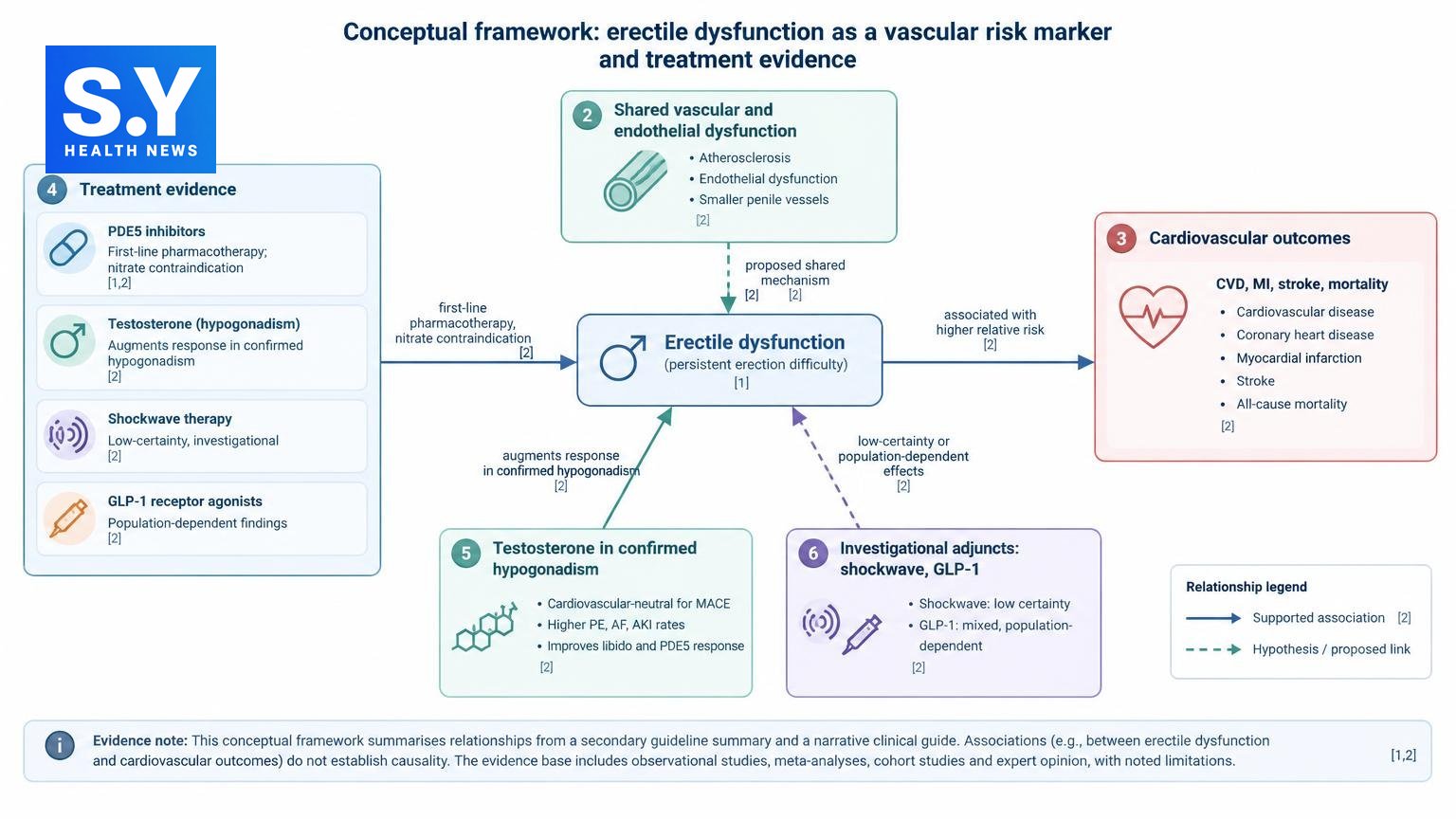
Conceptual framework: Conceptual framework, not a tested causal model. It summarises relationships discussed in this evidence review: erectile dysfunction is associated with higher relative risks of cardiovascular outcomes in pooled observational data; the shared vascular mechanism is proposed; PDE5 inhibitors are first-line pharmacotherapy with a nitrate contraindication; testosterone is relevant in confirmed hypogonadism; and shockwave and GLP-1 evidence is low-certainty or population-dependent. The framework is based on a secondary guideline summary and a narrative clinical guide, not on original research by the authors.
Academic References & Evidence
- Salonia A; Capogrosso P; Boeri L; Cocci A; Corona G; Dinkelman-Smit M; Falcone M; Jensen CF; Gül M; Kalkanli A; Kadioğlu A; Martinez-Salamanca JI; Afonso Morgado L; Russo GI; Serefoğlu EC; Verze P; Minhas S. Disturbi sessuali e riproduttivi maschili: le linee guida dell'Associazione Europea di Urologia – Disturbi sessuali maschili – Alessandra Graziottin. Eur Urol. 2025 88(1):76-102 DOI: 10.1016/j.eururo.2025.04.010. PMID: 40340108.
- Parth Bhavsar. Erectile Dysfunction. 2026
SANYUN Science Center explains published research on men's reproductive and sexual health, connecting scientific evidence with everyday questions while making sources and limitations clear.
Disclaimer: This article is for scientific education and research communication only. It does not provide medical advice, diagnosis, or individualized treatment recommendations, and does not endorse any medication, supplement, device, penile enlargement procedure, or other intervention. Decisions about sexual and reproductive health should be made in consultation with a qualified healthcare professional. Do not delay seeking professional care because of information in this article.
Original Content & Copyright Notice
- This article is prepared for SANYUN Science Center, drawing on published research and publicly available academic literature on men’s sexual and reproductive health. Its editorial explanations and presentation are developed for this platform.
- Copyright in the original editorial content, selection, and arrangement is reserved by SANYUN Science Center to the extent protected by applicable law. Referenced research, quotations, and third-party materials remain subject to the rights of their respective owners. This notice does not claim ownership of scientific facts or third-party research.
- Except where permitted by applicable law or an applicable license, prior written permission is required to reproduce, republish, translate, adapt, redistribute, or commercially reuse protected content. Attribution alone does not grant permission for such reuse.
- For permitted quotation or authorized reuse, clearly identify the source and retain a link to the original article.
- Source: SANYUN Science Center
- Original URL: Retain the original article URL on science.san-yun.com.
- Copyright Holder: SANYUN Science Center, for its own protected editorial content.
- Quotation, excerpts, or authorized reuse must not distort the scientific meaning, omit material limitations or disclaimers, or imply unverified medical claims, product efficacy, or endorsement by SANYUN Science Center.



