




Category: Clinical Insights
Core Research Direction: Erectile dysfunction as a marker of cardiometabolic and endothelial disease: mechanisms, diagnostic evaluation, and stepwise treatment context in adult men
Search Intent: Why does erectile dysfunction warrant cardiovascular assessment, what links it to endothelial dysfunction and metabolic disease, and how are PDE5 inhibitors and other therapies positioned in management?
Platform: SANYUN Science Center
Evidence reviewed through: 2026-11-13
Executive Summary
Erectile dysfunction (ED) is defined as the inability to achieve or maintain an erection sufficient for satisfactory sexual performance, and it can substantially reduce quality of life. It is not merely a sexual complaint: it is frequently a marker of underlying vascular and metabolic disease.[1]
The scale of the problem is large but imprecisely measured. At least 150 million men worldwide are estimated to have ED, yet true prevalence is uncertain because many patients do not seek care and many clinicians do not ask about sexual health.
ED is often an under-recognised cardiovascular risk factor, and because of its strong association with metabolic syndrome and cardiovascular disease (CVD), cardiac assessment is warranted in men who present with ED symptoms.
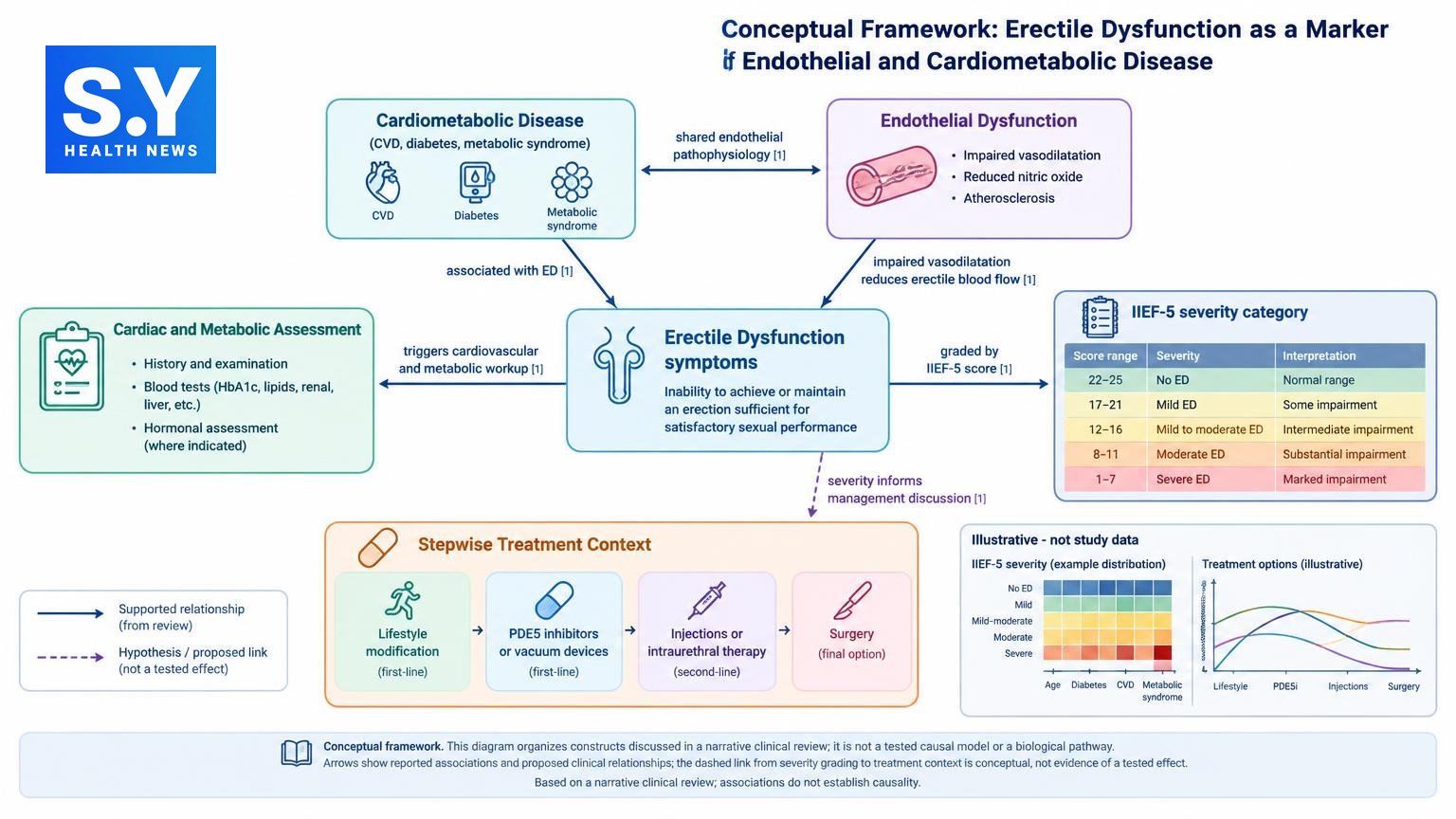
The link is biologically plausible: ED and vascular disease are thought to converge at the endothelium, the cell layer that governs vascular tone and participates in atherosclerosis. Evaluation therefore pairs a careful sexual and medical history with cardiovascular examination, metabolic blood testing and, where indicated, hormonal assessment. Treatment proceeds stepwise from lifestyle modification and first-line PDE5 inhibitors or vacuum devices to second-line injections or intraurethral therapy, with surgery reserved as a final option.
Why This Matters
The historic view of ED as an almost exclusively psychogenic disorder has been overturned. Current evidence suggests that more than 80% of cases have an organic aetiology, although psychological factors frequently coexist and can amplify distress, relationship strain and performance anxiety.
ED is not confined to older men. A 2013 study reported that about one in four men seeking medical help for ED in real-life settings was younger than 40 years, and a 2016 study found that 22.1% of men under 40 years had low Sexual Health Inventory for Men (SHIM) scores below 21, indicating some degree of erectile dysfunction.
Age remains relevant. Reported sexual activity participation falls from 73% among men aged 57–64 years to 26% among men aged 75–85 years, a decline that is multifactorial rather than a simple consequence of erectile failure alone.
Framing ED as a potential vascular warning has practical consequences. If a man's erectile difficulty is the first visible sign of endothelial dysfunction, diabetes or atherosclerosis, then treating the sexual symptom without assessing cardiometabolic risk may miss an opportunity for earlier risk-factor management.
Biological and Clinical Mechanism
An erection depends on blood flow into the corporal bodies and on relaxation of vascular smooth muscle. Endothelial dysfunction impairs the ability of arteriolar smooth muscle to relax and prevents vasodilatation, so the vascular events required for rigidity are compromised.
Atherosclerotic CVD narrows and hardens arteries, reducing blood flow to the corporal bodies that is essential for achieving an erection. Because both ED and CVD involve endothelial cell dysfunction in their pathophysiology, the penis can be viewed as a small-vessel vascular bed that may manifest systemic endothelial disease early.
Metabolic disease compounds the problem. Diabetes can affect both the blood vessels and the nerves supplying the penis; men with diabetes are reportedly four times more likely to experience ED and develop it on average about 15 years earlier than men without diabetes.
Not all ED is vascular. Neurogenic ED results from impaired nerve signalling to the corpora cavernosa, and can follow spinal cord injury, multiple sclerosis, Parkinson's disease, lumbar disc disease, traumatic brain injury, radical pelvic surgery or diabetes. Men treated for prostate cancer with radical prostatectomy, radiotherapy or LHRH agonists and antagonists frequently experience ED.
Medication review is part of mechanism-level reasoning. SSRIs such as citalopram, escitalopram, fluoxetine, fluvoxamine, paroxetine and sertraline can contribute to ED, and other prescribed drugs are recognised contributors.
What the Evidence Shows: Evaluation and Severity Grading
Clinical evaluation should distinguish psychogenic from organic ED and confirm that the patient has ED rather than another sexual disorder. Features pointing to a psychological cause include sudden onset, particularly if linked to a new partner or major life event, situational ED, normal erections with masturbation or another partner, morning erections, and high day-to-day variability in rigidity.
A full general and cardiovascular examination should be undertaken because ED can be the first symptom of underlying vascular disease. Recommended investigations include full blood count, electrolytes, renal and liver function, HbA1c to screen for diabetes and a lipid profile, with morning testosterone and other hormonal tests where hypogonadism is suspected.
| IIEF-5 score | Severity category | Interpretation |
|---|---|---|
| 22–25 | No ED | Erectile function in the normal range |
| 17–21 | Mild ED | Some impairment across the five items |
| 12–16 | Mild to moderate ED | Intermediate impairment |
| 8–11 | Moderate ED | Substantial impairment |
| 1–7 | Severe ED | Marked impairment of erectile function |
The IIEF-5, also known as SHIM, is a five-item validated questionnaire scored from 1 to 25. Severity bands are 1–7 severe, 8–11 moderate, 12–16 mild-moderate, 17–21 mild and 22–25 no ED. These bands are useful for communication and tracking, but they are symptom scores rather than direct measurements of endothelial function.
Stepwise Treatment Context
Initial ED management combines lifestyle modification with first-line therapy using PDE5 inhibitors and vacuum erection devices. Lifestyle measures are emphasised as first-line because they benefit both sexual function and overall health, and medication lists should be reviewed for contributing drugs.
PDE5 inhibitors enhance blood flow in the corpora cavernosa but do not initiate the erectile response: sexual stimulation is required to release nitric oxide from the vascular endothelium and penile nerve endings. They are described as highly effective with an overall success rate of up to 76%.
Safety is central. PDE5 inhibitors are contraindicated in patients taking nitrates because co-administration can cause pronounced systemic vasodilation and severe hypotension. The reported success rate is an aggregate figure, and underlying trial populations and definitions of success vary, so it should not be read as a guarantee for an individual.
Vacuum constriction devices are described as effective with high efficacy rates, although patient satisfaction is lower. Second-line options include intracavernosal injection and intraurethral prostaglandin suppositories; injection therapy carries a risk of priapism, which requires urgent medical attention. Penile prosthesis implantation is reserved for men who fail or decline conservative options.
Testosterone requires nuance. Supplementation is described as more effective for low libido than for ED, and oral PDE5 inhibitors alone are recommended as initial therapy for most men with both ED and hypogonadism; testosterone may be considered in proven hypogonadism after PDE5 inhibitor failure or with low libido. TRT may raise haemoglobin or haematocrit, which is associated with increased risk of heart attack, stroke and blood clots, and can cause prostate enlargement or other prostate disorders.
Interpretation and Limitations
The packet source is a narrative clinical review, not a systematic review or primary trial. Many quantitative statements are reported from cited studies whose sample sizes, settings and designs are not described in the review text, so precise prevalence, relative-risk and success-rate figures should be treated as context rather than definitive estimates.
Two distinct questions are often conflated: whether ED is associated with cardiometabolic disease, and whether treating ED changes cardiovascular outcomes. The review supports the association and recommends cardiac assessment, but it does not provide evidence that ED treatment reduces heart attacks or strokes. That remains an inference gap rather than an established benefit.
Severity scores and mechanistic statements also have limits. IIEF-5 bands classify symptoms but do not by themselves establish an organic cause; the psychogenic-versus-organic heuristics are clinical guides, not validated predictive instruments. Endothelial dysfunction is described as a shared pathway, but the review does not directly test it.
Research Outlook
Several emerging approaches remain early-stage. Gene therapy aims to replace proteins that may malfunction in penile tissue, but benefit has been demonstrated in animal models and human efficacy is not established. Stem cell studies report improved sexual function but are small-scale, short in follow-up, heterogeneous in aetiology and uncontrolled, which limits causal inference.
Melanocortin-pathway drugs such as intranasal PT-141 showed early signals in men with psychological causes of mild-to-moderate ED, but larger studies are needed to demonstrate safety and overall effectiveness. Low-intensity shock wave therapy is proposed to stimulate neovascularisation and endothelial function and may convert some PDE5 inhibitor non-responders, but this remains an investigational strategy.
Key Takeaways
- ED is common, often organic and frequently a marker of endothelial and cardiometabolic disease; cardiac assessment is warranted in symptomatic men.
- Evaluation should separate psychogenic from organic features, examine the cardiovascular system, and screen for diabetes, lipids and, where indicated, hypogonadism.
- Treatment is stepwise: lifestyle change and PDE5 inhibitors or vacuum devices first, then injections or intraurethral therapy, with surgery reserved for later.
- PDE5 inhibitors require sexual stimulation and are contraindicated with nitrates; testosterone is more useful for low libido than for ED itself and carries monitoring requirements.
Questions and Answers
What is erectile dysfunction and why is it considered a vascular condition?
ED is the inability to achieve or maintain an erection sufficient for satisfactory sexual performance. It is often vascular because ED and vascular disease are thought to share a link at the endothelium, and endothelial dysfunction impairs the smooth-muscle relaxation needed for vasodilatation and erection. More than 80% of cases are estimated to have an organic cause.
What does the evidence show about erectile dysfunction and cardiovascular risk?
ED is described as an under-recognised but important cardiovascular risk factor, and its strong association with metabolic syndrome and cardiovascular disease means cardiac assessment is warranted in symptomatic men. The evidence is largely associative: the review does not show that treating ED itself reduces cardiovascular events, so the link should prompt risk assessment rather than be read as proven causation.
How strong is the evidence reviewed in this article?
The source is a narrative clinical review rather than a systematic review or primary trial. Many figures are drawn from cited studies without sample size, design or setting details. Mechanistic claims such as an endothelial link are stated as propositions, and treatment success rates are aggregate review figures. The evidence supports clinical framing and associations, not definitive causal or outcome claims.
Does erectile dysfunction affect younger men as well as older men?
Yes. A 2013 study reported that about one in four men seeking medical help for ED in real-life settings was younger than 40 years, and a 2016 study found 22.1% of men under 40 years had low SHIM scores below 21. These are single-study figures reported through a review, so they indicate that ED occurs in younger men rather than establish precise prevalence.
What are the main risks of testosterone therapy and PDE5 inhibitors in ED?
PDE5 inhibitors are contraindicated with nitrates because co-administration can cause pronounced systemic vasodilation and severe hypotension. Testosterone replacement may raise haemoglobin or haematocrit, which is associated with increased risk of heart attack, stroke and blood clots, and can cause prostate enlargement or other prostate disorders. Both require clinical supervision and monitoring.
How is ED evaluated and treated in steps?
Evaluation distinguishes psychogenic from organic features, includes cardiovascular examination and metabolic blood tests such as HbA1c and lipids, and adds testosterone where hypogonadism is suspected. Treatment starts with lifestyle change plus PDE5 inhibitors or vacuum devices, moves to injections or intraurethral therapy, and reserves penile prosthesis for men who fail or decline conservative options.
Conceptual framework: Conceptual framework. This diagram organizes constructs discussed in a narrative clinical review; it is not a tested causal model or a biological pathway. Arrows show reported associations and proposed clinical relationships; the dashed-nuance link from severity grading to treatment context is conceptual, not evidence of a tested effect.
Academic References & Evidence
- Theresa Lowry Lehnen. Erectile dysfunction – treatment and management – Medical Independent. 2025 11(7):45
SANYUN Science Center explains published research on men's reproductive and sexual health, connecting scientific evidence with everyday questions while making sources and limitations clear.
Disclaimer: This article is for scientific education and research communication only. It does not provide medical advice, diagnosis, or individualized treatment recommendations, and does not endorse any medication, supplement, device, penile enlargement procedure, or other intervention. Decisions about sexual and reproductive health should be made in consultation with a qualified healthcare professional. Do not delay seeking professional care because of information in this article.
Original Content & Copyright Notice
- This article is prepared for SANYUN Science Center, drawing on published research and publicly available academic literature on men’s sexual and reproductive health. Its editorial explanations and presentation are developed for this platform.
- Copyright in the original editorial content, selection, and arrangement is reserved by SANYUN Science Center to the extent protected by applicable law. Referenced research, quotations, and third-party materials remain subject to the rights of their respective owners. This notice does not claim ownership of scientific facts or third-party research.
- Except where permitted by applicable law or an applicable license, prior written permission is required to reproduce, republish, translate, adapt, redistribute, or commercially reuse protected content. Attribution alone does not grant permission for such reuse.
- For permitted quotation or authorized reuse, clearly identify the source and retain a link to the original article.
- Source: SANYUN Science Center
- Original URL: Retain the original article URL on science.san-yun.com.
- Copyright Holder: SANYUN Science Center, for its own protected editorial content.
- Quotation, excerpts, or authorized reuse must not distort the scientific meaning, omit material limitations or disclaimers, or imply unverified medical claims, product efficacy, or endorsement by SANYUN Science Center.



