




Category: Erectile Dysfunction
Core Research Direction: Erectile dysfunction as a vascular and cardiovascular risk marker: mechanisms, strength of association with cardiovascular outcomes, and what diagnostic and treatment evidence supports in 2026
Search Intent: Why does erectile dysfunction often appear before heart disease, how strong is its link to cardiovascular events, and what does the current evidence show about how well different ED treatments work?
Platform: SANYUN Science Center
Evidence reviewed through: 2026-11-09
Executive Summary
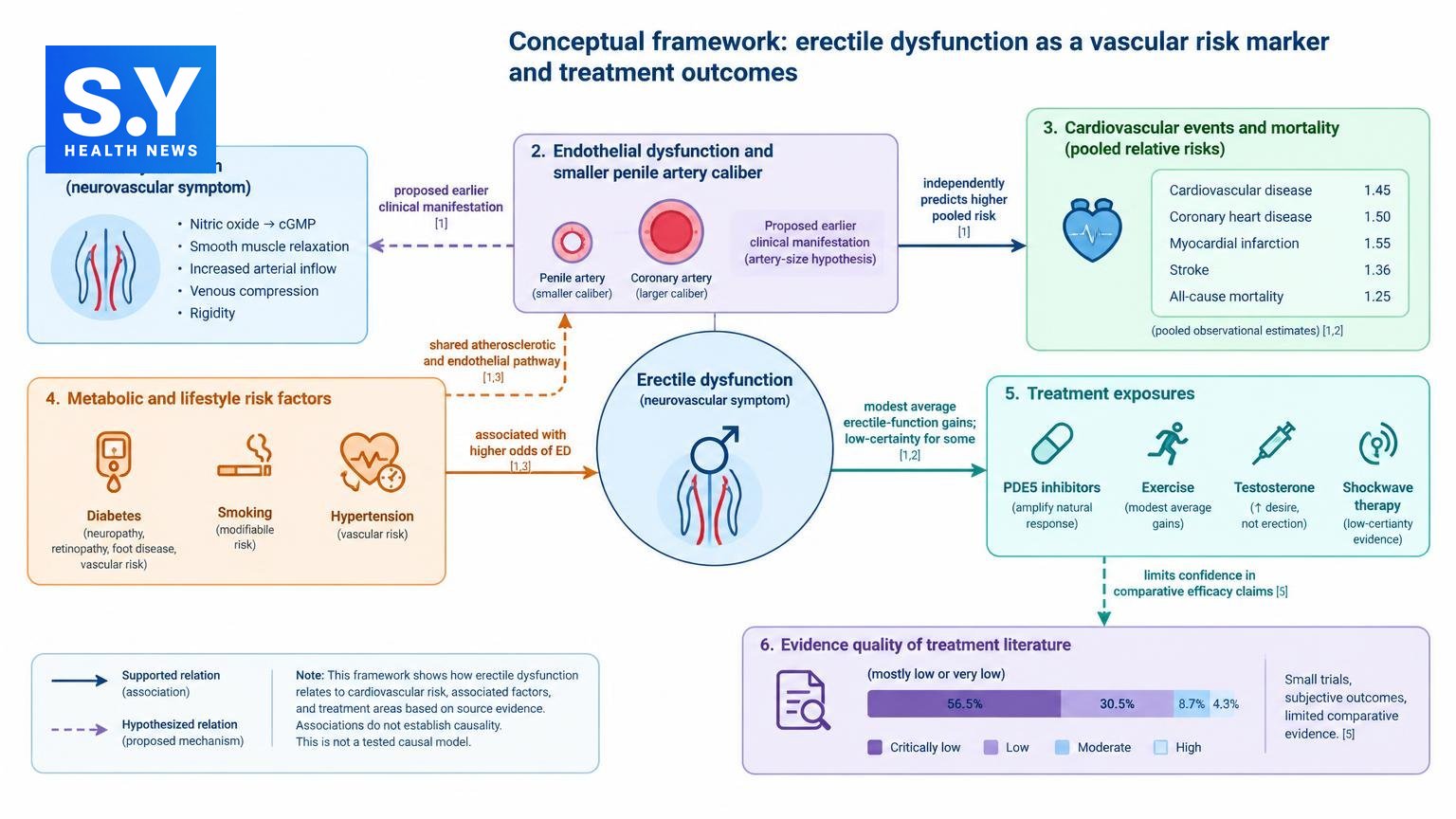
Erectile dysfunction (ED) is best understood as a neurovascular symptom rather than a purely sexual complaint. Erection depends on nitric oxide signalling that raises cyclic GMP, relaxing cavernosal smooth muscle so arterial inflow rises and subtunical venules are compressed, trapping blood and producing rigidity.[1]
The artery-size hypothesis proposes that because penile arteries are smaller in caliber than coronary arteries, the same degree of endothelial dysfunction becomes clinically apparent in erectile tissue earlier than in the coronary circulation.
Pooled meta-analytic evidence summarized in an umbrella review found that ED independently predicts cardiovascular disease (relative risk 1.45), coronary heart disease (1.50), myocardial infarction (1.55), stroke (1.36) and all-cause mortality (1.25). A separate umbrella review reported a nearly identical pattern, including cardiovascular disease at a relative risk of 1.45 with a 95% confidence interval of 1.36 to 1.54.[2]
These are observational associations from pooled cohorts, not causal demonstrations. Their practical value lies in prompting cardiovascular risk assessment when ED first appears, especially in men with diabetes, smoking, hypertension or dyslipidaemia.[3]
| Outcome | Reported pooled estimate | Population and measure | Interpretive caveat |
|---|---|---|---|
| Cardiovascular disease | Relative risk 1.45 (95% CI 1.36–1.54) in the JACC Advances umbrella review; 1.45 in the Mostafaei umbrella review | Men with erectile dysfunction in pooled meta-analyses | Observational association; causality not established |
| Coronary heart disease | Relative risk 1.50 | Men with ED in pooled meta-analyses | Pooled observational estimate |
| Myocardial infarction | Relative risk 1.55 | Men with ED in pooled meta-analyses | Pooled observational estimate |
| Stroke | Relative risk 1.36 | Men with ED in pooled meta-analyses | Pooled observational estimate |
| All-cause mortality | Relative risk 1.25 | Men with ED in pooled meta-analyses | Pooled observational estimate |
| Diabetes-associated ED odds | Neuropathy OR 3.47; retinopathy OR 3.01; foot disease OR 3.96 | 66,925 men with diabetes across 58 studies | Observational meta-analysis; causation not established |
Why This Matters
Erectile dysfunction is common and rarely discussed. It is one of the few symptoms that can surface a systemic vascular problem while the affected man still feels well. Because the penile arteries are narrower than the coronary arteries, plaque and endothelial dysfunction can produce symptoms in the penis before angina or an infarct.[4]
The clinical implication is not that every man with ED has heart disease. Most do not. The point is that a new presentation is a low-cost opportunity to measure blood pressure, lipids and glucose in a man who may never otherwise have been screened. The EAU 2026 framework incorporates Princeton IV cardiovascular assessment for exactly this reason.
The timing question deserves precision. ED can precede symptomatic coronary disease, but the interval and the proportion of men affected depend on the population studied; no single figure applies to everyone, and marketing claims of a fixed several-year warning window should be treated as approximations rather than established constants.
Biological and Clinical Mechanism
An erection is a coordinated vascular event. Parasympathetic signalling releases nitric oxide from endothelial cells and nonadrenergic noncholinergic neurons; nitric oxide activates guanylyl cyclase to produce cyclic GMP, which relaxes cavernosal smooth muscle. Arterial inflow increases, subtunical venules are compressed, and blood is trapped to produce rigidity. Phosphodiesterase type 5 inhibitors work by slowing cyclic GMP breakdown, which is why they amplify a natural response rather than creating an erection independently.
Because this chain depends on endothelium, nerves, hormones and psychology simultaneously, ED is a final common symptom of many processes. Vasculogenic disease is the dominant mechanism in older men, but neurogenic, endocrinological, drug-induced and psychogenic contributions frequently coexist.
Diabetes illustrates the convergence. In a 2024 systematic review and meta-analysis pooling 58 studies and 66,925 men with diabetes, diabetic neuropathy (odds ratio 3.47), retinopathy (3.01) and diabetic foot disease (3.96) were each associated with substantially higher odds of ED. Vascular disease (2.75), nephropathy (2.67), metabolic syndrome (2.22), cardiovascular disease (1.92), hypertension (1.74) and poorer glycaemic control as measured by HbA1c (1.44) independently increased risk.
The pattern in those odds ratios is informative: nearly every factor is a marker of blood vessel or nerve damage. ED in a man with diabetes is usually a visible sign of a systemic process rather than an isolated complaint. Type 2 diabetes is cited as the second major risk factor after age, with ED reported in 50–75% of diabetic men.
Smoking is the most reversible driver with a quantified signal. In the prospective-cohort subgroup of a meta-analysis, current smoking was associated with higher odds of ED than never smoking (odds ratio 1.51, 95% CI 1.34–1.71). That is an observational association, but the mechanism — endothelial injury and reduced nitric oxide availability — is coherent and the exposure is modifiable.
What the Evidence Shows on Cardiovascular Association
Two umbrella reviews converge on the same conclusion: ED carries a modest but consistent excess risk of cardiovascular events and death. The 2021 umbrella review of meta-analyses reported relative risks of 1.45 for cardiovascular disease, 1.50 for coronary heart disease, 1.55 for myocardial infarction, 1.36 for stroke and 1.25 for all-cause mortality. A 2023 umbrella review in JACC Advances reported a closely matching set of estimates, with cardiovascular disease at 1.45 (95% CI 1.36–1.54) and all P values below 0.001.
Strictly, these are relative risks in the range of roughly 1.25 to 1.55 — statistically clear at the population level but moderate in size for any individual. A relative risk of 1.45 does not mean a man with ED has a 45% chance of a cardiac event; it means his risk is about 45% higher than that of a comparable man without ED, on top of whatever baseline risk he already carries.
The most provocative data concern treatment rather than diagnosis. A 2024 longitudinal study of 509,788 men with ED found that men prescribed tadalafil or sildenafil had lower three-year rates of all-cause mortality (relative risk 0.66 and 0.76), myocardial infarction (0.73 and 0.83), stroke (0.66 and 0.78) and dementia (0.68 and 0.75) than men not taking them. The source itself cautions that this is observational data and cannot establish causation, because men prescribed and taking these drugs may differ in ways not fully adjusted for.
That caveat deserves emphasis. The finding is a useful counter to the idea that treating ED is cosmetic, and it is a reasonable hypothesis that phosphodiesterase inhibition or the associated better health engagement has vascular benefits. It is not evidence that taking a tablet protects the heart, and no reader should act on it as though it were.
What the Evidence Shows on Treatment
An umbrella review of systematic reviews published in 2026 assessed the treatment literature itself. From 1,191 studies it extracted 23 published meta-analyses yielding 42 summary effects across 36 interventions. On AMSTAR-2 appraisal, 13 (56.5%) were critically low quality, 7 (30.5%) low quality, 2 (8.7%) moderate quality and 1 (4.3%) high quality. Of the 42 summary effects, one each was rated high and moderate quality, while 47.6% (n=20) were low and 47.6% (n=20) very low quality.[5]
The authors concluded that the current ED evidence base is predominantly of low or very low quality, and that although statistically significant improvements were seen with both pharmacological and nonpharmacological interventions, small patient numbers and subjective outcome measures warrant caution. They called for further well-designed trials of single treatments and high-quality head-to-head meta-analyses.
This umbrella review is not a claim that treatments fail. It is a claim about evidence quality — that many commonly used options rest on small trials and patient-reported endpoints, and that comparative ranking across treatments is weaker than the marketing suggests. Guideline recommendations and evidence certainty are different things.
Lifestyle and Exercise Evidence
Lifestyle modification is the foundation most guidelines agree on, and the pooled numbers are modest but real. A meta-analysis of randomized trials found increased physical activity produced a 3.85-point improvement in IIEF erectile-function scores (95% CI 2.33–5.37). A separate 2023 meta-analysis reported roughly 2.8 points. The two estimates differ, which itself signals sensitivity to which trials and analyses are pooled.
Combination may add more than substitution. In a small randomized study, adding a prescribed aerobic exercise regimen (mean 3.4 hours per week, about 22.8 MET-hours per week) to phosphodiesterase inhibitor therapy produced a higher erectile-function domain score than the drug alone at three months (26.8 versus 24.7, P = 0.003). This was a single small trial, so the size of the added benefit should be read with caution.
Exercise gains of a few points on an erectile-function scale sit below the four-point threshold the Cochrane review assumed for clinical importance in its IIEF-EF analysis, though the pooled exercise confidence interval crosses that threshold. The honest reading is that exercise helps on average, helps more in some men, and is not a substitute for treating vascular risk factors.
A small randomized study and a large observational cohort are not the only designs in this field, but they dominate it. The TRAVERSE Sexual Function substudy randomized 1,161 men aged 45–80 with low libido, two testosterone values below 300 ng/dL and established or elevated cardiovascular risk to testosterone gel (n=587) or placebo gel (n=574). Testosterone improved the primary sexual-activity score versus placebo at 6 and 12 months, maintained at 24 months, and improved desire — but not erectile function.
That distinction matters clinically. Testosterone in confirmed hypogonadism produces a pooled mean erectile-function gain of about 2.3 IIEF-EF points, below the four-point threshold the Cochrane review used. Its main contribution appears to be improved desire and sexual activity rather than erection mechanics, and it is not effective monotherapy for ED.
Safety data are reassuring on the major question but not uniformly clean. The TRAVERSE trial (5,246 hypogonadal men with elevated cardiovascular risk) found transdermal testosterone non-inferior to placebo for major adverse cardiac events (hazard ratio 0.96, 95% CI 0.78–1.17) over a mean 21.7 months. However, higher rates of pulmonary embolism (0.9 versus 0.5%), atrial fibrillation (3.5 versus 2.4%) and acute kidney injury (2.3 versus 1.5%) were detected in the testosterone arm.
Regenerative and Device Therapies
Shockwave therapy is where enthusiasm and evidence diverge most sharply. A 2025 Cochrane review of 21 randomized trials (1,357 men) found low-certainty evidence that low-intensity shockwave therapy may improve short-term IIEF-EF scores by roughly 3.9 points and long-term scores by 5.3 points versus sham. Low certainty is a formal grading, not a rhetorical hedge.
A separate International Society for Sexual Medicine review reached a similarly measured conclusion. Across 36 studies, 30 of them randomized controlled trials, results for focused shockwave therapy versus sham were mixed; some trials showed statistically significant improvement in erectile-function scores and others found no difference. The reviewers noted that 78% of studies did not report or compare the minimal clinically important difference, and concluded that restorative therapies, shockwave included, require further investigation in well-designed trials before routine clinical use can be recommended.
For device and surgical options, the satisfaction data are comparatively strong. A systematic review of 83 studies enrolling 12,132 penile implant recipients found pooled patient satisfaction of 83% (95% CI 80–86%) among the 9,429 patients with satisfaction data, with mean follow-up of 47.6 months. Satisfaction is a different outcome from erection quality, and the pooled series are observational.
Phosphodiesterase inhibitors remain first-line for most men with ED. All four agents are reported effective in roughly 60 to 80% of men with ED. That range combines diverse populations and outcome definitions, and a success rate per intercourse attempt is not the same as a patient-level cure. The umbrella review's quality assessment is relevant here too: even the most established therapy rests partly on subjective endpoints.
Apparent treatment failure is frequently a use problem rather than a pharmacology problem, and the distinction matters for interpretation. If a man with new ED is given a prescription without assessment of blood pressure, lipids and glucose, the cardiovascular signal that should have triggered screening is simply lost.
Diagnostic Assessment and Risk Stratification
Evaluation begins with history — onset, whether erections occur during sleep or masturbation, medication exposure, pelvic surgery and cardiovascular symptoms — alongside examination and measurement of blood pressure and weight. Laboratory testing typically includes fasting glucose or HbA1c, a lipid panel and a morning total testosterone, with confirmatory second morning testosterone when low.
Where a vascular cause is suspected or treatment has failed, penile duplex Doppler ultrasound after vasoactive injection can measure arterial inflow and venous retention. Specialized testing is reserved for equivocal cases, surgical planning or situations where the distinction changes management.
The Princeton IV framework stratifies men with predominantly vasculogenic ED by ten-year atherosclerotic cardiovascular risk and adds coronary artery calcium scoring in the borderline-to-intermediate group, because risk scores alone can underestimate risk in men aged 40 to 60. Men with overt cardiovascular symptoms require exercise-based assessment and, when risk is high, cardiology referral.
Vasoactive drug safety is a separate matter. Phosphodiesterase inhibitors are contraindicated with organic nitrates and nitric oxide donors because of severe hypotension risk, and this is an absolute contraindication rather than a precaution. Men with unstable cardiac disease, recent myocardial infarction or stroke require in-person assessment before treatment decisions.
Interpretation and Limitations
The cardiovascular association is consistent across independent umbrella reviews, which strengthens confidence that it is not a statistical artefact. It is still observational. Men with ED are also more likely to carry diabetes, hypertension and smoking histories, and residual confounding by health status and socioeconomic factors cannot be excluded from pooled cohort data.
The evidence quality problem cuts across treatment questions. With 47.6% of summary effects graded low and 47.6% very low quality, and the majority of contributing meta-analyses rated critically low, readers should treat small numerical differences between treatments as provisional. This does not mean effective treatments are ineffective; it means comparative claims are weaker than the numbers suggest.
The phosphodiesterase inhibitor mortality finding is the most likely to be misread. A relative risk of 0.66 for all-cause mortality in a 509,788-man cohort is large enough to be interesting and small enough in absolute terms that healthy-user effects could plausibly explain much of it. The source explicitly warns against causal interpretation.
Younger men need a different reading of the evidence. A 2024 review from a large paediatric and adolescent urology practice reported a thirty-one-fold increase since 2014 in adolescent and young adult males presenting with ED, mostly attributed to psychogenic causes such as anxiety and depression. Single-practice referral data cannot establish population incidence; awareness, referral patterns and diagnostic coding all shift over a decade.
Sleep apnoea is an under-recognised contributor. In a 2018 study of 150 men newly diagnosed with moderate to severe obstructive sleep apnoea, ED prevalence was 51%. That is a single clinic sample without a comparator, so it establishes an association worth screening for rather than a prevalence figure generalisable to all men with sleep apnoea.
Glucagon-like peptide-1 receptor agonists show a two-sided picture. A 2025 controlled pilot study reported improvement in sexual function in men with obesity-associated hypogonadism. By contrast, in non-diabetic, non-hypogonadal men taking semaglutide for weight loss, a 2024 database analysis found higher rates of new ED diagnoses and testosterone deficiency, though the signal was considerably attenuated in adjusted analyses. Neither finding establishes causality in either direction.
Finally, some ED follows prostate cancer treatment. In a selected cohort of 92 men without severe ED before focal high-intensity focused ultrasound, 36% had severe ED (IIEF-5 ≤7) at 12 months. This is a single selected cohort and not a randomized comparison, but it illustrates that treatment-related ED is a counseling issue, not only a natural-history one.
Research Outlook
The clearest research need is comparative rather than incremental. The 2026 umbrella review explicitly recommends high-quality meta-analyses of intertreatment comparisons, and the ISSM restorative-therapies review recommends further well-designed trials before routine clinical use of shockwave and related therapies can be endorsed. Both point at the same gap: many trials, few rigorous head-to-head comparisons.
A second need is better outcome definition. The gap between statistically significant scale improvements and clinically meaningful change runs through nearly every treatment question in this field, and most restorative-therapy studies did not report the minimal clinically important difference. Future trials that pre-specify that threshold will be more informative than larger trials using the same endpoints.
A third is mechanistic. Whether phosphodiesterase inhibition itself modifies cardiovascular outcomes, as the observational cohort data hint, can only be answered by randomised evaluation. Until then, the prudent interpretation is that treating ED improves sexual function and creates a legitimate occasion for cardiovascular risk assessment, not that it has been shown to prevent heart attacks.
Key Takeaways
- Erectile dysfunction is a neurovascular symptom that frequently reflects systemic endothelial dysfunction, and penile arteries are smaller than coronary arteries, which is why symptoms can appear earlier.
- Pooled observational data associate ED with roughly 1.25 to 1.55-fold higher relative risks of cardiovascular disease, coronary heart disease, myocardial infarction, stroke and all-cause mortality. These are associations, not causal estimates.
- New-onset ED warrants measurement of blood pressure, lipids and glucose, particularly in men over 40 and in men with diabetes or smoking history, because the encounter is a screening opportunity.
- Diabetes is a dominant driver: neuropathy, retinopathy and foot disease were each associated with roughly threefold higher odds of ED in a 58-study meta-analysis of 66,925 men.
- Exercise produces modest pooled erectile-function gains of roughly 2.8 to 3.85 IIEF-EF points and may add to phosphodiesterase inhibitor therapy, but the added benefit rests on a single small trial.
- Testosterone improves desire and sexual activity in confirmed hypogonadism but not erectile function, with a pooled erectile gain of about 2.3 points; major adverse cardiac events were non-inferior to placebo in TRAVERSE, with higher rates of pulmonary embolism, atrial fibrillation and acute kidney injury.
- Shockwave and other restorative therapies remain investigational in the eyes of major guideline bodies, with low-certainty or mixed evidence and high rates of unreported minimal clinically important differences.
- The broader ED treatment evidence base is predominantly low or very low quality, so comparative claims between treatments should be treated as provisional.
Questions and Answers
Why does erectile dysfunction sometimes appear before heart disease symptoms?
Erection depends on arterial inflow through penile arteries that are smaller in caliber than coronary arteries. The artery-size hypothesis proposes that the same degree of endothelial dysfunction and atherosclerosis becomes symptomatic in narrower vessels first, so ED can surface before angina or infarction. This is a mechanistic rationale supported by observational timing data, not proof that ED causes heart disease, and the interval varies by population.
How strong is the link between erectile dysfunction and cardiovascular events in pooled studies?
Two umbrella reviews of meta-analyses converge on moderate relative risks: about 1.45 for cardiovascular disease, 1.50 for coronary heart disease, 1.55 for myocardial infarction, 1.36 for stroke and 1.25 for all-cause mortality. These are statistically consistent observational associations from pooled cohorts. A relative risk of 1.45 means roughly 45% higher risk than comparable men without ED, not a 45% absolute chance of an event.
How good is the overall evidence for erectile dysfunction treatments?
Weaker than commonly assumed. A 2026 umbrella review of 23 meta-analyses covering 36 interventions found 47.6% of summary effects graded low and 47.6% very low quality, with most contributing meta-analyses rated critically low on AMSTAR-2. Statistically significant improvements were seen with pharmacological and nonpharmacological treatments, but small samples and subjective endpoints limit confidence, especially for comparisons between treatments.
Does exercise improve erectile function, and by how much?
Pooled randomized evidence suggests modest benefit. One meta-analysis found increased physical activity produced a 3.85-point improvement in IIEF erectile-function scores (95% CI 2.33–5.37), and a separate 2023 meta-analysis reported roughly 2.8 points. A small randomized study found adding aerobic exercise to phosphodiesterase inhibitor therapy produced a higher erectile-function domain score at three months (26.8 versus 24.7, P = 0.003). Average gains are small, with larger benefit in some men.
Does testosterone therapy improve erections in men with low testosterone?
Partly, and not primarily through erection mechanics. In the TRAVERSE Sexual Function Study of 1,161 men with low libido and testosterone below 300 ng/dL, testosterone improved sexual-activity scores and desire but not erectile function. Pooled data in confirmed hypogonadism show a mean gain of about 2.3 IIEF-EF points, below the four-point threshold used in Cochrane analysis. Testosterone is not effective monotherapy for ED.
Is shockwave therapy for erectile dysfunction proven?
Not to the standard of established therapy. A 2025 Cochrane review of 21 trials (1,357 men) found low-certainty evidence of roughly 3.9-point short-term and 5.3-point long-term IIEF-EF gains versus sham. An ISSM-commissioned review of 36 studies found mixed results versus sham and noted that 78% of studies did not report the minimal clinically important difference, concluding further well-designed trials are needed before routine use.
Conceptual framework: Conceptual framework. Erectile dysfunction is positioned as a neurovascular symptom linked to cardiovascular outcomes through pooled observational relative risks, with diabetes, smoking and hypertension as associated risk factors. Treatment arrows reflect modest average effects and, for shockwave therapy, low-certainty evidence. Supported relations are associations, not causal proof; the artery-size explanation is a proposed mechanism. This framework is not a tested causal model.
Academic References & Evidence
- Erectile Dysfunction (Condition) | WARWIKI.
- Erectile Dysfunction.
- Dilixiati D; Waili A; Tuerxunmaimaiti A; Jehle DVK; Sunesra R; Uddin H; Pantazis A; Franco I; Gitlin J; Kohn T; El-Sakka A; Facio F. Erectile Dysfunction: 6 Causes, Complete Diagnosis Guide.
- Erectile Dysfunction Causes Explained | Bidwell.
- Current treatment for erectile dysfunction: an umbrella review of systematic reviews and meta-analyses. Figshare. 2026
SANYUN Science Center explains published research on men's reproductive and sexual health, connecting scientific evidence with everyday questions while making sources and limitations clear.
Disclaimer: This article is for scientific education and research communication only. It does not provide medical advice, diagnosis, or individualized treatment recommendations, and does not endorse any medication, supplement, device, penile enlargement procedure, or other intervention. Decisions about sexual and reproductive health should be made in consultation with a qualified healthcare professional. Do not delay seeking professional care because of information in this article.
Original Content & Copyright Notice
- This article is prepared for SANYUN Science Center, drawing on published research and publicly available academic literature on men’s sexual and reproductive health. Its editorial explanations and presentation are developed for this platform.
- Copyright in the original editorial content, selection, and arrangement is reserved by SANYUN Science Center to the extent protected by applicable law. Referenced research, quotations, and third-party materials remain subject to the rights of their respective owners. This notice does not claim ownership of scientific facts or third-party research.
- Except where permitted by applicable law or an applicable license, prior written permission is required to reproduce, republish, translate, adapt, redistribute, or commercially reuse protected content. Attribution alone does not grant permission for such reuse.
- For permitted quotation or authorized reuse, clearly identify the source and retain a link to the original article.
- Source: SANYUN Science Center
- Original URL: Retain the original article URL on science.san-yun.com.
- Copyright Holder: SANYUN Science Center, for its own protected editorial content.
- Quotation, excerpts, or authorized reuse must not distort the scientific meaning, omit material limitations or disclaimers, or imply unverified medical claims, product efficacy, or endorsement by SANYUN Science Center.



