




Category: Erectile Dysfunction
Core Research Direction: Evidence review of erectile dysfunction as a vascular and cardiovascular risk marker and of cause-directed management, including what specific trials and meta-analyses can and cannot establish about PDE5 inhibitors, lifestyle/exercise, testosterone, device therapy, and emerging treatments.
Search Intent: What does the research actually show about the causes of erectile dysfunction, its link to future cardiovascular events, and which treatments are supported by which kinds of evidence?
Platform: SANYUN Science Center
Evidence reviewed through: 2026-11-03
Executive Summary
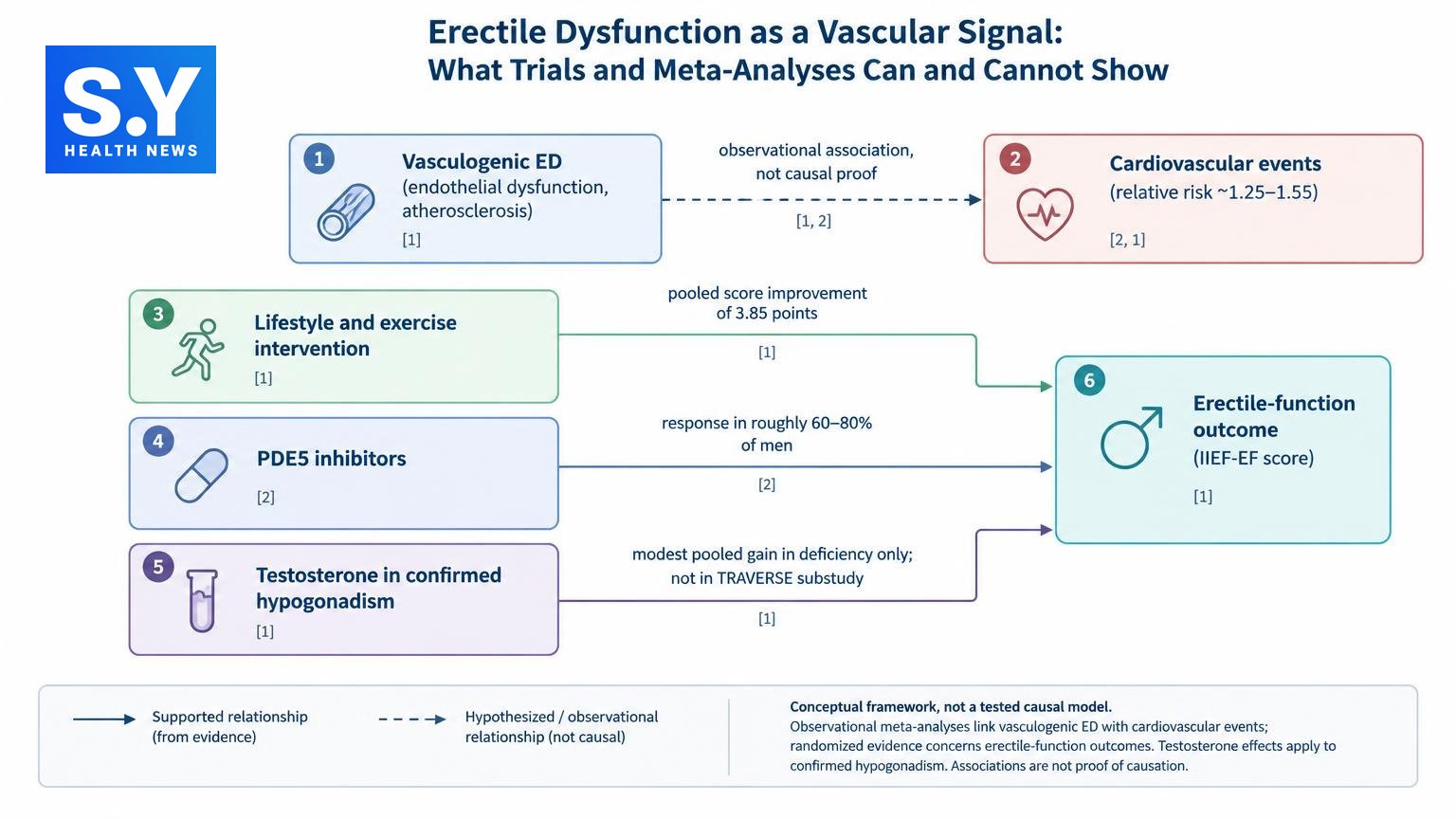
Erectile dysfunction (ED) is a symptom with several possible drivers, not a single disease. In midlife and older men the dominant contributor is vasculogenic, and the erectile complaint can surface before coronary symptoms because penile arteries are smaller in caliber than coronary arteries. Pooled observational data link ED with higher relative risks of cardiovascular disease, coronary heart disease, myocardial infarction, stroke and all-cause mortality, but these are associations from meta-analyses, not proof that treating ED prevents cardiac events.[1][2]
Treatment evidence is uneven. Phosphodiesterase type 5 (PDE5) inhibitors are the best-supported pharmacotherapy and are described as effective in roughly 60 to 80% of men with ED, a figure that blends differing outcome definitions and trial populations. Structured exercise produces a measurable pooled gain in erectile-function scores, and one small trial found an additive effect with PDE5 inhibitor therapy. Testosterone replacement produces only modest erectile-function gains in confirmed hypogonadism and did not improve erectile function in a large trial substudy. Shockwave, topical and supplement claims require more caution.
Why This Matters
ED is common and frequently untreated, and its significance extends beyond sexual function. A proposed mechanism holds that because penile arteries are smaller in caliber than coronary arteries, the same degree of endothelial dysfunction becomes symptomatic in erectile tissue before coronary arteries. That reasoning is plausible but remains a hypothesis rather than a demonstrated causal pathway.
The practical implication is that new-onset ED, especially in a man with vascular risk factors, is a reason to check blood pressure, glucose, lipids and overall cardiovascular risk rather than simply to reach for a prescription. At the same time, ED is a risk marker whose urgency depends on symptoms and individual risk assessment, not a diagnosis of heart disease. Evidence on whether formal risk stratification actually improves outcomes, rather than merely identifying risk, is not established in the reviewed materials.
Biological and Clinical Mechanism
An erection is a neurovascular event. Sexual stimulation triggers nitric oxide release from endothelial cells and nonadrenergic noncholinergic neurons; nitric oxide activates guanylyl cyclase to produce cyclic GMP, which relaxes corporal smooth muscle, increases arterial inflow and compresses subtunical venules to trap blood. PDE5 inhibitors prolong this signal by blocking cGMP degradation, which is why they require sexual stimulation and do not create an erection pharmacologically on their own.
ED is conventionally classified as psychogenic, organic or mixed, with mixed being most common. Vasculogenic causes include arterial insufficiency and corporal veno-occlusive dysfunction; neurogenic causes include diabetic neuropathy, spinal cord injury and pelvic surgery; endocrinological causes include hypogonadism and hyperprolactinemia; drug-induced causes include antihypertensives, SSRIs and antiandrogens; and psychogenic causes include performance anxiety and depression. Most men have more than one contributor, which is why cause-directed evaluation matters.[3]
What the Evidence Shows: Cardiovascular Risk
An umbrella review of meta-analyses cited as Mostafaei 2021 is described as finding that ED independently predicts cardiovascular outcomes. A separate 2023 JACC Advances umbrella review of prior meta-analyses reported relative risks of 1.45 (95% CI 1.36–1.54) for cardiovascular disease, 1.50 for coronary heart disease, 1.50 for cardiovascular mortality, 1.55 for myocardial infarction, 1.36 for stroke and 1.25 for all-cause mortality, all with P less than 0.001. A tertiary clinical synthesis reports the same pattern without the cardiovascular-mortality figure.
These numbers describe how much more often events occurred in men with ED across pooled observational studies. They do not establish that ED causes cardiac events, nor that treating ED reduces them. Adjustment for confounders varied across included studies, and the source summaries do not provide confidence intervals for every outcome. A separate claim that new-onset ED in men with cardiovascular risk factors preceded a major cardiac event by approximately 2–5 years appears in a tertiary clinical summary; the interval and proportion affected depend on the population studied, and no single lead time is established.
Guideline frameworks have moved toward formal cardiovascular risk stratification in men presenting with ED. The described Princeton IV approach calculates 10-year atherosclerotic cardiovascular disease risk and uses coronary artery calcium scoring in borderline-to-intermediate cases, because risk scores alone can underestimate risk in men aged 40 to 60. A rough functional screen for usual-partner sexual activity is walking one mile on flat ground in 20 minutes or briskly climbing two flights of stairs in about 10 seconds without cardiac symptoms. These are assessment frameworks, not evidence that screening itself improves outcomes.
What the Evidence Shows: PDE5 Inhibitors
PDE5 inhibitors are described as effective in roughly 60 to 80% of men with ED, a widely quoted range that blends varying outcome definitions and trial populations. All four agents are treated as broadly effective, with selection driven by onset, duration, food interaction, adverse effects and cost rather than by large efficacy differences. Apparent nonresponse should first trigger a review of timing, sexual stimulation, food effects, dose titration and adherence, because incorrect use may account for a substantial share of apparent failures.
Safety is dominated by the absolute contraindication to concomitant organic nitrates and nitric oxide donors, including recreational nitrites, because of severe hypotension risk. Caution is also advised with alpha-blockers and CYP3A4 inhibitors. A 2025 FDA Adverse Event Reporting System analysis of 53,517 reports across two decades found sildenafil generated the most reports, followed by tadalafil, vardenafil and avanafil, but spontaneous reporting reflects prescribing volume and reporting bias rather than incidence.
What the Evidence Shows: Lifestyle and Exercise
A meta-analysis of randomized trials found increased physical activity produced a 3.85-point improvement in IIEF erectile-function scores (95% CI 2.33–5.37). A separate synthesis describes a 2023 Journal of Sexual Medicine meta-analysis showing an improvement of roughly 2.8 points; differing pooled estimates illustrate how much the result depends on trial selection and outcome definition.
In one small randomized study, adding a prescribed aerobic exercise regimen (mean 3.4 hours per week, about 22.8 MET-hours per week) to PDE5 inhibitor therapy produced a higher erectile-function domain score than PDE5 inhibitor alone at three months (26.8 vs 24.7, P = 0.003). This is a single small trial, so the additive effect is suggestive rather than established. The Esposito et al. JAMA 2004 trial, in which obese men randomized to a Mediterranean diet plus increased physical activity had significant ED improvement at 2 years versus controls, is frequently cited but described here only through secondary summaries without effect sizes.[4]
Observational data support an association between smoking and ED: in the prospective-cohort subgroup of a meta-analysis, current smoking was associated with higher odds of ED than never smoking (OR 1.51, 95% CI 1.34–1.71). This is an association, not a demonstrated reversal effect.
What the Evidence Shows: Testosterone
The AUA defines testosterone deficiency as total testosterone below 300 ng/dL on two separate early-morning measurements together with symptoms or signs. In men with confirmed hypogonadism, testosterone replacement improved IIEF erectile-function scores by a pooled mean of about 2.3 points, which is below the 4-point threshold the Cochrane review assumed for clinical importance. Benefit appears greater with more severe hypogonadism and smaller in men with diabetes or obesity; in men without deficiency, testosterone has little or no effect on erectile function.
The nested TRAVERSE Sexual Function Study randomized 1,161 men aged 45–80 with low libido and two testosterone values below 300 ng/dL to testosterone gel or placebo. Testosterone improved the primary sexual-activity score versus placebo at 6 and 12 months, with the effect maintained at 24 months, and improved desire, but not erectile function. In the larger TRAVERSE trial of 5,246 symptomatic men with cardiovascular risk, transdermal testosterone was noninferior to placebo for major adverse cardiovascular events (HR 0.96, 95% CI 0.78–1.17 over a mean 21.7 months), while pulmonary embolism (0.9 vs 0.5%), atrial fibrillation (3.5 vs 2.4%) and acute kidney injury (2.3 vs 1.5%) occurred more often. These cardiovascular findings apply to a population selected for elevated risk.
What the Evidence Shows: Devices, Shockwave and Emerging Options
A 2025 Cochrane review of low-intensity extracorporeal shockwave therapy (21 trials, 1,357 men) found low-certainty evidence that the average short-term benefit may be too small to be clinically important, with uncertain and heterogeneous longer-term benefit. A separate summary of the same review reports short-term IIEF-EF gains of roughly 3.9 points and long-term gains of 5.3 points versus sham, again with low certainty. The AUA classifies the treatment as investigational, whereas the EAU offers a weak recommendation in selected men.
In the 96-man, 24-week randomized open-label FM71 study, 59% of MED3000 users versus 83% of tadalafil 5 mg users met the severity-adjusted IIEF-EF response criterion, while 44.9% versus 30.0% of intercourse attempts had a noticeable erection within 10 minutes. The open-label design and exclusions of men after prostatectomy or Peyronie's surgery, those with severe uncontrolled diabetes and prior PDE5-inhibitor nonresponders limit generalization. Because the product is sold without a prescription, men may bypass the clinician visit that would otherwise screen for the cardiovascular and endocrine risk factors ED often signals.
For penile implants, a systematic review of 83 studies enrolling 12,132 recipients found pooled patient satisfaction of 83% (95% CI 80–86%) among the 9,429 patients with satisfaction data, with mean follow-up of 47.6 months. This is pooled observational data, and satisfaction was not recorded for every recipient. Penile implants are reserved for men whose other treatments have failed or who prefer surgical management after full counseling.
Over-the-counter male enhancement supplements are described as unregulated and frequently containing hidden PDE5 inhibitors according to FDA safety notifications. This is a regulatory observation rather than a systematically sampled prevalence estimate, but it argues against treating supplement claims as evidence-based therapy.
Special Populations and Evaluation
Evaluation begins with a sexual, medical and psychosocial history covering onset, rigidity, morning erections, medication exposure and cardiovascular risk factors, followed by focused examination and laboratory testing. Fasting glucose or HbA1c, a lipid panel and a morning total testosterone are the core tests, with prolactin and thyroid function when clinically indicated. Advanced testing such as nocturnal penile tumescence and penile duplex Doppler ultrasound is reserved for equivocal cases or surgical planning; nocturnal testing is generally reliable only when completely normal, defined as at least one erectile episode with tip rigidity above 60% lasting more than 10 minutes.
Diagnostic imaging research is still early. In one feasibility study, post-injection shear wave elastography distinguished 26 men with arterial ED from 30 with nonvascular ED (AUC 0.81), but venogenic classification, cardiovascular-risk prediction and replacement of duplex Doppler were not tested.
ED is not confined to older men. A widely cited Journal of Sexual Medicine study found about 1 in 4 men presenting with newly diagnosed ED were under 40, though clinic-based samples may be skewed by under-reporting. In younger men, psychological and lifestyle contributors are especially prominent, while early vascular disease remains a reason to check blood pressure, lipids and glucose. A 2018 study of 150 men newly diagnosed with moderate to severe obstructive sleep apnea found ED prevalence of 51%, illustrating how a treatable comorbid condition can cluster with ED; this is a cross-sectional association rather than proof of causation.
Interpretation and Limitations
| Question | Best available evidence | What it can and cannot establish |
|---|---|---|
| Does ED predict cardiovascular events? | Umbrella reviews of observational meta-analyses | Relative risks around 1.25–1.55 are consistently reported, but residual confounding and heterogeneous adjustment limit causal inference; treating ED has not been shown to prevent events. |
| How well do PDE5 inhibitors work? | Guideline summaries and trial literature synthesized narratively | Roughly 60–80% effectiveness is quoted, but outcome definitions vary and trial populations differ; apparent failure often reflects incorrect use. |
| Does exercise improve erections? | Meta-analysis of randomized trials plus one small add-on trial | Pooled gains of roughly 3–4 IIEF-EF points are measurable; clinical importance for an individual is uncertain, and the add-on finding comes from one small study. |
| Does testosterone improve erections? | Pooled analysis plus a large randomized substudy | Modest pooled gain of about 2.3 IIEF-EF points in confirmed hypogonadism; no erectile-function improvement in the TRAVERSE substudy; cardiovascular neutrality applies to a risk-enriched population with small absolute increases in some adverse events. |
| Is shockwave therapy established? | Cochrane review of 21 trials and 1,357 men | Low-certainty short-term benefit that may be too small to matter clinically; guideline status ranges from investigational to a weak recommendation. |
| What about topical devices and supplements? | One open-label randomized study plus FDA regulatory observations | FM71 compared an unblinded device with tadalafil in a population that excluded PDE5-inhibitor nonresponders; supplements lack systematic safety data and may contain undeclared drugs. |
Several structural limitations recur across this literature. Much of the cardiovascular evidence is observational, so relative risks describe association. Trial populations are narrower than clinic populations: TRAVERSE selected men with cardiovascular risk, FM71 excluded prior PDE5-inhibitor nonresponders, and the exercise add-on trial was small. The source materials used here are secondary summaries, so primary trials should be consulted before clinical decisions. The review does not verify confidence intervals for every cardiovascular outcome or resolve discrepancies between pooled exercise estimates.
Research Outlook
Several questions remain open beyond those already discussed. Whether formal cardiovascular risk stratification in men with ED improves hard outcomes, rather than merely identifying risk, has not been established. Whether exercise adds meaningfully to PDE5 inhibitor therapy in larger and longer trials, and which men benefit most, needs confirmation. Testosterone's dissociation between sexual activity, desire and erectile function in TRAVERSE deserves mechanistic follow-up, particularly in men with and without confirmed deficiency. Shockwave therapy needs higher-certainty trials with clinically meaningful endpoints. Supplement safety requires systematic market surveillance rather than spontaneous reporting alone. None of these open questions undermines current first-line care, but each limits what clinicians can promise.
Key Takeaways
- ED is strongly associated with future cardiovascular events, with relative risks around 1.25–1.55 in pooled observational analyses, but association is not causation and treating ED has not been shown to prevent events.
- PDE5 inhibitors remain the best-supported pharmacotherapy, quoted as effective in roughly 60–80% of men, with nitrate co-use an absolute contraindication.
- Structured exercise produces measurable but modest pooled improvement in erectile-function scores, and one small trial suggests an additive effect with PDE5 inhibitors.
- Testosterone replacement modestly improves erectile-function scores in confirmed hypogonadism and did not improve erectile function in a large substudy; cardiovascular neutrality was shown in a risk-enriched population with small absolute increases in some adverse events.
- Shockwave therapy has low-certainty evidence and remains investigational in US guidance; unregulated supplements are a recurring safety concern.
Questions and Answers
How does erectile dysfunction relate to cardiovascular disease risk?
Pooled observational meta-analyses report that men with ED have higher relative risks of cardiovascular disease, coronary heart disease, myocardial infarction, stroke and all-cause mortality, with relative risks roughly between 1.25 and 1.55. These are associations from observational data, not proof that ED causes cardiac events or that treating ED prevents them, and adjustment for confounders varies across studies.
Why might erectile dysfunction appear before coronary symptoms?
A proposed mechanism is that penile arteries are smaller in caliber than coronary arteries, so the same endothelial dysfunction becomes symptomatic in erectile tissue earlier. This is a hypothesis rather than a demonstrated causal pathway, and lead time varies by population. A frequently cited 2–5 year interval comes from a tertiary summary of one analysis, not a universal rule.
How effective are PDE5 inhibitors for erectile dysfunction?
PDE5 inhibitors are described as effective in roughly 60 to 80% of men with ED, although that range blends different outcome definitions and trial populations. Apparent failure should first prompt a review of timing, sexual stimulation, food effects, dose titration and adherence. Concomitant organic nitrates or nitric oxide donors, including recreational nitrites, are an absolute contraindication.
Does exercise improve erectile function according to randomized evidence?
A meta-analysis of randomized trials reported a 3.85-point improvement in IIEF erectile-function scores with increased physical activity (95% CI 2.33–5.37), and one small trial found higher scores when aerobic exercise was added to PDE5 inhibitor therapy at three months. Pooled gains of this size are measurable but their clinical importance for an individual man is uncertain.
Does testosterone therapy improve erections in men with low testosterone?
In confirmed hypogonadism, testosterone replacement improved erectile-function scores by a pooled mean of about 2.3 points, below a 4-point threshold assumed clinically important. In the TRAVERSE sexual-function substudy, testosterone improved sexual activity and desire but not erectile function. In the larger TRAVERSE trial, testosterone was noninferior to placebo for major adverse cardiovascular events but atrial fibrillation, acute kidney injury and pulmonary embolism occurred more often.
Is low-intensity shockwave therapy proven for erectile dysfunction?
A 2025 Cochrane review of 21 trials and 1,357 men found low-certainty evidence that average short-term benefit may be too small to be clinically important, with uncertain longer-term benefit. Reported gains of roughly 3.9 short-term and 5.3 long-term IIEF-EF points versus sham should be read against that low certainty. The AUA classifies the treatment as investigational, while the EAU offers a weak recommendation in selected men.
Conceptual framework: Conceptual framework, not a tested causal model. Observational meta-analyses link vasculogenic ED with cardiovascular events; randomized evidence concerns erectile-function outcomes. Testosterone effects apply to confirmed hypogonadism. Associations are not proof of causation.
Academic References & Evidence
- Erectile Dysfunction (Condition) | WARWIKI.
- Erectile Dysfunction. 2026
- Erectile Dysfunction Causes Explained | Bidwell. 2026
- ED at a Young Age: Causes and When to Get Help | Bidwell. 2026
SANYUN Science Center explains published research on men's reproductive and sexual health, connecting scientific evidence with everyday questions while making sources and limitations clear.
Disclaimer: This article is for scientific education and research communication only. It does not provide medical advice, diagnosis, or individualized treatment recommendations, and does not endorse any medication, supplement, device, penile enlargement procedure, or other intervention. Decisions about sexual and reproductive health should be made in consultation with a qualified healthcare professional. Do not delay seeking professional care because of information in this article.
Original Content & Copyright Notice
- This article is prepared for SANYUN Science Center, drawing on published research and publicly available academic literature on men’s sexual and reproductive health. Its editorial explanations and presentation are developed for this platform.
- Copyright in the original editorial content, selection, and arrangement is reserved by SANYUN Science Center to the extent protected by applicable law. Referenced research, quotations, and third-party materials remain subject to the rights of their respective owners. This notice does not claim ownership of scientific facts or third-party research.
- Except where permitted by applicable law or an applicable license, prior written permission is required to reproduce, republish, translate, adapt, redistribute, or commercially reuse protected content. Attribution alone does not grant permission for such reuse.
- For permitted quotation or authorized reuse, clearly identify the source and retain a link to the original article.
- Source: SANYUN Science Center
- Original URL: Retain the original article URL on science.san-yun.com.
- Copyright Holder: SANYUN Science Center, for its own protected editorial content.
- Quotation, excerpts, or authorized reuse must not distort the scientific meaning, omit material limitations or disclaimers, or imply unverified medical claims, product efficacy, or endorsement by SANYUN Science Center.



