




Category: Erectile Dysfunction
Core Research Direction: Erectile dysfunction as a vascular and cardiovascular risk marker, and how guideline-based management (PDE5 inhibitors, testosterone, shared decision-making) is framed for clinicians and patients
Search Intent: Is erectile dysfunction an early warning sign of cardiovascular disease, and how should it shape diagnosis and treatment decisions in adult men?
Platform: SANYUN Science Center
Evidence reviewed through: 2026-10-30
Executive Summary
Erectile dysfunction (ED) is associated with higher risks of cardiovascular disease, coronary heart disease and stroke, and current clinical frameworks increasingly treat it as a risk-enhancing factor rather than an isolated sexual complaint. The most quantitative summary available here reports that ED independently predicts cardiovascular disease (relative risk 1.45), coronary heart disease (relative risk 1.50) and stroke (relative risk 1.36). These are observational associations derived from an umbrella review of prior meta-analyses, not proof that ED causes cardiac events.[1]
This review interprets two sources: a physician-authored secondary guide that summarizes primary literature through 2026, and a 2018 interview with the chair of the American Urological Association (AUA) guideline panel. Neither source is a primary trial report, and the underlying studies were not independently appraised here. Within those limits, the evidence supports three practical messages: ED should prompt cardiovascular risk assessment; phosphodiesterase type 5 (PDE5) inhibitors remain first-line pharmacotherapy with a hard nitrate contraindication; and treatment selection is framed as a shared decision rather than a fixed ladder.[2]
Why Erectile Dysfunction Matters Beyond Sexual Function
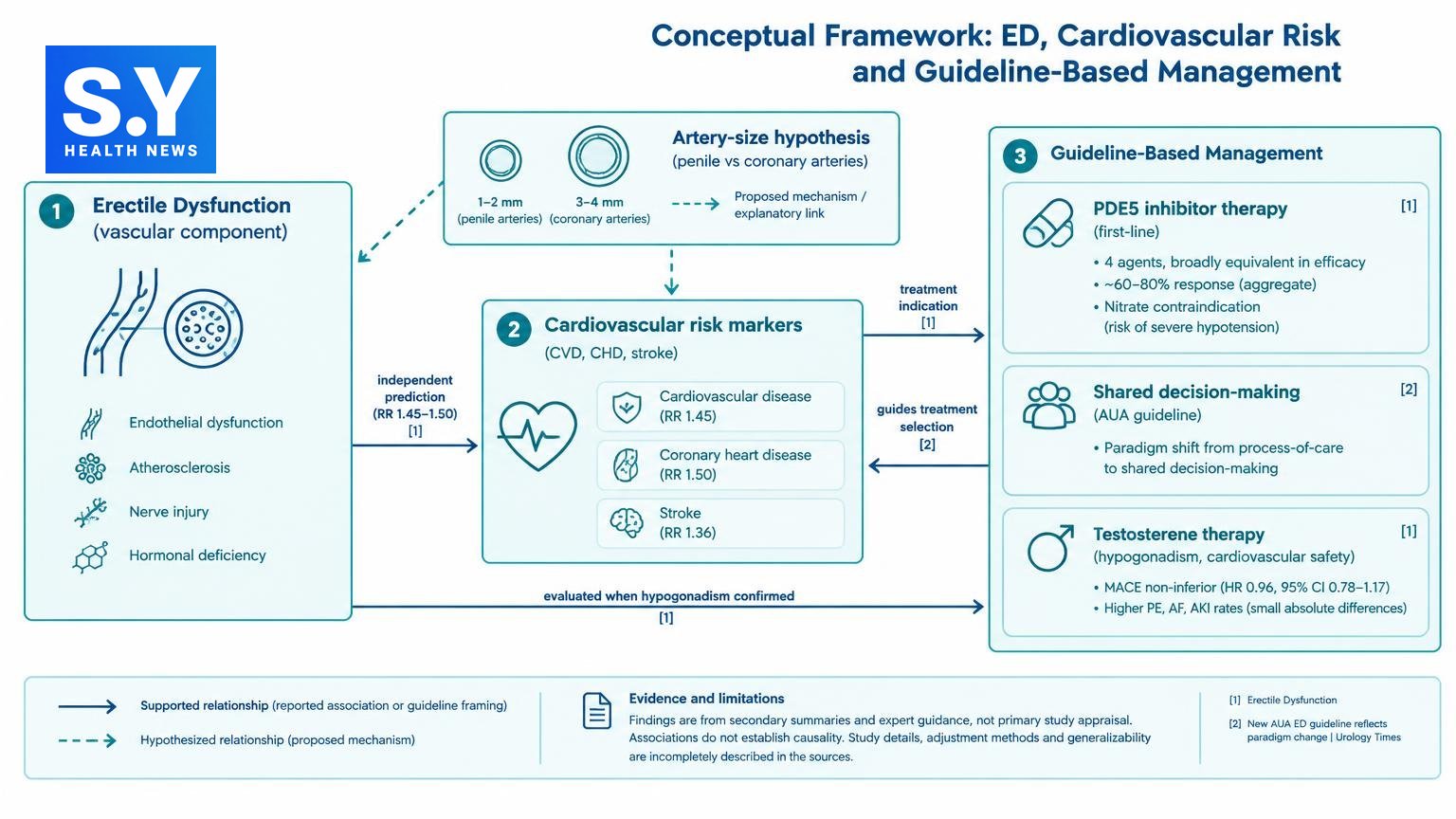
An erection is a vascular event. Sexual arousal triggers nitric oxide release from penile nerves, which raises cyclic GMP, relaxes arterial smooth muscle and allows blood to fill the corpora cavernosa. Endothelial dysfunction, atherosclerosis, nerve injury and hormonal deficiency can each disrupt this chain. Because the penile arteries are much smaller than the coronary arteries, the same atherosclerotic process may produce symptoms in the penis earlier than in the heart. The secondary guide describes penile arteries as 1 to 2 mm in diameter versus coronary arteries at 3 to 4 mm, and frames this as the artery-size hypothesis.
That hypothesis is biologically coherent and consistent with the observed epidemiological association, but it remains a hypothesis. Shared risk factors such as hypertension, dyslipidemia, diabetes and smoking could drive both conditions without ED being on the causal pathway to cardiac events. For clinical communication, the distinction matters: ED is a signal that warrants evaluation and risk-factor modification, not a guaranteed predictor of a future heart attack.
What the Cardiovascular Risk Evidence Shows
The 2023 umbrella review summarized in the secondary guide reported relative risks of 1.45 for cardiovascular disease, 1.50 for coronary heart disease and 1.36 for stroke among men with ED. The word "independently" implies adjustment for at least some confounders, but the specific adjustments, the quality of the included meta-analyses and the overlap between cohorts are not described in the source available here. The absolute risk for any individual man will depend heavily on his baseline cardiovascular risk profile, which these summary estimates cannot capture.
The same source reports that a 2024 consensus statement (Princeton IV) formally treats ED as a cardiovascular risk-enhancing factor and that the American College of Cardiology classified ED alongside chronic kidney disease and metabolic syndrome. Those are expert interpretations of observational evidence, not new randomized data. They do change the clinical framing: a man presenting with ED should have blood pressure, glycemic status and lipids reviewed, and his overall atherosclerotic risk discussed, before treatment is chosen.
Guideline-Based Management and Shared Decision-Making
The 2018 AUA guideline was described by its panel chair as rigorous and evidence based and as an evolution from the 2005 guideline. The panel chair said the guideline adopts a paradigm change intended to move all therapies forward in a way that is most useful and appropriate for patients, and the interview reports a shift from a process-of-care model to a shared decision-making model. That is a statement of guideline philosophy from an interview, not an empirical comparison of outcomes under the two models. Readers should also note that the panel chair disclosed consultant and trial-investigator relationships with multiple pharmaceutical and device companies.
PDE5 inhibitors are described as first-line pharmacotherapy, with the four available agents broadly equivalent in efficacy and choice individualized by onset, duration, food interaction and cost. The guide states that all four medications are effective in roughly 60 to 80 percent of men with ED. That aggregate figure is a secondary summary; the definition of effectiveness, the populations studied and the trial designs behind it are not specified. Apparent treatment failure is often attributed to incorrect use, such as insufficient waiting time, a heavy fatty meal, inadequate stimulation, suboptimal dosing or unrecognized low testosterone, rather than true drug inefficacy.
The critical safety boundary is nitrate therapy. The guide states that PDE5 inhibitors are absolutely contraindicated with any nitrate medication because of the risk of severe hypotension. This is established safety guidance rather than an original trial result, but it is the single interaction most likely to cause harm if missed.
Testosterone Therapy and Cardiovascular Safety
Testosterone therapy is relevant mainly when hypogonadism is confirmed, and it is not described as standalone ED therapy. The TRAVERSE trial enrolled 5,246 hypogonadal men with elevated cardiovascular risk and found transdermal testosterone non-inferior to placebo for major adverse cardiac events (hazard ratio 0.96, 95 percent confidence interval 0.78 to 1.17) over a mean of 21.7 months. Non-inferiority answers a safety question; it does not establish cardiovascular benefit.
Important caveats come with that result. TRAVERSE reportedly detected higher rates of pulmonary embolism (0.9 versus 0.5 percent), atrial fibrillation (3.5 versus 2.4 percent) and acute kidney injury (2.3 versus 1.5 percent) in the testosterone arm. These are small absolute differences but clinically relevant for counseling. A 2026 meta-analysis of 41 randomized trials reportedly corroborated the null major adverse cardiac event signal (odds ratio 0.83, 95 percent confidence interval 0.52 to 1.32), although the pooled population and heterogeneity are not described in the source available here.
Emerging and Adjunctive Evidence
A 2025 Cochrane review of 21 randomized trials (1,357 men) found that low-intensity shockwave therapy may improve short-term erectile function scores by roughly 3.9 points and long-term scores by 5.3 points versus sham, with low certainty of evidence. The guide notes that the AUA still classifies the therapy as investigational. Low certainty means the true effect could differ substantially from the estimate.
Two further lines of evidence are hypothesis-generating. In a 2018 study of 150 men newly diagnosed with moderate to severe obstructive sleep apnea, ED prevalence was 51 percent, a single-cohort cross-sectional finding that supports screening for sleep apnea in the right clinical context. In a 2025 controlled pilot study of men with obesity-associated hypogonadism, tirzepatide produced greater weight loss and erectile function improvement than lifestyle alone and raised several hormone measures. Pilot designs and small samples limit generalization, and these findings should not be read as established treatment effects.
Interpretation and Limitations
The central limitation is the evidence base available for this review. Both sources are secondary: a physician-written guide summarizing primary studies, and an interview-based guideline commentary. The umbrella review, the consensus statement, the TRAVERSE trial, the Cochrane review and the other cited studies were not directly appraised here, so study design, risk of bias and generalizability remain incompletely assessed. The relative risks are summary measures that may not apply uniformly across age groups, baseline risk or ED severity. The 60 to 80 percent PDE5 inhibitor response figure lacks a stated outcome definition.
The artery-size hypothesis is a plausible explanatory model, not a confirmed causal pathway, and the observational association cannot distinguish it from shared risk factors. The TRAVERSE finding is robust for its prespecified non-inferiority question, but the adverse-event signals warrant attention in individualized risk-benefit discussions. The shockwave evidence is low certainty, and the tirzepatide and sleep apnea data are too limited to support broad treatment recommendations.
| Measure / finding | Result | Population / follow-up | Limitations |
|---|---|---|---|
| relative risk (RR) | 1.45 / 1.50 / 1.36 relative risk | men with erectile dysfunction | Secondary summary of an umbrella review; original methodology and confounder control not provided here; the guide frames the underlying causal hypothesis as the artery-size hypothesis. |
| hazard ratio (MACE) | 0.96 HR (95% CI 0.78–1.17) | hypogonadal men with elevated cardiovascular risk; n=5,246; mean 21.7 months | Reported secondhand; non-inferiority design does not establish benefit; specific adverse events cited separately. |
| event rate | PE 0.9 vs 0.5%; AF 3.5 vs 2.4%; AKI 2.3 vs 1.5% percent | hypogonadal men with elevated cardiovascular risk; n=5,246; mean 21.7 months | Secondhand report; denominators not restated in this excerpt. |
| IIEF-EF change | 3.9 short-term; 5.3 long-term points | men with erectile dysfunction in randomized trials; n=1,357; short-term and long-term | Low certainty of evidence; investigational per AUA per the guide. |
| response proportion | 60–80 percent | men with erectile dysfunction | Aggregate secondary statement; population and definition of effectiveness not specified. |
| odds ratio (MACE) | 0.83 OR (95% CI 0.52–1.32) | randomized trials of testosterone therapy; n=41 trials; 2026 meta-analysis | Secondhand; pooled population and heterogeneity not described. |
| The guide states PDE5 inhibitors are absolutely contraindicated with any nitrate medication because of the risk of severe hypotension. | men using nitrate medications or recreational nitrites | Safety guidance; not an original trial result. |
Research Outlook
The most important open question is whether routine cardiovascular risk assessment and risk-factor modification in men with ED actually reduce cardiac events. Observational associations cannot answer that, and prospective studies would be needed. Longer surveillance of the adverse events signaled in TRAVERSE, including pulmonary embolism and atrial fibrillation, would sharpen counseling for testosterone therapy. The shared decision-making model described in the 2018 guideline also remains largely unevaluated; whether it changes treatment selection, adherence or satisfaction is not established by the sources reviewed here.
Key Takeaways
- ED is associated with higher risks of cardiovascular disease (relative risk 1.45), coronary heart disease (relative risk 1.50) and stroke (relative risk 1.36) in an umbrella review summarized in the secondary guide. These are observational associations, not proof of causation.
- The artery-size hypothesis proposes that smaller penile arteries (1 to 2 mm) become symptomatic before coronary arteries (3 to 4 mm), but it remains a hypothesis.
- The 2018 AUA guideline is described by its chair as shifting to shared decision-making and as intending to advance all therapies in a patient-appropriate way.
- PDE5 inhibitors are described as effective in roughly 60 to 80 percent of men with ED, and they are absolutely contraindicated with any nitrate medication.
- In TRAVERSE, testosterone was non-inferior to placebo for major adverse cardiac events (hazard ratio 0.96, 95 percent confidence interval 0.78 to 1.17) over a mean of 21.7 months in 5,246 men, though pulmonary embolism, atrial fibrillation and acute kidney injury were numerically higher in the testosterone arm.
Questions and Answers
Is erectile dysfunction an early warning sign of heart disease?
It can function as a clinical signal, but not a reliable early-warning test. A 2023 umbrella review summarized in the secondary guide found ED independently predicts cardiovascular disease (relative risk 1.45), coronary heart disease (relative risk 1.50) and stroke (relative risk 1.36). These are observational associations and cannot prove that ED causes cardiac events. The practical message is that new ED should prompt cardiovascular risk assessment rather than being dismissed as a normal part of aging.
How does the artery-size hypothesis explain the link?
The hypothesis proposes that penile arteries, described as 1 to 2 mm in diameter, are much smaller than coronary arteries at 3 to 4 mm. When atherosclerosis begins, smaller vessels may produce symptoms earlier, so ED could appear before angina or a heart attack. This is a proposed mechanism consistent with the observed association, but it is not confirmed. Shared risk factors such as hypertension, diabetes and smoking remain plausible alternative explanations.
How strong is the evidence that ED predicts cardiovascular events?
The evidence is observational and summarized secondhand here. The relative risks of 1.45, 1.50 and 1.36 come from an umbrella review of prior meta-analyses, but the specific confounders adjusted for, the quality of included studies and the overlap between cohorts are not described. Absolute risk depends on each man's baseline profile. The association is consistent enough to shape clinical guidance, but it is not causal proof.
What should a man with new erectile dysfunction expect at evaluation?
The sources reviewed here support a structured assessment rather than an immediate prescription. Evaluation should include cardiovascular risk review, including blood pressure, glycemic status and lipids, and consideration of hormonal and sleep-related contributors. A 2018 study of 150 men with moderate to severe obstructive sleep apnea found ED prevalence of 51 percent, which supports screening for sleep apnea when clinically suspected. Persistent ED in a man with vascular risk factors is the scenario most likely to warrant broader cardiovascular workup.
Are PDE5 inhibitors safe, and who should avoid them?
PDE5 inhibitors are described as first-line therapy and as effective in roughly 60 to 80 percent of men with ED, though that figure is an aggregate secondary summary. The critical contraindication is any nitrate medication, because the combination can cause severe hypotension. Apparent treatment failure is often due to incorrect use rather than true inefficacy, so timing, food, stimulation and dose should be reviewed before switching agents. No individualized prescribing advice is provided here.
Does testosterone therapy increase heart risk?
The largest trial summarized here, TRAVERSE, enrolled 5,246 hypogonadal men with elevated cardiovascular risk and found transdermal testosterone non-inferior to placebo for major adverse cardiac events (hazard ratio 0.96, 95 percent confidence interval 0.78 to 1.17) over a mean of 21.7 months. Higher rates of pulmonary embolism, atrial fibrillation and acute kidney injury were reported in the testosterone arm, so the risk-benefit discussion remains individualized. A 2026 meta-analysis of 41 randomized trials reportedly corroborated the null major adverse cardiac event signal (odds ratio 0.83, 95 percent confidence interval 0.52 to 1.32).
Conceptual framework: Conceptual framework of the variables discussed in this evidence review: erectile dysfunction as a vascular condition, cardiovascular risk markers, the proposed artery-size hypothesis, PDE5 inhibitor therapy, shared decision-making and testosterone therapy in confirmed hypogonadism. Solid links reflect reported associations or guideline framing; dashed links are proposed mechanisms. This is a reading aid, not a tested causal model or biological pathway, and it draws on secondary summaries rather than primary study appraisal.
Academic References & Evidence
- Parth Bhavsar. Erectile Dysfunction. Teledirect MD. 2026
- Arthur L. Burnett, II. New AUA ED guideline reflects paradigm change | Urology Times. Urology Times. 2018
SANYUN Science Center explains published research on men's reproductive and sexual health, connecting scientific evidence with everyday questions while making sources and limitations clear.
Disclaimer: This article is for scientific education and research communication only. It does not provide medical advice, diagnosis, or individualized treatment recommendations, and does not endorse any medication, supplement, device, penile enlargement procedure, or other intervention. Decisions about sexual and reproductive health should be made in consultation with a qualified healthcare professional. Do not delay seeking professional care because of information in this article.
Original Content & Copyright Notice
- This article is prepared for SANYUN Science Center, drawing on published research and publicly available academic literature on men’s sexual and reproductive health. Its editorial explanations and presentation are developed for this platform.
- Copyright in the original editorial content, selection, and arrangement is reserved by SANYUN Science Center to the extent protected by applicable law. Referenced research, quotations, and third-party materials remain subject to the rights of their respective owners. This notice does not claim ownership of scientific facts or third-party research.
- Except where permitted by applicable law or an applicable license, prior written permission is required to reproduce, republish, translate, adapt, redistribute, or commercially reuse protected content. Attribution alone does not grant permission for such reuse.
- For permitted quotation or authorized reuse, clearly identify the source and retain a link to the original article.
- Source: SANYUN Science Center
- Original URL: Retain the original article URL on science.san-yun.com.
- Copyright Holder: SANYUN Science Center, for its own protected editorial content.
- Quotation, excerpts, or authorized reuse must not distort the scientific meaning, omit material limitations or disclaimers, or imply unverified medical claims, product efficacy, or endorsement by SANYUN Science Center.



