




Category: Health Academy
Core Research Direction: What erectile dysfunction is, what commonly causes it (diabetes, vascular/nerve damage, medications, emotional factors), how it is evaluated, and how treatment options differ in supporting evidence — with emphasis on separating established first-line treatments from low-certainty options and distinguishing erection trouble from penile pain.
Search Intent: What should an adult man know about what causes erectile dysfunction, how doctors evaluate it, and how well-supported the different treatment options really are?
Platform: SANYUN Science Center
Evidence reviewed through: 2026-11-20
Executive Summary
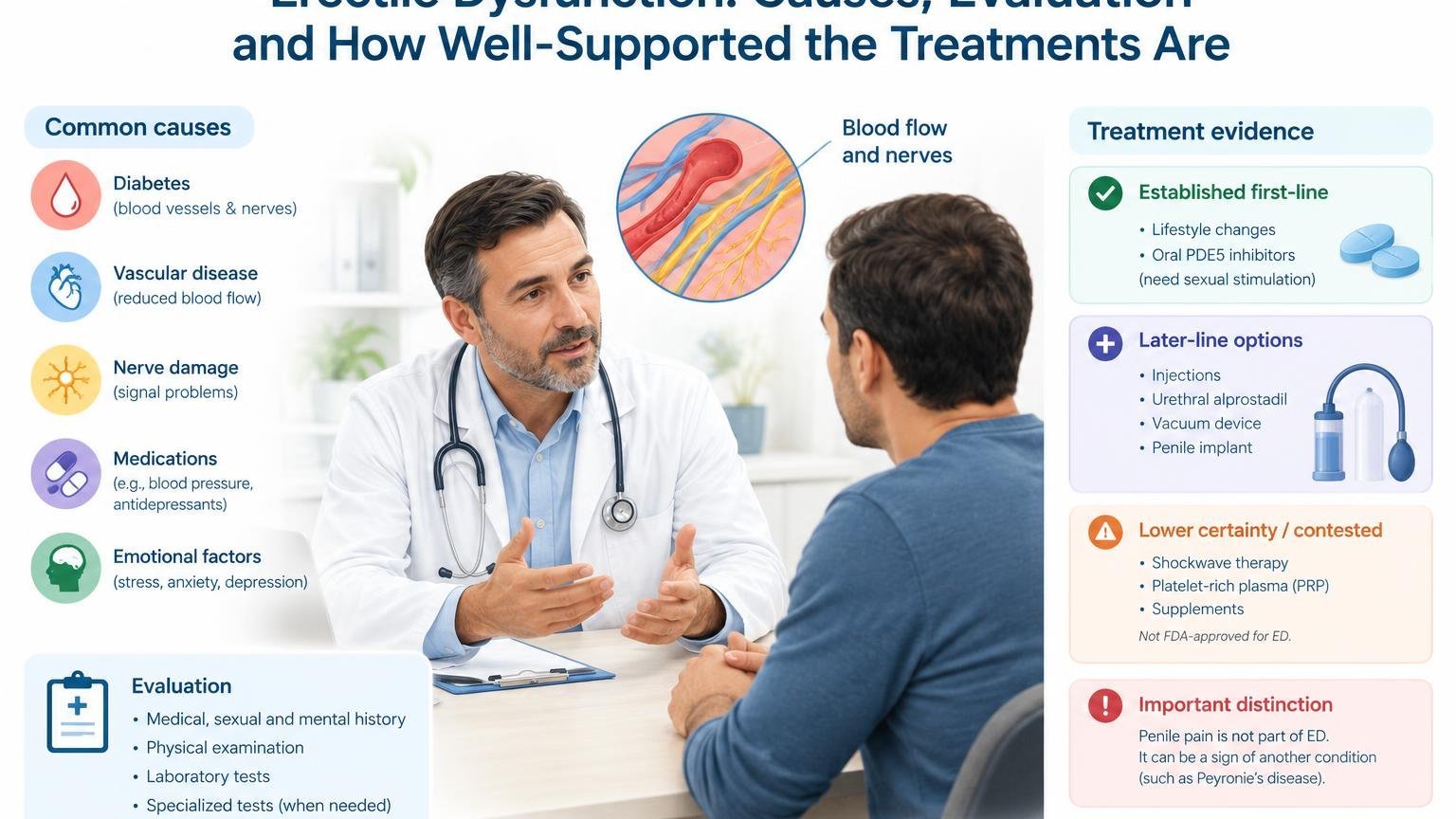
Erectile dysfunction (ED) means a man cannot get or keep an erection firm enough for sex, and it is explicitly not treated as a routine part of aging by the US National Institute of Diabetes and Digestive and Kidney Diseases (NIDDK). Its listed symptoms range from erections that happen only sometimes, to erections that do not last long enough, to none at all. Because trouble with erections can accompany diabetes, blood-vessel disease, nerve damage, medication effects and emotional distress, evaluation starts with a broad medical, sexual and mental health history, a physical examination and laboratory or other tests.[1]
Treatment evidence is not uniform. Oral PDE5 inhibitors are the usual first drug step for many men and require sexual stimulation to work; they are not taken with nitrates because of the risk of a dangerous blood-pressure drop. Injections, urethral alprostadil, vacuum devices and penile implants are established later-line options. Shockwave therapy and platelet-rich plasma (PRP) are the options whose evidence is weakest or most contested: a 2025 Cochrane review rated shockwave evidence low certainty, and two meta-analyses of PRP reached opposite conclusions. Neither shockwave nor PRP is described as an FDA-approved ED treatment.[2]
One distinction deserves its own paragraph. Pain during erections or during sex is not part of the NIDDK symptom list for ED. It belongs to a different line of questioning, such as Peyronie's disease, in which scar tissue can cause curvature, lumps and pain, and in which the acute phase can last up to 18 months. Filing pain under performance anxiety can leave a physical problem unevaluated.[3]
Why This Matters
ED is common and it is not only a problem of older men. In the Massachusetts Male Aging Study, 52% of men aged 40 to 70 reported some degree of erectile dysfunction. In a 2013 single-clinic study by Capogrosso and colleagues, 1 in 4 men seeking first medical help for new ED was 40 or younger. Those figures come from secondary reporting and should be read as context rather than a current global prevalence estimate.
The clinical importance goes beyond sex. NIDDK notes that ED may be a symptom of another health problem, and diabetes is one of the most commonly linked conditions. Research cited by NIDDK reports that men with diabetes are more than three times as likely to develop ED and that ED can appear 10 to 15 years earlier in men with diabetes, and NIDDK reports that more than half of men with diabetes will experience ED at some point. These are associations drawn from cited research, not proof that diabetes caused any individual case, and the underlying study designs are not detailed in the secondary source.[4]
What Causes ED: A Short List, Not a Single Story
An erection depends on blood flow and nerve signaling, so conditions that damage vessels or nerves are central. Years of elevated blood sugar can damage the blood vessels and nerves involved in getting and keeping an erection, which is the mechanism usually invoked for the diabetes association described above. NIDDK also lists heart and blood-vessel disease, hormone problems such as low testosterone, nerve damage, enlarged prostate and several classes of medication among the causes it names.
Medications are a practical and frequently overlooked contributor. NIDDK identifies blood-pressure medicines, diuretics and antidepressants as drugs that can cause ED as a side effect, and many men managing diabetes take one or more of these. That is a reason to bring a complete medication list to an appointment, including over-the-counter products, vitamins and supplements, and to let the prescriber decide whether any substitution is appropriate rather than stopping a medicine independently.
Emotional factors are real but are one item on a longer list. NIDDK's emotional-cause list includes anxiety, depression, stress, feeling isolated or lonely, and low self-esteem or negative body image, and it says these can cause ED or make it worse. The source gives no figures for how often emotional factors are the main cause, and it does not establish which came first for any individual. Psychological difficulty can also follow a physical problem rather than cause it, so the two directions need to be considered together.
Lifestyle factors sit alongside these causes. NIDDK states that a healthy diet can lower the risk of developing ED or improve symptoms, and that foods lowering the risk of diabetes, heart disease and obesity can also help ED. The same page lists quitting smoking, regular physical activity, reaching or keeping a healthy weight and limiting alcohol among the changes that can help, either alone or alongside other treatment. These are summary assertions; the page does not report effect sizes or the trials behind them.
How ED Is Evaluated
NIDDK describes diagnosis as drawing on a medical, sexual and mental health history, a physical examination, and laboratory and other tests. In practice, the history covers when the problem began, whether the difficulty is getting an erection, keeping one or both, whether erections still occur in other circumstances such as on waking, changes in sexual desire, and every medicine and supplement being taken. The physical examination looks for vascular, neurological and hormonal clues and for physical changes to the penis.
Specialized testing is not automatic. Depending on what the history and examination suggest, clinicians may use ultrasound imaging of blood flow, a nighttime erection test or an injection test. For men whose erections fade quickly, a urologist may check blood flow with a penile Doppler ultrasound, sometimes after a medicine that triggers an erection, to look for a venous leak, in which blood drains out and the erection is not held. These tests answer specific questions; they are not a universal screening panel.
| Step | What it involves | What it can and cannot establish |
|---|---|---|
| Medical, sexual and mental health history | Onset and pattern of erection difficulty, desire changes, emotional factors, and a full list of prescriptions, over-the-counter medicines, vitamins and supplements | Can identify likely contributors and flag medication effects; cannot by itself confirm a cause |
| Physical examination | Checks for vascular, neurological and hormonal clues and for physical changes to the penis | Can detect signs such as plaques on examination; findings need interpretation in context |
| Laboratory tests | Blood work that may include thyroid and prostate markers, alongside glucose and lipid assessment where relevant | Narrows the differential; does not measure erection quality directly |
| Specialized tests | Ultrasound of blood flow, nighttime erection testing or injection testing when indicated | Can address specific questions such as venous leak; not routine for every man |
What the Treatment Evidence Shows
NIDDK frames treatment as addressing underlying causes first and then focusing on sexual function, and it describes the choice of treatment as a personal decision. In the commonly cited sequence, most men start with lifestyle changes and an oral PDE5 inhibitor, and if pills do not work or cannot be used, the next options are injections into the penis, medicine placed in the urethra, a vacuum device or a penile implant. That sequence is a secondary summary attributing the guidance to NIDDK and Mayo Clinic.
The four oral PDE5 inhibitors named in the commercial explainer are sildenafil, tadalafil, vardenafil and avanafil. They increase blood flow to the penis and need sexual stimulation; they do not cause an erection on their own. Common side effects reported from prescribing information include headache, flushing, stuffy nose, backache, upset stomach and vision changes. The safety point that matters most is the nitrate interaction: labels list nitrate use such as nitroglycerin for chest pain as a reason not to take these medicines, because the combination can cause a dangerous drop in blood pressure.
Later-line established options work through different routes. Alprostadil can be injected into the side or base of the penis with a fine needle, or placed in the urethra as a small pellet using a special applicator, which suits men who prefer to avoid a needle. A vacuum device uses a plastic tube and pump to draw blood into the penis, with an elastic ring at the base to hold the erection. A penile implant is placed surgically and may be inflatable or semirigid; it is usually suggested only after other treatments have been tried. These are described as established options, not as interchangeable first choices.
Where the Evidence Is Weak or Contested
Low-intensity shockwave therapy aims sound waves at the penis with the goal of improving blood flow, and its evidence base is unsettled. A 2025 Cochrane review pooled 21 randomized trials with 1,357 men and found that shockwave therapy may have a small short-term effect on erectile function that men may not notice, and may improve erectile function in the long term. All of the evidence was rated low certainty, and several trials were funded by device makers. Separately, a 2025 meta-analysis of 12 randomized trials with 882 men with vasculogenic ED, the type caused by blood-flow problems, reported improvement compared with sham treatment.
Those two results are not a contradiction so much as a difference in certainty. The Cochrane review's low-certainty rating means the true effect could be substantially different from the estimate, and the pooled effect may be small enough that patients do not notice it. The vasculogenic subgroup result is narrower and comes from a secondary summary that does not describe certainty or funding. A reasonable reading is that shockwave remains an area of active study rather than a treatment with a settled place in the sequence.
Platelet-rich plasma, often marketed as the P-Shot, shows the clearest example of conflicting evidence. A 2024 meta-analysis by Du and colleagues of 12 controlled trials with 991 patients found better erectile function scores with PRP than with control treatments, with a standardized mean difference of 0.59, and the authors called for larger, higher-quality trials with longer follow-up. A 2026 meta-analysis by de Amorim and colleagues, restricted to randomized placebo-controlled trials, pooled 7 trials with 479 men and found no difference from placebo in erectile function scores at 1, 3 or 6 months, with low to moderate certainty.
The design difference helps explain the gap. The 2024 analysis included controlled and single-arm trials, which are more susceptible to placebo response and expectation effects, while the 2026 analysis restricted inclusion to placebo-controlled randomized trials, the design best suited to isolating a specific treatment effect. When the more rigorous design finds no difference, the burden of proof shifts toward larger and better-controlled studies. Neither shockwave therapy nor PRP is described as an FDA-approved treatment for ED.
Supplements belong on the low-certainty side as well. According to the National Center for Complementary and Integrative Health as cited, there is no definite evidence that any herbal product is effective or safe for ED, and some can be dangerous. The FDA has warned that many sexual enhancement products contain undeclared drug ingredients, including sildenafil-like compounds, which can interact with nitrates and other medicines. NIDDK also advises against ordering an ED medicine online before talking with a health care professional.
Erection Trouble Versus Penile Pain
NIDDK's ED symptom list is about getting and keeping an erection, and pain is not on it. Pain during an erection or during sex belongs to a different question: what is hurting, and why? Peyronie's disease is one condition in that territory. Scar tissue called plaque forms under the skin of the penis and can pull it into a curve; NIDDK says this plaque is not the same as arterial plaque and is not cancer, and that the exact cause is not known, though it may follow injury or relate to autoimmune disease.
Timing matters within that condition. NIDDK describes an acute phase, which can last up to 18 months, in which plaque forms, the penis may start to curve, and it may hurt even without an erection. A chronic phase usually begins 12 to 18 months after symptoms first appear, when the plaque and curve may stabilize, pain may lessen, and ED may develop or get worse. NIDDK also says some nonsurgical treatments may be used in the acute phase, though the source does not report how much earlier or later evaluation changes outcomes.
The prevalence figures for Peyronie's disease illustrate how much uncertainty remains. NIDDK says about 1 in 100 men in the United States over 18 have been diagnosed, while studies of men reporting symptoms lead researchers to estimate that more than 1 in 10 actually have it. The source does not explain the gap. A clinician can usually feel plaques on examination, and people with the condition are usually referred to a urologist.
One urgent sign crosses both topics. MedlinePlus guidance for people taking sildenafil lists an erection that is painful or lasts longer than 4 hours among symptoms to contact a doctor about immediately. That guidance is written for people taking the medicine, and the source states that the research it cites does not cover painful or prolonged erections in people not taking it. Either way, a painful or prolonged erection warrants prompt clinical contact rather than watchful waiting.
Interpretation and Limitations
The evidence summarized here comes from patient-education pages, a commercial clinic explainer, a public-health explainer and a single-topic educational guide. None is a primary trial report, and the treatment comparisons are descriptions of published reviews rather than a new systematic review. The NIDDK ED page was last reviewed in October 2024, while the Peyronie's page cited for the pain distinction was last reviewed in August 2019 and the MedlinePlus sildenafil guidance was revised in August 2023. Readers should check current versions.
Several specific gaps limit how far the numbers can be pushed. The Massachusetts Male Aging Study figure is a secondary citation without sample size or time frame in the quoted passage. The Capogrosso figure comes from one clinic. The diabetes relative-risk figure is attributed to research cited by NIDDK without the primary study design. The shockwave and PRP results differ by inclusion criteria, certainty ratings and funding, and the quoted summaries do not provide all of those details. Statistical differences on rating scales are not automatically differences men would notice in daily life.
One further caution concerns the source mix. The commercial explainer is medically reviewed by its clinic's medical director, but it is still a commercial source with an incentive to present certain services favorably, and it prices some of those services. The diabetes guide is built on NIDDK-cited information within an educational site. These are useful summaries, not independent regulatory or guideline documents. Claims about what is or is not FDA-approved should be confirmed against current regulatory information when a decision depends on them.
Research Outlook
The most active uncertainty concerns the regenerative and device-based approaches. The 2024 PRP authors called for more high-quality, larger trials with longer follow-up, and the 2026 placebo-controlled analysis should sharpen how future trials are designed: placebo control, adequate size and follow-up beyond six months will matter. For shockwave therapy, the low-certainty Cochrane rating and the device-maker funding of several trials point to a need for independent, well-controlled studies with outcomes men actually notice.
A second gap concerns evaluation and natural history rather than new devices. The sources do not report how much earlier or later assessment changes outcomes in Peyronie's disease, nor how often emotional factors are the primary cause of ED rather than a contributing or downstream factor. Those are questions about clinical pathways, not just molecular mechanisms, and they matter for how men are triaged and what they are told at the first appointment.
Key Takeaways
- ED is defined as trouble getting or keeping an erection firm enough for sex and is explicitly not framed as a routine part of aging; its listed symptoms do not include pain.
- Evaluation combines a medical, sexual and mental health history, a physical examination, and laboratory or other tests, and often uncovers contributing conditions or medications rather than a single cause.
- Oral PDE5 inhibitors are the usual first drug step for many men, require sexual stimulation and must not be combined with nitrates; injections, urethral alprostadil, vacuum devices and implants are established later-line options.
- Shockwave therapy and PRP are not FDA-approved ED treatments; the best-controlled PRP evidence found no difference from placebo, and shockwave evidence is rated low certainty.
- Pain with erections or during sex is a different clinical question from erection difficulty and deserves its own evaluation rather than being filed under performance anxiety.
Questions and Answers
What is erectile dysfunction and what symptoms define it?
Erectile dysfunction means a man cannot get or keep an erection firm enough for sex. Listed symptoms include erections that occur only sometimes, erections that do not last long enough for sex, and the inability to get an erection at all. Pain is not part of the definition or symptom list, and the condition is not treated as a routine part of aging.
How do doctors evaluate erectile dysfunction?
Evaluation typically combines a medical, sexual and mental health history, a physical examination, and laboratory and other tests. The history covers onset and pattern of symptoms, desire changes, emotional factors, and every medicine and supplement. Specialized tests such as penile ultrasound, nighttime erection testing or injection testing are used selectively when the history and examination point to a specific question.
Are PDE5 inhibitors the best-supported erectile dysfunction treatment?
Oral PDE5 inhibitors are the usual first drug step for many men and are described as established first-line treatment, but they need sexual stimulation and do not cause an erection on their own. They must never be combined with nitrates because of the risk of a dangerous blood-pressure drop. If they fail or cannot be used, established later options include alprostadil injections or urethral medicine, vacuum devices and penile implants.
Does shockwave therapy work for erectile dysfunction?
The evidence is low certainty. A 2025 Cochrane review of 21 randomized trials with 1,357 men found shockwave therapy may have a small short-term effect that men may not notice and may improve long-term function, but rated all evidence low certainty and noted several device-maker-funded trials. A separate 2025 meta-analysis of 882 men with vasculogenic ED reported improvement versus sham. Shockwave is not an FDA-approved ED treatment.
Why do studies disagree about platelet-rich plasma for erectile dysfunction?
A 2024 meta-analysis of 12 controlled trials with 991 patients found better erectile function scores with PRP than controls, but included single-arm designs vulnerable to placebo effects. A 2026 meta-analysis restricted to 7 randomized placebo-controlled trials with 479 men found no difference from placebo at 1, 3 or 6 months, with low to moderate certainty. The stricter design currently weighs against a specific effect; PRP is not FDA-approved for ED.
Is penile pain with erections the same as erectile dysfunction?
No. NIDDK's ED symptom list concerns getting and keeping an erection and does not include pain. Pain during erections or sex, especially with a lump or curvature, raises a different question such as Peyronie's disease, whose acute phase can last up to 18 months. Painful erections or ones lasting longer than 4 hours warrant prompt medical contact.
Sources and References
- Arthur L. Burnett. Erectile Dysfunction (ED) – NIDDK. National Institute of Diabetes and Digestive and Kidney Diseases (NIDDK), NIH
- Jen Adams; Josh Allen. Erectile Dysfunction Treatments: What the Evidence Shows. InjectCo
- MedicalFoundationOfNC.org Research Team. Erectile pain and performance concerns: Why the symptom changes the care question. MedicalFoundationOfNC.org
- LondonBridgeUrology.net Editorial Team. Diabetes and Erectile Dysfunction. LondonBridgeUrology.net
SANYUN Science Center explains published research on men's reproductive and sexual health, connecting scientific evidence with everyday questions while making sources and limitations clear.
Disclaimer: This article is for scientific education and research communication only. It does not provide medical advice, diagnosis, or individualized treatment recommendations, and does not endorse any medication, supplement, device, penile enlargement procedure, or other intervention. Decisions about sexual and reproductive health should be made in consultation with a qualified healthcare professional. Do not delay seeking professional care because of information in this article.
Original Content & Copyright Notice
- This article is prepared for SANYUN Science Center, drawing on published research and publicly available academic literature on men’s sexual and reproductive health. Its editorial explanations and presentation are developed for this platform.
- Copyright in the original editorial content, selection, and arrangement is reserved by SANYUN Science Center to the extent protected by applicable law. Referenced research, quotations, and third-party materials remain subject to the rights of their respective owners. This notice does not claim ownership of scientific facts or third-party research.
- Except where permitted by applicable law or an applicable license, prior written permission is required to reproduce, republish, translate, adapt, redistribute, or commercially reuse protected content. Attribution alone does not grant permission for such reuse.
- For permitted quotation or authorized reuse, clearly identify the source and retain a link to the original article.
- Source: SANYUN Science Center
- Original URL: Retain the original article URL on science.san-yun.com.
- Copyright Holder: SANYUN Science Center, for its own protected editorial content.
- Quotation, excerpts, or authorized reuse must not distort the scientific meaning, omit material limitations or disclaimers, or imply unverified medical claims, product efficacy, or endorsement by SANYUN Science Center.



