




Category: Health Academy
Core Research Direction: Patient education overview of what erectile dysfunction is, who it affects, common causes including lifestyle and cardiometabolic conditions, and why it may be an early sign of heart or blood vessel problems
Search Intent: What causes erectile dysfunction, and why might it signal an underlying heart or blood vessel problem?
Platform: SANYUN Science Center
Evidence reviewed through: 2026-11-25
Executive Summary
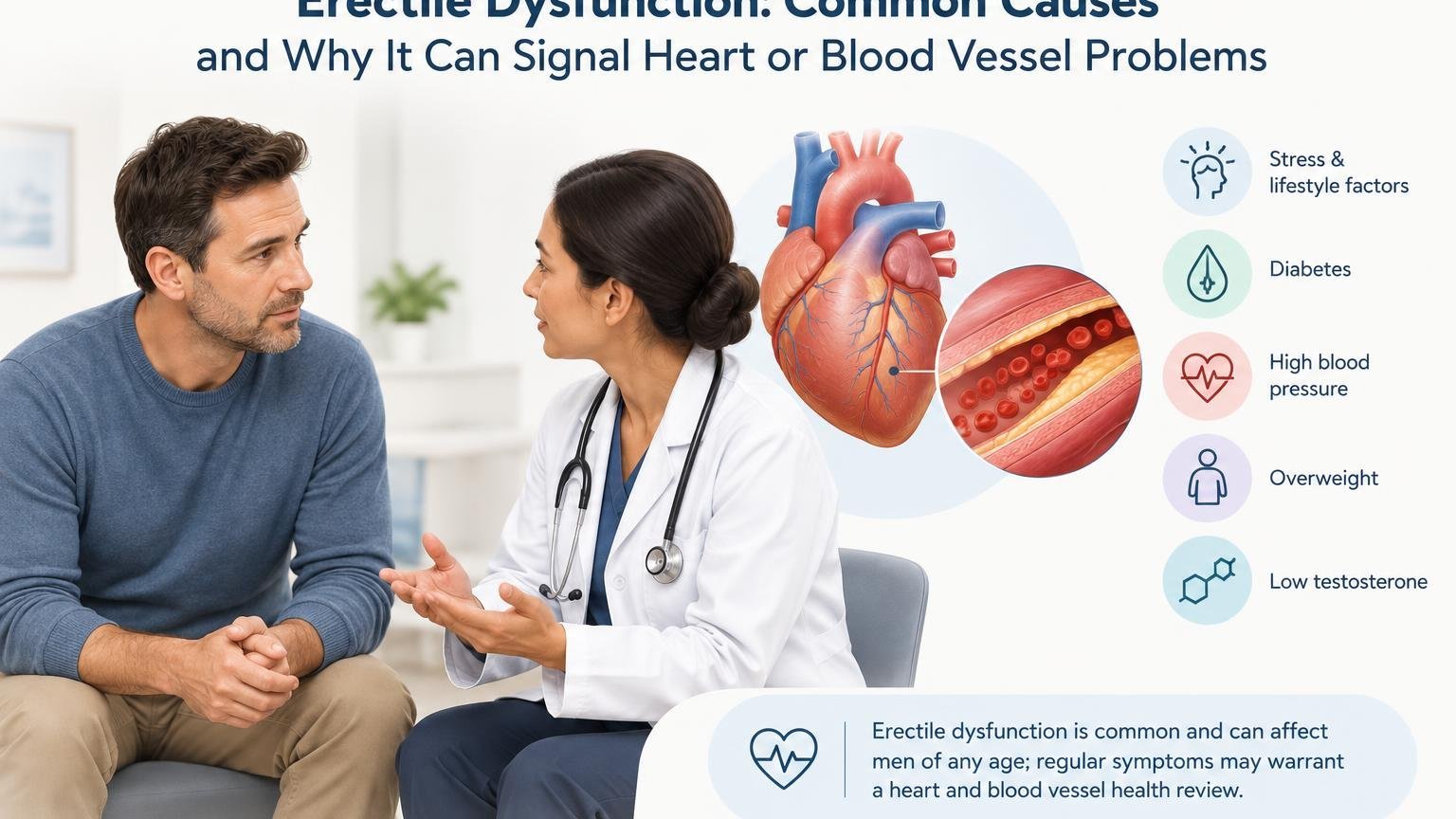
Erectile dysfunction is a common sexual health problem affecting millions of men worldwide. It means being unable to get or keep an erection for sexual intercourse. It can affect men of any age, not only older men, and it may happen occasionally or often. The source advises that it should not cause shame or embarrassment. Occasional erection problems can be linked to stress, anxiety, relationship issues, tiredness, heavy alcohol drinking or drug use. Regular problems may be linked to health conditions such as diabetes, high blood pressure, heart disease, being overweight or low testosterone. Because getting an erection depends on healthy blood flow, regular erection problems can sometimes be an early sign of heart or blood vessel problems. Doctors may check heart health and other risk factors, and may order blood tests for blood sugar, cholesterol and testosterone. This article explains these points in plain language and highlights what the evidence does and does not show.[1]
What Erectile Dysfunction Means
Erectile dysfunction is defined as being unable to get or keep an erection for sexual intercourse. It is described as a common sexual health problem that affects millions of men worldwide. Importantly, it is not limited to older men. The source states clearly that men of any age can experience it, sometimes without a clear reason. Erection problems can occur occasionally or often. The source also emphasizes that this condition should not cause shame or embarrassment, because sexual health is a key part of overall well-being. This framing matters: embarrassment can delay conversations with a doctor, and those conversations are the route to understanding possible underlying causes.
Why This Matters
Erectile dysfunction is more than a sexual problem. The source explains that because getting an erection depends on healthy blood flow, regular erection problems can sometimes be an early sign of heart or blood vessel problems. That does not mean every man with erectile dysfunction has heart disease. It does mean that regular symptoms deserve a proper conversation with a doctor, who may check heart health and other risk factors, and may order blood tests for blood sugar, cholesterol and testosterone levels. The source also notes that erectile dysfunction can occur alongside other health problems, such as urinary symptoms that may be caused by an enlarged prostate. Seeing the condition in this wider health context helps men and their partners take it seriously without alarm.
How Blood Flow Connects Erections and Blood Vessels
An erection depends on healthy blood flow. The source uses this biological fact to explain why regular erection problems can sometimes be an early sign of heart or blood vessel problems. The logic is straightforward in general terms: the blood vessels involved in erection are small, and problems with blood vessel health may show up there. However, the source presents this as a possible link framed with the word sometimes, not as a rule that applies to every man. It does not provide statistics, study designs or risk estimates. Readers should therefore understand the heart-vessel connection as a clinically relevant possibility that warrants medical assessment, not as a diagnosis or a guaranteed prediction.
Occasional Versus Regular Erection Problems
The source separates occasional erection problems from regular ones, and this distinction matters for understanding causes. Occasional problems can be caused by stress, anxiety, relationship issues, tiredness, or habits such as drinking too much alcohol or using drugs. These factors are often temporary or situational. Regular problems, by contrast, may be linked to health conditions such as diabetes, high blood pressure, heart disease, being overweight or low testosterone. The source does not say that occasional problems never have physical causes or that regular problems are always physical. It offers a practical frame: intermittent difficulties are often linked to stress, lifestyle and relationship factors, while persistent difficulties deserve closer medical attention.
Common Physical and Medical Contributors
Several health conditions are named by the source as possible links to regular erection problems: diabetes, high blood pressure, heart disease, being overweight and low testosterone. Previous surgery in the pelvis, such as surgery for prostate cancer, or radiation therapy can also cause erectile dysfunction. These are described as possible contributors, not as inevitable outcomes. The source does not quantify how often these conditions lead to erectile dysfunction or how strong each association is. It also does not describe the underlying mechanisms in detail beyond the general dependence on healthy blood flow. For patients, the practical message is that a doctor may want to look at cardiovascular and metabolic health when erection problems are regular.
Psychological, Lifestyle and Relationship Factors
Stress, anxiety, relationship issues and tiredness are listed by the source as possible causes of occasional erection problems, along with heavy alcohol drinking and drug use. These factors are not mutually exclusive with physical causes. A man may experience anxiety about erection difficulties that itself worsens the problem, or relationship strain that contributes to it. The source does not present a psychological model or a treatment protocol; it simply lists these as recognized contributors. The practical implication is that an honest conversation with a doctor should include lifestyle habits and emotional factors, not only physical symptoms. The source advises being open and honest about health and lifestyle and notes that small changes in habits could help.
| Pattern of symptoms | Factors named in the source | What the source suggests |
|---|---|---|
| Occasional erection problems | Stress, anxiety, relationship issues, tiredness, heavy alcohol drinking, drug use | These factors can cause occasional problems; the source advises openness about lifestyle and notes small habit changes could help. |
| Regular erection problems | Diabetes, high blood pressure, heart disease, being overweight, low testosterone | Regular problems may be linked to these health conditions; a doctor may check heart health, other risk factors and blood tests. |
| Prior pelvic surgery or radiation | Surgery for prostate cancer, radiation therapy | The source states these can also cause erectile dysfunction. |
| Possible heart or blood vessel link | Healthy blood flow is required for erection | Regular erection problems can sometimes be an early sign of heart or blood vessel problems; doctors may check heart health and risk factors. |
What a Doctor May Check
According to the source, when a man talks to a doctor about erectile dysfunction, the doctor may check heart health and other risk factors, because erectile dysfunction can sometimes be linked to heart or blood vessel problems. The doctor may also do blood tests to check blood sugar, cholesterol levels and testosterone levels. The source does not specify which tests are routine, how results are interpreted, or what treatment should follow. It also notes that erectile dysfunction can occur alongside other health problems; for example, needing to urinate more often, having a sudden or urgent need to urinate, or getting up at night to urinate may be caused by an enlarged prostate, which can be treated with medicines or surgery. These points are general guidance, not a personal treatment plan.
Interpreting the Evidence and Its Limits
The available source is a patient education page, described as general information about erectile dysfunction and not a substitute for professional medical advice or treatment. It was reviewed by a named specialist in 2026. That makes it a useful expert-reviewed overview for patients, but it is not a clinical trial, a systematic review or a population study. It reports no sample sizes, effect sizes, confidence intervals or prevalence figures. Statements such as erectile dysfunction affecting millions of men worldwide are broad descriptive claims, not quantified findings. The link between regular erection problems and heart or blood vessel problems is framed with the word sometimes. Readers should not interpret the page as proving that erectile dysfunction causes heart disease, or that every man with erectile dysfunction will develop cardiovascular problems.
The source also makes a distinction between occasional and regular problems that is clinically intuitive but not statistically quantified. It lists possible causes without ranking their relative importance. It advises that small changes in habits could help, but does not specify which changes, how much benefit to expect, or in what timeframe. The recommendation that doctors may check heart health and blood tests is clinical guidance rather than evidence from a study. These limitations do not make the source unhelpful; they define what it can and cannot support. It is appropriate for explaining concepts, prompting health conversations and reducing shame. It is not a basis for self-diagnosis or for deciding on treatment without a clinician.
Practical Understanding and Research Outlook
For a man experiencing erection problems, the practical takeaway is to notice the pattern. Occasional difficulties linked to stress, tiredness or relationship strain are described by the source as potentially reversible contributors, and honesty about lifestyle habits is encouraged. Regular difficulties may warrant a broader health review, including heart health, blood sugar, cholesterol and testosterone checks. Partners can help by approaching the topic without blame, since the source emphasizes that sexual health is part of overall well-being and that erectile dysfunction should not cause shame. The source does not provide data on prevention or treatment outcomes, so future research and updated guidance would be needed to quantify risks and benefits. This article is general education and should not replace a personal medical consultation.
Key Takeaways
- Erectile dysfunction means being unable to get or keep an erection for sexual intercourse and can affect men of any age, not only older men.
- Occasional erection problems can be linked to stress, anxiety, relationship issues, tiredness, heavy alcohol drinking or drug use.
- Regular erection problems may be linked to diabetes, high blood pressure, heart disease, being overweight or low testosterone.
- Because erections depend on healthy blood flow, regular erection problems can sometimes be an early sign of heart or blood vessel problems, and a doctor may check heart health and order blood tests.
- Previous pelvic surgery, such as prostate cancer surgery, or radiation therapy can also cause erectile dysfunction.
Questions and Answers
What is erectile dysfunction, and can it affect younger men?
Erectile dysfunction is the inability to get or keep an erection for sexual intercourse. It is a common sexual health problem affecting millions of men worldwide. The reviewed patient source states that it can affect men of any age, not only older men, and that it may occur sometimes without a clear reason. It can happen occasionally or often and should not cause shame. These are general descriptions, not prevalence estimates.
What causes occasional versus regular erection problems?
The reviewed source links occasional erection problems to stress, anxiety, relationship issues, tiredness, heavy alcohol drinking or drug use. Regular problems may be linked to diabetes, high blood pressure, heart disease, being overweight or low testosterone. It does not quantify how often each factor is responsible or rank their importance. The distinction is a practical guide for conversation, not a diagnostic formula, and some men may have overlapping physical and psychological factors.
Why can erectile dysfunction be an early sign of heart or blood vessel problems?
The source explains that getting an erection depends on healthy blood flow, so regular erection problems can sometimes be an early sign of heart or blood vessel problems. It does not give statistics or prove causation. This means the link is a clinically relevant possibility that warrants medical assessment, not a guarantee that heart disease is present. A doctor may check heart health and other risk factors and order blood tests for blood sugar, cholesterol and testosterone.
How strong is the evidence in this patient education source?
The source is an expert-reviewed patient education page, not a clinical trial or systematic review. It provides no sample sizes, effect estimates or prevalence figures, and it describes itself as general information that is not a substitute for professional medical advice. Statements about millions of men affected and about heart or blood vessel links are broad educational claims framed with words such as sometimes. They are useful for understanding and prompting discussion but cannot quantify individual risk.
Who should consider talking to a doctor about erection problems?
The source encourages any man who is troubled by erection problems to speak with a doctor, without shame. Regular problems are particularly relevant because they may be linked to diabetes, high blood pressure, heart disease, being overweight or low testosterone. A doctor may check heart health and other risk factors and may order blood tests for blood sugar, cholesterol and testosterone. Men with prior pelvic surgery or radiation therapy may also be at risk. This is general guidance, not personalized advice.
What lifestyle and relationship factors matter for erectile dysfunction?
Stress, anxiety, relationship issues, tiredness, heavy alcohol drinking and drug use are named by the source as possible causes of occasional erection problems. The source advises being open and honest with a doctor about health and lifestyle and notes that small changes in habits could help. It does not specify which changes or how much benefit to expect. Partners can support a calm conversation, since sexual health is part of overall well-being and erectile dysfunction should not cause shame.
Sources and References
- Afonso Morgado. Erectile dysfunction – Patients.
SANYUN Science Center explains published research on men's reproductive and sexual health, connecting scientific evidence with everyday questions while making sources and limitations clear.
Disclaimer: This article is for scientific education and research communication only. It does not provide medical advice, diagnosis, or individualized treatment recommendations, and does not endorse any medication, supplement, device, penile enlargement procedure, or other intervention. Decisions about sexual and reproductive health should be made in consultation with a qualified healthcare professional. Do not delay seeking professional care because of information in this article.
Original Content & Copyright Notice
- This article is prepared for SANYUN Science Center, drawing on published research and publicly available academic literature on men’s sexual and reproductive health. Its editorial explanations and presentation are developed for this platform.
- Copyright in the original editorial content, selection, and arrangement is reserved by SANYUN Science Center to the extent protected by applicable law. Referenced research, quotations, and third-party materials remain subject to the rights of their respective owners. This notice does not claim ownership of scientific facts or third-party research.
- Except where permitted by applicable law or an applicable license, prior written permission is required to reproduce, republish, translate, adapt, redistribute, or commercially reuse protected content. Attribution alone does not grant permission for such reuse.
- For permitted quotation or authorized reuse, clearly identify the source and retain a link to the original article.
- Source: SANYUN Science Center
- Original URL: Retain the original article URL on science.san-yun.com.
- Copyright Holder: SANYUN Science Center, for its own protected editorial content.
- Quotation, excerpts, or authorized reuse must not distort the scientific meaning, omit material limitations or disclaimers, or imply unverified medical claims, product efficacy, or endorsement by SANYUN Science Center.



