




Category: Erectile Dysfunction
Core Research Direction: Erectile dysfunction as an early vascular marker of future coronary artery disease, with age as an effect modifier: interpreting population-based longitudinal incidence data and its diagnostic/risk-screening implications
Search Intent: Does erectile dysfunction predict future coronary artery disease in community-dwelling men, and does the strength of that association differ by age at ED onset?
Platform: SANYUN Science Center
Evidence reviewed through: 2026-11-03
Executive Summary
A population-based cohort of 1402 community-dwelling men with regular sexual partners and no known coronary artery disease screened participants biennially for erectile dysfunction between January 1, 1996 and December 31, 2005. Coronary artery disease incidence densities were far higher among men with erectile dysfunction at ages 40 to 49 (48.52 versus 0.94 per 1000 person-years without erectile dysfunction), and the gap narrowed progressively at older ages, reaching 29.63 versus 23.30 per 1000 person-years at 70 or older.[1]
The authors concluded that erectile dysfunction in younger men was associated with a marked increase in future cardiac event risk, whereas in older men it appeared to have little prognostic importance. They proposed that erectile dysfunction and coronary artery disease may be differing manifestations of a common vascular pathology, and suggested young men with erectile dysfunction may be ideal candidates for cardiovascular risk factor screening and intervention.
This review interprets the published evidence; it is not new research or a systematic review. The age-stratified incidence data are observational, event counts in younger strata appear small, and the available text does not report confidence intervals, person-time denominators or adjusted hazard ratios. Later pooled estimates summarized in a secondary narrative source broaden the association but are not age-stratified and cannot confirm the age-modification claim, while screening benefit itself remains untested.[2]
Why This Matters
Erectile dysfunction prevalence in the cohort rose steeply with age: 2% in men aged 40 to 49, 6% at 50 to 59, 17% at 60 to 69 and 39% at 70 or older. Because the symptom is common at older ages, its value as a warning signal depends on how much extra risk it identifies beyond age itself. Age-stratified incidence data are the right tool for that question because they can show whether erectile dysfunction adds discriminating information where baseline coronary risk is low, and whether it adds little where baseline risk is already high.
For clinicians and patients, the stakes run in two directions. Cardiovascular screening carries costs, false positives and anxiety, and missed early coronary disease is consequential. A marker that is most informative in younger men would channel limited diagnostic attention toward a group in which a positive signal meaningfully changes pretest probability. The cohort data do not show that acting on erectile dysfunction prevents cardiac events; screening and intervention were framed as plausible implications, not tested benefits.
A secondary narrative source reports pooled relative risks that situate erectile dysfunction within broader cardiovascular risk discussions, including about 1.45 for cardiovascular disease (95% CI 1.36-1.54) and 1.50 for coronary heart disease. These are average associations across heterogeneous studies and cannot substitute for age-stratified prognosis in an individual; their role here is context, not confirmation of the cohort's age-modification conclusion.
Biological and Clinical Mechanism
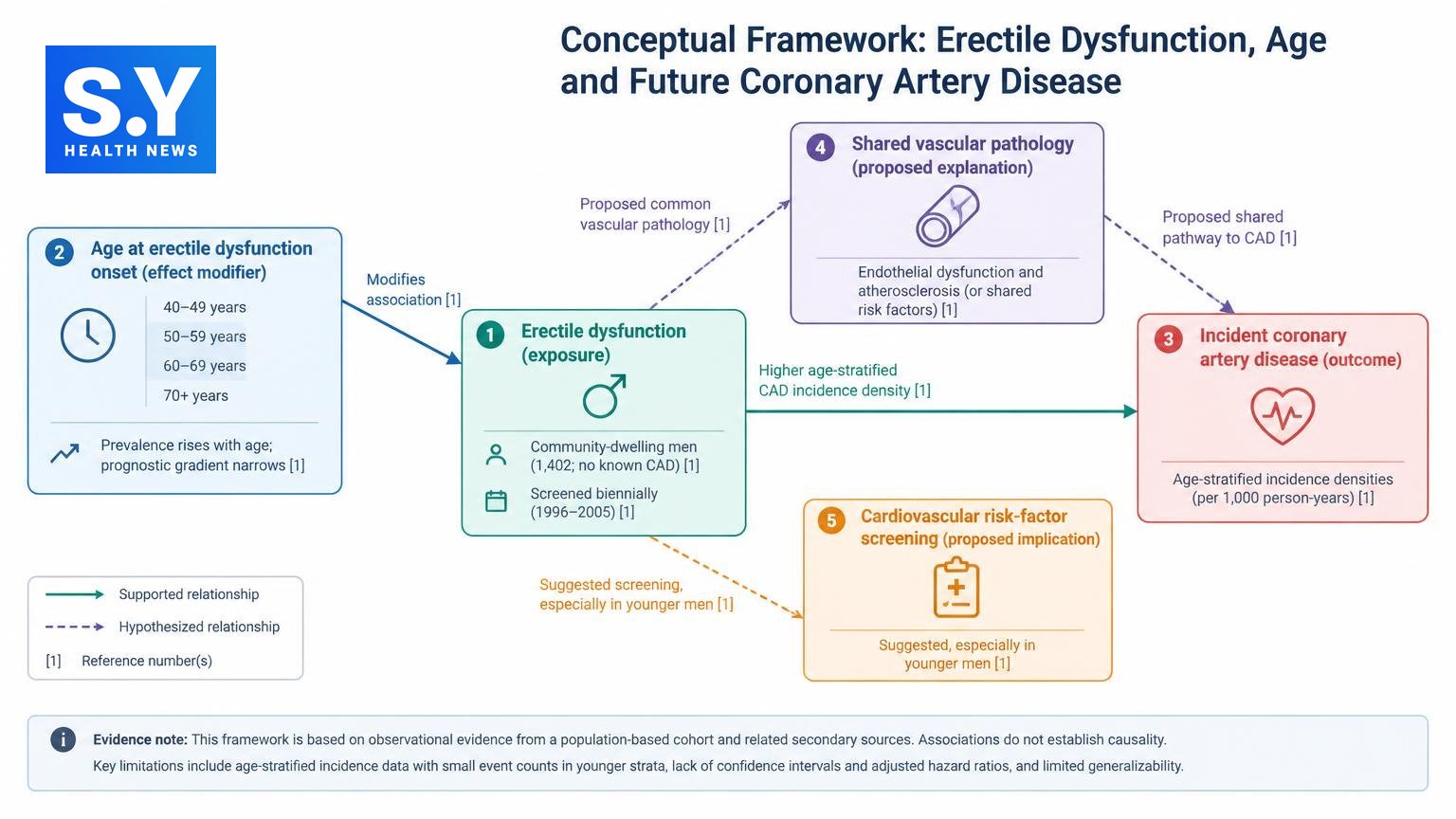
The cohort authors proposed that erectile dysfunction and coronary artery disease may be differing manifestations of one underlying vascular pathology. The commonly cited explanatory model is anatomical: penile arteries are smaller than coronary arteries, so endothelial dysfunction and atherosclerotic change may become symptomatic in the penis before they cause cardiac symptoms. This is a plausible hypothesis, not a mechanism directly demonstrated by incidence data, which record whether events occurred rather than imaging or measuring a shared lesion process.
An alternative interpretation is that erectile dysfunction and coronary disease share risk factors such as age, hypertension, dyslipidemia, diabetes and smoking, and that erectile dysfunction partly indexes cumulative vascular burden. The cohort reports adjustment for potential confounders in time-dependent Cox proportional hazards models, but the available text does not give the covariate set or the adjusted estimates, so the degree of confounding control cannot be verified. Shared risk factors and shared pathology are not mutually exclusive and could both contribute to the observed gradient.
Age plausibly modifies the relationship because different explanations dominate at different ages. Erectile dysfunction is uncommon in younger men, so when it appears without another clear cause it may signal underlying vascular disease more strongly. In older men it is so prevalent that its positive predictive value for distinguishing future coronary events is diluted. The authors' conclusion follows this reasoning: erectile dysfunction in a younger man was associated with a marked increase in future cardiac event risk, whereas in older men it appeared to have little prognostic importance.
What the Evidence Shows
The cohort permits a direct age-stratified comparison of incidence densities. Among men without erectile dysfunction, coronary artery disease incidence densities per 1000 person-years were 0.94 at ages 40 to 49, 5.09 at 50 to 59, 10.72 at 60 to 69 and 23.30 at 70 or older. Among men with erectile dysfunction, the corresponding densities were 48.52, 27.15, 23.97 and 29.63 per 1000 person-years. The contrast is most dramatic in the youngest group and becomes progressively less pronounced at older ages.
| Age group | CAD incidence density without ED (per 1000 person-years) | CAD incidence density with ED (per 1000 person-years) | Absolute difference (per 1000 person-years) |
|---|---|---|---|
| 40-49 years | 0.94 | 48.52 | 47.58 |
| 50-59 years | 5.09 | 27.15 | 22.06 |
| 60-69 years | 10.72 | 23.97 | 13.25 |
| 70 years or older | 23.30 | 29.63 | 6.33 |
These figures are incidence densities, not risk ratios, and that distinction matters. They describe how many coronary events arose per unit of person-time within each age-and-erectile-dysfunction stratum. The arithmetic differences shown in the table are derived from the reported densities and are descriptive only; they do not quantify the independent contribution of erectile dysfunction after adjustment. The excerpt provides no confidence intervals, no person-time denominators per stratum and no adjusted hazard ratios from the Cox models. The pattern is suggestive of age modification, but its precision is unknown, especially in younger strata where few men had erectile dysfunction.
The secondary source summarizes later pooled evidence: an umbrella review of prior meta-analyses reported relative risks of about 1.45 for cardiovascular disease (95% CI 1.36-1.54), 1.50 for coronary heart disease, 1.50 for cardiovascular mortality, 1.55 for myocardial infarction, 1.36 for stroke and 1.25 for all-cause mortality, all with P less than 0.001. These estimates reinforce the broader erectile-dysfunction-cardiovascular association but are reported secondhand, are not age-stratified and cannot confirm or refute the cohort's age-modification finding.
The same secondary source cites other observations, including an erectile dysfunction prevalence of 51% in 150 men with moderate to severe obstructive sleep apnea and a roughly 2.8-point improvement in IIEF-EF scores with aerobic exercise in a meta-analysis. These concern comorbidity and management rather than the core prognostic question, are reported without confidence intervals or methodological detail and are best treated as background. A separate report that a 2024 database analysis linked semaglutide use for weight loss to new erectile dysfunction diagnoses also notes that adjusted analyses attenuated the signal considerably, illustrating how observational signals can shrink under adjustment.
Interpretation and Limitations
Several limitations temper the conclusion. The sample comprised community-dwelling men with regular sexual partners who underwent biennial screening and had no known coronary artery disease at entry, excluding men without partners, men with established coronary disease and potentially the least medically engaged men. The cohort reflects a single geographic population, so absolute incidence may not generalize across countries or healthcare systems. The available text does not clarify how erectile dysfunction was defined or measured, whether severity or duration were analyzed, or whether presumed vascular and psychogenic cases were distinguished.
The statistical-versus-clinical distinction deserves emphasis. A large relative difference in the youngest stratum can rest on a very small absolute baseline: 0.94 versus 48.52 per 1000 person-years is clinically striking, but if only a handful of younger men had erectile dysfunction the estimate is fragile. Conversely, a smaller relative gap in older men may still correspond to meaningful absolute numbers because background incidence is high. Without person-time counts and confidence intervals, the stability of the age-specific estimates cannot be assessed from the available text.
Association is not causation, and the cohort cannot establish that erectile dysfunction itself accelerates coronary disease or that treating it prevents cardiac events. The age-modification conclusion is the authors' interpretation of stratified data, supported by a plausible biological rationale but not by a formal interaction test reported in the excerpt. The shared-vascular-pathology explanation remains a hypothesis, and the adjusted model results that would most directly test an independent association are unavailable for appraisal.
Secondary summaries carry their own distortions. The commercial physician guide cited here is not primary research and does not report full methods for the umbrella review it summarizes; its pooled relative risks are useful context but not independently verified. Neither source justifies a personalized prediction of an individual man's cardiac risk based on erectile dysfunction alone.
Research Outlook
The authors suggested that young men with erectile dysfunction may be ideal candidates for cardiovascular risk factor screening and medical intervention. This is a hypothesis-generating implication: it follows from the larger relative signal at younger ages but was not tested as a screening program. Evaluating it would require prospective studies with defined erectile dysfunction assessment, standardized cardiovascular risk measurement and clinical endpoints, plus attention to overdiagnosis and downstream testing burden.
Future analyses would benefit from reporting adjusted hazard ratios with interaction terms for age, complete covariate sets and calibration of erectile dysfunction against established risk scores. Whether adding the symptom to conventional risk prediction improves discrimination and reclassification is open. It also remains uncertain whether any erectile dysfunction intervention alters cardiovascular outcomes, and which men with the symptom most benefit from diagnostic workup.
Related literature points to treatable comorbidities that may confound or mediate the relationship, such as the reported 51% erectile dysfunction prevalence among men with moderate to severe obstructive sleep apnea. Aerobic exercise improving erectile function scores modestly in pooled trials reinforces that lifestyle factors link sexual and vascular health, although that evidence is secondhand and does not show that exercise reduces coronary events. These lines support a broader vascular-health framing without replacing age-stratified prognostic data.
Key Takeaways
- In a population-based cohort of 1402 men screened from 1996 to 2005, coronary artery disease incidence densities were far higher in men with erectile dysfunction at ages 40 to 49 (48.52 versus 0.94 per 1000 person-years), with the gap narrowing at older ages.
- The authors concluded that erectile dysfunction in younger men was associated with a marked increase in future cardiac event risk, whereas in older men it appeared to have little prognostic importance.
- Erectile dysfunction prevalence rose from 2% at ages 40 to 49 to 39% at 70 or older, so at older ages the symptom is common enough that its incremental predictive value is diluted.
- The shared-vascular-pathology explanation is a plausible hypothesis rather than a demonstrated mechanism; observation cannot separate causation from shared risk factors.
- Screening younger men with erectile dysfunction is a proposed clinical implication, not a demonstrated benefit; precision is limited by unreported event counts, person-time denominators and confidence intervals.
Questions and Answers
Is erectile dysfunction considered an early warning sign of coronary artery disease, and what supports that idea?
Erectile dysfunction is proposed as a vascular warning sign because the cohort authors suggested it and coronary artery disease may be differing manifestations of one underlying vascular pathology. Support comes from observational incidence data in which men with erectile dysfunction had higher age-stratified coronary incidence densities. This is a hypothesis supported by association, not proof of a shared causal mechanism; shared risk factors could contribute.
What did the population-based cohort find about erectile dysfunction and later coronary artery disease?
Among 1402 community-dwelling men without known coronary disease, incidence densities per 1000 person-years were far higher in men with erectile dysfunction at ages 40 to 49 (48.52 versus 0.94 without it), and remained higher with a narrowing gap at older ages (29.63 versus 23.30 at 70 or older). The authors concluded the symptom carried marked prognostic weight in younger men and little in older men.
Does the association between erectile dysfunction and coronary artery disease differ by age group?
The age-stratified incidence densities suggest it does: the largest difference between men with and without erectile dysfunction appeared in the youngest group and the smallest in the oldest. However, no formal interaction test, adjusted hazard ratio or confidence interval is reported in the available text, and event counts in younger strata appear small. The age-modification conclusion is the authors' interpretation rather than a definitively quantified effect.
How strong is the overall evidence that erectile dysfunction predicts cardiovascular disease?
Observational evidence consistently shows an association. A secondary source summarizes an umbrella review reporting relative risks of about 1.45 for cardiovascular disease (95% CI 1.36-1.54) and 1.50 for coronary heart disease. These are pooled averages from observational meta-analyses, reported secondhand and not age-stratified, so they cannot establish causation or replace the more informative but incompletely reported age-specific cohort data.
Should younger men with erectile dysfunction be screened for cardiovascular risk factors?
The cohort authors suggested young men with erectile dysfunction may be ideal candidates for cardiovascular risk factor screening and medical intervention, but this was a proposed implication, not a tested screening program. The logic is that the symptom at a young age, when background risk is low, may carry more diagnostic information. Whether screening improves outcomes remains unproven and requires individualized clinical judgment.
What are the main limitations of using erectile dysfunction as a coronary risk marker?
Erectile dysfunction is common at older ages, reaching 39% at 70 or older, so its incremental predictive value there is limited. The cohort excluded men without partners and those with prior coronary disease, came from one geographic population, and the available text lacks confidence intervals, person-time counts and adjusted estimates. No cited study shows that treating or screening for erectile dysfunction prevents cardiac events.
Conceptual framework: Conceptual framework: erectile dysfunction as exposure, age as effect modifier and incident coronary artery disease as outcome in a population-based cohort of 1402 community-dwelling men. The association is observational; shared vascular pathology and screening implications are proposed, not proven.
Academic References & Evidence
- Inman BA; Sauver JL; Jacobson DJ; McGree ME; Nehra A; Lieber MM; Roger VL; Jacobsen SJ. Medline ® Abstract for Reference 35 of 'Diabetic autonomic neuropathy'. Mayo Clin Proc. 2009 :108 PMID: 19181643.
- Parth Bhavsar. Erectile Dysfunction. Teledirect MD (commercial physician health guide). 2026
SANYUN Science Center explains published research on men's reproductive and sexual health, connecting scientific evidence with everyday questions while making sources and limitations clear.
Disclaimer: This article is for scientific education and research communication only. It does not provide medical advice, diagnosis, or individualized treatment recommendations, and does not endorse any medication, supplement, device, penile enlargement procedure, or other intervention. Decisions about sexual and reproductive health should be made in consultation with a qualified healthcare professional. Do not delay seeking professional care because of information in this article.
Original Content & Copyright Notice
- This article is prepared for SANYUN Science Center, drawing on published research and publicly available academic literature on men’s sexual and reproductive health. Its editorial explanations and presentation are developed for this platform.
- Copyright in the original editorial content, selection, and arrangement is reserved by SANYUN Science Center to the extent protected by applicable law. Referenced research, quotations, and third-party materials remain subject to the rights of their respective owners. This notice does not claim ownership of scientific facts or third-party research.
- Except where permitted by applicable law or an applicable license, prior written permission is required to reproduce, republish, translate, adapt, redistribute, or commercially reuse protected content. Attribution alone does not grant permission for such reuse.
- For permitted quotation or authorized reuse, clearly identify the source and retain a link to the original article.
- Source: SANYUN Science Center
- Original URL: Retain the original article URL on science.san-yun.com.
- Copyright Holder: SANYUN Science Center, for its own protected editorial content.
- Quotation, excerpts, or authorized reuse must not distort the scientific meaning, omit material limitations or disclaimers, or imply unverified medical claims, product efficacy, or endorsement by SANYUN Science Center.



