




Category: Erectile Dysfunction
Core Research Direction: Erectile dysfunction as an early marker of systemic vascular/endothelial disease, and how lifestyle and metabolic interventions (including investigational and supplement approaches) fit into contemporary guideline-directed ED care
Search Intent: Is erectile dysfunction an early warning sign of cardiovascular disease, and which treatments — from PDE5 inhibitors and lifestyle change to newer or unproven options — are actually supported by evidence?
Platform: SANYUN Science Center
Evidence reviewed through: 2026-11-04
Executive Summary
Erectile dysfunction (ED) is common and multifactorial, and recent reviews frame it less as an isolated sexual complaint than as a window onto systemic vascular health. In one 2026 narrative review, ED is described both as a condition affecting sexual health and as an early marker of cardiovascular risk and endothelial dysfunction. A separate editorial similarly calls ED an early warning sign of systemic vascular disease that may appear years before overt cardiovascular events.[1][2]
The clinical implication is twofold. First, unexplained ED may justify cardiovascular risk assessment; a reviewer summarizing a 2026 narrative review states that ED often precedes coronary artery disease by two to five years. Second, phosphodiesterase type 5 (PDE5) inhibitors remain first-line pharmacotherapy, but they are partly symptomatic: the same review notes that in a substantial proportion of patients they are insufficiently effective, and an editorial argues they cannot reverse the upstream pathological basis of ED.[3]
Lifestyle and metabolic factors — diet, physical activity, weight reduction, sleep and stress management — are described as modifiable contributors with potentially significant impact on erectile function, and lifestyle intervention is characterized as essential but often underused. Beyond established care the evidence thins: regenerative options such as low-intensity shockwave therapy are judged insufficient for routine use, gut-microbiota strategies remain conceptual, and a 2026 industry-funded preprint of a standardized Shilajit resin reports large improvements but is unreviewed at this cutoff.[4]
Why Cardiovascular Risk Assessment Matters in ED
ED is widespread. An editorial places the prevalence of some degree of ED at approximately 50% of men over 40, rising markedly with age, and notes a projection that global incidence would reach 322 million by 2025 — a projection rather than an observed count. Prevalence figures are not interchangeable across sources: a commercial consumer article states that approximately 40% of men are affected at age 40 and 70% at age 70 without citing the underlying studies or definitions, so any single figure should be read as definition-dependent.[5]
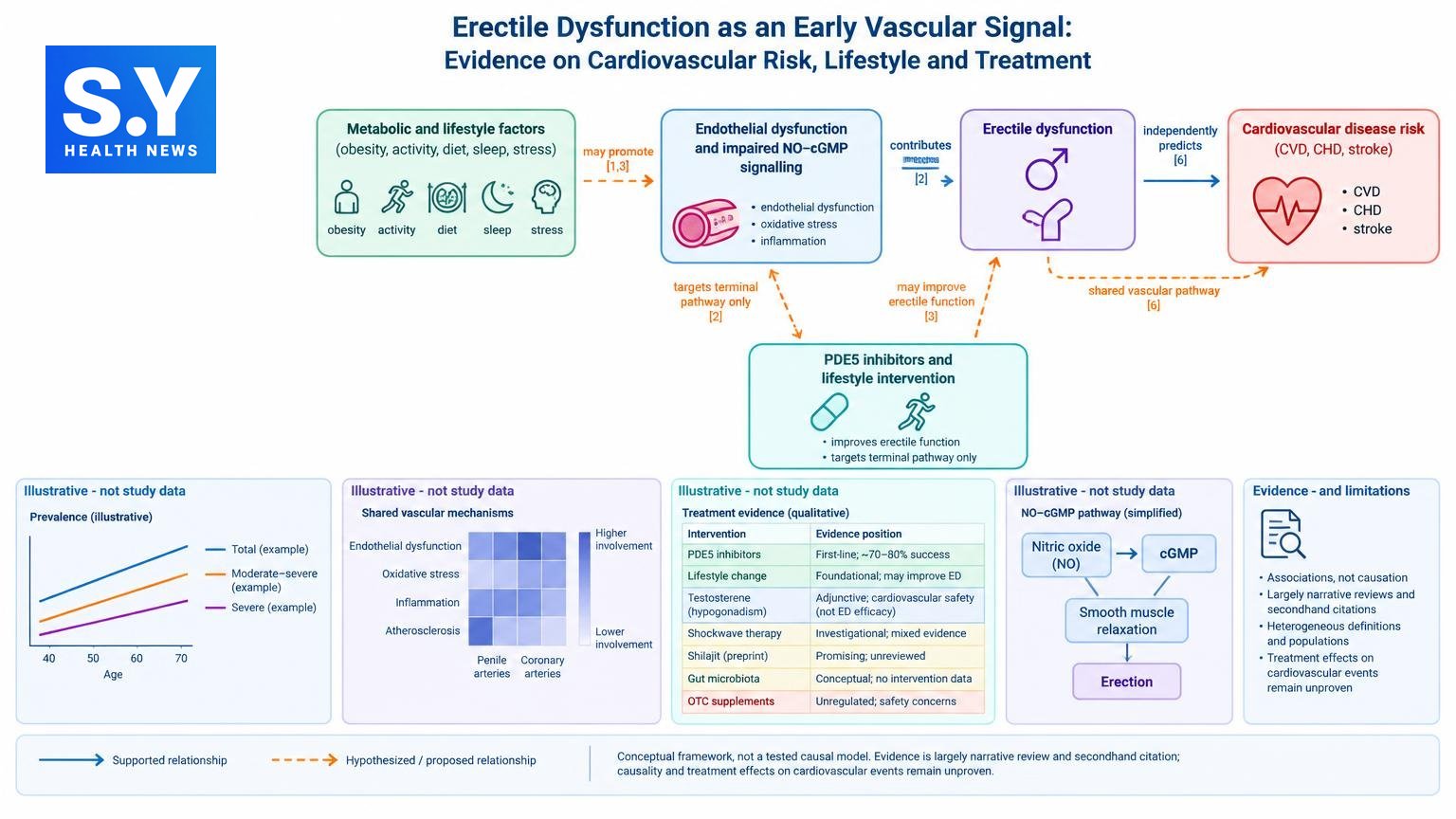
The case for clinical attention does not rest on prevalence alone. The strongest quantitative claims in this packet concern the cardiovascular association: a physician-authored guide reports that a 2023 umbrella review found ED independently predicts cardiovascular disease (RR 1.45), coronary heart disease (RR 1.50) and stroke (RR 1.36), and that the 2024 Princeton IV Consensus treats ED as a cardiovascular risk-enhancing factor. These are relative risks cited secondhand here, without confidence intervals in the quoted passage, and they describe associations, not proof that treating ED modifies cardiovascular outcomes.[6]
There is also an infertility dimension. The same editorial reports that infertility prevalence reaches as high as 17.5% and that ED has been reported in 26% of males with infertility, though the primary sources of those estimates are not identified in the available text. ED additionally carries psychological and relational weight — self-esteem, mood, quality of life and intimate relationships are all affected — which is why a purely mechanistic framing undersells the condition.
The NO–cGMP Mechanism and Its Upstream Drivers
The core pathway is the nitric oxide–cyclic guanosine monophosphate (NO–cGMP) cascade. Nitric oxide relaxes cavernosal smooth muscle, increases arterial inflow and initiates the veno-occlusive mechanism that maintains rigidity. Normal erection also depends on endothelial function, neural input and pelvic floor muscle activity, and disruption of any of these can produce ED. PDE5 inhibitors work by inhibiting PDE5-mediated degradation of cGMP, amplifying this terminal effector pathway.
That mechanism explains both the drugs' usefulness and their ceiling. As one editorial puts it, PDE5 inhibitors act mainly by acutely enhancing the terminal NO–cGMP pathway and cannot reverse the upstream pathological basis of ED; some patients respond poorly or cannot tolerate them because of adverse effects. The upstream pathology is largely vascular and endothelial: endothelial dysfunction, oxidative stress and chronic low-grade inflammation are described as interacting and reinforcing one another to impair NO–cGMP signaling.
This is where the cardiovascular link becomes biologically plausible rather than merely epidemiological. The same processes that narrow coronary arteries — endothelial dysfunction and atherosclerotic plaque — also affect the smaller penile arteries, and a physician-authored guide argues that because penile arteries are smaller, plaque produces symptoms there first. Central obesity is highlighted as a major modifiable risk factor because it promotes inflammation, oxidative stress, endothelial dysfunction and testosterone suppression; waist circumference is recommended as a practical measure because it is reported to correlate more strongly with ED severity than BMI alone.
Sleep adds another input. A physician-authored guide reports that among 150 men newly diagnosed with moderate-to-severe obstructive sleep apnea, ED prevalence was 51%, and describes intermittent nocturnal hypoxia, sleep fragmentation and sympathetic activation as plausible contributors. Nocturnal erections are informative in a different way: one review discusses them as an indicator of intact vascular and neurological structures, a concept useful for distinguishing organic from predominantly psychogenic patterns, though test-accuracy data are not supplied.
Evidence by Intervention
PDE5 inhibitors — sildenafil, tadalafil, vardenafil and avanafil — remain first-line pharmacologic therapy, with reported success rates of approximately 70–80% in the general ED population. They should not be used with organic nitrates, and caution is advised with alpha-blockers and strong CYP3A4 inhibitors. Safety deserves emphasis rather than a footnote: PDE5 inhibitors are absolutely contraindicated with nitrate medications and recreational nitrites because the combination can cause severe, potentially fatal hypotension.
Lifestyle change is positioned as foundational rather than optional. The 2026 narrative review states that weight reduction of 5–10% can meaningfully improve erectile function and that bariatric surgery may normalize erectile function in some obese men, though the excerpt provides no trial-level effect estimates. Diet, physical activity, sleep and stress management are described as modifiable contributors, and lifestyle intervention is characterized as essential but often underused within an integrated approach to sexual health.
Hormonal therapy has a narrower role. Testosterone is not a standalone ED treatment; it is relevant in confirmed hypogonadism, and the review does not recommend routine prolactin and thyroid testing for all patients, though these may be useful when clinical suspicion exists, especially in young men with unexplained ED. The cited TRAVERSE trial (n=5,246 hypogonadal men with elevated cardiovascular risk) found transdermal testosterone non-inferior to placebo for major adverse cardiac events (HR 0.96, 95% CI 0.78–1.17) over a mean 21.7 months. That is a cardiovascular safety finding, not evidence of erectile-function benefit.
Regenerative approaches sit at a different evidentiary level. The 2026 review concludes that evidence is insufficient to recommend routine use of low-intensity shockwave therapy and platelet-rich plasma, noting modest improvements in some studies but inconsistent results, heterogeneous protocols, conflicting sham-controlled trials and unproven long-term durability. A secondhand summary of a 2025 Cochrane review of 21 randomized trials (1,357 men) reports that shockwave therapy may improve IIEF-EF scores by roughly 3.9 points short-term and 5.3 points long-term versus sham, rated low certainty. A statistically detectable score change of this size is not automatically clinically decisive, and the citation is secondhand within this packet.
Newer and supplementary approaches divide sharply by evidence quality. Gut dysbiosis is proposed as a contributor through weakened short-chain fatty acid and NO signaling, endotoxemia-mediated endothelial inflammation and perturbed androgen metabolism, but this rests on a conceptual editorial and small studies. Over-the-counter male enhancement supplements are unregulated and, according to the guide, frequently contain hidden PDE5 inhibitors per FDA safety notifications. Consumer articles promoting herbs such as Cordyceps make claims — for example that cordycepin improves erectile responses — without supplying human trial citations.
| Intervention | Evidence position | Reported outcome | Key caveat |
|---|---|---|---|
| Lifestyle and weight reduction | Foundational in narrative reviews | Weight reduction of 5–10% may meaningfully improve erectile function | No trial-level effect estimates in the reviewed excerpt |
| PDE5 inhibitors | First-line pharmacotherapy | Success rates of approximately 70–80% in the general ED population | Contraindicated with organic nitrates; symptomatic rather than restorative |
| Testosterone (confirmed hypogonadism) | Adjunctive, not standalone | MACE HR 0.96 (95% CI 0.78–1.17) versus placebo in TRAVERSE | Cardiovascular safety endpoint, not an ED efficacy trial; cited secondhand |
| Low-intensity shockwave therapy | Investigational | About 3.9-point short-term and 5.3-point long-term IIEF-EF gain versus sham, low certainty | Inconsistent protocols and unproven durability |
| Standardized Shilajit resin | Single industry-funded preprint | IIEF total +32.1% versus +13.6% (d=0.67, p=0.005) at 90 days | Not peer reviewed at cutoff; manufacturer-funded; nitric oxide unchanged |
| Gut microbiota modulation | Conceptual | Proposed effects via short-chain fatty acids, endotoxemia and androgen metabolism | No intervention data; editorial-level hypothesis |
| OTC male enhancement supplements | Unregulated | Frequently contain hidden PDE5 inhibitors per FDA notifications | Variable composition; potential nitrate interaction risk |
The Shilajit Preprint: A Case Study in Reading New Evidence
A 2026 preprint randomized, double-blind, placebo-controlled multicenter trial enrolled 100 men aged 35–55 with mild-to-moderate ED (IIEF erectile function domain 11–25) and androgen-deficiency symptoms across two sites, who received 250 mg twice daily of a standardized Shilajit resin or matched placebo for 90 days. IIEF total score improved +32.1% versus +13.6% (d=0.67, p=0.005), with gains in four of five domains (d=0.52–0.61, p=0.011–0.044); sexual desire improvement did not reach significance (d=0.44, p=0.109).
The same trial reported total testosterone rising +46.1% versus +10.0% (d=0.44, p=0.030) and free testosterone +37.4% versus +6.8% (d=0.41, p=0.048), and 56–58% versus 12–14% of participants rated much or very much improved on global assessment at day 90. Notably, nitric oxide showed no significant between-group difference — a discordance that complicates any simple NO-mediated explanation and suggests the testosterone pathway may be more relevant than the NO–cGMP pathway in this formulation.
The trial was funded by the manufacturer of the resin evaluated, and author disclosures include founders and a paid consultant of that company. It is a preprint, unreviewed at this cutoff, and reports a single product formulation. Whether the reported differences are clinically decisive depends on baseline severity, the minimal clinically important difference, blinding integrity and the analysis population — none fully resolved in the available abstract. Independent replication is needed before these findings can inform routine care.
Interpretation and Limitations
The cardiovascular signal is the most consequential claim in this literature, and it is also the most easily over-read. Relative risks of 1.45 for cardiovascular disease, 1.50 for coronary heart disease and 1.36 for stroke indicate that men with ED have more cardiovascular events; they do not show that ED causes those events, nor that treating ED lowers them. The temporal claim that ED often precedes coronary artery disease by two to five years is a review-level statement rather than a pooled estimate.
Much of the framing rests on narrative reviews and editorials rather than primary trials. The description of ED as an early marker of cardiovascular risk and endothelial dysfunction, and the conclusion that it can be a clinical entry point for detecting systemic disease, are author-level syntheses. They are influential and biologically coherent, but their evidentiary weight differs from a randomized trial.
Secondhand citation compounds this. Several of the most quotable numbers here — the umbrella review relative risks, the Cochrane shockwave estimates, the TRAVERSE result, the sleep apnea prevalence — reach this review through a commercial physician-authored guide, not through the primary publications. Values may be accurate, but the chain of transmission should be acknowledged, and the guide itself is not an independent academic source.
There is also internal tension worth naming. If a supplement improved erections mainly through NO signaling, one might expect nitric oxide to change; in the Shilajit trial it did not differ significantly between groups. The authors instead emphasize testosterone and symptom-domain changes. That is a hypothesis-generating pattern, not a demonstrated mechanism, and it underscores the need to distinguish statistical significance from clinical importance.
Finally, much of the supplement material in the consumer source is unsourced. Assertions that cordycepin increases erectile and orgasmic responses, or that particular herbs treat ED, are not accompanied by human trial citations in that article, and should not be weighed against guideline-directed therapy. Unregulated products carry additional risk when they contain hidden PDE5 inhibitors, given the absolute contraindication with nitrates.
Research Outlook
Three lines of inquiry look most productive. The first is mechanistic stratification: separating vasculogenic, neurogenic, hormonal and psychogenic contributions so that treatments are matched to dominant drivers rather than applied generically. Waist circumference outperforming BMI as a correlate of ED severity hints that visceral adiposity captures something clinically relevant.
The second is the upstream, systemic perspective. If ED is a local manifestation of systemic disorders, then interventions targeting inflammation, endothelial function and metabolic health deserve rigorous testing with erectile function as a prespecified endpoint rather than a side observation. The third is methodological: regenerative and supplement research needs standardized protocols, adequate sham controls, long-term durability data and independent funding before routine recommendation is defensible.
Microbiota-directed strategies remain at the hypothesis stage, with proposed pathways involving short-chain fatty acids, endotoxemia and androgen metabolism but no intervention evidence in this packet. For clinicians, the practical message is less about novelty than about sequence: assess cardiovascular risk when ED is unexplained, address modifiable lifestyle and metabolic factors as foundational care, use PDE5 inhibitors appropriately with attention to nitrates, and present investigational options honestly as investigational.
Key Takeaways
- ED is described in 2026 reviews as an early marker of cardiovascular risk and endothelial dysfunction, with one reviewer summarizing that ED often precedes coronary artery disease by two to five years.
- An umbrella review cited secondhand reports that ED independently predicts cardiovascular disease (RR 1.45), coronary heart disease (RR 1.50) and stroke (RR 1.36) — associations, not causal proof, and not evidence that treating ED reduces cardiovascular events.
- PDE5 inhibitors remain first-line with reported success rates of approximately 70–80%, but they enhance the terminal NO–cGMP pathway rather than reversing upstream pathology, and are absolutely contraindicated with nitrates and recreational nitrites.
- Lifestyle change is foundational: weight reduction of 5–10% can meaningfully improve erectile function, and diet, physical activity, sleep and stress management are described as modifiable contributors that are often underused.
- Low-intensity shockwave therapy and platelet-rich plasma are investigational, with inconsistent results and unproven durability; routine use is not supported by current evidence.
- A 2026 industry-funded preprint of standardized Shilajit resin reported IIEF improvements of +32.1% versus +13.6% at 90 days, but it is unreviewed at this cutoff, reports no significant change in nitric oxide, and requires independent replication.
- Unregulated male enhancement supplements frequently contain hidden PDE5 inhibitors, which matters because of the nitrate interaction risk; consumer herb claims such as those for cordycepin lack human trial citations in the source reviewed.
Questions and Answers
How is erectile dysfunction linked to endothelial function and the nitric oxide–cGMP pathway?
Erection depends on nitric oxide relaxing cavernosal smooth muscle, raising arterial inflow and triggering the veno-occlusive mechanism that maintains rigidity, with cyclic GMP as the key downstream signal. PDE5 inhibitors slow cGMP breakdown to amplify this pathway. Endothelial dysfunction, oxidative stress and chronic low-grade inflammation impair the same signaling, which is why ED is treated as a vascular as well as a sexual condition.
Does erectile dysfunction predict heart disease and stroke?
Evidence summarized in a physician-authored guide reports that an umbrella review found ED independently predicts cardiovascular disease (RR 1.45), coronary heart disease (RR 1.50) and stroke (RR 1.36), and that a 2024 consensus treats ED as a cardiovascular risk-enhancing factor. These are associations from review-level evidence, cited secondhand here, not proof that ED causes cardiovascular events or that treating ED lowers cardiovascular risk.
How strong is the evidence for low-intensity shockwave therapy for erectile dysfunction?
It is investigational. One review found modest improvements in some studies but inconsistent results, heterogeneous protocols, conflicting sham-controlled trials and unproven long-term durability, concluding evidence is insufficient for routine use. A secondhand summary of a 2025 Cochrane review of 21 trials (1,357 men) reported roughly 3.9-point short-term and 5.3-point long-term IIEF-EF gains versus sham, rated low certainty.
What did the 2026 Shilajit resin trial in men with erectile dysfunction find?
In a 2026 preprint randomized placebo-controlled trial, 100 men aged 35–55 with mild-to-moderate ED received 250 mg twice daily of standardized Shilajit resin or placebo for 90 days. IIEF total score improved +32.1% versus +13.6% (d=0.67, p=0.005), and testosterone rose more with the resin. Nitric oxide showed no significant between-group difference. The trial was manufacturer-funded and unreviewed at this cutoff, so it is promising but not established.
Can weight loss and lifestyle change improve erectile function in men with erectile dysfunction?
Reviews describe lifestyle as a modifiable factor with potentially significant impact on erectile function, listing diet, physical activity, weight reduction, sleep and stress management, and characterize lifestyle intervention as essential but often underused. Weight reduction of 5–10% can meaningfully improve erectile function, though the reviewed excerpt gives no trial-level effect estimates and the evidence is review-level rather than from a single large trial.
Are over-the-counter male enhancement supplements safe for erectile dysfunction?
They carry real risk. A physician-authored guide states that over-the-counter male enhancement supplements are unregulated and frequently contain hidden PDE5 inhibitors per FDA safety notifications. That matters because PDE5 inhibitors are absolutely contraindicated with nitrate medications and recreational nitrites, a combination that can cause severe, potentially fatal hypotension. Consumer herb claims, such as those for cordycepin, lack human trial citations in the source reviewed.
Conceptual framework: Conceptual framework, not a tested causal model. Nodes summarize variables discussed in this evidence review of men with erectile dysfunction. Arrows marked supported reflect reported associations; the metabolic-to-endothelial and endothelial-to-cardiovascular links are proposed. Evidence is largely narrative review and secondhand citation; causality and treatment effects on cardiovascular events remain unproven.
Academic References & Evidence
- F.C.N. Kersten; J. Versfelt; M.P.J. Nicolai. Overzichtsartikelen Archives – NTvL. NED TIJDSCHR LEEFSTIJLGENEESKD. 2026 4(5):188–96
- Shujie Xia; Lei Wu. Exploring novel therapeutic strategies for the… : Current Urology. Current Urology. 2026 DOI: 10.1097/CU9.0000000000000377.
- Crocetto F; Amicuzi U; Musone M; Imbimbo C; Tammaro S; Napolitano L; Reccia P; De Luca L; Del Giudice F; Stizzo M; Olivetta M; Lieto DD; Mauro MD; Mattiello G; Puca G; Della Rosa G; Magliocchetti M; Giugliano M; Capoluongo R; Coppola M; Imperatore S; Madonna A; Capone F; Del Biondo D; Barone B. Crocetto F. et al., 2026: Erectile Dysfunction: A Comprehensive Review of Pathophysiology, Diagnosis and Contemporary Management. – STORZ MEDICAL Blog. Medicina (Kaunas). 2026 62(5):854 DOI: 10.3390/medicina62050854.
- Divya Yadav; Amandeep Singh; Karan Shah; Utsa Basu; Kurmi Prakash Harishchandra; Manoj Karwa; Surya Teja Reddy. TruBlk™ Shilajit Resin Improves Sexual Function in Men with Erectile Dysfunction: A Randomised, Double-Blind, Placebo-Controlled, Multicenter Trial. 2026 (preprint)
- Erectile Dysfunction: What Are Its Causes and Natural Ways to Treat it.
- Erectile Dysfunction. 2026
SANYUN Science Center explains published research on men's reproductive and sexual health, connecting scientific evidence with everyday questions while making sources and limitations clear.
Disclaimer: This article is for scientific education and research communication only. It does not provide medical advice, diagnosis, or individualized treatment recommendations, and does not endorse any medication, supplement, device, penile enlargement procedure, or other intervention. Decisions about sexual and reproductive health should be made in consultation with a qualified healthcare professional. Do not delay seeking professional care because of information in this article.
Original Content & Copyright Notice
- This article is prepared for SANYUN Science Center, drawing on published research and publicly available academic literature on men’s sexual and reproductive health. Its editorial explanations and presentation are developed for this platform.
- Copyright in the original editorial content, selection, and arrangement is reserved by SANYUN Science Center to the extent protected by applicable law. Referenced research, quotations, and third-party materials remain subject to the rights of their respective owners. This notice does not claim ownership of scientific facts or third-party research.
- Except where permitted by applicable law or an applicable license, prior written permission is required to reproduce, republish, translate, adapt, redistribute, or commercially reuse protected content. Attribution alone does not grant permission for such reuse.
- For permitted quotation or authorized reuse, clearly identify the source and retain a link to the original article.
- Source: SANYUN Science Center
- Original URL: Retain the original article URL on science.san-yun.com.
- Copyright Holder: SANYUN Science Center, for its own protected editorial content.
- Quotation, excerpts, or authorized reuse must not distort the scientific meaning, omit material limitations or disclaimers, or imply unverified medical claims, product efficacy, or endorsement by SANYUN Science Center.



