




Category: Erectile Dysfunction
Core Research Direction: Erectile dysfunction in men with obstructive sleep apnoea: strength of the association and whether CPAP treatment improves erectile function, including the quality of the underlying evidence base
Search Intent: In men with obstructive sleep apnoea, how strong is the link with erectile dysfunction, and does treating the apnoea with CPAP actually improve erections?
Platform: SANYUN Science Center
Evidence reviewed through: 2026-11-09
Executive Summary
Obstructive sleep apnoea (OSA) is a common sleep disorder characterised by repeated episodes of intermittent hypoxia during sleep. Erectile dysfunction (ED) has repeatedly been observed at high frequency in men with OSA, and a link between the two conditions has been hypothesised. A recent systematic review with narrative synthesis was designed to evaluate the literature linking ED and OSA, the possible mechanisms involved, and treatment options.[1]
The review included eighteen studies: five randomised controlled trials, eleven prospective studies and two cross-sectional studies. Across this literature, reported ED prevalence in men with OSA reached as high as 82%, and individual cohorts found figures around 68% in severe OSA and 68% in another OSA cohort. Such figures are striking, but they come from heterogeneous clinical samples rather than a single representative population.
The treatment question is less settled. Studies of continuous positive airway pressure (CPAP) in men with OSA and ED showed results ranging from no significant effect to complete resolution of ED. The review authors concluded that CPAP is a safe treatment likely to improve OSA symptoms and does not negatively affect erectile function, with some probable benefit, but that the degree of effect on ED remains unclear.
The wider evidence base for ED treatments is weak. An umbrella review of meta-analyses up to October 2025 found that most summary effects were graded low or very low quality. This context matters when interpreting both the OSA-ED association and the CPAP literature: statistically significant improvements are not the same as reliably demonstrated clinical benefit.[2]
Why This Matters
ED is defined as the inability to achieve or maintain a penile erection sufficient for satisfactory sexual activity. It is common and multifactorial, with vasculogenic, neurogenic and endocrine contributions. Recognising OSA as a potential contributor matters because OSA is treatable, and because sleep-related hypoxia, sleep fragmentation and hormonal disruption are plausible pathways to sexual dysfunction.[3]
For clinicians and patients, the practical question is not simply whether OSA and ED co-occur, but whether identifying and treating OSA changes erectile outcomes. If CPAP reliably improved erections, screening men with ED for OSA would have clear therapeutic value. The current evidence supports vigilance and assessment but does not establish CPAP as a dependable ED treatment.
Biological and Clinical Mechanisms
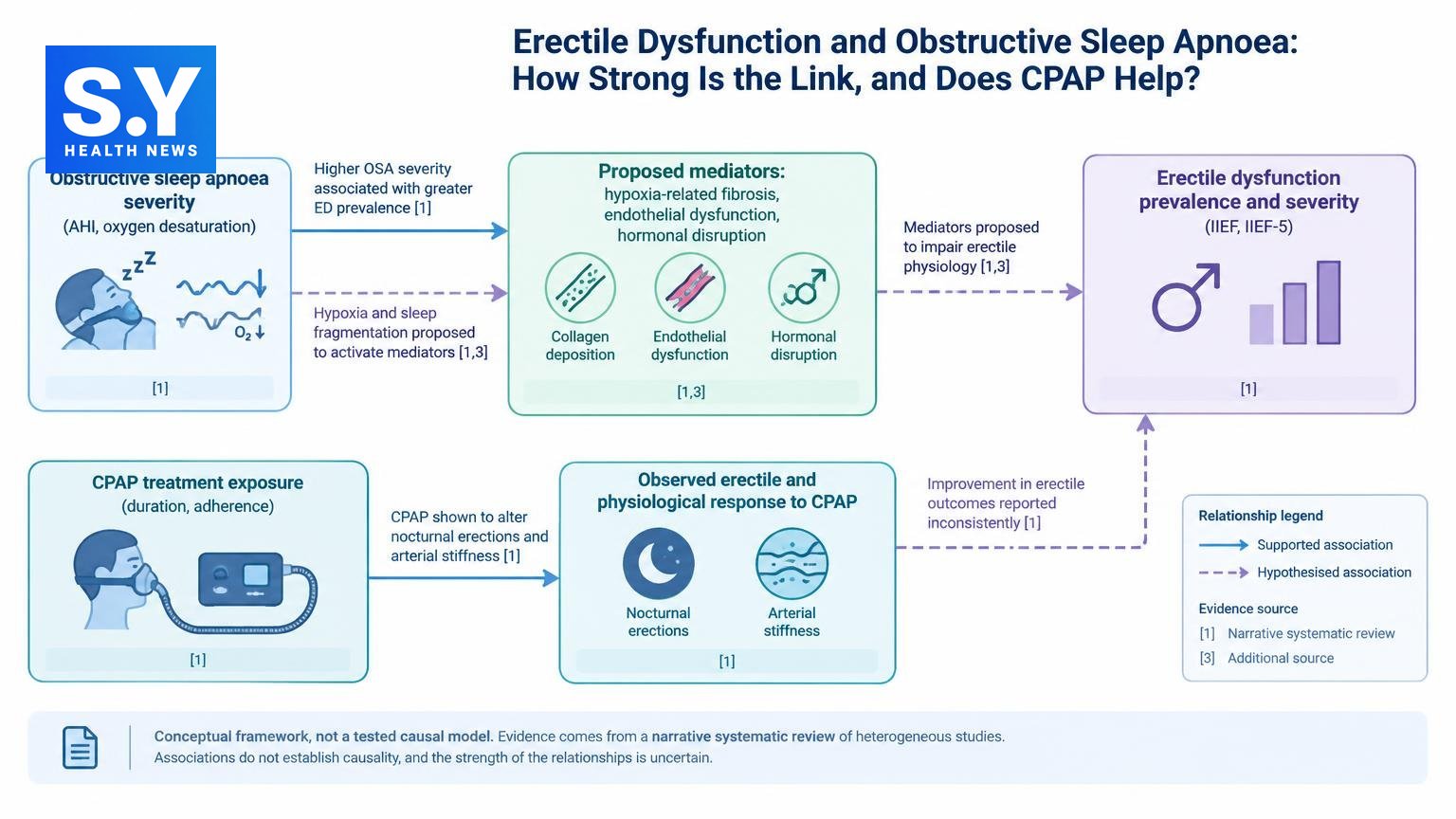
Several mechanisms have been proposed to explain how OSA might impair erectile function. One pathway centres on intermittent hypoxia: hypoxia has been reported to reduce prostaglandin E1, which ordinarily inhibits pro-fibrotic cytokines. The proposed consequence is increased collagen deposition in penile tissue, reduced elasticity and impaired veno-occlusion, leading to incomplete tumescence. This is a narrative mechanistic account rather than a directly estimated effect in the review.
A complementary three-part account describes nocturnal hypoxia damaging the vascular endothelium, sleep fragmentation disrupting testosterone production that peaks during REM sleep, and chronic sympathetic activation raising catecholamines and worsening endothelial function. All three converge on the vascular pathway that PDE5 inhibitors target. These mechanisms are biologically plausible but derive from secondary and narrative sources, not from controlled human experiments in the reviewed evidence.
Neurological involvement has also been reported. In one included study, 17 of 25 OSA patients (68%) had an altered bulbocavernosus reflex, and those patients had higher apnoea-hypopnoea indices, more sleep time with oxygen saturation below 90%, and lower daytime oxygen pressure. This small study raises the possibility of nerve involvement in OSA-related ED, but its sample is too small to generalise.
Hormonal pathways are inconsistent. Some studies reported lower testosterone in men with OSA, and severity-related differences have been observed, while others found no significant change in testosterone after CPAP. The relationship between OSA, testosterone and erectile function therefore remains unresolved and is unlikely to be a single uniform pathway.
What the Evidence Shows
The systematic review searched MEDLINE, PubMed and Embase for studies published between January 2000 and January 2022. Because the included studies differed in design, methods and population size, the authors used a narrative synthesis rather than meta-analysis. Quality was appraised with a mixed-methods tool by two reviewers, and no study was excluded on quality grounds, which means weaker studies contributed to the conclusions.
Prevalence estimates varied widely. In a study of 94 men with severe OSA defined by an apnoea-hypopnoea index above 30 per hour, 68% also had ED defined by an IIEF-5 score below 21. In another included study, 47% of OSA patients had ED, and prevalence rose with OSA severity to 24% in mild, 48% in moderate and 60% in severe OSA. A secondary guide also cites a 2018 study of 150 men with moderate to severe OSA in which ED prevalence was 51%.
The treatment evidence is more mixed. In a small randomised trial of 30 men with OSA and ED, sildenafil compared with CPAP for 12 weeks produced successful intercourse in 54% versus 24%, an IIEF increase of 62% versus 26%, and overall satisfaction of 53% versus 20%. A larger randomised comparison of CPAP against sildenafil in severe OSA reported successful intercourse of 30% versus 58% and post-intervention IIEF changes of 58% versus 135%. These head-to-head trials consistently favoured the PDE5 inhibitor on erectile endpoints.
Prospective CPAP studies have been more encouraging in some settings. In 80 patients with OSA and ED treated with CPAP for three months, 23% were reclassified as normal, and the proportion with more than 80% nocturnal penile rigidity rose from 14% to 40%. However, a study of 27 men with type 2 diabetes and OSA completing three months of CPAP found no change in total or free testosterone or SHIM score, suggesting that comorbidities may modify the response.
A randomised trial comparing CPAP with a PDE5 inhibitor for 12 weeks found an insignificant 11% IIEF improvement with CPAP, alongside an increase in nocturnal erections from 2.7 to 4.1 and improvement in arterial stiffness from 13.7 to 7.3. No change in testosterone, luteinising hormone or follicle-stimulating hormone occurred with either treatment. These findings suggest CPAP may affect vascular and nocturnal erectile physiology without consistently translating into reported erectile function gains.
Hormonal studies add further uncertainty. In 207 men stratified by OSA severity and treated with CPAP for three months, severe OSA patients had lower testosterone than a simple-snoring group, and CPAP did not significantly change serum testosterone. A CPAP-withdrawal trial of 70 men found that withdrawal for two weeks increased DHEA alone while other hormones remained unaffected.
| Variable or outcome | Reported finding | Population and context | Interpretation |
|---|---|---|---|
| ED prevalence in OSA | Up to 82% across the literature | Men with OSA; heterogeneous cohorts | High but variable co-occurrence; not a single population estimate |
| ED in severe OSA | 68% with IIEF-5 below 21 | 94 men with AHI above 30/h | Consistent with a strong association in severe disease |
| Prevalence by OSA severity | 24% mild, 48% moderate, 60% severe | OSA patients stratified by severity | Suggests a severity gradient, though observational |
| CPAP versus sildenafil | Successful intercourse 54% vs 24%; IIEF +62% vs +26% | 30 men with OSA and ED, 12 weeks | Small trial favouring sildenafil over CPAP |
| CPAP versus sildenafil | Successful intercourse 30% vs 58%; IIEF +58% vs +135% | 82 men with severe OSA and ED, 3 months | PDE5 inhibitor outperformed CPAP on erectile endpoints |
| CPAP erectile response | Insignificant 11% IIEF improvement | Men with OSA and ED, 12 weeks | Possible physiological benefit without clear reported gain |
| CPAP in diabetes | No change in SHIM or testosterone | 27 men with type 2 diabetes and OSA, 3 months | Comorbidity may blunt or mask benefit |
Interpretation and Limitations
The association between OSA and ED appears reasonably consistent across observational studies, but its strength cannot be precisely quantified from this review. Prevalence figures ranging up to 82%, with individual cohorts at 68% and 51%, come from selected clinical samples. Men referred for sleep studies may differ from the general population in body weight, cardiovascular risk and other factors that independently cause ED, so confounding is likely.
The CPAP evidence is limited by small samples, short treatment durations and non-randomised designs. Several trials were small, and the review intentionally retained lower-quality studies. The results range from no effect to complete resolution, which is a breadth that should caution against strong claims in either direction. CPAP may improve nocturnal erections and arterial stiffness without reliably improving patient-reported erectile function.
The broader ED evidence base is also weak. An umbrella review of 23 meta-analyses found that 13 were rated critically low quality and 7 low quality, while 20 of 42 summary effects were low quality and 20 very low quality. Statistically significant improvements in ED were observed with pharmacological and non-pharmacological interventions, but the authors urged caution because of limited patient numbers and subjective outcome indicators.
Outcome measurement matters. IIEF and related scales are patient-reported and can be influenced by expectation, relationship factors and mood. Nocturnal penile rigidity and arterial stiffness are more objective but may not capture what men experience during partnered sex. A change on a physiological measure is not automatically a meaningful clinical improvement.
Research Outlook
The systematic review authors called for further randomised controlled trials to evaluate CPAP for ED in men with OSA. Until more robust evidence is available, they described CPAP as safe for OSA and likely to improve OSA symptoms, with no negative effect on erectile function and some probable benefit whose magnitude is uncertain.
The umbrella review reached a similar conclusion at a broader level, recommending well-designed studies of single treatments and high-quality meta-analyses of comparisons between treatments. For the OSA-ED question specifically, future trials would need adequate sample sizes, longer follow-up and consistent definitions of both OSA severity and erectile outcome.
Mechanistic work also needs clarification. The roles of intermittent hypoxia, collagen deposition, endothelial dysfunction and testosterone suppression are plausible but inconsistently supported. Distinguishing men whose ED is primarily vascular, hormonal or nerve-related may help identify who benefits most from OSA treatment.
Key Takeaways
- ED is common in men with OSA, with reported prevalence reaching up to 82% and around 68% in some severe-OSA cohorts, but these figures come from heterogeneous clinical samples.
- Studies of CPAP for ED range from no significant effect to complete resolution, and the review could not establish the size of any benefit.
- Head-to-head trials generally found PDE5 inhibitors outperformed CPAP on erectile endpoints, although the trials were small.
- Proposed mechanisms include hypoxia-related tissue fibrosis, endothelial damage, sleep fragmentation affecting testosterone and sympathetic activation, but these are not consistently confirmed.
- The wider ED treatment evidence is predominantly low or very low quality, so statistically significant findings should be interpreted cautiously.
- CPAP remains appropriate for treating OSA itself and appears not to harm erectile function, but it should not be assumed to reliably reverse ED.
Questions and Answers
How common is erectile dysfunction in men with obstructive sleep apnoea?
Reported prevalence varies widely. One systematic review found figures up to 82% across the literature, while individual cohorts reported 68% in severe OSA, 68% in another OSA group and 51% in newly diagnosed moderate to severe OSA. These are clinical samples, so the figures are not a single representative population estimate.
What mechanisms might link sleep apnoea to erectile dysfunction?
Proposed pathways include intermittent hypoxia reducing prostaglandin E1 and increasing collagen deposition in penile tissue, endothelial damage from hypoxia and sympathetic activation, sleep fragmentation disrupting testosterone production, and possible nerve involvement shown by altered bulbocavernosus reflexes. These mechanisms are biologically plausible but not consistently confirmed in controlled human studies.
Does CPAP treatment improve erectile function in men with sleep apnoea?
The evidence is mixed. Studies range from no significant effect to complete resolution of ED. Some prospective studies reported improvements in erectile scores and nocturnal rigidity, while a randomised trial found only an insignificant 11% IIEF improvement. The review concluded CPAP does not harm erectile function and may offer some benefit, but the magnitude is unclear.
How strong is the evidence linking obstructive sleep apnoea with erectile dysfunction?
The association is consistently observed but not precisely quantified. The systematic review used a narrative synthesis because studies were heterogeneous, and it retained lower-quality studies. The broader ED evidence base is mostly low or very low quality, so the association is plausible and clinically relevant but not firmly established in causal terms.
Do PDE5 inhibitors work better than CPAP for erectile dysfunction in men with sleep apnoea?
In small head-to-head trials, PDE5 inhibitors generally performed better on erectile endpoints. Sildenafil versus CPAP produced successful intercourse of 54% versus 24%, and another trial reported 58% versus 30% with larger IIEF gains for sildenafil. These trials were small, so the comparison is suggestive rather than definitive.
What should men with erectile dysfunction and possible sleep apnoea understand before starting treatment?
Both conditions are treatable, but the evidence does not show that CPAP reliably reverses ED. CPAP is appropriate for OSA and appears not to worsen erectile function. Erectile symptoms deserve assessment for vascular, hormonal and other causes, and treatment decisions should be individualised with a clinician rather than assuming one therapy will address both problems.
Conceptual framework: Conceptual framework, not a tested causal model. It shows the hypothesised pathway from OSA severity through proposed mediators to erectile dysfunction, alongside the inconsistently observed effect of CPAP on erectile outcomes. Evidence comes from a narrative systematic review of heterogeneous studies.
Academic References & Evidence
- Zain Ahmed Siddiqui; Daniel Peter McNicholas; Adam Spacey; Ian Pearce; Vaibhav Modgil. The Relationship between Erectile Dysfunction and Obstructive Sleep Apnoea and the Impact on Severity of ED following Treatment of OSA: A Systematic Review. Urol Int. 2026 110(2):176–185 DOI: 10.1159/000546690. PMID: 40784340.
- Current treatment for erectile dysfunction: an umbrella review of systematic reviews and meta-analyses. 2026 DOI: 10.6084/m9.figshare.31562993.v1.
- Parth Bhavsar. Erectile Dysfunction.
SANYUN Science Center explains published research on men's reproductive and sexual health, connecting scientific evidence with everyday questions while making sources and limitations clear.
Disclaimer: This article is for scientific education and research communication only. It does not provide medical advice, diagnosis, or individualized treatment recommendations, and does not endorse any medication, supplement, device, penile enlargement procedure, or other intervention. Decisions about sexual and reproductive health should be made in consultation with a qualified healthcare professional. Do not delay seeking professional care because of information in this article.
Original Content & Copyright Notice
- This article is prepared for SANYUN Science Center, drawing on published research and publicly available academic literature on men’s sexual and reproductive health. Its editorial explanations and presentation are developed for this platform.
- Copyright in the original editorial content, selection, and arrangement is reserved by SANYUN Science Center to the extent protected by applicable law. Referenced research, quotations, and third-party materials remain subject to the rights of their respective owners. This notice does not claim ownership of scientific facts or third-party research.
- Except where permitted by applicable law or an applicable license, prior written permission is required to reproduce, republish, translate, adapt, redistribute, or commercially reuse protected content. Attribution alone does not grant permission for such reuse.
- For permitted quotation or authorized reuse, clearly identify the source and retain a link to the original article.
- Source: SANYUN Science Center
- Original URL: Retain the original article URL on science.san-yun.com.
- Copyright Holder: SANYUN Science Center, for its own protected editorial content.
- Quotation, excerpts, or authorized reuse must not distort the scientific meaning, omit material limitations or disclaimers, or imply unverified medical claims, product efficacy, or endorsement by SANYUN Science Center.



