




Category: Erectile Dysfunction
Core Research Direction: Distinguishing pain as a separate clinical question from erectile dysfunction, and the broader evidence quality problem in ED treatment research
Search Intent: When erection problems come with pain or a penile lump, why does the care question differ from classic erectile dysfunction — and how strong is the evidence behind ED treatments overall?
Platform: SANYUN Science Center
Evidence reviewed through: 2026-11-13
Executive Summary
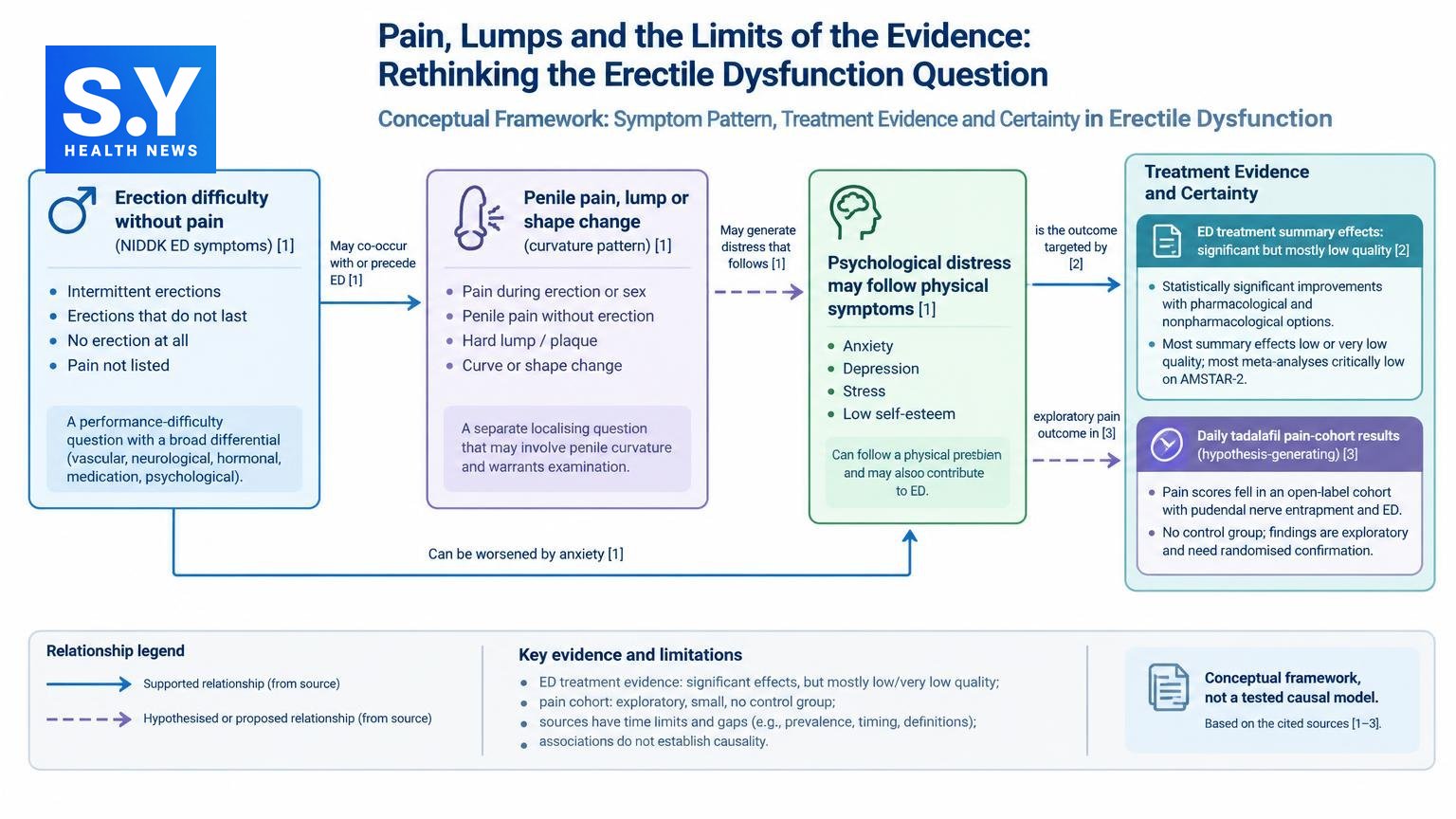
Erectile dysfunction, as described by the National Institute of Diabetes and Digestive and Kidney Diseases (NIDDK), means trouble getting or keeping an erection firm enough for sex; its listed symptoms are intermittent erections, erections that do not last, or none at all. Pain is not on that list. Pain during erections, pain without erections, a hard lump or a change in penile shape point toward a different assessment question, and NIDDK handles several of these under penile curvature, or Peyronie's disease.[1]
That distinction matters for how the evidence is read. A 2026 umbrella review of meta-analyses on erectile dysfunction treatments found statistically significant improvements with both pharmacological and nonpharmacological options, but rated the reliability of the evidence base as poor, with most summary effects of low or very low quality and most included meta-analyses critically low on AMSTAR-2 appraisal.[2]
Separately, a small open-label exploratory cohort in men with pudendal nerve entrapment and erectile dysfunction reported a fall in pain scores on daily tadalafil, but the authors themselves called the findings hypothesis-generating and in need of randomised confirmation.[3]
Why This Matters
Erectile dysfunction is commonly framed as a vascular and psychological problem, and that framing is useful: the NIDDK overview names blood vessel, nerve and hormone conditions, medicines, lifestyle behaviors and emotional factors as contributors. But a framing built around performance difficulty can quietly absorb a second symptom — pain — that has its own differential and its own timeline.
The consequence is practical. If a man describes painful erections plus a new firm area, the NIDDK Peyronie's page lists hard lumps, curvature, changes in shape such as narrowing or shortening, and pain during erection or sex as signs; that page also notes people with the condition are usually referred to a urologist, who can often feel plaques on examination. None of this replaces an evaluation, but it shows why the question "what is hurting, and why?" is distinct from "why is the erection less reliable?"
The second reason this matters is confidence calibration. Men are routinely offered a widening menu of ED treatments, from oral drugs to shockwave devices. The 2026 umbrella review's quality appraisal suggests that the menu is more diverse than the underlying evidence is robust, which is a different problem from saying any treatment does not work.
Two Symptom Patterns, Two Clinical Questions
The NIDDK erectile dysfunction material describes erection difficulty without pain: erections that occur sometimes but not every time, erections that do not last long enough, or no erection at all. Pain is explicitly absent from that symptom list.
The penile curvature material describes a different cluster: pain during an erection or during sex, hard lumps, a curve, and shape changes. NIDDK notes that the scar tissue, called plaque, forms under the skin of the penis and is not the same as arterial plaque and is not cancer; the exact cause is unknown, though it may follow penile injury or relate to autoimmune disease.
These are not mutually exclusive. Men with penile curvature can also have erection difficulty, and the NIDDK description of the condition's chronic phase notes that erectile dysfunction may develop or worsen as plaque and curvature stabilise. The clinical task is therefore not to sort patients into one box, but to ask both questions in the same visit.
| Variable | Source-grounded definition | Interpretation |
|---|---|---|
| Erectile dysfunction symptom set | Trouble getting or keeping an erection firm enough for sex; intermittent, non-sustaining or absent erections; pain not listed | A performance-difficulty question with a broad vascular, neurological, hormonal, medication and psychological differential |
| Painful erection or penile pain | Pain during erection or sex, or penile pain without erection, sometimes with a hard lump, curve or shape change | A separate localising question that may involve penile curvature and warrants examination rather than assumption |
| Peyronie's disease phases | Acute phase up to 18 months with plaque formation and possible pain; chronic phase usually beginning 12–18 months after onset, with stabilisation and possible ED | Timing affects what is being assessed, but the sources do not quantify how much earlier evaluation changes outcomes |
| Diagnosed vs estimated prevalence | About 1 in 100 U.S. men over 18 diagnosed; more than 1 in 10 estimated to have it in symptom-reporting studies | A wide gap the cited sources do not explain; supports caution about under-recognition but not a precise figure |
| Psychological direction | Emotional distress, depression and anxiety listed as possible complications of penile curvature; anxiety also listed as an ED contributor | Worry can follow a physical problem as well as cause one, so anxiety alone is an incomplete explanation |
Mechanism: Why Pain Is Not Just Severe Performance Anxiety
The physiology of erection is often summarised as a vascular sequence: arousal triggers nerve signals that release nitric oxide in penile arteries, nitric oxide activates guanylate cyclase, cyclic GMP relaxes arterial smooth muscle, and blood fills the corpora cavernosa. This is a narrative description rather than a measured finding, and it explains why vascular and neurological disease can impair erection.[4]
That sequence does not by itself explain focal penile pain or a palpable lump. The penile curvature material points to plaque under the penile skin as a structural change that can pull the penis into a curve and cause pain, sometimes even without an erection. A structural explanation and a vascular-performance explanation are not competitors; they answer different questions.
The psychological layer runs in both directions. NIDDK lists anxiety, depression, stress, isolation and low self-esteem among emotional factors that can cause or worsen erectile dysfunction, and it also lists emotional distress, depression and anxiety about sexual ability or penile appearance as possible complications of penile curvature. Anxiety following a physical symptom is therefore compatible with the sources, and it undercuts the shortcut of settling on performance anxiety before the pain has been examined.
For pain specifically, pharmacological rationale is thinner. An exploratory study of daily tadalafil in men with pudendal nerve entrapment and erectile dysfunction invoked proposed neurovascular and anti-inflammatory properties of PDE5 inhibitors to justify testing effects on pain, erectile function, urinary symptoms and quality of life. That is a hypothesis-generating rationale; the study did not demonstrate the mechanism.
What the Evidence Shows
The clearest recent signal about ED treatment evidence as a whole comes from the 2026 umbrella review. From 1,191 screened studies it extracted 23 published meta-analyses, producing 42 summary effects across 36 interventions, measured with the International Index of Erectile Function or its shorter versions and the Erectile Hardness Score.
The quality picture is sobering. On AMSTAR-2, 13 of 23 meta-analyses (56.5%) were rated critically low, 7 (30.5%) low, 2 (8.7%) moderate and 1 (4.3%) high. At the level of individual summary effects, only two were rated high and moderate respectively, while 20 (47.6%) were low and 20 (47.6%) very low.
This is a statement about certainty, not about futility. The review did observe statistically significant improvements in erectile dysfunction with both pharmacological and nonpharmacological interventions, but it cautioned that limited patient numbers and the subjective nature of the outcome indicators constrain interpretation. Questionnaires such as the IIEF are patient-reported, and a statistically significant score change is not automatically a clinically meaningful one for an individual.
The same tension appears in specific technologies. A 2025 Cochrane review summarised in a physician-authored guide reported that low-intensity shockwave therapy may improve IIEF-EF scores by roughly 3.9 points short-term and 5.3 points long-term versus sham across 21 randomised trials in 1,357 men, but rated the certainty of that evidence as low, with several included studies industry-funded, mainly by device makers.
For pain as an outcome, the available evidence is much earlier. In the open-label cohort of 30 men with pudendal nerve entrapment and erectile dysfunction, mean pain on a visual analogue scale fell from 7.2 at baseline to 3.7 at one month and 3.4 at three months on daily tadalafil (p<0.001). Mean IIEF-5 rose from 14.0 to 20.0 at one month and 21.0 at three months (p<0.001). Without a control group, regression to the mean, expectancy and natural fluctuation cannot be separated from drug effect.
Interpretation and Limitations
Three qualifications should travel with any reading of this evidence. First, the umbrella review is secondary literature about meta-analyses: its quality ratings describe the reliability of reviews, not the biology of erectile dysfunction. Its conclusion that evidence reliability is poor sits alongside a recommendation for better-designed single-treatment studies and high-quality comparisons between treatments, which is an argument about study design rather than a verdict on any named therapy.
Second, the pain literature summarised here is exploratory and observational. The pudendal nerve entrapment cohort had 30 participants, no control arm and an open-label design; the authors explicitly described the findings as hypothesis-generating and called for randomised controlled trial confirmation. Its pain scores should not be read as an established treatment effect for painful erections in general, and the population is a specific subgroup rather than all men with penile pain.
Third, the public-health sources have their own boundaries. The NIDDK erectile dysfunction pages were last reviewed in October 2024 and the penile curvature page in August 2019, so current versions should be checked. The prevalence figures — about 1 in 100 diagnosed versus more than 1 in 10 estimated from symptom-reporting studies — are presented without explanation of the gap, which limits how they should be used in counselling.
There are also gaps in what the cited material cannot answer. It does not define "performance anxiety" as a term, gives no figures for how often emotional factors are the main cause, and does not report how much earlier or later evaluation of penile pain changes outcomes. Those absences are part of the evidence picture, not a reason to substitute confidence for them.
One safety point deserves separate emphasis. MedlinePlus guidance for people taking sildenafil lists an erection that is painful or lasts longer than four hours among symptoms warranting immediate contact with a doctor. That guidance is written for people taking the medicine, and the cited research does not cover painful or prolonged erections in people who are not taking it; prompt clinical contact is the appropriate response either way.
Research Outlook
The most direct research need is methodological. If most meta-analyses in this field are rated critically low and nearly half of summary effects are very low quality, then larger and better-controlled trials with clearly defined minimal clinically important differences would change interpretation more than another small positive series. The umbrella review's authors make essentially this request for well-designed single-treatment studies and rigorous head-to-head comparisons.
For pain as a distinct outcome, randomised controlled designs are the obvious next step, since the existing exploratory cohort cannot separate treatment from time and expectation. Whether PDE5 inhibitors have clinically useful analgesic effects in pelvic pain syndromes remains an open question rather than an established relationship, and the proposed neurovascular and anti-inflammatory rationale still needs direct testing.
On the clinical-question side, better documentation would help. Studies that separate erection difficulty from penile pain, lump and shape change as parallel outcomes — rather than folding them into a single sexual function score — would make it easier to know whether the two questions require different pathways. The widespread discrepancy between diagnosed and estimated prevalence of penile curvature also suggests that recognition, not only treatment, remains a research target.
Key Takeaways
- Erectile dysfunction, as described by NIDDK, is trouble getting or keeping an erection firm enough for sex; pain is not among its listed symptoms, so painful erections or a penile lump raise a separate assessment question.
- Penile curvature can progress through an acute phase of up to 18 months and a chronic phase usually beginning 12–18 months after symptom onset, during which pain may lessen while erectile dysfunction may develop or worsen.
- Anxiety can follow a physical sexual problem as well as contribute to erectile dysfunction, so it should not be used to close the pain question before examination.
- The 2026 umbrella review found 23 meta-analyses and 42 summary effects, but 13 meta-analyses were critically low quality and only two summary effects were rated high or moderate quality.
- A small open-label cohort reported large falls in pain scores on daily tadalafil in men with pudendal nerve entrapment and ED, but its authors called the results hypothesis-generating pending randomised trials.
- A painful erection or one lasting longer than four hours is listed in sildenafil guidance as a reason to contact a doctor immediately.
Questions and Answers
What is the difference between erectile dysfunction and painful erections?
Erectile dysfunction is defined as trouble getting or keeping an erection firm enough for sex, with intermittent, non-sustaining or absent erections listed as symptoms; pain is not on that list. Pain during erections, pain without erections, a hard lump or a shape change point to a separate question about what is hurting, which may involve penile curvature and warrants examination.
How strong is the evidence behind erectile dysfunction treatments?
A 2026 umbrella review of 23 meta-analyses found statistically significant improvements with pharmacological and nonpharmacological treatments, but rated the evidence base poorly. Thirteen meta-analyses were critically low quality on AMSTAR-2, and of 42 summary effects only two were high or moderate quality while 40 were low or very low. Significant results therefore do not equal high certainty.
Can daily tadalafil reduce penile or pelvic pain in men with erectile dysfunction?
An open-label exploratory cohort of 30 men with pudendal nerve entrapment and erectile dysfunction reported mean pain scores falling from 7.2 to 3.7 at one month and 3.4 at three months on daily tadalafil. There was no control group, and the authors called the findings hypothesis-generating and called for randomised trial confirmation. It is not evidence of an established pain treatment.
Does anxiety cause erectile dysfunction or follow a physical problem like Peyronie's disease?
Both directions are plausible in the cited sources. NIDDK lists anxiety, depression, stress and low self-esteem as emotional factors that can cause or worsen erectile dysfunction. Its penile curvature page also lists emotional distress, depression and anxiety about sexual ability or penile appearance as possible complications, so worry can follow a physical problem. Anxiety alone is an incomplete explanation.
Is shockwave therapy for erectile dysfunction supported by high-certainty evidence?
A 2025 Cochrane review summarised in a physician guide found low-intensity shockwave therapy may improve IIEF-EF scores by roughly 3.9 points short-term and 5.3 points long-term versus sham across 21 trials in 1,357 men. The certainty was rated low, and several studies were industry-funded, mainly by device makers. Benefit is possible but not firmly established.
When should a painful erection or a four-hour erection prompt urgent medical contact?
MedlinePlus guidance for people taking sildenafil lists an erection that is painful or lasts longer than four hours among symptoms warranting immediate contact with a doctor. That guidance is written for people taking the medicine, and the cited research does not cover painful or prolonged erections in people not taking it, so prompt clinical contact is appropriate either way.
Conceptual framework: Conceptual framework, not a tested causal model. It separates erection difficulty without pain from penile pain, lump or shape change, notes that anxiety may follow as well as contribute, and places treatment evidence in context: a 2026 umbrella review found statistically significant effects but mostly low or very low certainty, while a small open-label tadalafil pain cohort remains hypothesis-generating.
Academic References & Evidence
- Erectile pain and performance concerns: Why the symptom changes the care question.
- Current treatment for erectile dysfunction: an umbrella review of systematic reviews and meta-analyses. 2026 DOI: 10.6084/m9.figshare.31562993.v1.
- Effect of Daily Tadalafil on Pudendal Nerve Entrapment Symptoms in Men with Erectile Dysfunction: A Prospective Exploratory Study. DOI: 10.21203/rs.3.rs-10188890/v1. (preprint)
- Erectile Dysfunction. 2026
SANYUN Science Center explains published research on men's reproductive and sexual health, connecting scientific evidence with everyday questions while making sources and limitations clear.
Disclaimer: This article is for scientific education and research communication only. It does not provide medical advice, diagnosis, or individualized treatment recommendations, and does not endorse any medication, supplement, device, penile enlargement procedure, or other intervention. Decisions about sexual and reproductive health should be made in consultation with a qualified healthcare professional. Do not delay seeking professional care because of information in this article.
Original Content & Copyright Notice
- This article is prepared for SANYUN Science Center, drawing on published research and publicly available academic literature on men’s sexual and reproductive health. Its editorial explanations and presentation are developed for this platform.
- Copyright in the original editorial content, selection, and arrangement is reserved by SANYUN Science Center to the extent protected by applicable law. Referenced research, quotations, and third-party materials remain subject to the rights of their respective owners. This notice does not claim ownership of scientific facts or third-party research.
- Except where permitted by applicable law or an applicable license, prior written permission is required to reproduce, republish, translate, adapt, redistribute, or commercially reuse protected content. Attribution alone does not grant permission for such reuse.
- For permitted quotation or authorized reuse, clearly identify the source and retain a link to the original article.
- Source: SANYUN Science Center
- Original URL: Retain the original article URL on science.san-yun.com.
- Copyright Holder: SANYUN Science Center, for its own protected editorial content.
- Quotation, excerpts, or authorized reuse must not distort the scientific meaning, omit material limitations or disclaimers, or imply unverified medical claims, product efficacy, or endorsement by SANYUN Science Center.



