




Category: Erectile Dysfunction
Core Research Direction: Erectile dysfunction in men with prediabetes and type 2 diabetes: prevalence, metabolic and glycemic correlates, and whether earlier lifestyle intervention (DPPOS) is associated with lower odds of ED, set against the overall quality of the ED treatment-evidence base.
Search Intent: In men with prediabetes or type 2 diabetes, how common is erectile dysfunction, what factors are associated with it, and does earlier intensive lifestyle intervention relate to lower odds of ED?
Platform: SANYUN Science Center
Evidence reviewed through: 2026-11-25
Executive Summary
Erectile dysfunction is common in men with disordered glucose metabolism, but it is often discussed as a downstream complication rather than as a measurable outcome at the prediabetes stage. A cross-sectional analysis nested in the Diabetes Prevention Program Outcomes Study (DPPOS) examined exactly that question. At the 2017 DPPOS visit, the International Index of Erectile Function was administered, and 88% of the 648 male participants (n = 568) completed the survey.[1]
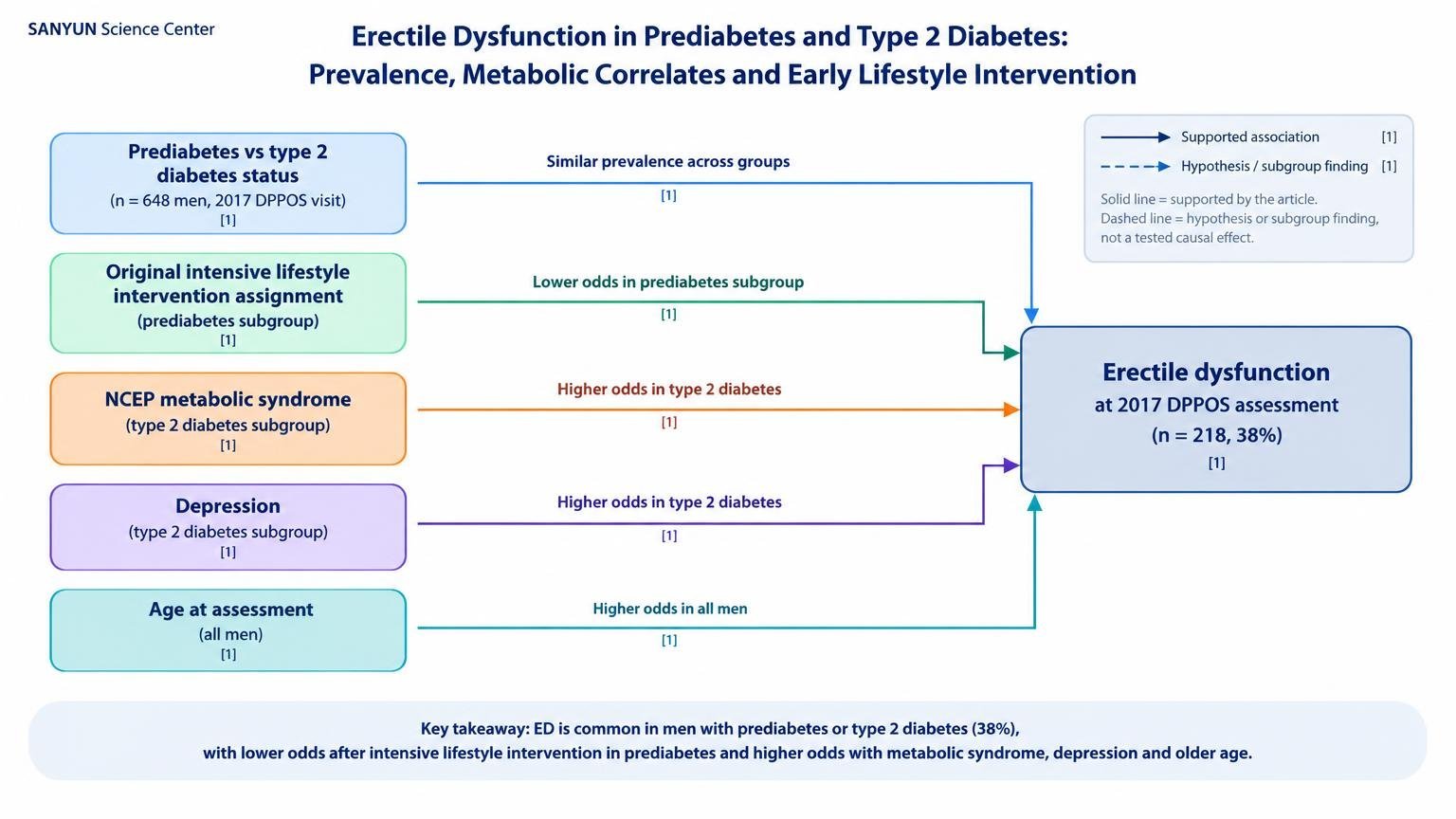
Overall, 218 men (38%) met erectile dysfunction criteria, and prevalence was similar in prediabetes (41%) and type 2 diabetes (37%), a difference that was not statistically significant (p = 0.4). In all men, older age increased the odds of erectile dysfunction (p < 0.001). The most provocative finding concerned the prediabetes subgroup: men originally assigned to intensive lifestyle intervention, but not metformin, had lower odds of erectile dysfunction than the placebo group (OR 0.35, 95% CI 0.13 to 0.94). Among men with type 2 diabetes, erectile dysfunction risk did not differ by original DPP treatment assignment, but NCEP-defined metabolic syndrome (OR 1.85, 95% CI 1.14 to 3.01) and depression (OR 2.05, 95% CI 1.10 to 3.79) were associated with higher odds.
These are observational associations measured at a single follow-up visit, and they sit within a broader erectile dysfunction treatment literature that an umbrella review of 23 meta-analyses concludes is predominantly of low or very low quality. The practical message is not that lifestyle intervention prevents erectile dysfunction, but that the prediabetes interval is a plausible window for risk mitigation that deserves prospective testing.[2]
Why This Matters
Erectile dysfunction is frequently framed as a vascular and neuropathic complication of established diabetes. The DPPOS analysis matters because it locates substantial prevalence one step earlier, in men whose glucose values have not yet crossed the diagnostic threshold for type 2 diabetes. The authors describe erectile dysfunction as prevalent in men with prediabetes and type 2 diabetes in this cohort, and they interpret the prediabetes finding as suggesting a potential opportunity for risk mitigation in that interval.
That framing has two consequences. First, it shifts attention toward the timing of metabolic risk rather than only its chronicity, since prevalence was not significantly different between the two glycemic groups. Second, it raises the question of whether behavioral change during prediabetes carries benefits for sexual function that are not captured by the same behavioral change once diabetes is established. Neither consequence is settled by a single cross-sectional analysis, but both are testable.
Biological and Clinical Mechanism
Erectile function depends on coordinated vascular, neural, hormonal and psychological inputs. Endothelial nitric oxide signaling relaxes cavernosal smooth muscle so that blood can fill the penis; anything that impairs endothelial function, damages the small penile arteries or disrupts the cavernous nerves can degrade erection quality. Insulin resistance, hyperglycemia, dyslipidemia and hypertension all plausibly act on that pathway, which is why metabolic syndrome and depression were treated as candidate correlates in the DPPOS analysis rather than as incidental covariates.
The mechanism story should be stated carefully. The DPPOS design cannot distinguish endothelial from neuropathic from psychological contributions, and the correlates reported are statistical associations adjusted in multivariable logistic regression, not demonstrated causal pathways. The finding that NCEP-defined metabolic syndrome was associated with higher odds of erectile dysfunction in men with type 2 diabetes is consistent with a clustering of vascular risk factors, but it does not establish which component drives the association.
What the Evidence Shows
The DPPOS analysis is best described as a cross-sectional analysis within a randomized controlled trial follow-up cohort. Participants had originally been randomized in the Diabetes Prevention Program to intensive lifestyle intervention, metformin or placebo, and erectile dysfunction was assessed years later at the 2017 visit. That design supports statements about associations at the time of assessment and about differences by original randomized assignment; it does not support statements about incident erectile dysfunction, time to onset or within-person change.
In the prediabetes subgroup, the odds ratio for erectile dysfunction associated with original intensive lifestyle intervention assignment was 0.35 (95% CI 0.13 to 0.94) compared with placebo, while metformin assignment was not associated with lower odds. The confidence interval is wide and approaches 1.0, so the estimate is compatible with a modest benefit as well as a substantial one; the direction is interesting, the precision is limited. Non-Hispanic White race was also associated with higher odds of erectile dysfunction than other races (OR 4.3, 95% CI 1.92 to 9.65), a finding that requires cautious interpretation given potential residual confounding and the single-study setting.
In the type 2 diabetes subgroup, the pattern differed. Erectile dysfunction risk did not differ by original DPP treatment assignment, but metabolic syndrome (OR 1.85, 95% CI 1.14 to 3.01) and depression (OR 2.05, 95% CI 1.10 to 3.79) were associated with higher odds. Read together, the subgroup results suggest that the metabolic context at the time of assessment may matter more than historical randomization once diabetes has developed, while the reverse may hold in prediabetes. That interpretation is a hypothesis generated by the data, not a tested interaction.
| Variable | Definition in the analysis | Interpretation |
|---|---|---|
| Intensive lifestyle intervention assignment | Original DPP randomization to ILS versus placebo, assessed for association with ED at the 2017 DPPOS visit in men with prediabetes | OR 0.35 (95% CI 0.13–0.94) for ED; wide interval, subgroup analysis, not proof of prevention |
| Metformin assignment | Original DPP randomization to metformin versus placebo in the same prediabetes subgroup | Not associated with decreased odds of ED in the reported analysis |
| NCEP metabolic syndrome | Metabolic syndrome defined by National Cholesterol Education Program criteria at ED assessment in men with type 2 diabetes | OR 1.85 (95% CI 1.14–3.01); association with higher odds of ED |
| Depression | Depression recorded at ED assessment in men with type 2 diabetes | OR 2.05 (95% CI 1.10–3.79); association with higher odds of ED |
| Age | Age at the time of ED assessment, analyzed in all men combined | Higher age associated with increased odds of ED (p < 0.001); effect size not stated in the available excerpt |
| Race/ethnicity | Self-reported race, analyzed in men with prediabetes against other races | OR 4.3 (95% CI 1.92–9.65) for Non-Hispanic White race; residual confounding plausible |
Interpretation and Limitations
The most important limitation is timing. Erectile dysfunction was measured at one visit, and the correlates were measured at or around the same visit. The analysis therefore cannot establish whether metabolic syndrome preceded erectile dysfunction, whether depression contributed to it, or whether lifestyle intervention altered its trajectory. The prediabetes odds ratio reflects original randomized assignment, which is a strength, but the outcome was not the trial's primary endpoint and the subgroup was not powered for a definitive erectile dysfunction comparison.
The prevalence comparison deserves the same restraint. The 41% versus 37% difference between prediabetes and type 2 diabetes was not statistically significant (p = 0.4), so describing erectile dysfunction as equally common in the two groups is defensible for this cohort but should not be generalized as a fixed epidemiological constant. The 38% overall figure applies to surveyed DPPOS men, a selected trial-derived population, not to all men with dysglycemia.
The wider treatment context compounds the uncertainty. An umbrella review screened 1,191 studies and extracted 23 published meta-analyses yielding 42 summary effects across the IIEF, IIEF-5, IIEF-EF and EHS endpoints, covering 36 interventions. On AMSTAR-2 appraisal, 13 (56.5%) of those meta-analyses were rated critically low, 7 (30.5%) low, 2 (8.7%) moderate and 1 (4.3%) high quality. Of the 42 summary effects, only two were rated high and moderate quality respectively, while 47.6% (n = 20) were rated low and 47.6% (n = 20) very low.
The umbrella review's authors note that statistically significant improvements were observed with both pharmacological and nonpharmacological interventions, but caution that interpretation is limited by small patient numbers and the subjective nature of outcome indicators. They conclude that the current treatment evidence base is predominantly of low or very low quality, and they recommend further well-designed single-treatment studies and high-quality meta-analyses comparing treatments. For readers, that means statistically significant score changes in erectile dysfunction trials should not automatically be read as durable clinical benefit.
Research Outlook
The DPPOS findings point toward a prospective question: does structured lifestyle change during prediabetes reduce the incidence of erectile dysfunction, and does the effect differ from what is achievable after diabetes develops? Answering that would require repeated erectile function assessment over time, prespecified endpoints and adjustment for depression and relationship factors, none of which the current cross-sectional design provides. The authors' own framing is appropriately modest: a potential opportunity, not a demonstrated protective effect.
On the treatment side, the priority identified by the umbrella review is methodological. Better-designed trials of single interventions and rigorous head-to-head meta-analyses would clarify which options genuinely outperform alternatives, rather than adding further low-certainty comparisons to an already uncertain literature. Until then, clinicians and patients are working with an evidence base in which statistically significant results coexist with limited certainty, and that tension should be acknowledged in shared decisions.
Key Takeaways
- In the 2017 DPPOS visit, 568 of 648 male participants (88%) completed the International Index of Erectile Function, and 218 (38%) met erectile dysfunction criteria.
- Prevalence was similar in prediabetes (41%) and type 2 diabetes (37%), a non-significant difference (p = 0.4); older age was associated with higher odds of erectile dysfunction (p < 0.001).
- Among men with prediabetes, original intensive lifestyle intervention assignment, but not metformin, was associated with lower odds of erectile dysfunction (OR 0.35, 95% CI 0.13 to 0.94); the interval is wide and the finding is a subgroup association, not proof of prevention.
- Among men with type 2 diabetes, treatment assignment was not associated with erectile dysfunction, while NCEP metabolic syndrome (OR 1.85) and depression (OR 2.05) were associated with higher odds.
- An umbrella review of 23 meta-analyses covering 36 interventions found the erectile dysfunction treatment evidence base predominantly low or very low quality (47.6% low, 47.6% very low summary effects).
Questions and Answers
What is erectile dysfunction and why is it relevant in prediabetes and type 2 diabetes?
Erectile dysfunction is the consistent inability to achieve or maintain an erection sufficient for satisfactory sexual performance. In men with disordered glucose metabolism it is relevant because vascular, neural, hormonal and psychological contributors converge on the same pathways. In the DPPOS cohort, 38% of surveyed men met erectile dysfunction criteria, with similar prevalence in prediabetes (41%) and type 2 diabetes (37%).
How common was erectile dysfunction in the Diabetes Prevention Program Outcomes Study?
At the 2017 DPPOS visit, 88% of 648 male participants (n = 568) completed the International Index of Erectile Function. Overall, 218 men (38%) met erectile dysfunction criteria. Prevalence was 41% in men with prediabetes and 37% in men with type 2 diabetes, a difference that was not statistically significant (p = 0.4).
Was intensive lifestyle intervention associated with lower odds of erectile dysfunction in prediabetes?
Yes, in the prediabetes subgroup. Men originally assigned to intensive lifestyle intervention, but not metformin, had lower odds of erectile dysfunction than the placebo group (OR 0.35, 95% CI 0.13 to 0.94). This was a subgroup analysis of historical randomized assignment with a wide confidence interval, so it supports a hypothesis about the prediabetes window rather than a claim that lifestyle intervention prevents erectile dysfunction.
Which metabolic factors were linked to erectile dysfunction in men with type 2 diabetes?
Among DPPOS men with type 2 diabetes, erectile dysfunction risk did not differ by original DPP treatment assignment. However, NCEP-defined metabolic syndrome was associated with higher odds (OR 1.85, 95% CI 1.14 to 3.01), as was depression (OR 2.05, 95% CI 1.10 to 3.79). These are adjusted observational associations measured at the same assessment visit.
How strong is the overall evidence base for erectile dysfunction treatments?
An umbrella review of 23 meta-analyses yielding 42 summary effects across 36 interventions concluded that the evidence base is predominantly low or very low quality. On AMSTAR-2 appraisal, 56.5% of the meta-analyses were rated critically low and 30.5% low. Of the 42 summary effects, 47.6% were rated low and 47.6% very low, with only two rated high and moderate quality respectively.
What are the main limitations of the DPPOS erectile dysfunction findings?
Erectile dysfunction was assessed cross-sectionally at a single 2017 visit, so the analysis cannot establish temporal order or causation. Subgroup estimates such as the prediabetes lifestyle odds ratio have wide confidence intervals, the race finding may reflect residual confounding, and the cohort is a selected trial-derived population. The authors describe the prediabetes result as a potential opportunity for risk mitigation, not a demonstrated effect.
Conceptual framework: Conceptual framework of study variables. The DPPOS analysis is cross-sectional at the 2017 assessment: prediabetes and type 2 diabetes status, original DPP lifestyle intervention assignment, NCEP metabolic syndrome, depression and age are shown in relation to erectile dysfunction. Associations are supported for the reported odds ratios; the prediabetes lifestyle finding is a subgroup association, not a causal effect, and the framework is not a tested causal model.
Academic References & Evidence
- Blair YA; Doherty L; Temprosa M; Pop-Busui R; Gadde KM; Singh P; Owora AH; Wessells H; Sarma AV. DiaComp :: Publication. Journal of diabetes and its complications. 2024 38:108669 PMID: 38219334.
- Current treatment for erectile dysfunction: an umbrella review of systematic reviews and meta-analyses. 2026 DOI: 10.6084/m9.figshare.31562993.v1.
SANYUN Science Center explains published research on men's reproductive and sexual health, connecting scientific evidence with everyday questions while making sources and limitations clear.
Disclaimer: This article is for scientific education and research communication only. It does not provide medical advice, diagnosis, or individualized treatment recommendations, and does not endorse any medication, supplement, device, penile enlargement procedure, or other intervention. Decisions about sexual and reproductive health should be made in consultation with a qualified healthcare professional. Do not delay seeking professional care because of information in this article.
Original Content & Copyright Notice
- This article is prepared for SANYUN Science Center, drawing on published research and publicly available academic literature on men’s sexual and reproductive health. Its editorial explanations and presentation are developed for this platform.
- Copyright in the original editorial content, selection, and arrangement is reserved by SANYUN Science Center to the extent protected by applicable law. Referenced research, quotations, and third-party materials remain subject to the rights of their respective owners. This notice does not claim ownership of scientific facts or third-party research.
- Except where permitted by applicable law or an applicable license, prior written permission is required to reproduce, republish, translate, adapt, redistribute, or commercially reuse protected content. Attribution alone does not grant permission for such reuse.
- For permitted quotation or authorized reuse, clearly identify the source and retain a link to the original article.
- Source: SANYUN Science Center
- Original URL: Retain the original article URL on science.san-yun.com.
- Copyright Holder: SANYUN Science Center, for its own protected editorial content.
- Quotation, excerpts, or authorized reuse must not distort the scientific meaning, omit material limitations or disclaimers, or imply unverified medical claims, product efficacy, or endorsement by SANYUN Science Center.



