




Category: Latest Research
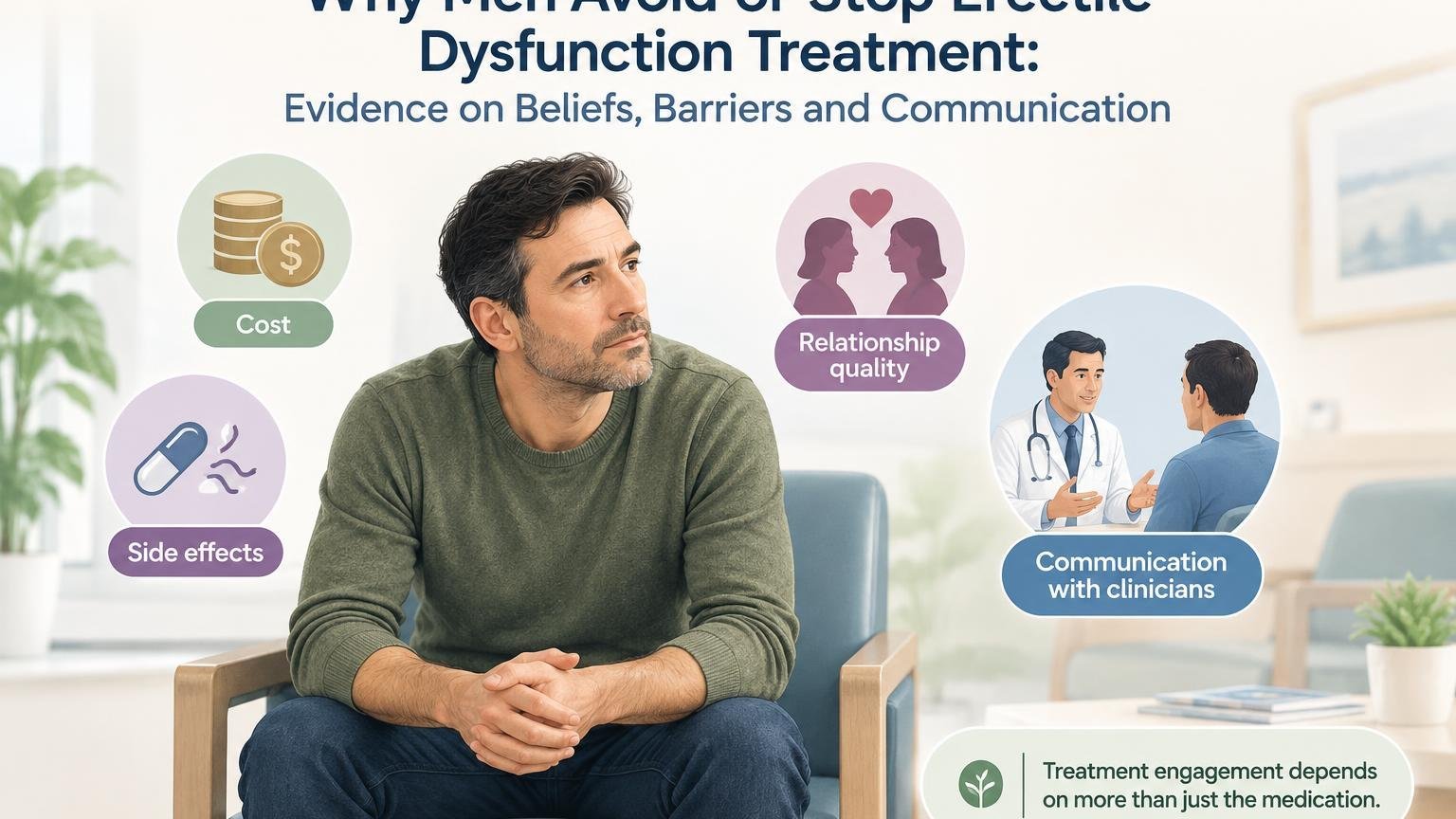
Core Research Direction: Understanding why men use, discontinue, or avoid erectile dysfunction treatments—including beliefs, barriers (cost, side effects, relationship quality, embarrassment), and information sources—informing education on treatment engagement and communication with clinicians
Search Intent: Why do men stop using or avoid seeking treatment for erectile dysfunction, and what beliefs and barriers drive their treatment decisions?
Platform: SANYUN Science Center
Evidence reviewed through: 2026-11-23
Executive Summary
Many men who could benefit from erectile dysfunction (ED) treatment either never seek it or stop it early. A systematic review published in 2021 examined why. It searched multiple databases up to August 2018 and included 50 studies, extracting rates of treatment utilisation alongside barriers and enablers reported by men. Discontinuation varied enormously across treatment types, and the most prevalent barriers were treatment ineffectiveness, side effects, the quality of intimate relationships and treatment costs.[1]
The review's most striking enabler finding concerned communication: men who reported side effects to a healthcare professional were significantly less likely to discontinue treatment. That observation is associative, not proof that disclosure causes persistence, but it places the clinical conversation at the centre of treatment engagement. A separate cross-sectional survey table adds context on beliefs and information sources: embarrassment, concerns about medication harm, satisfaction with self-medication and perceptions that sexual enhancers are unsafe all appeared among reasons for not seeking medical consultation.[2]
Why Treatment Engagement Matters
Successful ED treatment has been linked to improvements in quality of life, yet treatment utilisation remains sub-optimal. The systematic review was designed to identify both the rates at which men use treatment and the barriers and enablers they experience. That dual focus matters because the reasons men give for stopping are not necessarily the reasons they never start, and the two pathways may require different educational responses.
For clinicians and educators, the practical question is not simply whether a drug works in a trial. It is whether a man sees the problem as worth treating, whether he trusts the treatment, whether he can afford it, whether his relationship supports it, and whether he feels able to raise difficulties rather than quietly stopping. The reviewed evidence suggests those questions belong in the consultation, not outside it.
What the Systematic Review Found
The review included 50 studies and reported wide ranges of discontinuation. For phosphodiesterase type 5 inhibitors, discontinuation ranged from 4.4% to 76%; for intracavernosal injections, from 18.6% to 79.9%; and for urethral suppositories, from 32% to 69.2%. Among men with a penile prosthesis, 30% discontinued having sex for reasons such as device complications, lack of a partner or loss of sexual interest. These ranges should be read as heterogeneity across studies rather than as expected outcomes for an individual patient.
The most prevalent barriers to utilisation were treatment ineffectiveness, side effects, the quality of men's intimate relationships and treatment costs. The review also noted that most included research focused on barriers and reasons for discontinuing, with only a small number exploring factors men found helpful. This asymmetry is important: the literature is better at explaining dropout than at explaining persistence.
The enabler finding deserves careful phrasing. Men who reported side effects to a healthcare professional were significantly less likely to discontinue treatment. This is an association within observational studies. It may reflect that men who disclose are more engaged, better supported or receiving adjusted treatment, rather than disclosure itself causing persistence. Still, it is consistent with the broader message that beliefs and communication are potentially modifiable targets.
Beliefs, Information Sources and Reasons for Not Seeking Care
The survey table offers a different kind of evidence: a cross-sectional snapshot of beliefs and reported behaviour. It reports that 190 respondents (49.5%) perceived a need for ED treatment, while 180 (46.9%) reported having consulted at male clinics for ED. The table excerpt does not state the total sample denominator for all rows, so these percentages should not be combined into a single population estimate without the full paper.
Among those giving reasons for not seeking medical consultation (n = 235, multiple responses allowed), the most frequently cited reasons included satisfaction with self-medication (73 responses, 31.0%), reluctance to discuss ED due to social embarrassment (70 responses, 29.8%), concern about harmful effects of medications (61 responses, 26.0%) and the view that ED is not a serious condition (30 responses, 12.8%). Because multiple responses were allowed, these percentages describe responses rather than unique men, and they should not be summed as if they were mutually exclusive categories.
Information sources were similarly varied. Among respondents reporting sources of information about ED (n = 176, multiple responses allowed), friends were cited in 36 responses (20.4%) and a wife in 54 responses (30.7%). The table also shows that perceptions of sexual enhancers were mixed: 114 responses (29.7%) regarded them as safe and 158 (41.1%) as unsafe. Among those considering enhancers unsafe (n = 268), reasons included serious side effects (79 responses, 29.5%), potential cardiovascular risks (74 responses, 27.6%) and risk of addiction or dependence (69 responses, 25.7%).
| Domain | Reported finding | What it suggests | Interpretation caveat |
|---|---|---|---|
| Discontinuation across treatments | PDE5 inhibitors 4.4% to 76%; intracavernosal injections 18.6% to 79.9%; urethral suppositories 32% to 69.2% | Dropout is common but highly variable across studies and treatments | Ranges reflect heterogeneous study designs and populations; not individual risk estimates |
| Main barriers | Treatment ineffectiveness, side effects, intimate relationship quality and treatment costs | Practical and relational factors shape continued use | Most included studies focused on barriers; fewer examined enablers |
| Communication enabler | Men who reported side effects to a healthcare professional were significantly less likely to discontinue | Disclosure may be a marker of better engagement and support | Observational association; cannot establish causation |
| Reasons for not seeking consultation | Satisfaction with self-medication 31.0%; social embarrassment 29.8%; concern about medication harm 26.0% (n = 235, multiple responses) | Beliefs and embarrassment may delay clinical care | Percentages are of responses, not unique respondents |
| Perceived safety of sexual enhancers | Safe 29.7%; unsafe 41.1%; reasons for unsafe include side effects 29.5%, cardiovascular risks 27.6%, addiction/dependence 25.7% | Safety beliefs are a substantial part of treatment reluctance | Denominators for perception rows are not fully stated in the table excerpt |
Interpretation and Limitations
The systematic review's findings are constrained by the quality of the included studies. The authors report that studies did not use validated measures of treatment utilisation or of barriers and enablers, and that no study used psychological theory to inform the examination of factors influencing utilisation. That means the field has identified plausible influences without yet measuring them consistently or testing mechanisms. The review searched up to August 2018, so it is an older evidence base rather than a new current-year study.
The survey table has its own limits. It is a cross-sectional table of results, not a prospective study of decisions over time. Multiple responses were allowed, so percentages overlap and cannot be interpreted as proportions of distinct men. The excerpt does not state the total sample denominator for every row. And all of this describes associations and reported beliefs, not causal effects of embarrassment, cost or communication on discontinuation.
There is also a mismatch in what the literature measures. Discontinuation rates capture behaviour after a prescription, whereas reasons for not seeking consultation capture behaviour before any clinical contact. The review and the survey table speak to different stages of the same engagement problem. Neither shows that changing a belief will change behaviour, although the review explicitly frames beliefs as potentially modifiable and relevant to clinicians supporting better treatment use.
What This Means for Clinical Communication
The practical message is not that men should be told to try harder. It is that conversations should anticipate the specific reasons men stop. Asking about effectiveness, side effects, cost, relationship context and expectations may surface barriers that otherwise remain private. The review's enabler signal suggests that men who feel able to report side effects may stay engaged longer, although the evidence cannot prove that a particular communication style causes persistence.
Education also needs to address beliefs directly. A man who believes ED is not serious, who is embarrassed, who worries about medication harm or who is satisfied with self-medication may not present at all. The survey table shows those reasons were reported in a clinical survey context, which makes them relevant to pre-consultation education. They are not diagnoses and should not be treated as fixed traits.
Research Outlook
The review authors call for attention to men's beliefs about ED and its treatment because beliefs are potentially modifiable. Progress would require studies that use validated measures, apply psychological theory to explain utilisation, and examine enablers as thoroughly as barriers. Prospective designs that follow men from first discussion through treatment changes would help distinguish early avoidance from later discontinuation. Until then, the evidence supports cautious, person-centred communication rather than prediction.
Key Takeaways
- A 2021 systematic review of 50 studies found wide discontinuation ranges across ED treatments and identified ineffectiveness, side effects, relationship quality and cost as the most prevalent barriers.
- Reporting side effects to a healthcare professional was significantly associated with lower discontinuation, but this is an observational association, not proof of cause and effect.
- A cross-sectional survey table reported social embarrassment, concern about medication harm, satisfaction with self-medication and beliefs that enhancers are unsafe among reasons for not seeking medical consultation.
- The evidence base is limited by non-validated measures, lack of psychological theory and a search cutoff of August 2018, so it informs education and conversation rather than individual prognosis.
Questions and Answers
Why do men stop using erectile dysfunction treatment?
A systematic review of 50 studies identified treatment ineffectiveness, side effects, the quality of intimate relationships and treatment costs as the most prevalent barriers to ED treatment utilisation. Discontinuation rates varied widely across treatments, from 4.4% to 76% for PDE5 inhibitors. These are study-level associations, not predictions for an individual man, and the reviewed studies lacked validated measures of utilisation and barriers.
Does telling a doctor about side effects reduce erectile dysfunction treatment discontinuation?
Men who reported side effects to a healthcare professional were significantly less likely to discontinue treatment in the systematic review. This is an observed association within mostly observational studies. It may reflect greater engagement, better support or treatment adjustment rather than disclosure itself causing persistence. It does not prove that reporting side effects will keep any particular man on treatment.
What beliefs make men reluctant to seek medical help for erectile dysfunction?
In one cross-sectional survey table, reasons for not seeking consultation included satisfaction with self-medication (31.0% of responses), social embarrassment (29.8%), concern about harmful medication effects (26.0%) and the view that ED is not serious (12.8%). Multiple responses were allowed, so these percentages describe responses rather than unique men, and the table does not establish cause and effect.
How safe do men think erectile dysfunction medications are?
In the survey table, 114 responses (29.7%) perceived sexual enhancers such as Viagra and Snafi as safe, while 158 (41.1%) perceived them as unsafe. Among reasons for considering them unsafe, serious side effects were cited in 79 responses (29.5%), potential cardiovascular risks in 74 (27.6%) and addiction or dependence in 69 (25.7%). These are reported beliefs in a cross-sectional table, not clinical safety findings.
How strong is the evidence on erectile dysfunction treatment barriers and enablers?
The systematic review is broad, including 50 studies, but its authors report that included studies did not use validated measures of treatment utilisation or of barriers and enablers, and that none used psychological theory to examine influences on utilisation. The search ran to August 2018. The survey table is cross-sectional and allows multiple responses. The evidence is useful for generating hypotheses and guiding communication, not for proving causal effects.
What helps men stay engaged with erectile dysfunction treatment?
The clearest enabler signal in the review was that men who reported side effects to a healthcare professional were significantly less likely to discontinue. The review frames men's beliefs about ED and treatment as potentially modifiable and relevant to clinician support. However, few included studies examined enablers, and the association does not establish that encouraging disclosure will cause any individual to persist with treatment.
Sources and References
- Paul Williams; Hayley McBain; Aliya Amirova; Stanton Newman; Kathleen Mulligan. Men's beliefs about treatment for erectile dysfunction-what influences treatment use? A systematic review. International Journal of Impotence Research. 2021 33(1):16-42 DOI: 10.1038/s41443-020-0249-1.
- Table 3..
SANYUN Science Center explains published research on men's reproductive and sexual health, connecting scientific evidence with everyday questions while making sources and limitations clear.
Disclaimer: This article is for scientific education and research communication only. It does not provide medical advice, diagnosis, or individualized treatment recommendations, and does not endorse any medication, supplement, device, penile enlargement procedure, or other intervention. Decisions about sexual and reproductive health should be made in consultation with a qualified healthcare professional. Do not delay seeking professional care because of information in this article.
Original Content & Copyright Notice
- This article is prepared for SANYUN Science Center, drawing on published research and publicly available academic literature on men’s sexual and reproductive health. Its editorial explanations and presentation are developed for this platform.
- Copyright in the original editorial content, selection, and arrangement is reserved by SANYUN Science Center to the extent protected by applicable law. Referenced research, quotations, and third-party materials remain subject to the rights of their respective owners. This notice does not claim ownership of scientific facts or third-party research.
- Except where permitted by applicable law or an applicable license, prior written permission is required to reproduce, republish, translate, adapt, redistribute, or commercially reuse protected content. Attribution alone does not grant permission for such reuse.
- For permitted quotation or authorized reuse, clearly identify the source and retain a link to the original article.
- Source: SANYUN Science Center
- Original URL: Retain the original article URL on science.san-yun.com.
- Copyright Holder: SANYUN Science Center, for its own protected editorial content.
- Quotation, excerpts, or authorized reuse must not distort the scientific meaning, omit material limitations or disclaimers, or imply unverified medical claims, product efficacy, or endorsement by SANYUN Science Center.



