




Category: Erectile Dysfunction
Core Research Direction: Evidence quality and clinical framing of current erectile dysfunction treatments and comorbidities (cardiovascular risk, testosterone/GLP-1, sleep apnea) as summarized in secondary sources
Search Intent: How strong is the current evidence for erectile dysfunction treatments, and how should clinicians interpret cardiovascular, metabolic and hormonal contributors?
Platform: SANYUN Science Center
Evidence reviewed through: 2026-11-16
Executive Summary
Erectile dysfunction (ED) is common, treatable and clinically informative beyond the bedroom. The central evidence question for 2026 is not whether treatments produce statistically significant improvements on erectile function scales, but how much confidence clinicians and patients should place in those improvements and how ED should be interpreted as a marker of cardiovascular and metabolic disease.[1][2]
A 2026 umbrella review of systematic reviews and meta-analyses screened 1191 studies, extracted 23 published meta-analyses and summarised 42 effects covering the IIEF, IIEF-5, IIEF-EF and erectile hardness score across 36 interventions. Its most important finding is methodological: the evidence base for ED treatments is predominantly of low or very low quality. Of the 23 meta-analyses, 13 were rated critically low and 7 low on AMSTAR-2, and among the 42 summary effects, 20 were low and 20 very low quality.
Secondary clinical sources add context that is clinically useful but evidentially weaker. Observational umbrella data link ED with higher relative risks of cardiovascular disease, coronary heart disease, myocardial infarction, stroke and mortality. Testosterone, GLP-1 receptor agonists and obstructive sleep apnea each sit at an earlier, more uncertain stage, with controlled trials, pilot studies and database analyses producing mixed or confounded signals.
The practical synthesis is that ED treatments are reasonably accepted in guideline-based practice, but the underlying certainty is generally modest; and that ED should prompt cardiovascular and metabolic assessment rather than a prescription alone. None of the secondary sources here constitutes original clinical research or a systematic review performed for this article.[3]
Why This Matters
ED is a vascular and neurohormonal symptom with a broad differential. Clinical guidance describes it as a risk marker for cardiovascular and other underlying disease, so the consultation is an opportunity to detect hypertension, dysglycaemia, dyslipidaemia, hypogonadism and sleep disorders that might otherwise remain undiagnosed. This reframing changes the purpose of assessment from symptom relief alone to risk stratification.
The size of the affected population and the frequency with which men avoid discussion make this a public-health issue as much as a sexual-health one. The secondary guide summarised here reports estimates of 30 million to 50 million affected men in the United States, with roughly 40 percent affected by age 40 and 70 percent by age 70.
At the same time, the certainty problem matters. If most treatment effects rest on low-quality evidence, then shared decision-making should be honest about effect sizes, the subjectivity of erectile function questionnaires, and the difference between a statistically significant score change and a meaningful improvement in sexual life.
Biological and Clinical Mechanism
Penile erection depends on coordinated neural, vascular, hormonal and psychological input. Sexual arousal triggers nitric oxide release in penile arteries; nitric oxide activates guanylate cyclase, raising cyclic GMP, which relaxes cavernosal smooth muscle and allows blood to fill the corpora cavernosa. PDE5 inhibitors block the enzyme that degrades cGMP, extending this relaxation signal. They do not create an erection on their own: sexual stimulation is required, a point reinforced by consumer guidance on tadalafil.[4]
Because the same endothelial and atherosclerotic processes affect penile and coronary arteries, and penile arteries are much smaller, vascular ED can appear before cardiac symptoms. This artery-size hypothesis is a plausible mechanistic explanation for the observed association between ED and later cardiovascular events, but it remains a model rather than proven causality in the secondary sources reviewed here.
Testosterone contributes to libido and nitric oxide signalling but is not the primary driver of erection mechanics. This is why guidance recommends measuring morning total testosterone and evaluating a confirmed low result through a hypogonadism pathway rather than prescribing testosterone on symptoms alone. Obesity-related functional hypogonadism, sleep fragmentation and medications such as opioids add further endocrine and neurological pathways.
What the Evidence Shows: Treatment Certainty
The umbrella review is the most directly relevant evidence-quality document in this packet. It found that pharmacological and non-pharmacological interventions both produced statistically significant improvements on erectile function measures, but warned that these findings should be interpreted cautiously because of limited patient numbers and the subjective nature of the outcome indicators.
AMSTAR-2 appraisal of the included meta-analyses gave a stark picture: 13 of 23 (56.5 percent) were critically low quality and 7 (30.5 percent) low quality, with only 2 moderate and 1 high. At the level of summary effects, only two of 42 were rated high or moderate quality, while 20 (47.6 percent) were low and 20 (47.6 percent) very low.
This does not mean treatments do not work. It means that the pooled literature is limited by small samples, heterogeneous designs, subjective endpoints and a shortage of head-to-head comparisons between treatments. The review authors explicitly called for better-designed single-treatment studies and high-quality meta-analyses comparing interventions.
| Evidence domain | Study design | Key reported result | Interpretation |
|---|---|---|---|
| ED treatment certainty | Umbrella review of 23 meta-analyses, 42 summary effects, studies to October 2025 | 13/23 meta-analyses critically low; 20/42 effects low and 20/42 very low quality | Statistically significant improvements exist, but certainty is predominantly low; do not equate significance with robust proof |
| ED and cardiovascular risk | 2021 umbrella review of observational meta-analyses, summarised secondarily | CVD RR 1.45 (95% CI 1.36-1.54); CHD RR 1.50; MI RR 1.55; stroke RR 1.36 | Consistent association; observational, not causal; supports cardiovascular assessment |
| Testosterone therapy and MACE | TRAVERSE randomised trial, 5,246 hypogonadal men at cardiovascular risk, mean 21.7 months | HR 0.96 (95% CI 0.78-1.17), noninferior to placebo; more AF, AKI and PE | Reassuring for MACE noninferiority, but selected population and specific formulation; adverse events still matter |
| Testosterone therapy, observational cohort | 2026 observational cohort in Journal of Sexual Medicine | HR 1.27 for major cardiac events, similar in men with diagnosed deficiency | Confounded by indication; authors state causality is unclear |
| Low-intensity shockwave therapy | 2025 Cochrane review, 21 randomised trials, 1,357 men | IIEF-EF improvement of about 3.9 points short-term and 5.3 points long-term versus sham; low certainty | Possible benefit, not enough for routine recommendation; some industry funding |
| Aerobic exercise | 2023 meta-analysis | IIEF-EF improvement of about 2.8 points | Modest average benefit; useful adjunct, details of certainty not supplied |
| GLP-1 agonists | 2025 pilot study; 2025 comparative trial; 2024 database analysis; 2026 narrative review | Tirzepatide improved IIEF-5 and testosterone in obesity-associated hypogonadism; semaglutide improved sperm morphology but only testosterone improved IIEF-15; new ED 1.47% vs 0.32% in a database analysis | Inconsistent and population-dependent; no causal conclusion for sexual side effects |
| OSA and CPAP | 2018 cohort of 150 men; 2023 meta-analysis; 2021 Cochrane review | ED prevalence 51% in moderate-severe OSA; IIEF-5 37.7 with sildenafil vs 27.3 with CPAP; CPAP evidence very uncertain | OSA is a relevant contributor; sildenafil may outperform CPAP for erections, but treating OSA remains worthwhile |
Cardiovascular Risk: Association, Not Destiny
The most frequently cited quantitative link in the secondary guide is a 2021 umbrella review reporting that men with ED have higher relative risks of cardiovascular disease (RR 1.45, 95% CI 1.36 to 1.54), coronary heart disease (RR 1.50), cardiovascular mortality (RR 1.50), myocardial infarction (RR 1.55), stroke (RR 1.36) and all-cause mortality (RR 1.25). These are observational associations from pooled meta-analyses, not evidence that ED causes cardiac events.
Clinical implications should be calibrated to that uncertainty. A relative risk around 1.45 is meaningful at population level but does not tell an individual man his absolute risk. Absolute risk depends on age, blood pressure, lipids, glucose, smoking and family history. The reasonable clinical action is to treat new or persistent ED as a prompt for cardiovascular risk assessment, not as a diagnosis of heart disease.
Treatment safety intersects with cardiac risk. PDE5 inhibitors must never be combined with nitrate therapy, and review of alpha blockers, blood pressure, cardiac stability and product-specific washout intervals is advised. Chest pain during sexual activity requires stopping and emergency advice that a PDE5 inhibitor was taken, so nitrates are not inadvertently given.
Testosterone: Randomised Reassurance and Observational Noise
The TRAVERSE trial randomised 5,246 men with hypogonadism and pre-existing or high cardiovascular risk to transdermal testosterone or placebo for a mean of 21.7 months. Major adverse cardiac events were noninferior with testosterone (HR 0.96, 95% CI 0.78 to 1.17), but atrial fibrillation, acute kidney injury and pulmonary embolism were more common in the testosterone group. Noninferiority for one composite endpoint does not establish absence of harm across all outcomes.
A 2026 observational cohort reported a higher major cardiac event risk among testosterone users (HR 1.27), but men diagnosed with testosterone deficiency showed a similar increase, and the authors stated it was unclear whether testosterone itself drives the risk. This is a textbook confounding-by-indication problem: the indication, not necessarily the drug, may carry the risk.
For ED specifically, testosterone is not stand-alone therapy. Guidance and the secondary guide agree that confirmed hypogonadism should be diagnosed with symptoms plus consistently low repeat morning testosterone, and that replacement can improve libido and augment PDE5 inhibitor response rather than replace erectile treatment.
Metabolic and Sleep Contributors: GLP-1 Agonists and OSA
GLP-1 receptor agonists illustrate why population matters. In men with obesity-associated hypogonadism, a 2025 controlled pilot study found tirzepatide produced greater weight loss and IIEF-5 improvement than lifestyle alone and significantly raised total testosterone, luteinizing hormone, follicle-stimulating hormone and sex hormone-binding globulin. In a separate 2025 trial in men with type 2 diabetes and hypogonadism, semaglutide improved sperm morphology while testosterone reduced sperm counts, although only testosterone significantly improved IIEF-15 scores.
The signal reverses in a different population. A 2024 database analysis of 3,094 non-diabetic, non-hypogonadal men aged 18 to 50 found higher rates of new ED diagnosis or PDE5 inhibitor prescription among semaglutide users (1.47 versus 0.32 percent) and of testosterone deficiency (1.53 versus 0.80 percent) than in matched men never prescribed semaglutide. Absolute rates were low and the design cannot prove causation.
Obstructive sleep apnea is an under-recognised contributor. In a 2018 study of 150 men newly diagnosed with moderate to severe OSA, ED prevalence was 51 percent. Erectile function scores rose after three months of CPAP in the same study, but the authors could not determine conclusively whether CPAP works as stand-alone ED treatment.
Comparative data favour PDE5 inhibition over CPAP for erectile outcomes. A 2023 meta-analysis of 8 studies and 457 patients reported higher post-treatment IIEF-5 scores with sildenafil than with CPAP (37.7 versus 27.3), suggesting combination may add benefit. A 2021 Cochrane review rated CPAP versus no CPAP evidence as very uncertain and found sildenafil may slightly improve erectile function compared with CPAP at 12 weeks. Treating OSA remains worthwhile for its own health consequences.
Interpretation and Limitations
Three layered limitations should shape how this evidence is read. First, the treatment umbrella review shows that most pooled effects are low or very low certainty, limiting strong comparative claims between interventions. Second, several of the most striking numbers in the secondary guide come from observational meta-analyses or database studies, which cannot establish causation. Third, some figures are drawn from single small cohorts, pilots or spontaneous adverse-event reports, where absolute rates are low and signals require confirmation.
A 2025 FAERS analysis of 53,517 reports from 2004 to 2024 found label-listed side effects for all four PDE5 inhibitors plus some nervous-system, cardiovascular and eye signals not on labels that need further study. Spontaneous reporting is hypothesis-generating, not proof of causality, and reporting rates are affected by publicity and prescribing volume.
A further limitation is that erectile function endpoints are questionnaire-based and partially subjective. An improvement of a few points on IIEF-EF can be statistically significant yet not correspond to a clinically meaningful change for an individual. The umbrella review itself highlighted this subjectivity and the limited number of patients as reasons for caution.
Finally, the sources here are secondary and one is consumer-facing. This article interprets published summaries and does not conduct an independent systematic review, meta-analysis or clinical review. Effect estimates are reported as summarised, and where the secondary source omits certainty details, this review does not fill the gap.
Research Outlook
The umbrella review's most actionable recommendation is a call for better-designed single-treatment studies and high-quality head-to-head meta-analyses. Priorities include standardised erectile function endpoints with defined minimal clinically important differences, longer follow-up, and reduced industry influence in device trials such as those of low-intensity shockwave therapy, where several studies were industry-funded.
For metabolic and sleep contributors, the agenda is clearer phenotyping. GLP-1 effects appear to depend on baseline gonadal and metabolic status, so trials should stratify by hypogonadism and diabetes. Testosterone cardiovascular safety needs long-term randomised data beyond MACE composites, given the atrial fibrillation, kidney and thromboembolic signals in TRAVERSE. OSA research needs adequately powered CPAP and combination-therapy trials with erectile endpoints.
Key Takeaways
- An updated 2026 umbrella review of 23 meta-analyses and 42 summary effects concluded that ED treatment evidence is predominantly low or very low quality, even though pharmacological and non-pharmacological interventions show statistically significant improvements.
- Among the 23 meta-analyses, 13 were critically low and 7 low quality on AMSTAR-2; only one high-quality and two moderate-quality reviews were identified.
- ED is associated with higher relative risks of cardiovascular disease (RR 1.45, 95% CI 1.36 to 1.54), coronary heart disease (RR 1.50), myocardial infarction (RR 1.55) and stroke (RR 1.36), but these are observational associations that should prompt risk assessment, not a diagnosis.
- TRAVERSE found transdermal testosterone noninferior to placebo for major adverse cardiac events (HR 0.96, 95% CI 0.78 to 1.17) over mean 21.7 months, with more atrial fibrillation, acute kidney injury and pulmonary embolism; a 2026 observational cohort reported HR 1.27 with acknowledged confounding.
- GLP-1 effects on erectile function are population-dependent and inconsistent: tirzepatide improved IIEF-5 and testosterone in obesity-associated hypogonadism, but a database analysis found higher new ED diagnosis rates among non-diabetic, non-hypogonadal semaglutide users (1.47 versus 0.32 percent).
- Obstructive sleep apnea is a relevant contributor, with 51 percent ED prevalence in one cohort of 150 men with moderate to severe OSA; CPAP evidence remains very uncertain, and sildenafil may slightly outperform CPAP for erectile function at 12 weeks.
- PDE5 inhibitors do not cause erections without sexual stimulation, are absolutely contraindicated with nitrates, and require review of alpha blockers, blood pressure and cardiac stability.
- Measure morning total testosterone and confirm low results through a hypogonadism pathway rather than prescribing testosterone from symptoms alone; an erection lasting four hours or longer is a urologic emergency.
Questions and Answers
How strong is the evidence for current erectile dysfunction treatments?
An updated 2026 umbrella review of 23 meta-analyses found the ED treatment evidence base is predominantly low or very low quality. Of 42 summary effects, 20 were low and 20 very low quality; 13 of 23 meta-analyses were rated critically low on AMSTAR-2. Pharmacological and non-pharmacological interventions showed statistically significant improvements, but small samples and subjective outcome measures limit certainty.
Does erectile dysfunction increase the risk of heart attack or stroke?
Observational umbrella data associate ED with higher relative risks of cardiovascular disease (RR 1.45, 95% CI 1.36 to 1.54), coronary heart disease (RR 1.50), myocardial infarction (RR 1.55) and stroke (RR 1.36). These are associations, not proof of causation, and relative risks do not specify an individual's absolute risk. They support cardiovascular risk assessment when ED is new or persistent.
Is testosterone therapy safe for the heart in men with hypogonadism and cardiovascular risk?
In TRAVERSE, transdermal testosterone was noninferior to placebo for major adverse cardiac events (HR 0.96, 95% CI 0.78 to 1.17) over mean 21.7 months in 5,246 men with hypogonadism and cardiovascular risk. However, atrial fibrillation, acute kidney injury and pulmonary embolism were more common with testosterone. A 2026 observational cohort reported HR 1.27 but acknowledged confounding, so uncertainty remains.
Do GLP-1 agonists like semaglutide and tirzepatide improve or worsen erectile dysfunction?
The effect appears population-dependent. In a 2025 pilot, tirzepatide improved IIEF-5 scores and raised testosterone in men with obesity-associated hypogonadism. In a 2025 trial in men with type 2 diabetes and hypogonadism, only testosterone significantly improved IIEF-15 scores. A 2024 database analysis found higher new ED rates among non-diabetic semaglutide users (1.47 versus 0.32 percent), but causality is unproven.
What is the link between obstructive sleep apnea and erectile dysfunction?
In a 2018 study of 150 men with newly diagnosed moderate to severe OSA, ED prevalence was 51 percent. Proposed mechanisms include intermittent hypoxia and sleep fragmentation lowering testosterone. CPAP improved erectile scores after three months in the same study, but a 2021 Cochrane review rated CPAP evidence very uncertain. Treating OSA remains worthwhile for overall health.
Why do PDE5 inhibitors not work without sexual stimulation, and what safety rules apply?
PDE5 inhibitors block cGMP breakdown but do not initiate erection; sexual stimulation is required. Sildenafil and vardenafil are affected by high-fat meals, and inadequate stimulation, insufficient waiting time or suboptimal dosing are common causes of apparent failure. Never combine them with nitrates. Review alpha blockers, blood pressure and cardiac stability, and seek urgent care for an erection lasting four hours or longer.
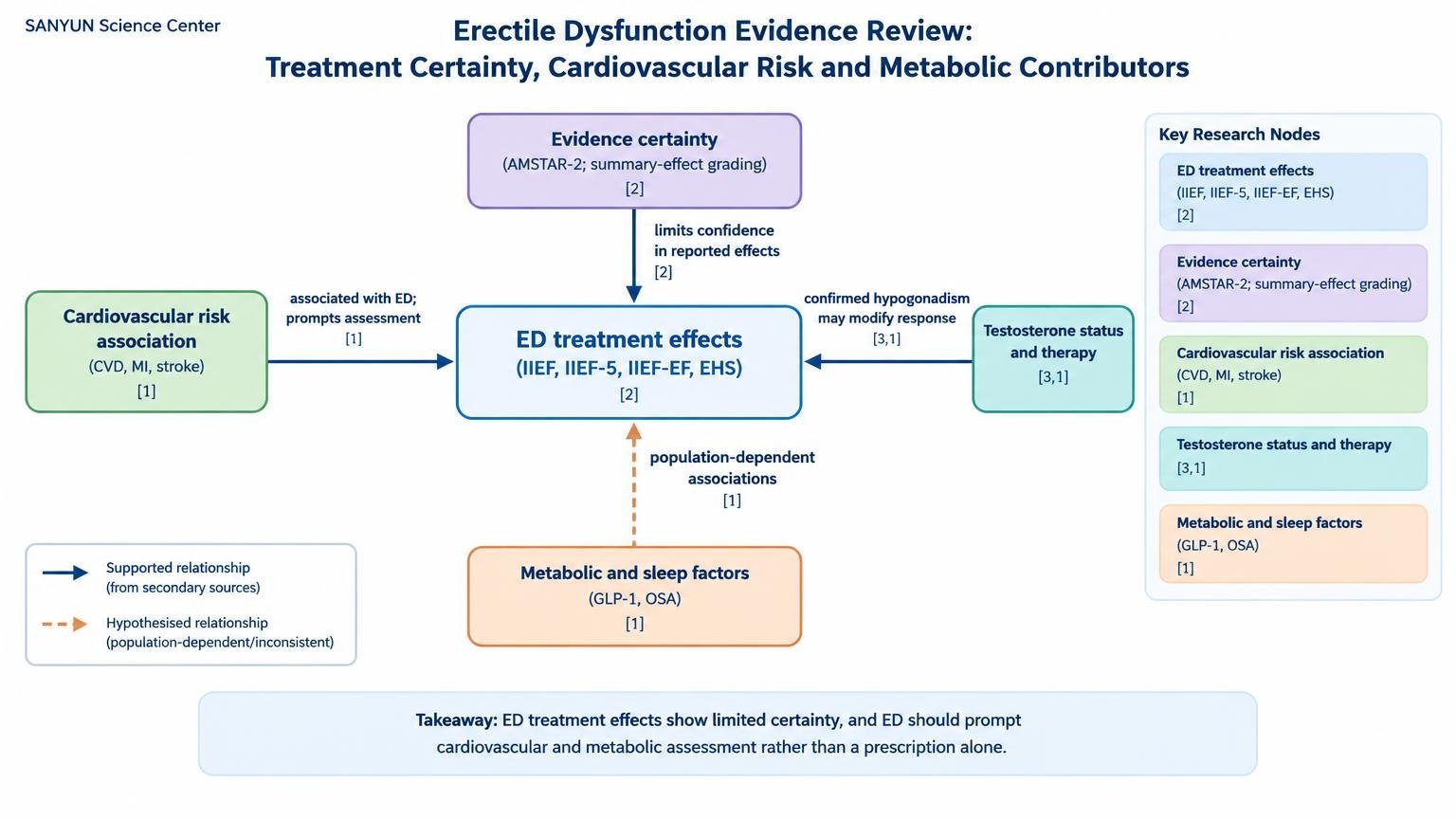
Conceptual framework: Conceptual framework, not a tested causal model. It shows how evidence certainty limits confidence in ED treatment effects, while cardiovascular risk, testosterone and metabolic or sleep factors are associated with ED in observational or mixed secondary evidence. Association is not causation.
Academic References & Evidence
- Parth Bhavsar. Erectile Dysfunction. 2026
- Current treatment for erectile dysfunction: an umbrella review of systematic reviews and meta-analyses. 2026 DOI: 10.6084/m9.figshare.31562993.v1.
- Erectile dysfunction | iatroX. Journal of Urology. 2018 200:633-641
- Does tadalafil cause an erection without sexual stimulation? | iatroX.
SANYUN Science Center explains published research on men's reproductive and sexual health, connecting scientific evidence with everyday questions while making sources and limitations clear.
Disclaimer: This article is for scientific education and research communication only. It does not provide medical advice, diagnosis, or individualized treatment recommendations, and does not endorse any medication, supplement, device, penile enlargement procedure, or other intervention. Decisions about sexual and reproductive health should be made in consultation with a qualified healthcare professional. Do not delay seeking professional care because of information in this article.
Original Content & Copyright Notice
- This article is prepared for SANYUN Science Center, drawing on published research and publicly available academic literature on men’s sexual and reproductive health. Its editorial explanations and presentation are developed for this platform.
- Copyright in the original editorial content, selection, and arrangement is reserved by SANYUN Science Center to the extent protected by applicable law. Referenced research, quotations, and third-party materials remain subject to the rights of their respective owners. This notice does not claim ownership of scientific facts or third-party research.
- Except where permitted by applicable law or an applicable license, prior written permission is required to reproduce, republish, translate, adapt, redistribute, or commercially reuse protected content. Attribution alone does not grant permission for such reuse.
- For permitted quotation or authorized reuse, clearly identify the source and retain a link to the original article.
- Source: SANYUN Science Center
- Original URL: Retain the original article URL on science.san-yun.com.
- Copyright Holder: SANYUN Science Center, for its own protected editorial content.
- Quotation, excerpts, or authorized reuse must not distort the scientific meaning, omit material limitations or disclaimers, or imply unverified medical claims, product efficacy, or endorsement by SANYUN Science Center.



