




Category: Erectile Dysfunction
Core Research Direction: Evidence quality and durability of erectile dysfunction treatments: what an umbrella review of 23 meta-analyses says about certainty, and what a real-world single-arm digital-therapy cohort (RELOED) does and does not establish about sustained benefit 3 months after a 3-month app-based program
Search Intent: How strong is the evidence behind current erectile dysfunction treatments, and how durable are reported benefits from app-based multimodal therapy in real-world use?
Platform: SANYUN Science Center
Evidence reviewed through: 2026-11-12
Executive Summary
Two recent evidence streams frame the current debate about erectile dysfunction (ED) care. The first is an umbrella review that synthesised 23 published meta-analyses covering 36 interventions; it concluded that the evidence base is predominantly of low or very low quality, even though statistically significant improvements were seen with both pharmacological and nonpharmacological treatments.[1]
The second is RELOED, a prospective, single-arm real-world cohort of men with organic ED and an IIEF-5 score below 21 who used a three-month app-based programme combining cardiovascular exercise, pelvic floor training, psychological modules and education. Its primary endpoint was the proportion of men with at least a 3-point IIEF-5 improvement three months after completing therapy; 74.3% (95% CI 66.1–81.4%) met that threshold six months after starting.[2]
The two findings answer different questions. The umbrella review addresses how much confidence clinicians can place in the wider treatment literature. RELOED addresses whether a specific digital programme was followed by retained improvement in routine use. Neither establishes that app-based therapy is superior to alternatives, and RELOED cannot establish efficacy versus no treatment because it had no comparator group.
Why This Matters
ED is common, clinically meaningful and increasingly treated through a crowded menu of drugs, devices, behavioural programmes and digital applications. When an umbrella review finds that 20 of 42 summary effects were rated low certainty and another 20 very low, the practical implication is not that treatments fail but that effect estimates carry substantial uncertainty. Clinicians and patients are often choosing between options whose relative ranking rests on weak comparative evidence.
Digital therapeutics add a further question: durability. A programme that improves symptoms only while it is being used has different value from one whose benefits persist after the programme ends. RELOED was designed around exactly this question, with persistence of effect three months after therapy completion as the primary endpoint.
Biological and Clinical Context of Multimodal ED Care
ED is frequently described as having a substantial vascular component, and penile vascular physiology depends on coordinated neural, endothelial and smooth-muscle signalling. Multimodal programmes therefore target several plausible contributors at once: cardiovascular fitness through exercise, pelvic floor muscle function through targeted training, and psychological and educational factors through structured modules. This rationale is mechanistic and plausible; it is not by itself evidence that each component contributes independently to the observed outcome.[3]
This distinction matters for interpretation. A bundled intervention cannot, without component-isolating designs, reveal which element drove improvement, whether components interacted, or whether the benefit simply reflects regression to the mean, natural fluctuation, or the effect of attention and structure. RELOED's design does not answer those questions.
What the Umbrella Review Found
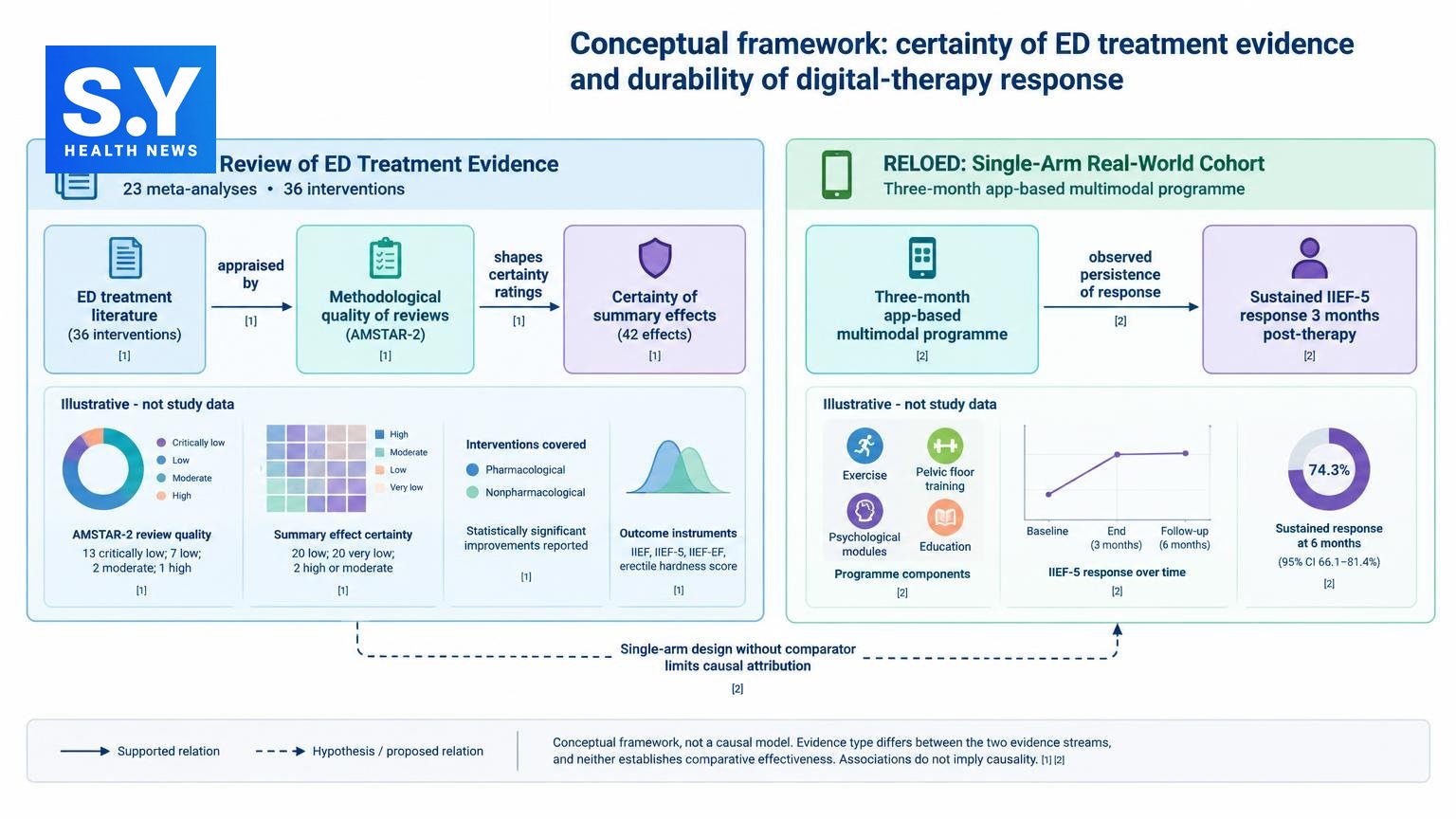
The umbrella review searched PubMed, Web of Science, the Cochrane Library and Embase for studies published up to October 2025. From 1191 screened studies it extracted 23 published meta-analyses, yielding 42 summary effects distributed across the IIEF (20), IIEF-5 (9), IIEF-EF (6) and the erectile hardness score (7), covering 36 interventions.
Methodological appraisal was sobering. Using AMSTAR-2, 13 of the 23 meta-analyses (56.5%) were rated critically low quality, 7 (30.5%) low, 2 (8.7%) moderate and only 1 (4.3%) high. At the level of summary effects, only two were rated high and moderate quality respectively, whereas 20 (47.6%) were rated low and 20 (47.6%) very low.
The authors nevertheless report that statistically significant improvements in ED were observed with both pharmacological and nonpharmacological interventions. Their own caution is important: findings should be interpreted carefully because of the limited number of patients and the subjective nature of outcome indicators such as the IIEF and erectile hardness score.
| Umbrella review variable | Reported value | Interpretation |
|---|---|---|
| Meta-analyses included | 23 meta-analyses from 1191 screened studies | Breadth of synthesis, not depth of primary data |
| Summary effects and interventions | 42 summary effects across 36 interventions | Many interventions, few high-certainty estimates |
| AMSTAR-2 review quality | 13 critically low; 7 low; 2 moderate; 1 high | Most included reviews had serious methodological limitations |
| Certainty of summary effects | 20 low; 20 very low; 2 high or moderate | Certainty is uneven and generally poor |
| Outcome instruments | IIEF, IIEF-5, IIEF-EF, erectile hardness score | Patient-reported or clinician-scored surrogates |
| Direction of findings | Statistically significant improvements for pharmacological and nonpharmacological interventions | Statistical significance does not equal high certainty or clinical superiority |
What RELOED Adds and What It Cannot Show
RELOED enrolled men with organic ED coded N48.4 and an IIEF-5 below 21 who had used the Kranus EDERA programme therapeutically. The programme is described as a three-month, app-based therapy combining cardiovascular training, pelvic floor exercises, psychological modules and educational content. The design was a prospective, single-arm cohort in a real-world setting.
The primary endpoint was the proportion of patients with an improvement of at least 3 IIEF-5 points three months after completing therapy. At six months after start — three months after therapy ended — 74.3% (95% CI 66.1–81.4%) showed a sustained clinically relevant improvement. The authors also report a significant improvement in subjective health status, though the abstract gives no effect size or instrument detail.
The confidence interval is informative. Even at its lower bound, roughly two-thirds of participants met the responder threshold, which is a reasonably precise estimate within this cohort. But precision within a single-arm cohort is not the same as protection against bias. Without a concurrent control group, the observed proportion cannot be separated from secular change, natural symptom fluctuation, placebo or expectancy effects, or selection of men already motivated to complete a digital programme.
The authors conclude that RELOED demonstrates sustained efficacy of the digital application under everyday conditions. That conclusion is stated as a claim about efficacy, but the design supports at best a description of observed durability among users. The distinction between an observed association over time and a demonstrated causal effect is central here.
What the Evidence Does Not Tell Us About Digital Therapy Durability
Several design features limit how far the durability result generalises. The abstract does not report the sample size, the number of men screened versus enrolled, retention or adherence, or how many men completed the full three-month programme. Attrition in app-based programmes is often substantial, and a cohort restricted to therapeutic users may over-represent those who persisted.
The primary endpoint is also relative to baseline rather than to a comparator. A responder is a man whose IIEF-5 rose by at least 3 points at the six-month assessment; the analysis does not describe trajectories between baseline, programme end and follow-up, so it cannot show whether improvement grew, plateaued or declined after the programme stopped. A single follow-up snapshot three months after therapy end establishes persistence at one time point, not durable maintenance over longer horizons.
Finally, the abstract does not detail the statistical model, handling of missing data, or adjustment for baseline severity and concurrent ED treatments. Men using the programme therapeutically may also have continued PDE5 inhibitors or other care, which would complicate attribution of the observed change to the digital programme alone.
Interpretation and Limitations Across Both Evidence Streams
The umbrella review and RELOED point in different directions on the surface but are compatible. The review says the broad ED treatment literature is uncertain and methodologically uneven; RELOED adds a specific, uncontrolled real-world observation about a multimodal digital programme. Neither contradicts the other, and neither strengthens the other's certainty.
There are also limits to how the umbrella review should be read. AMSTAR-2 ratings describe the methodological quality of the included reviews, not necessarily the quality of every underlying randomised trial, and certainty ratings were applied by reviewers across heterogeneous interventions and outcome instruments. The review's conclusion that evidence is predominantly low or very low quality is therefore a summary judgement about a diverse field, not a uniform verdict on each individual treatment.
For RELOED, the most important limitation is structural: a single-arm design cannot separate the intervention from the many factors that accompany participation in a structured programme. Its result is a hypothesis-generating signal about durability that warrants controlled confirmation, not proof of efficacy.
Research Outlook
The umbrella review's authors call for further well-designed studies of single treatments and for high-quality meta-analyses that compare treatments head to head. That recommendation addresses the central gap: the field has many interventions and many meta-analyses, but relatively few high-certainty comparative estimates.
For digital therapeutics specifically, the natural next steps follow from RELOED's design. Controlled comparisons, longer follow-up beyond three months after therapy end, reporting of adherence and attrition, and component-isolating designs would clarify whether multimodal app-based programmes add durable benefit beyond standard care. Until such data exist, claims about sustained efficacy should be framed as observations from users rather than established treatment effects.
Key Takeaways
- An umbrella review of 23 meta-analyses covering 36 ED interventions found that 20 of 42 summary effects were low certainty and 20 very low, with 13 of 23 reviews rated critically low on AMSTAR-2.
- Statistically significant improvements were reported for both pharmacological and nonpharmacological ED treatments, but the authors caution that patient numbers were limited and outcome measures were subjective.
- RELOED, a prospective single-arm real-world cohort, reported that 74.3% (95% CI 66.1–81.4%) of men using a three-month app-based programme retained a clinically relevant IIEF-5 improvement three months after therapy ended.
- The single-arm design, absence of a comparator, and unreported sample size and adherence in the abstract limit causal interpretation of the durability result.
- The two evidence streams answer different questions: one assesses certainty across the treatment literature, the other describes persistence of benefit among users of one digital programme.
Questions and Answers
What did the umbrella review of 23 meta-analyses find about erectile dysfunction treatment evidence?
It found that the evidence base for ED treatments is predominantly of low or very low quality. Among 42 summary effects, 20 were rated low certainty and 20 very low, and 13 of the 23 included meta-analyses were rated critically low on AMSTAR-2. Statistically significant improvements were still reported for both pharmacological and nonpharmacological interventions.
How durable was the improvement after the three-month app-based erectile dysfunction programme in RELOED?
In the RELOED single-arm cohort, 74.3% of men (95% CI 66.1–81.4%) showed a sustained improvement of at least 3 IIEF-5 points six months after starting the programme, which was three months after therapy ended. This describes persistence at one follow-up point among users, not a controlled comparison with untreated or alternatively treated men.
Does RELOED prove that app-based therapy causes lasting erectile dysfunction improvement?
No. RELOED was a prospective, single-arm real-world cohort without a comparator group, and the abstract does not report sample size, adherence or attrition. It can describe how often improvement was retained among users, but it cannot separate the programme's effect from natural fluctuation, expectancy, selection of motivated users, or concurrent treatments. The authors' efficacy conclusion should be read as a hypothesis.
Which outcome measures are used in erectile dysfunction treatment research and what are their limits?
The umbrella review's included meta-analyses used the International Index of Erectile Function, its simplified forms such as IIEF-5 and IIEF-EF, and the erectile hardness score. These are patient-reported or clinician-scored instruments. They capture meaningful symptom burden but remain subjective surrogates rather than objective physiological measures of erectile function.
What are the main limitations of the current erectile dysfunction treatment evidence base?
The umbrella review found most included meta-analyses were methodologically weak and most summary effects were low or very low certainty. It also noted limited patient numbers and subjective outcome indicators. It did not provide high-certainty head-to-head comparisons, which is why the authors call for better single-treatment studies and comparative meta-analyses.
How should clinicians and patients interpret a 74.3% sustained response rate in a real-world digital therapy cohort?
They should read it as a reasonably precise estimate within one uncontrolled cohort of men who used the programme therapeutically, not as proof of comparative effectiveness. The confidence interval of 66.1–81.4% describes statistical precision, not protection against bias. Confirmation requires controlled studies with longer follow-up and reporting of adherence, attrition and concurrent treatments.
Conceptual framework: Conceptual framework, not a causal model. Left: an umbrella review of 23 meta-analyses covering 36 ED interventions, showing how AMSTAR-2 review quality informs certainty ratings of 42 summary effects. Right: RELOED's single-arm real-world cohort of a three-month app-based programme, where sustained IIEF-5 response three months after therapy end is observed without a comparator. Supported edges reflect reported associations; the dashed relation marks the proposed limiting role of the uncontrolled design. Evidence type differs between the two panels, and neither establishes comparative effectiveness.
Academic References & Evidence
- Current treatment for erectile dysfunction: an umbrella review of systematic reviews and meta-analyses. 2026 DOI: 10.6084/m9.figshare.31562993.v1.
- Lea Eberhardt. RELOED: Real-World longitudinale Follow-up Studie über eine digitale Gesundheitsanwendung (DiGA) bei erektiler Dysfunktion.
- Erectile Dysfunction.
SANYUN Science Center explains published research on men's reproductive and sexual health, connecting scientific evidence with everyday questions while making sources and limitations clear.
Disclaimer: This article is for scientific education and research communication only. It does not provide medical advice, diagnosis, or individualized treatment recommendations, and does not endorse any medication, supplement, device, penile enlargement procedure, or other intervention. Decisions about sexual and reproductive health should be made in consultation with a qualified healthcare professional. Do not delay seeking professional care because of information in this article.
Original Content & Copyright Notice
- This article is prepared for SANYUN Science Center, drawing on published research and publicly available academic literature on men’s sexual and reproductive health. Its editorial explanations and presentation are developed for this platform.
- Copyright in the original editorial content, selection, and arrangement is reserved by SANYUN Science Center to the extent protected by applicable law. Referenced research, quotations, and third-party materials remain subject to the rights of their respective owners. This notice does not claim ownership of scientific facts or third-party research.
- Except where permitted by applicable law or an applicable license, prior written permission is required to reproduce, republish, translate, adapt, redistribute, or commercially reuse protected content. Attribution alone does not grant permission for such reuse.
- For permitted quotation or authorized reuse, clearly identify the source and retain a link to the original article.
- Source: SANYUN Science Center
- Original URL: Retain the original article URL on science.san-yun.com.
- Copyright Holder: SANYUN Science Center, for its own protected editorial content.
- Quotation, excerpts, or authorized reuse must not distort the scientific meaning, omit material limitations or disclaimers, or imply unverified medical claims, product efficacy, or endorsement by SANYUN Science Center.



