




Category: Erectile Dysfunction
Core Research Direction: Evidence quality and clinical framing of current erectile dysfunction treatments, including the cardiovascular-risk signal and the modest, low-certainty evidence behind nonpharmacological options
Search Intent: How strong is the evidence behind today's erectile dysfunction treatments, and what should men with ED and their clinicians actually take away from it?
Platform: SANYUN Science Center
Evidence reviewed through: 2026-11-13
Executive Summary
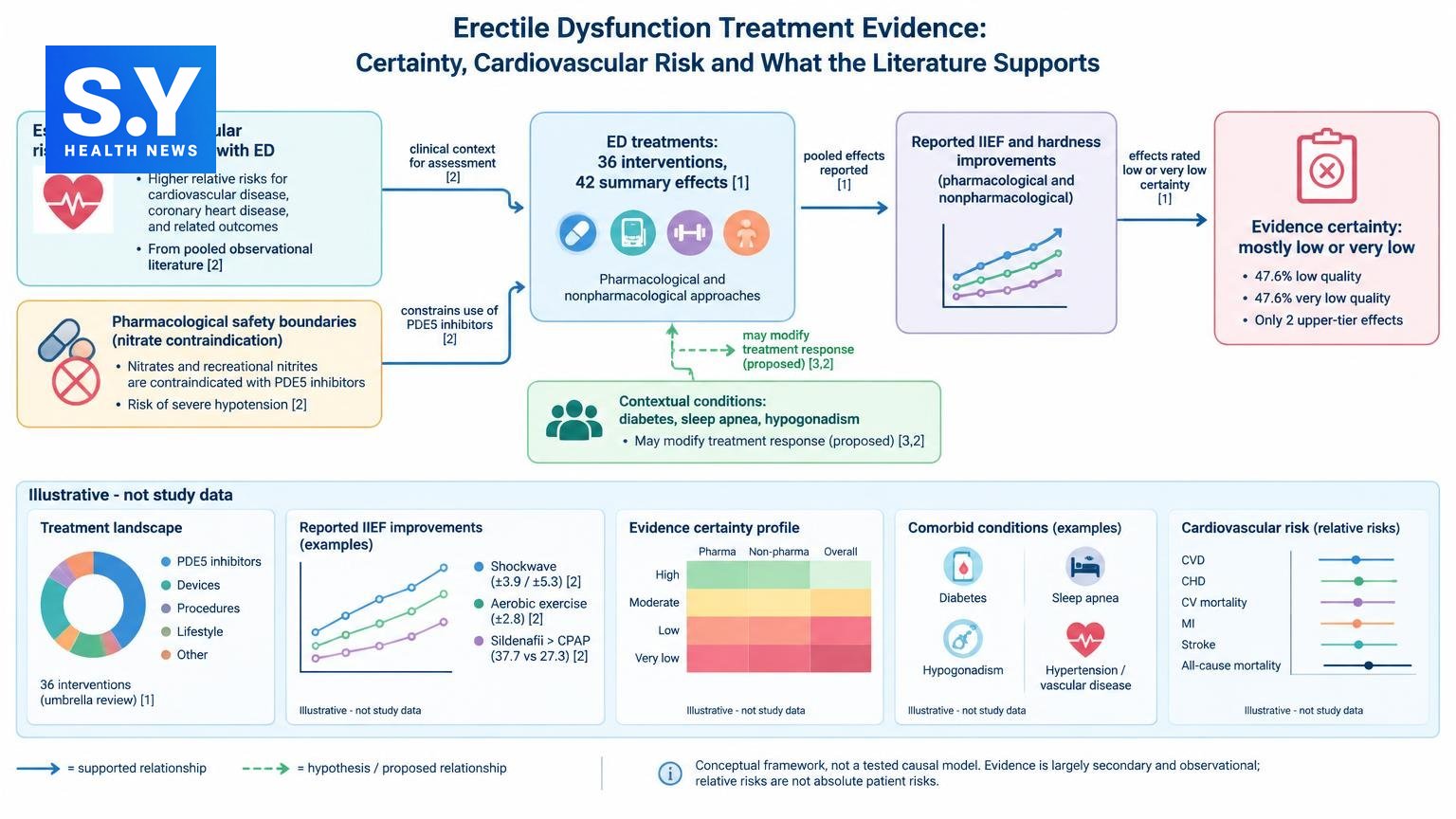
Erectile dysfunction (ED) is a common, treatable condition whose evidence base is broader than it is deep. A 2026 umbrella review of published meta-analyses screened 1,191 studies, extracted 23 meta-analyses and 42 summary effects covering 36 interventions, using the International Index of Erectile Function (IIEF) or its short forms and the Erectile Hardness Score as endpoints. Its headline finding is not that treatments fail but that the reliability of the evidence behind them is poor.[1]
The quality appraisal is striking. By AMSTAR-2, 13 of 23 meta-analyses (56.5%) were rated critically low and 7 (30.5%) low; only 2 were moderate and 1 high. Among the 42 summary effects, just two were rated high and moderate quality respectively, while 20 (47.6%) were low and 20 (47.6%) very low.
That does not mean nothing works. Statistically significant improvements were reported for both pharmacological and nonpharmacological interventions, but the reviewers caution that small patient numbers and subjective outcome measures limit interpretation. Parallel clinical literature supplies the second theme: ED behaves as a marker of cardiovascular risk, and several widely discussed nonpharmacological options carry effect estimates that are modest in size and uncertain in certainty.[2]
Why This Matters
Men with ED are frequently managing a condition that is neither rare nor purely sexual in origin. Patient education attributed to the National Institute of Diabetes and Digestive and Kidney Diseases estimates that about 5% of 40-year-old men and up to 25% of 65-year-old men have ED, and that roughly 80% of cases have a physical cause, with damaged nerves, arteries and smooth muscle tissue often driven by diabetes, hypertension, vascular disease and similar conditions.[3]
The clinical stakes are therefore larger than erection quality alone. A 2021 umbrella review summarized in a physician-authored guide reported that men with ED had higher relative risks of cardiovascular disease (RR 1.45, 95% CI 1.36 to 1.54), coronary heart disease (RR 1.50), cardiovascular mortality (RR 1.50), myocardial infarction (RR 1.55), stroke (RR 1.36) and all-cause mortality (RR 1.25). These are relative risks from pooled observational literature, not proof that ED causes cardiac events.
Meanwhile, the treatment market has become crowded and commercial. The umbrella review's authors describe an increasingly diverse treatment landscape whose evidence reliability is poor, and they call for better single-treatment trials and high-quality comparisons between treatments. For patients and clinicians choosing among pills, devices, procedures and lifestyle programmes, that is the central practical tension.
Mechanism: Vascular, Hormonal and Drug-Related Contributors
The dominant biological model of erection is vascular. Phosphodiesterase type 5 (PDE5) inhibitors block the enzyme that breaks down cyclic GMP, the molecule responsible for relaxing penile smooth muscle and allowing blood to flow into the penis. They do not create desire and do not produce an erection without sexual stimulation; patient education makes the same point, describing oral medicines as relaxing penile blood vessels rather than acting as aphrodisiacs.
The artery-size hypothesis offers an explanation for why ED so often precedes cardiac symptoms. Penile arteries are roughly 1 to 2 mm in diameter, compared with 3 to 4 mm for coronary arteries, so atherosclerotic change may become symptomatic in the smaller vessel bed first. This is presented in the source as a hypothesis, and it is a plausible but not definitively proven explanation for the epidemiological association.
Hormonal contributors are narrower than popular discussion suggests. Testosterone is described as modulating libido and contributing to nitric oxide signalling rather than being the primary driver of erection mechanics. In men with confirmed hypogonadism, defined by symptoms plus consistently low testosterone on repeat fasting morning tests, replacement can improve libido and augment the response to PDE5 inhibitors, but it is not effective as standalone ED therapy.
Medication effects and comorbidity matter as well. Up to half of men with diabetes have ED according to patient education material, and the listed contributors include antihypertensives, some antidepressants, 5-alpha reductase inhibitors and opioids. Obstructive sleep apnea is another under-recognized association: among 150 men newly diagnosed with moderate to severe OSA, ED prevalence was 51%.
What the Evidence Shows
Across 36 interventions and 42 summary effects, the umbrella review found statistically significant improvements in ED with both pharmacological and nonpharmacological approaches. That breadth is real, but certainty is not evenly distributed. The quality appraisal rated 47.6% of summary effects low and another 47.6% very low, leaving only two effects in the upper tiers. Readers should treat any single dramatic claim drawn from this literature with caution.
For nonpharmacological options, several specific effect estimates are available but consistently modest and uncertain. A 2025 Cochrane review of 21 randomized trials in 1,357 men found low-intensity shockwave therapy may improve short-term IIEF-EF scores by roughly 3.9 points and long-term scores by 5.3 points versus sham, with low certainty; reviewers also noted that several included trials were industry-funded, mainly by device makers.
Aerobic exercise has a smaller reported signal. A 2023 Journal of Sexual Medicine meta-analysis found aerobic exercise improves IIEF-EF scores by about 2.8 points. The guide summarizing it notes that the average gain was larger in severe ED, but the summary provided does not include a confidence interval or the number of pooled trials, which limits how precisely the effect can be judged.
Sleep apnea treatment is often discussed as an ED intervention, but the evidence is weak. A 2021 Cochrane review rated CPAP versus no CPAP as very uncertain and found sildenafil may slightly improve erectile function compared with CPAP at 12 weeks. A 2023 meta-analysis of 8 studies in 457 patients reported higher post-treatment IIEF-5 domain scores with sildenafil than CPAP (37.7 versus 27.3), and its authors suggested combining the two may add benefit, although that suggestion was not directly tested.
Hormonal and metabolic interventions add further nuance. In TRAVERSE, 5,246 hypogonadal men with preexisting or high cardiovascular risk took transdermal testosterone or placebo; major adverse cardiac events were noninferior to placebo (HR 0.96, 95% CI 0.78 to 1.17) over a mean 21.7 months, though atrial fibrillation, acute kidney injury and pulmonary embolism were more common with testosterone. TRAVERSE addressed cardiovascular safety in hypogonadism, not ED as a primary endpoint.
GLP-1 receptor agonist evidence is early and two-sided. A 2025 controlled pilot study compared tirzepatide, lifestyle intervention and transdermal testosterone in men with obesity-associated hypogonadism; tirzepatide produced greater weight loss and IIEF-5 improvement than lifestyle alone and raised total testosterone and related hormones. In contrast, a 2024 TriNetX database analysis of 3,094 non-diabetic, non-hypogonadal men aged 18 to 50 found higher rates of new ED diagnosis or PDE5 inhibitor prescription on semaglutide (1.47% versus 0.32%) and of testosterone deficiency (1.53% versus 0.80%). Absolute rates were low, and database designs cannot establish causation.
Reading Effect Sizes and Certainty Together
| Intervention or exposure | Reported result | Evidence character | How to read it |
|---|---|---|---|
| Current ED treatments overall (36 interventions) | 42 summary effects; 20 low and 20 very low quality; 2 upper-tier | Umbrella review of 23 meta-analyses, published up to October 2025 | Breadth of options exceeds depth of certainty; statistically significant gains are common but reliability is poor |
| Low-intensity shockwave therapy | IIEF-EF improvement of about 3.9 points short-term and 5.3 points long-term versus sham | 2025 Cochrane review, 21 trials, 1,357 men, low certainty | Consistent direction but weak certainty and device-industry funding in several trials |
| Aerobic exercise | IIEF-EF improvement of about 2.8 points | 2023 meta-analysis summarized secondarily | Small average benefit; details on trial count not supplied in the summary |
| CPAP for sleep apnea versus sildenafil | Post-treatment IIEF-5 domain scores 37.7 versus 27.3 favouring sildenafil | 2023 meta-analysis, 8 studies, 457 patients; separate 2021 Cochrane review rated CPAP evidence very uncertain | Does not establish CPAP as stand-alone ED therapy; combination suggestion remains untested |
| Testosterone in hypogonadal men at high cardiovascular risk | MACE hazard ratio 0.96 versus placebo (95% CI 0.78-1.17) over mean 21.7 months | Randomized controlled trial (TRAVERSE), 5,246 men | Cardiac safety signal neutral; atrial fibrillation, acute kidney injury and pulmonary embolism more frequent with testosterone |
| Semaglutide in non-diabetic, non-hypogonadal men aged 18-50 | New ED diagnosis or PDE5 inhibitor prescription 1.47% versus 0.32%; testosterone deficiency 1.53% versus 0.80% | 2024 database cohort of 3,094 men with matched comparators | Absolute rates low; observational design cannot establish causation |
The table makes a point that individual studies obscure: effect direction and effect certainty are separate dimensions. Shockwave therapy and aerobic exercise both show positive average IIEF changes, yet neither rests on high-certainty evidence. The umbrella review's quality profile suggests this pattern is structural rather than confined to a single intervention.
The Cardiovascular Signal and Clinical Framing
The cardiovascular association is the most clinically consequential finding in the surrounding literature, even though it sits outside the umbrella review's treatment-effectiveness scope. Relative risks of 1.45 for cardiovascular disease and 1.50 for coronary heart disease in men with ED, drawn from a 2021 umbrella review of systematic reviews and meta-analyses, are large enough to justify attention but do not quantify absolute risk for an individual patient.
A widely cited clinical consensus summarized in the same guide frames ED as a cardiac risk marker and recommends risk stratification before sexual activity resumes, but that consensus text is a secondary summary rather than a primary trial. The practical implication is that new-onset ED in a man without an obvious explanation deserves blood pressure, glucose or HbA1c and lipid assessment alongside any sexual-health discussion.
Safety framing around PDE5 inhibitors remains standard and should not be softened by the uncertain effectiveness literature. These drugs are absolutely contraindicated with nitrate medications and recreational nitrites because the combination can cause severe, potentially fatal hypotension. A 2025 analysis of 53,517 FDA Adverse Event Reporting System reports from 2004 to 2024 found labelled side effects for all four agents plus some nervous-system, cardiovascular and eye signals not on the labels that warrant further study; spontaneous reporting cannot establish incidence.
Interpretation and Limitations
The umbrella review is the strongest anchor for statements about evidence certainty, but it is an umbrella review, not a new trial. Its conclusions depend on the quality of the 23 meta-analyses it summarizes, many of which were rated critically low by AMSTAR-2. It also relies on IIEF-family and hardness scores, which are subjective and can be influenced by expectation, relationship context and trial conduct.
Several specific numbers come from a physician-authored clinical guide that cites primary studies not included in this packet. The cardiovascular relative risks, the shockwave and exercise effect sizes, the CPAP comparisons, the TRAVERSE results and the GLP-1 findings are all secondary summaries here. They should be read as accurate reporting of what those sources state, not as verified primary data.
Prevalence figures attributed to NIDDK and reproduced in patient education are similarly second-hand and vary across populations and definitions. The 5% and up to 25% figures by age, the 80% physical-cause estimate and the up to 50% figure in diabetes describe broad patterns and should not be applied to an individual without clinical assessment.
The GLP-1 literature illustrates how easily observational signals are over-read. The TriNetX analysis found higher rates of ED diagnosis and testosterone deficiency among semaglutide users, but absolute rates were low and the design cannot exclude confounding by indication, weight loss trajectory or health-seeking behaviour. The contrasting pilot finding in obesity-associated hypogonadism shows that direction of effect may depend on baseline hormonal status.
Research Outlook
The umbrella review's own recommendation is the clearest research agenda: well-designed studies of single treatments and high-quality meta-analyses comparing treatments head to head. The current literature contains many statistically significant results but few high-certainty ones, so additional small trials of the same design are unlikely to resolve the uncertainty.
Three areas deserve particular scrutiny. First, nonpharmacological interventions such as shockwave therapy need sham-controlled trials independent of device manufacturers, given the low certainty and industry funding already noted. Second, cardiovascular risk stratification in ED requires prospective evidence linking risk assessment to outcomes, not only observational relative risks. Third, GLP-1 receptor agonists require adequately powered studies with hormonal endpoints and prespecified ED measures before their net effect on sexual function can be stated confidently.
Key Takeaways
- The largest synthesis of ED treatment evidence rates most of it low or very low quality: 20 of 42 summary effects were very low and 20 low, with only two in higher tiers.
- Statistically significant improvements are reported for pharmacological and nonpharmacological interventions, but small patient numbers and subjective endpoints limit confidence.
- ED is associated with higher relative risks of cardiovascular disease and mortality, supporting cardiovascular assessment rather than sexual treatment alone.
- Shockwave therapy and aerobic exercise show modest average IIEF improvements of roughly 3.9 to 5.3 points and about 2.8 points respectively, with weak certainty for shockwave and limited detail for exercise.
- PDE5 inhibitors remain the most familiar pharmacological option, do not act without sexual stimulation, and are absolutely contraindicated with nitrates and recreational nitrites.
- Testosterone is not stand-alone ED therapy; in hypogonadal men at high cardiovascular risk, TRAVERSE found noninferior cardiac safety but more atrial fibrillation, acute kidney injury and pulmonary embolism.
Questions and Answers
What did the 2026 umbrella review of erectile dysfunction treatments find about evidence quality?
It found the evidence base predominantly low or very low quality. Of 23 meta-analyses, 13 (56.5%) were rated critically low by AMSTAR-2 and only one high. Among 42 summary effects across 36 interventions, 20 were low and 20 very low quality, with just two in higher tiers. Statistically significant improvements were still reported for pharmacological and nonpharmacological approaches.
How does erectile dysfunction relate to cardiovascular disease risk?
Pooled observational evidence summarized in a physician-authored guide reports that men with ED have higher relative risks of cardiovascular disease (RR 1.45, 95% CI 1.36 to 1.54), coronary heart disease (RR 1.50), myocardial infarction (RR 1.55), stroke (RR 1.36) and all-cause mortality (RR 1.25). These are associations from secondary literature, not proof of causation, and they are relative rather than absolute risks.
How effective is low-intensity shockwave therapy for erectile dysfunction, and how certain is that evidence?
A 2025 Cochrane review of 21 randomized trials in 1,357 men found shockwave therapy may improve short-term IIEF-EF scores by roughly 3.9 points and long-term scores by 5.3 points versus sham. However, the review rated the evidence low certainty and noted that several included trials were industry-funded, mainly by device makers.
Does testosterone replacement treat erectile dysfunction on its own?
No. Testosterone is described as modulating libido and nitric oxide signalling rather than driving erection mechanics, and replacement is not effective as standalone ED therapy. In men with confirmed hypogonadism, it can improve libido and augment response to PDE5 inhibitors. In TRAVERSE, cardiac events were noninferior to placebo (HR 0.96, 95% CI 0.78-1.17), but atrial fibrillation, acute kidney injury and pulmonary embolism were more common.
What are the safety limits of PDE5 inhibitors for erectile dysfunction?
PDE5 inhibitors block breakdown of cyclic GMP and require sexual stimulation to produce an erection; they do not increase desire. They are absolutely contraindicated with nitrate medications and recreational nitrites because the combination can cause severe, potentially fatal hypotension. A 2025 analysis of 53,517 FDA adverse-event reports also flagged some unlabelled nervous-system, cardiovascular and eye signals needing further study, though such reporting cannot establish incidence.
Do GLP-1 drugs such as semaglutide improve or worsen erectile function?
The evidence is inconsistent and depends on baseline hormonal status. In a 2025 pilot in men with obesity-associated hypogonadism, tirzepatide improved IIEF-5 scores and raised testosterone more than lifestyle alone. But a 2024 database analysis of 3,094 non-diabetic, non-hypogonadal men aged 18 to 50 found higher rates of new ED diagnosis or PDE5 inhibitor prescription on semaglutide (1.47% versus 0.32%), with low absolute rates and no causal inference possible.
Conceptual framework: Conceptual framework, not a tested causal model. It maps how the umbrella review's 36 interventions and 42 summary effects relate to mostly low or very low certainty, alongside the observational cardiovascular risk association and standard safety boundaries. Comorbid conditions are shown as proposed modifiers of treatment response. Evidence is largely secondary and observational; relative risks are not absolute patient risks.
Academic References & Evidence
- Current treatment for erectile dysfunction: an umbrella review of systematic reviews and meta-analyses. Figshare. 2026 DOI: 10.6084/m9.figshare.31562993.v1.
- Parth Bhavsar, MD. Erectile Dysfunction. 2026
- Krames Online – Erectile Dysfunction Quiz.
SANYUN Science Center explains published research on men's reproductive and sexual health, connecting scientific evidence with everyday questions while making sources and limitations clear.
Disclaimer: This article is for scientific education and research communication only. It does not provide medical advice, diagnosis, or individualized treatment recommendations, and does not endorse any medication, supplement, device, penile enlargement procedure, or other intervention. Decisions about sexual and reproductive health should be made in consultation with a qualified healthcare professional. Do not delay seeking professional care because of information in this article.
Original Content & Copyright Notice
- This article is prepared for SANYUN Science Center, drawing on published research and publicly available academic literature on men’s sexual and reproductive health. Its editorial explanations and presentation are developed for this platform.
- Copyright in the original editorial content, selection, and arrangement is reserved by SANYUN Science Center to the extent protected by applicable law. Referenced research, quotations, and third-party materials remain subject to the rights of their respective owners. This notice does not claim ownership of scientific facts or third-party research.
- Except where permitted by applicable law or an applicable license, prior written permission is required to reproduce, republish, translate, adapt, redistribute, or commercially reuse protected content. Attribution alone does not grant permission for such reuse.
- For permitted quotation or authorized reuse, clearly identify the source and retain a link to the original article.
- Source: SANYUN Science Center
- Original URL: Retain the original article URL on science.san-yun.com.
- Copyright Holder: SANYUN Science Center, for its own protected editorial content.
- Quotation, excerpts, or authorized reuse must not distort the scientific meaning, omit material limitations or disclaimers, or imply unverified medical claims, product efficacy, or endorsement by SANYUN Science Center.



