




Category: Erectile Dysfunction
Core Research Direction: Evidence quality and comparative effectiveness of current erectile dysfunction treatments, with emphasis on the low-to-very-low certainty of the underlying meta-analytic evidence, the contested roles of low-intensity shockwave therapy and platelet-rich plasma, and the cardiovascular risk context of ED
Search Intent: How strong is the evidence behind current erectile dysfunction treatments, and which options such as shockwave therapy and PRP are actually supported by reliable trials?
Platform: SANYUN Science Center
Evidence reviewed through: 2026-11-20
Executive Summary
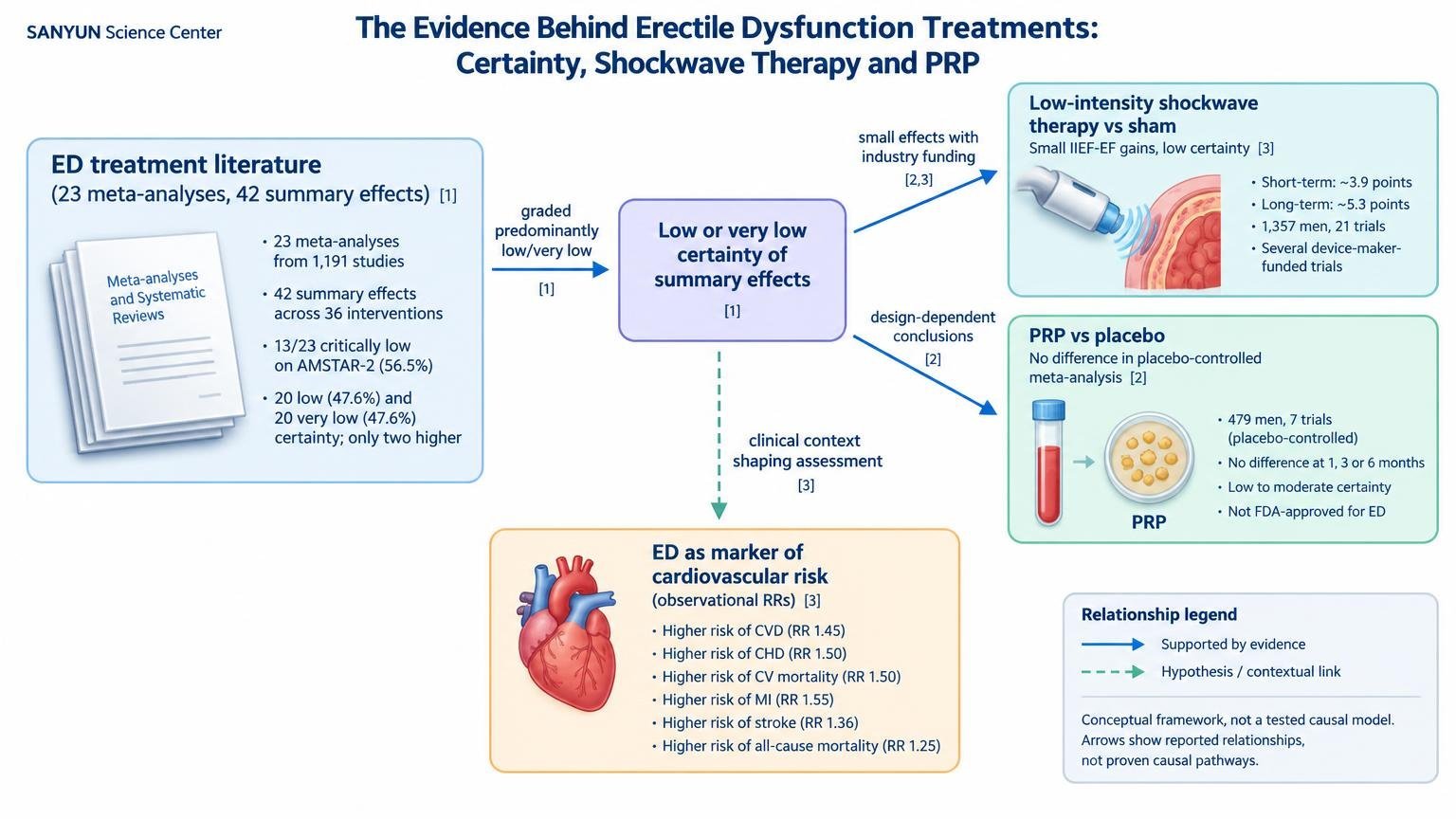
Erectile dysfunction is common and treatable, but the quality of the evidence supporting individual treatments is uneven. An umbrella review of systematic reviews and meta-analyses, searching four major databases for studies published up to October 2025, extracted 23 published meta-analyses from 1191 studies, yielding 42 summary effects across 36 interventions measured by the International Index of Erectile Function and its variants and the erectile hardness score.[1]
The central finding concerns certainty rather than efficacy. On AMSTAR-2 appraisal, 13 of the 23 meta-analyses (56.5%) were rated critically low quality, 7 (30.5%) low, 2 (8.7%) moderate and 1 (4.3%) high. Among the 42 summary effects, 20 (47.6%) were graded low and 20 (47.6%) very low, with only two rated high and moderate respectively.
The review authors concluded that the evidence base is predominantly low or very low quality: statistically significant improvements appeared with both pharmacological and nonpharmacological interventions, but these findings deserve caution because patient numbers were limited and outcome indicators are subjective. They called for better single-treatment trials and high-quality head-to-head meta-analyses.
- Established oral and injectable drug treatments remain the backbone of care, but the certainty behind pooled estimates is frequently low.
- Low-intensity shockwave therapy shows small pooled effects versus sham, graded low certainty, with several trials funded by device makers.[2][3]
- Platelet-rich plasma results diverge sharply by trial design: a broader 2024 meta-analysis favored PRP, while a 2026 placebo-controlled-only meta-analysis found no difference from placebo.
Why This Matters
Men are commonly presented with a menu of options — pills, injections, urethral medicine, vacuum devices, implants, shockwave therapy and PRP — as if each carried comparable support. The umbrella review shows that the menu is real but the evidence behind each item is not equally robust, and that much of the literature rests on small studies with subjective endpoints.
Erectile dysfunction is also not merely a sexual complaint. A 2021 umbrella review of systematic reviews and meta-analyses reported that men with ED had higher relative risks of cardiovascular disease (RR 1.45, 95% CI 1.36–1.54), coronary heart disease (RR 1.50), cardiovascular mortality (RR 1.50), myocardial infarction (RR 1.55), stroke (RR 1.36) and all-cause mortality (RR 1.25), all with P less than 0.001. These are observational associations, not proof of causation, but they make ED a clinically meaningful moment for cardiovascular assessment.
Prevalence data underline how many men are affected: in the Massachusetts Male Aging Study, 52% of men aged 40 to 70 reported some degree of erectile dysfunction, and in a 2013 single-clinic study, 1 in 4 men seeking first medical help for new ED was 40 or younger.
Mechanism and Clinical Context
An erection depends on nitric oxide signalling, cyclic GMP–mediated smooth-muscle relaxation and adequate arterial inflow. One proposed explanation for the ED–cardiovascular link is the artery-size hypothesis: penile arteries are 1 to 2 mm in diameter, compared with 3 to 4 mm for coronary arteries, so atherosclerotic change may become symptomatic in the penis before the heart. This is a proposed mechanism and does not by itself establish causality.
Treatment logic follows the mechanism. PDE5 inhibitors slow the breakdown of cyclic GMP and require sexual stimulation to act. They are absolutely contraindicated with nitrates such as nitroglycerin, because the combination can cause a dangerous drop in blood pressure. Any evaluation for ED therefore has to include a medication review, not just a prescription.
Contextual contributors matter too. In a cohort of 150 men newly diagnosed with moderate to severe obstructive sleep apnea, ED prevalence was 51%; erectile function scores rose after three months of continuous positive airway pressure, but the authors could not determine whether CPAP works as a standalone ED treatment. A 2021 Cochrane review rated CPAP versus no CPAP evidence as very uncertain and found sildenafil may slightly improve erectile function compared with CPAP at 12 weeks.
What the Evidence Shows
The umbrella review functioned as a map of maps: rather than pooling patients, it pooled published meta-analyses and graded their credibility. Its value lies in showing where confidence is justified and where a statistically significant pooled estimate sits on fragile foundations. The authors note that significant improvements were observed across both pharmacological and nonpharmacological interventions, but with limited patient numbers and subjective outcome measures.
Guideline framing has shifted. The 2018 AUA guideline, as summarised in secondary clinical guidance, presents every treatment that is not contraindicated as a potential first-line option chosen through shared decision-making, rather than a rigid ladder. That places a heavier informational burden on clinicians: if all options are on the table, the strength of evidence behind each one becomes part of the conversation.
| Intervention or factor | Reported result | Population and comparator | Certainty or design caveat |
|---|---|---|---|
| Umbrella review of ED treatments | 42 summary effects across 36 interventions; 20 low (47.6%) and 20 very low (47.6%); only two higher quality | 23 meta-analyses from 1191 studies, literature to October 2025 | 13 of 23 meta-analyses (56.5%) rated critically low on AMSTAR-2 |
| Low-intensity shockwave therapy | Short-term IIEF-EF improvement of roughly 3.9 points and long-term 5.3 points versus sham | 1,357 men in 21 randomized trials | Low certainty; several device-maker-funded trials; short-term effect may not be noticed by men |
| Shockwave therapy in vasculogenic ED | Improvement versus sham reported | 882 men in 12 randomized trials | Secondary reporting without effect size or certainty rating; not FDA-approved for ED |
| Platelet-rich plasma (2024 meta-analysis) | Better erectile function scores than control, standardized mean difference 0.59 | 991 patients in 12 controlled trials | Pooled controlled and single-arm designs; authors called for larger, longer, higher-quality trials |
| Platelet-rich plasma (2026 meta-analysis) | No difference from placebo at 1, 3 or 6 months | 479 men in 7 randomized placebo-controlled trials | Low to moderate certainty; design restriction changes the conclusion; not FDA-approved for ED |
| Aerobic exercise | IIEF-EF improvement of about 2.8 points | Men in the meta-analyzed exercise studies | Secondary reporting; trial count and confidence interval not stated in the supplied text |
| Sildenafil versus CPAP in OSA with ED | Post-treatment IIEF-5 of 37.7 versus 27.3 | 457 patients across 8 studies | Indirect comparison from a 2023 meta-analysis; combination benefit was suggested, not tested |
Shockwave Therapy: Small Signals, Low Certainty
Low-intensity shockwave therapy aims sound waves at the penis with the goal of improving blood flow. A 2025 Cochrane review pooling 21 randomized trials in 1,357 men found it may have a small short-term effect on erectile function that men may not notice, and may improve long-term function. The same review reported short-term IIEF-EF gains of roughly 3.9 points and long-term gains of 5.3 points versus sham, but rated all evidence low certainty and noted that several trials were funded by device makers.
A 2025 meta-analysis restricted to 12 randomized trials in 882 men with vasculogenic ED reported improvement compared with sham treatment. That sounds more encouraging than the Cochrane appraisal, but the contrast is instructive: a positive pooled estimate and a low certainty rating are not contradictory. Both can be true when effects are small, endpoints are subjective and trials are few, small or industry-funded.
Regulatory status is a separate question from trial results. According to the secondary source summarising this literature, shockwave therapy is not an FDA-approved treatment for ED. Men considering it should understand that a plausible mechanism and a statistically significant pooled result do not add up to established efficacy.
Platelet-Rich Plasma: A Divergence Worth Understanding
Platelet-rich plasma is made from a man's own blood; platelets carry growth factors, and the preparation is injected into the penis with the goal of improving erectile function. Two recent syntheses reach opposite conclusions, and the difference is largely methodological.
A 2024 meta-analysis by Du and colleagues of 12 controlled trials in 991 patients found better erectile function scores with PRP than with control treatments, with a standardized mean difference of 0.59. The authors themselves called for more high-quality, larger trials with longer follow-up. A 2026 meta-analysis by de Amorim and colleagues, restricted to randomized placebo-controlled trials, pooled 7 trials in 479 men and found no difference from placebo in erectile function scores at 1, 3 or 6 months, with low to moderate certainty.
When the more rigorous design restriction removes the apparent benefit, the most defensible reading is that the current placebo-controlled evidence does not demonstrate that PRP improves erectile function. That does not prove harm or prove futility; it means the effect has not been reliably shown. As with shockwave therapy, PRP is not an FDA-approved treatment for ED according to the same secondary source.
Interpretation and Limitations
Three limitations deserve emphasis. First, an umbrella review inherits the flaws of the meta-analyses it summarises; when more than half are rated critically low, the summary effects cannot be stronger than their inputs. Second, erectile function is typically measured with subjective questionnaires, and small trials with subjective endpoints are prone to optimistic pooled estimates. Third, several key sources here are secondary: the Cochrane review, the PRP meta-analyses and the FDA statements are relayed through narrative or commercial patient-education articles rather than quoted from their full primary texts, so effect sizes and certainty ratings should be read as reported rather than independently verified.
It is equally important not to overstate skepticism. Low certainty does not mean a treatment does nothing; it means the estimate could change with better data. PDE5 inhibitors remain the most commonly used first treatment in practice, and the umbrella review did observe statistically significant improvements across intervention types. The problem is comparative: there is little high-quality evidence telling men which option is better for them, which is precisely the gap the umbrella review authors highlight.
One frequently misunderstood association concerns GLP-1 receptor agonists. In a 2024 TriNetX database analysis of 3,094 non-diabetic, non-hypogonadal men aged 18 to 50 prescribed semaglutide for weight loss, rates of new ED diagnosis or PDE5 inhibitor prescription were 1.47% versus 0.32% in matched unexposed men, and testosterone deficiency 1.53% versus 0.80%. Absolute rates were low, and the source explicitly cautions that an observational database cannot prove the drug caused the difference.
By contrast, in obese men with functional hypogonadism, GLP-1–based drugs can raise testosterone, and one pilot study found tirzepatide also improved erectile function scores. A 2026 narrative review described the overall GLP-1 evidence in men as promising but inconsistent, with case reports of possible sexual side effects with tirzepatide. The direction of effect may depend on baseline metabolic and hormonal status.
Testosterone therapy deserves its own caution. In the 2023 TRAVERSE trial of 5,246 men with hypogonadism and preexisting or high cardiovascular risk, transdermal testosterone was noninferior to placebo for major adverse cardiac events (HR 0.96, 95% CI 0.78–1.17) over a mean 21.7 months, though atrial fibrillation, acute kidney injury and pulmonary embolism were more common with testosterone. A 2026 observational cohort reported a major cardiac event hazard ratio of 1.27 with testosterone use, but men diagnosed with testosterone deficiency showed the same increase and the authors state it is unclear whether testosterone itself drives the risk.
Safety issues outside the trial literature also matter. According to NCCIH as relayed, there is no definite evidence that any herbal product is effective or safe for ED, and some can be dangerous. The FDA has warned that many sexual enhancement products contain hidden sildenafil-like compounds not listed on the label, which can interact with nitrates and other medicines.
Finally, adverse-event surveillance of the four PDE5 inhibitors illustrates how post-marketing data generate hypotheses rather than conclusions. A 2025 analysis of 53,517 FDA Adverse Event Reporting System reports from 2004 to 2024 found the labelled side effects plus some unlabelled nervous-system, cardiovascular and eye signals that require further study; spontaneous reports cannot establish causation.
Research Outlook
The clearest research priority is comparative rather than additive. The umbrella review authors recommend further well-designed studies of single treatments and high-quality meta-analyses that compare treatments with each other. Until those exist, claims that one modality is superior to another rest largely on indirect comparisons and differing trial designs.
For shockwave therapy and PRP specifically, the path forward is familiar: larger randomized trials, sham or placebo controls, prespecified and clinically meaningful endpoints, longer follow-up, and transparent reporting of industry funding. The divergence between the 2024 and 2026 PRP meta-analyses shows how much conclusions can shift when trial design is tightened, and that lesson applies across the field.
Key Takeaways
- The ED treatment evidence base is predominantly low or very low quality: 20 of 42 summary effects were low and 20 very low, with only two rated higher.
- Low-intensity shockwave therapy may produce small improvements versus sham, but the evidence is low certainty and several trials were device-maker funded.
- PRP looked favourable in a 2024 meta-analysis of controlled trials (standardized mean difference 0.59) but showed no difference from placebo in a 2026 placebo-controlled-only meta-analysis.
- ED is associated with higher cardiovascular risk, so evaluation should include cardiovascular risk assessment rather than treatment alone.
- PDE5 inhibitors must never be combined with nitrates because of the risk of a dangerous drop in blood pressure.
- Hidden drug ingredients in sexual enhancement products remain a safety concern flagged by the FDA.
Questions and Answers
What does an umbrella review of erectile dysfunction treatments show about evidence quality?
An umbrella review covering literature to October 2025 extracted 23 meta-analyses from 1191 studies, producing 42 summary effects across 36 interventions. On AMSTAR-2 appraisal, 13 meta-analyses (56.5%) were critically low quality, and 20 of 42 summary effects were graded low and 20 very low. The authors concluded the evidence base is predominantly low or very low quality and should be interpreted cautiously.
Does low-intensity shockwave therapy improve erectile function according to randomized trials?
A 2025 Cochrane review of 21 randomized trials in 1,357 men found shockwave therapy may improve short-term IIEF-EF scores by roughly 3.9 points and long-term scores by 5.3 points versus sham, but rated the evidence low certainty and noted short-term effects men may not notice. Several included trials were funded by device makers, and the therapy is not FDA-approved for ED.
Why do meta-analyses disagree about platelet-rich plasma for erectile dysfunction?
The disagreement is largely methodological. A 2024 meta-analysis of 12 controlled trials in 991 patients found better erectile function scores with PRP than control, standardized mean difference 0.59, but pooled broader designs. A 2026 meta-analysis restricted to 7 randomized placebo-controlled trials in 479 men found no difference from placebo at 1, 3 or 6 months, with low to moderate certainty.
Is erectile dysfunction a sign of cardiovascular disease risk?
It can be a meaningful marker. A 2021 umbrella review found men with ED had higher relative risks of cardiovascular disease (RR 1.45, 95% CI 1.36–1.54), coronary heart disease (RR 1.50), myocardial infarction (RR 1.55), stroke (RR 1.36) and all-cause mortality (RR 1.25). These are observational associations rather than proof of causation, but they support cardiovascular risk assessment in men presenting with ED.
What are the main safety concerns with erectile dysfunction medications and supplements?
PDE5 inhibitors must never be combined with nitrates such as nitroglycerin, because the combination can cause a dangerous drop in blood pressure. According to NCCIH as relayed, no herbal product has definite evidence of effectiveness or safety for ED, and the FDA has warned that many sexual enhancement products contain hidden sildenafil-like compounds that can interact with nitrates and other medicines.
How strong is the evidence that testosterone therapy is safe for the heart in men with hypogonadism?
The 2023 TRAVERSE trial of 5,246 men with hypogonadism and preexisting or high cardiovascular risk found transdermal testosterone noninferior to placebo for major adverse cardiac events (HR 0.96, 95% CI 0.78–1.17) over a mean 21.7 months, though atrial fibrillation, acute kidney injury and pulmonary embolism were more common. A 2026 observational cohort reported an HR of 1.27, but confounding by indication is acknowledged and causality remains unclear.
Conceptual framework: Conceptual framework, not a tested causal model. The figure summarises an umbrella review of 23 meta-analyses (42 summary effects) graded predominantly low or very low certainty, alongside shockwave and PRP trial findings and the observational ED–cardiovascular association. Arrows show reported relationships, not proven causal pathways.
Academic References & Evidence
- Current treatment for erectile dysfunction: an umbrella review of systematic reviews and meta-analyses. 2026 DOI: 10.6084/m9.figshare.31562993.v1.
- Jen Adams. Erectile Dysfunction Treatments: What the Evidence Shows.
- Erectile Dysfunction.
SANYUN Science Center explains published research on men's reproductive and sexual health, connecting scientific evidence with everyday questions while making sources and limitations clear.
Disclaimer: This article is for scientific education and research communication only. It does not provide medical advice, diagnosis, or individualized treatment recommendations, and does not endorse any medication, supplement, device, penile enlargement procedure, or other intervention. Decisions about sexual and reproductive health should be made in consultation with a qualified healthcare professional. Do not delay seeking professional care because of information in this article.
Original Content & Copyright Notice
- This article is prepared for SANYUN Science Center, drawing on published research and publicly available academic literature on men’s sexual and reproductive health. Its editorial explanations and presentation are developed for this platform.
- Copyright in the original editorial content, selection, and arrangement is reserved by SANYUN Science Center to the extent protected by applicable law. Referenced research, quotations, and third-party materials remain subject to the rights of their respective owners. This notice does not claim ownership of scientific facts or third-party research.
- Except where permitted by applicable law or an applicable license, prior written permission is required to reproduce, republish, translate, adapt, redistribute, or commercially reuse protected content. Attribution alone does not grant permission for such reuse.
- For permitted quotation or authorized reuse, clearly identify the source and retain a link to the original article.
- Source: SANYUN Science Center
- Original URL: Retain the original article URL on science.san-yun.com.
- Copyright Holder: SANYUN Science Center, for its own protected editorial content.
- Quotation, excerpts, or authorized reuse must not distort the scientific meaning, omit material limitations or disclaimers, or imply unverified medical claims, product efficacy, or endorsement by SANYUN Science Center.



