




Category: Erectile Dysfunction
Core Research Direction: Evidence quality and applicability of current treatments for erectile dysfunction, with focus on couple-based/telehealth sexual counseling after prostate cancer treatment and postpartum, and on the overall certainty of the ED treatment evidence base
Search Intent: How reliable is the evidence behind current erectile dysfunction treatments, and can remote or couple-based sexual counseling meaningfully improve sexual outcomes for men with ED?
Platform: SANYUN Science Center
Evidence reviewed through: 2026-11-10
Executive Summary
Erectile dysfunction (ED) is among the most heavily researched conditions in men's sexual health, yet the strength of that research base is often overstated. A 2026 umbrella review that synthesized 23 published meta-analyses found that most of the underlying reviews were of critically low or low methodological quality, and that almost all summary effects were graded low or very low certainty. Statistically significant improvements were reported for both pharmacological and nonpharmacological interventions, but the authors cautioned that small patient numbers and subjective outcome scales limit how confidently these results can be applied.[1]
A parallel body of trial evidence addresses a different question: whether structured sexual counseling, delivered face-to-face or remotely, adds value for couples navigating ED in specific contexts. In one randomized trial of couples after localized prostate cancer treatment, outcomes did not change during a waitlist period, and neither dropout nor improvements differed significantly between face-to-face and internet-based counseling formats. Across all participants, erectile function scores nevertheless improved over 12 months, alongside smaller gains in female partner sexual function.[2]
More recent trial data in postpartum couples suggest that five structured online couple-based counseling sessions improved both partners' sexual function and reduced sexual distress through two-month follow-up. Together, these findings support couple-based and telehealth counseling as feasible and potentially useful adjuncts, while the broader ED treatment literature still carries substantial certainty limitations.[3]
Why This Matters
Most men seeking help for ED are offered a treatment pathway built around phosphodiesterase type 5 inhibitors, with counseling, devices, injections and surgery positioned according to preference and response. Patients reasonably assume that such a widely used pathway rests on high-quality evidence. The umbrella review complicates that assumption: of 42 summary effects spanning 36 interventions, only two were graded high or moderate quality, while 20 were low and 20 very low.
This distinction matters clinically. A statistically significant pooled improvement on a questionnaire does not automatically translate into a meaningful, durable change in a couple's sexual life, particularly when the outcome instrument is subjective and the contributing samples are small. Recognizing that gap helps clinicians set realistic expectations, prioritize shared decision-making, and avoid presenting uncertain adjuncts as settled science.
Biological and Clinical Context
Erectile function depends on coordinated vascular, neurological, hormonal and psychological processes. The outcome measures used across the reviewed literature reflect this complexity: the International Index of Erectile Function (IIEF) and its shorter and domain-specific forms (IIEF-5, IIEF-EF) capture self-reported erectile function, while the Erectile Hardness Score (EHS) captures a narrower, qualitative dimension of rigidity. The umbrella review used these instruments as its endpoints, which makes the evidence base clinically recognizable but also dependent on self-report.
In couples affected by prostate cancer treatment, the relevant mechanism is often multifactorial: surgical or radiation effects on erectile tissue and nerve function intersect with psychological distress, changed sexual scripts and partner adjustment. A counseling intervention therefore targets the relational and psychological contributors rather than the vascular lesion itself, which is why it is best evaluated with couple-level outcomes such as the IIEF alongside the Female Sexual Function Index (FSFI) and dyadic adjustment measures.
In the postpartum setting, sexual function and sexual distress are shaped by fatigue, breastfeeding, hormonal change, altered body image and shifts in couple dynamics. A couple-based tele-counseling program addresses these relational factors through structured sessions rather than through direct physiological treatment, and its effects are measured with the FSFI-6, IIEF-5 and a sexual distress scale.
What the Evidence Shows
| Evidence source and design | Population and intervention | Reported outcomes | Key limitation |
|---|---|---|---|
| Umbrella review of 23 meta-analyses, 42 summary effects across 36 interventions, studies to October 2025 | Patients in pooled ED treatment studies; pharmacological and nonpharmacological interventions | Statistically significant IIEF, IIEF-5, IIEF-EF and EHS improvements for many interventions | 56.5% of meta-analyses critically low on AMSTAR-2; 47.6% of summary effects very low certainty |
| Randomized trial, adaptive allocation to 3-month waitlist, 3-session face-to-face, or internet-based counseling | Couples after localized prostate cancer treatment | No significant between-group differences in dropout or improvement; IIEF rose from 29.7 to 36.2 and FSFI from 15.4 to 18.2 over 12 months | 34% dropout; across-time change not clearly attributable to counseling |
| Randomized controlled trial, 140 couples, five online couple-based sessions versus routine postpartum care | Exclusively breastfeeding first-time mothers and their spouses in Qazvin, Iran, recruited January to July 2023 | Significant improvements in women's and men's sexual function and reductions in sexual distress (p < 0.001) through two-month follow-up | Routine-care comparator; short follow-up; effect sizes not detailed in the supplied report |
The umbrella review provides the broadest picture of treatment certainty. Twenty-three meta-analyses were extracted from 1191 studies, producing 42 summary effects on the IIEF (n = 20), IIEF-5 (n = 9), IIEF-EF (n = 6) and EHS (n = 7). On the AMSTAR-2 appraisal tool, 13 meta-analyses (56.5%) were rated critically low quality, 7 (30.5%) low, 2 (8.7%) moderate and 1 (4.3%) high. The distribution of summary-effect certainty was similarly skewed: 20 effects (47.6%) were low quality and 20 (47.6%) very low, leaving only two rated high or moderate.
Importantly, the review did not find that treatments fail. Statistically significant improvements were observed with both pharmacological and nonpharmacological interventions. The authors' concern is methodological: limited patient numbers and subjective outcome indicators mean the effect estimates should be interpreted cautiously. Their conclusion is that the ED treatment landscape is increasingly diverse, yet the reliability of the evidence is poor, and they call for better-designed single-treatment studies and high-quality head-to-head meta-analyses.
The prostate cancer counseling trial adds a different kind of evidence. Couples were adaptively randomized to a 3-month waitlist, a 3-session face-to-face format, or an internet-based format, with a second internet-based group added to examine website use. Among 115 couples randomized to face-to-face or the first internet arm and 71 couples in the second internet group, 34% dropped out. Outcomes did not change during the waitlist period, and neither dropout nor improvements differed significantly between the three treatment groups.
In a mixed-model analysis including all participants, mean IIEF scores improved from 29.7 at baseline to 36.2 at 12 months (P < .001), and FSFI scores improved from 15.4 to 18.2 (P = .034). Better IIEF scores were associated with finding an effective medical treatment for ED and with normal female sexual function at baseline. Within the second internet group, men who completed more than 75% of the intervention improved significantly more. The pattern suggests that longitudinal improvement occurred broadly, but the trial did not demonstrate that either counseling format outperformed the others.
The postpartum tele-counseling trial reports a more clearly positive signal. One hundred forty exclusively breastfeeding first-time mothers and their spouses were recruited in Qazvin, Iran, between January and July 2023 and randomized to five structured online couple-based sessions delivered via a social media platform or to routine postpartum care. Women receiving counseling showed significant improvements in sexual function and reductions in distress at all follow-up points (p < 0.001), and men showed significant gains in sexual function with marked reductions in sexual distress (p < 0.001).
Interpretation and Limitations
The central interpretive issue is that statistical significance and clinical usefulness are not interchangeable. The umbrella review's high proportion of low-certainty effects reflects both the limitations of the primary trials and the weaknesses of the meta-analyses that pooled them. A patient deciding whether to pursue an adjunctive therapy, and a clinician recommending one, should know that the pooled effect may rest on small samples and self-reported questionnaires rather than on objective, blinded outcomes.
The prostate cancer counseling trial carries its own constraints. A 34% dropout rate is substantial and could bias longitudinal estimates in either direction. The absence of significant differences between face-to-face, internet-based and waitlist conditions is a null finding, not proof of equivalence, and the waitlist group's stability during the control period argues against a strong nonspecific effect of time alone. The dose-response observation in the second internet group is hypothesis-generating and cannot establish causality, and the association between better erectile function and effective medical treatment is correlational.
The postpartum trial's strengths include randomization, a defined population, validated instruments and repeated assessment. Its limitations are equally relevant to applicability: it was conducted in a single country with a specific cultural and healthcare context, the comparator was routine care rather than an active intervention, follow-up extended only to two months, and the supplied report does not provide effect sizes. Whether the benefits persist beyond two months, or generalize to non-breastfeeding or higher-parity couples, remains unknown.
Neither counseling trial should be read as evidence that counseling replaces medical ED treatment. In the prostate cancer cohort, better erectile function was linked to finding an effective medical treatment, suggesting that psychological and relational support complements rather than substitutes for vascular or pharmacological management.
Research Outlook
The umbrella review's own recommendation is a useful roadmap: further well-designed studies of single treatments, and high-quality meta-analyses comparing treatments against one another rather than against control conditions alone. Such work would help distinguish which interventions genuinely add benefit and which simply produce small, statistically detectable shifts on subjective scales.
For couple-based and telehealth counseling, the priorities are clearer. Longer follow-up is needed to test durability of effects beyond two months, active comparators are needed to separate counseling-specific effects from attention and routine care, and trials should report effect sizes alongside significance tests. The prostate cancer trial's finding that internet-based counseling performed comparably to a face-to-face format is encouraging for access, but replication with lower attrition would strengthen that claim.
Key Takeaways
- The ED treatment evidence base is broad but uncertain: an umbrella review of 23 meta-analyses found 56.5% rated critically low quality and 47.6% of summary effects graded very low certainty.
- Significant improvements on erectile function scales were reported for pharmacological and nonpharmacological interventions, but small samples and subjective endpoints warrant caution.
- In couples after localized prostate cancer treatment, internet-based sexual counseling was not significantly different from a brief face-to-face format, with 34% dropout and improvements across all participants over 12 months.
- Five online couple-based counseling sessions improved sexual function and reduced sexual distress in postpartum women and their spouses through two-month follow-up in a 140-couple trial.
- Counseling should be understood as a complement to, not a substitute for, medical evaluation and treatment of ED.
Questions and Answers
How strong is the evidence behind current erectile dysfunction treatments?
A 2026 umbrella review of 23 meta-analyses found that 56.5% were critically low quality on AMSTAR-2 and only one was high quality. Of 42 summary effects across 36 interventions, 47.6% were low and 47.6% very low certainty. Significant improvements were reported for many treatments, but small samples and subjective outcome scales limit confidence.
Does internet-based sexual counseling work as well as face-to-face counseling for couples after prostate cancer treatment?
In a randomized trial, couples after localized prostate cancer treatment received a 3-month waitlist, 3 face-to-face sessions, or an internet-based program. Neither dropout nor improvements differed significantly between groups, and 34% dropped out overall. Erectile function scores improved across all participants from 29.7 to 36.2 over 12 months, but the trial did not show one format was superior.
Can tele-sexual counseling improve sexual function for postpartum couples?
A randomized trial of 140 exclusively breastfeeding first-time mothers and their spouses found that five structured online couple-based sessions improved sexual function and reduced sexual distress in both women and men (p < 0.001) through two-month follow-up. The comparator was routine postpartum care, follow-up was short, and effect sizes were not detailed, so durability and generalization remain uncertain.
What do the IIEF and EHS measure in erectile dysfunction research?
The International Index of Erectile Function (IIEF) and its shorter forms (IIEF-5, IIEF-EF) are self-reported questionnaires assessing erectile function, while the Erectile Hardness Score (EHS) rates rigidity qualitatively. The umbrella review used these as endpoints across 42 summary effects. Because they rely on self-report, they are clinically relevant but subjective, which contributes to the cautious interpretation of pooled results.
What are the limitations of couple-based sexual counseling trials after prostate cancer?
The prostate cancer counseling trial had 34% dropout, did not find significant differences between face-to-face, internet-based and waitlist conditions, and could not attribute across-time improvements to counseling itself. The dose-response finding in the second internet group is hypothesis-generating. Null between-group results indicate uncertainty rather than proven equivalence.
Should sexual counseling replace medical treatment for erectile dysfunction?
No. Evidence indicates counseling supports relational and psychological aspects of sexual health, while better erectile function in the prostate cancer trial was associated with finding an effective medical treatment for ED. Counseling and telehealth programs are best viewed as adjuncts that complement medical evaluation and treatment, not substitutes, particularly where vascular or surgical factors drive dysfunction.
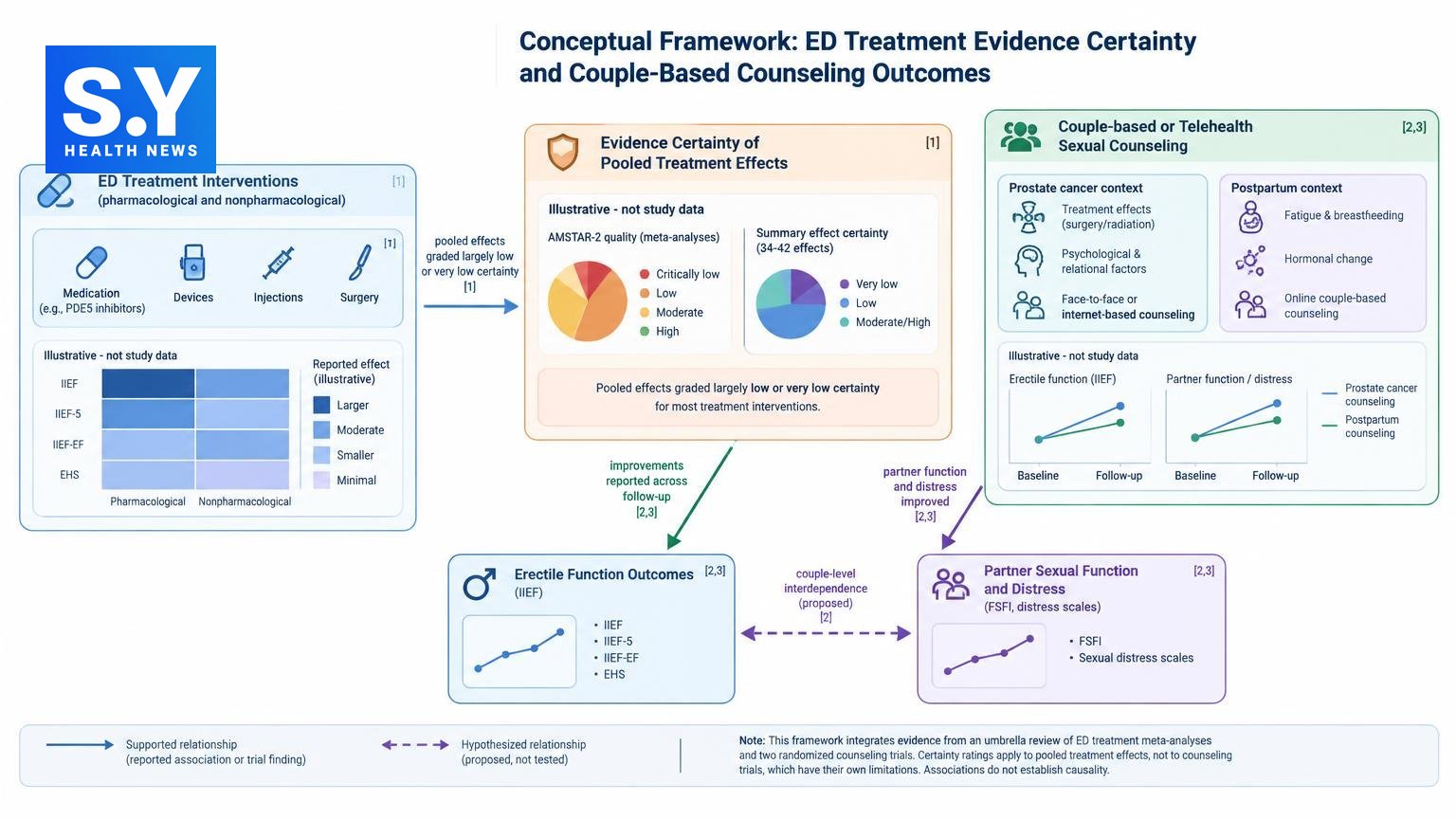
Conceptual framework: Conceptual framework. Evidence from an umbrella review of ED treatment meta-analyses and two randomized counseling trials is mapped to intervention, certainty and couple-level outcome constructs. Supported links reflect reported associations or trial findings; the couple-interdependence link is proposed. Certainty ratings apply to pooled treatment effects, not to counseling trials, which have their own limitations.
Academic References & Evidence
- Current treatment for erectile dysfunction: an umbrella review of systematic reviews and meta-analyses. 2026 DOI: 10.6084/m9.figshare.31562993.v1.
- Leslie R. Schover; Andrea L. Canada; Ying Yuan; Dawen Sui; Leah Neese; Rosell Jenkins; Michelle M. Rhodes. A randomized trial of internet-based versus traditional sexual counseling for couples after localized prostate cancer treatment. Cancer. 2012 118(2):500-509 DOI: 10.1002/cncr.26308.
- Tele-Sexual Counseling Improved Sexual Function and Reduced Sexual Distress in Postpartum Women and Their Spouses: A Randomized Controlled Trial-学者服务. Journal of Sex & Marital Therapy. 2026 :1-17 DOI: 10.1080/0092623X.2026.2699265.
SANYUN Science Center explains published research on men's reproductive and sexual health, connecting scientific evidence with everyday questions while making sources and limitations clear.
Disclaimer: This article is for scientific education and research communication only. It does not provide medical advice, diagnosis, or individualized treatment recommendations, and does not endorse any medication, supplement, device, penile enlargement procedure, or other intervention. Decisions about sexual and reproductive health should be made in consultation with a qualified healthcare professional. Do not delay seeking professional care because of information in this article.
Original Content & Copyright Notice
- This article is prepared for SANYUN Science Center, drawing on published research and publicly available academic literature on men’s sexual and reproductive health. Its editorial explanations and presentation are developed for this platform.
- Copyright in the original editorial content, selection, and arrangement is reserved by SANYUN Science Center to the extent protected by applicable law. Referenced research, quotations, and third-party materials remain subject to the rights of their respective owners. This notice does not claim ownership of scientific facts or third-party research.
- Except where permitted by applicable law or an applicable license, prior written permission is required to reproduce, republish, translate, adapt, redistribute, or commercially reuse protected content. Attribution alone does not grant permission for such reuse.
- For permitted quotation or authorized reuse, clearly identify the source and retain a link to the original article.
- Source: SANYUN Science Center
- Original URL: Retain the original article URL on science.san-yun.com.
- Copyright Holder: SANYUN Science Center, for its own protected editorial content.
- Quotation, excerpts, or authorized reuse must not distort the scientific meaning, omit material limitations or disclaimers, or imply unverified medical claims, product efficacy, or endorsement by SANYUN Science Center.



