




Category: Erectile Dysfunction
Core Research Direction: How strong is the evidence base for current erectile dysfunction treatments, and what does nocturnal penile tumescence and rigidity monitoring contribute to distinguishing psychogenic from organic ED?
Search Intent: How reliable is the clinical evidence behind today's range of erectile dysfunction treatments, and how useful is RigiScan nocturnal monitoring for identifying psychogenic erectile dysfunction?
Platform: SANYUN Science Center
Evidence reviewed through: 2026-11-16
Executive Summary
Two complementary lines of evidence frame how clinicians should think about erectile dysfunction (ED) in 2026. The first concerns treatment: a 2026 umbrella review of systematic reviews and meta-analyses covering literature published up to October 2025 concluded that the evidence base for current ED treatments is predominantly of low or very low quality, despite statistically significant improvements with both pharmacological and nonpharmacological interventions.[1]
The second concerns diagnosis. A 2019 narrative review concluded that nocturnal penile tumescence and rigidity (NPTR) monitoring with RigiScan remains a useful method for identifying psychogenic ED: a normal recording in a man with ED complaints probably suggests psychogenic ED, while an abnormal recording may represent organic ED. The same review, however, identified unresolved disputes about how well radial rigidity tracks axial rigidity, how well NPTR corresponds to sexually stimulated erection, and whether normal findings truly exclude organic disease in every population.[2]
Read together, these papers make a simple point. Statistical significance is not the same as high certainty, and a supportive diagnostic test is not the same as a definitive one. Both conclusions matter for how men are counselled and how research priorities are set.
Why This Matters
ED is common, treatable and frequently linked to broader cardiometabolic health, so the reliability of its evidence base has consequences beyond the bedroom. When a treatment landscape expands faster than its underpinning trials, patients may be offered options whose short-term scores look favourable but whose comparative and long-term performance is uncertain. The umbrella review makes this explicit: the treatment landscape is increasingly diverse, yet the reliability of the evidence is poor, and the authors call for well-designed single-treatment studies and high-quality head-to-head meta-analyses.
On the diagnostic side, the psychogenic-versus-organic distinction shapes referral, investigation and expectations. A test that appears to confirm a psychological cause could short-circuit a search for vascular, neurological or hormonal contributors, or could reassure a man inappropriately. Understanding what NPTR monitoring can and cannot establish is therefore a practical clinical skill, not an academic footnote.
Mechanism: How Nocturnal Erections and Psychogenic ED Are Understood
NPTR monitoring rests on the observation that erections occur during sleep, largely independent of waking psychological state. If a man reports erectile difficulty with a partner but records normal tumescence and rigidity overnight, the reasoning is that the vascular and neural machinery can still produce an erection, pointing toward a psychogenic contribution. Conversely, absent or reduced nocturnal activity may suggest an organic cause. The review frames this logic while cautioning that it is probabilistic rather than absolute.
The review also complicates the label "psychogenic." It states that psychogenic ED arises not only from psychosocial factors but also from physiological changes including central nervous system abnormality. In other words, the psychogenic-organic dichotomy is a clinical convenience rather than a clean biological partition, and a purely psychological explanation may coexist with measurable central mechanisms.
What the Treatment Evidence Shows
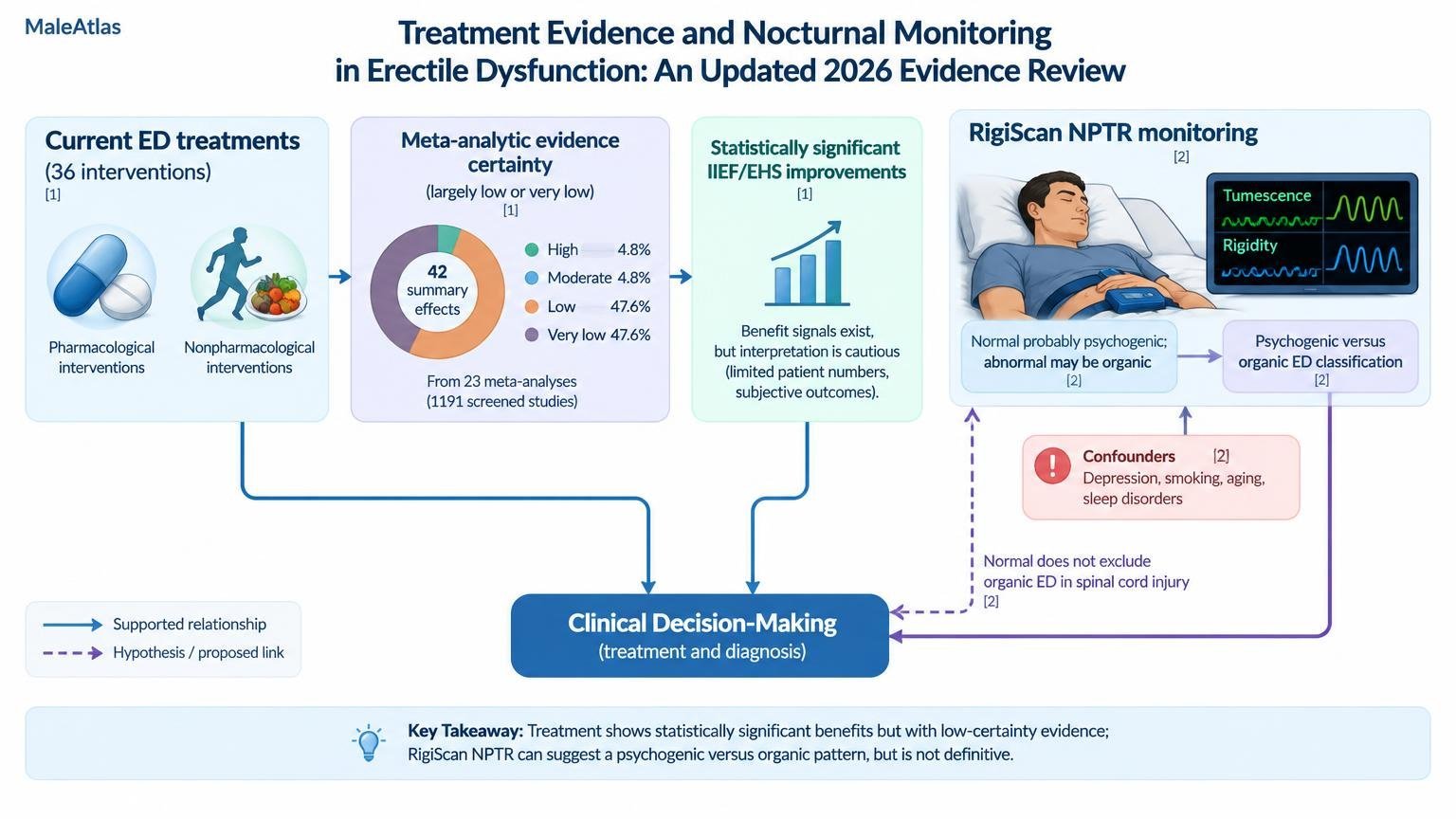
The umbrella review screened 1191 studies and extracted 23 published meta-analyses, yielding 42 summary effects across the International Index of Erectile Function (IIEF), its five-item version (IIEF-5), the erectile function domain (IIEF-EF) and the erectile hardness score (EHS). These summary effects covered 36 interventions, spanning the pharmacological and nonpharmacological range that contemporary guidelines discuss.
The quality picture is sobering. Applying AMSTAR-2 to the included meta-analyses, 13 of 23 (56.5%) were rated critically low quality, 7 (30.5%) low, 2 (8.7%) moderate and 1 (4.3%) high. When the 42 summary effects themselves were graded, only two were rated high and moderate quality respectively, while 20 (47.6%) were low and 20 (47.6%) very low.
This does not mean treatments do not work. The review reports statistically significant improvements in ED with both pharmacological and nonpharmacological interventions. The caveat is interpretive: limited patient numbers and the subjective nature of outcome indicators mean the pooled effects should be read cautiously. Patient-reported erectile function scores are meaningful, but they are not hard clinical endpoints, and small pooled samples amplify the influence of individual trials.
| Variable | Source-grounded definition | Interpretation |
|---|---|---|
| Meta-analyses included | 23 published meta-analyses extracted from 1191 screened studies | Breadth of the literature is substantial, but breadth is not the same as quality |
| Summary effects | 42 effects covering 36 interventions across IIEF, IIEF-5, IIEF-EF and EHS endpoints | Many interventions are represented, but endpoint heterogeneity limits pooling |
| AMSTAR-2 ratings of reviews | 13 critically low (56.5%), 7 low (30.5%), 2 moderate (8.7%), 1 high (4.3%) | Most contributing reviews had serious methodological limitations |
| Certainty of summary effects | 20 low (47.6%), 20 very low (47.6%), 2 higher quality | Statistically significant pooled effects often rest on low-certainty evidence |
| Direction of findings | Statistically significant improvements with pharmacological and nonpharmacological interventions | Benefit signals exist, but certainty and sample size constrain confidence |
What the Nocturnal Monitoring Evidence Shows
The NPTR review is a comprehensive English-language literature search rather than a pooled analysis, so its conclusions are qualitative. Within that limit, it supports a probabilistic interpretation: a normal recording in a man with ED complaints probably suggests psychogenic ED, and an abnormal recording may represent organic ED. The word "probably" is doing real work here.
Two technical issues limit how far a recording can be trusted. First, radial rigidity of 60% or less correlates well with axial rigidity, but above 60% that correlation is questioned, meaning the device's rigidity signal may be least reliable precisely in the higher range that matters for judging functional adequacy. Second, the consistency between NPTR and sexually stimulated erection is questionable, and NPTR correlates differently with different patient-reported outcome scoring systems.
False reassurance is a recognised concern. A normal NPTR recording in patients with ED does not necessarily mean psychogenic ED, especially in patients with spinal cord injury, where preserved reflex nocturnal activity may coexist with severely impaired erectile function in other contexts.
Recordings are also vulnerable to confounders. The review lists depression, smoking, aging, negative dream content and sleep disorders as influences on NPTR results. These are not trivial artefacts: they overlap heavily with the populations in whom the psychogenic-organic question is hardest to answer, and they mean an abnormal tracing cannot be assumed to reflect penile vascular disease alone.
Interpretation and Limitations
The contrast between the two bodies of evidence is instructive. Treatment research has volume but uneven rigour: many meta-analyses exist, yet most are rated critically low or low, and almost all summary effects carry low or very low certainty. Diagnostic research on NPTR has the opposite shape: a focused, mechanistically plausible test supported by a narrative synthesis, with unresolved questions about measurement validity, ecological validity and normative thresholds. Neither body of evidence is strong enough to justify confident, unqualified claims.
Several specific limitations deserve emphasis. The umbrella review's quality ratings describe the reviews it included, not the primary trials directly, and the review itself is a summary of summaries, so errors and biases can compound across layers. Its endpoint set is patient-reported or semi-objective, with no hard clinical outcomes such as pregnancy, treatment discontinuation or cardiovascular events. The NPTR review is narrative, with no pooled sensitivity or specificity estimates and no quantified false-positive rate.
There is also a conceptual limitation. Both papers treat "psychogenic" and "organic" as useful categories while undercutting their sharpness. The NPTR review explicitly notes central nervous system contributions to psychogenic ED, and the confounders it lists overlap with organic risk factors. A normal or abnormal nocturnal recording therefore informs clinical reasoning; it does not adjudicate causation.
Research Outlook
The most direct research implication comes from the umbrella review's recommendation: well-designed studies of single treatments, plus high-quality meta-analyses comparing treatments head to head, are urgently needed. That agenda would address the core weakness identified here, namely that statistical significance has been achieved more often than methodological certainty.
For NPTR, the open questions are more specific. The relationship between radial and axial rigidity above 60% needs clarification, the correspondence between nocturnal and sexually stimulated erection needs prospective evaluation, normative criteria need standardisation, and the false-negative problem in populations such as spinal cord injury needs quantification. Until then, NPTR is best understood as one input among several, interpreted alongside history, examination, cardiovascular risk assessment and, where appropriate, hormonal testing.
Key Takeaways
- A 2026 umbrella review covering literature to October 2025 extracted 23 meta-analyses and 42 summary effects on 36 ED interventions, but rated most contributing reviews and most summary effects as low or very low quality.
- Statistically significant improvements were reported for both pharmacological and nonpharmacological ED treatments, yet the authors urge caution because of limited patient numbers and subjective outcome measures.
- RigiScan NPTR monitoring is still considered useful for diagnosing psychogenic ED: normal recordings probably suggest psychogenic ED and abnormal recordings may indicate organic ED, but the evidence is narrative rather than quantitatively pooled.
- Radial-axial rigidity correlation is questioned above 60% radial rigidity, and a normal NPTR recording does not necessarily confirm psychogenic ED, particularly after spinal cord injury.
- Depression, smoking, aging, negative dream content and sleep disorders can all influence NPTR recordings, so abnormal tracings should not be read as isolated markers of vascular disease.
Questions and Answers
What is nocturnal penile tumescence and rigidity monitoring used for in erectile dysfunction?
NPTR monitoring with RigiScan records erections during sleep to help distinguish psychogenic from organic ED. A normal recording in a man with ED complaints probably suggests psychogenic ED, while an abnormal recording may represent organic ED. However, the supporting review is narrative and cautions that the test is probabilistic, vulnerable to confounders and not definitive in all populations, including men with spinal cord injury.
How strong is the evidence for current erectile dysfunction treatments?
A 2026 umbrella review covering literature to October 2025 found the evidence predominantly low or very low quality. Of 23 included meta-analyses, 13 were rated critically low by AMSTAR-2, and of 42 summary effects, 20 were low and 20 very low certainty. Statistically significant improvements were still reported for pharmacological and nonpharmacological treatments, but the authors urge cautious interpretation.
Does a normal RigiScan result always mean erectile dysfunction is psychogenic?
No. The NPTR review states that a normal recording in patients with ED does not necessarily mean psychogenic ED, especially in patients with spinal cord injury. Recordings can also be influenced by depression, smoking, aging, negative dream content and sleep disorders. A normal tracing is therefore supportive context for clinical reasoning, not a stand-alone confirmation of a psychological cause.
Why is radial rigidity above 60 percent questioned in NPTR interpretation?
The review reports that radial rigidity of 60% or less correlates well with axial rigidity, but above 60% the correlation between the two is questioned. Since higher rigidity values are clinically important for judging whether an erection is functionally adequate, this measurement uncertainty limits how confidently a high-range reading can be interpreted on its own.
What limits the umbrella review of erectile dysfunction treatments?
It summarises meta-analyses rather than primary trials, so limitations compound across layers. Its endpoints are patient-reported or semi-objective, sample sizes in contributing reviews were limited, and the review itself calls for better single-treatment trials and head-to-head comparisons. The quality ratings describe the included reviews, not the underlying trials directly, so the conclusions should be read as a map of uncertainty rather than a verdict on any single therapy.
Can psychogenic erectile dysfunction involve physiological mechanisms?
Yes. The NPTR review states that psychogenic ED results not only from psychosocial factors but also from physiological changes including central nervous system abnormality. This means the psychogenic-organic distinction is a clinical convenience rather than a clean biological boundary, and a diagnosis of psychogenic ED should not be taken to imply that no measurable physiological processes are involved.
Conceptual framework: Conceptual framework. The figure maps how current ED treatments connect to largely low-certainty meta-analytic evidence and statistically significant but cautiously interpreted improvements, alongside how RigiScan NPTR recordings inform psychogenic versus organic classification. Supported links reflect review conclusions; the dashed-level caveat about spinal cord injury is proposed nuance, not proven test performance.
Academic References & Evidence
- Current treatment for erectile dysfunction: an umbrella review of systematic reviews and meta-analyses. Figshare. 2026 DOI: 10.6084/m9.figshare.31562993.v1.
- Zijun Zou; Haocheng Lin; Yan Zhang; Run Wang. The Role of Nocturnal Penile Tumescence and Rigidity (NPTR) Monitoring in the Diagnosis of Psychogenic Erectile Dysfunction: A Review. Sexual Medicine Reviews. 2019 7(3):442-454 DOI: 10.1016/j.sxmr.2018.10.005.
SANYUN Science Center explains published research on men's reproductive and sexual health, connecting scientific evidence with everyday questions while making sources and limitations clear.
Disclaimer: This article is for scientific education and research communication only. It does not provide medical advice, diagnosis, or individualized treatment recommendations, and does not endorse any medication, supplement, device, penile enlargement procedure, or other intervention. Decisions about sexual and reproductive health should be made in consultation with a qualified healthcare professional. Do not delay seeking professional care because of information in this article.
Original Content & Copyright Notice
- This article is prepared for SANYUN Science Center, drawing on published research and publicly available academic literature on men’s sexual and reproductive health. Its editorial explanations and presentation are developed for this platform.
- Copyright in the original editorial content, selection, and arrangement is reserved by SANYUN Science Center to the extent protected by applicable law. Referenced research, quotations, and third-party materials remain subject to the rights of their respective owners. This notice does not claim ownership of scientific facts or third-party research.
- Except where permitted by applicable law or an applicable license, prior written permission is required to reproduce, republish, translate, adapt, redistribute, or commercially reuse protected content. Attribution alone does not grant permission for such reuse.
- For permitted quotation or authorized reuse, clearly identify the source and retain a link to the original article.
- Source: SANYUN Science Center
- Original URL: Retain the original article URL on science.san-yun.com.
- Copyright Holder: SANYUN Science Center, for its own protected editorial content.
- Quotation, excerpts, or authorized reuse must not distort the scientific meaning, omit material limitations or disclaimers, or imply unverified medical claims, product efficacy, or endorsement by SANYUN Science Center.



