




Category: Erectile Dysfunction
Core Research Direction: Evidence quality, comparative effectiveness, and procedural outcomes in the treatment of erectile dysfunction, with attention to predictors of penile prosthesis infection and satisfaction
Search Intent: How reliable is the evidence behind current erectile dysfunction treatments, and what does long-term penile prosthesis experience show about infection risk and satisfaction?
Platform: SANYUN Science Center
Evidence reviewed through: 2026-11-25
Executive Summary
Erectile dysfunction (ED) sits in an unusual position in men's health: it has a large and expanding treatment menu, broad guideline endorsement of shared decision-making across modalities, and a mechanism story (nitric oxide signalling, cGMP, vascular and neural integrity) that is well accepted. What it does not consistently have is high-quality comparative evidence. An umbrella review that screened 1191 publications and extracted 23 meta-analyses found that 56.5% of those reviews were of critically low methodological quality, that only two of 42 summary effects were graded high or moderate, and that the overall treatment evidence base is predominantly low or very low quality, despite statistically significant improvements with both pharmacological and nonpharmacological interventions.[1]
At the surgical end of the spectrum, a ten-year single-center series provides concrete procedural outcomes rather than comparative efficacy. Among 549 men who underwent 576 penile prosthesis placements between 2008 and 2018, early prosthetic infection occurred in 35 placements (6.1%) with an explant rate of 3.1%. Patient satisfaction was 82.0% and partner satisfaction 88.3%. Univariate associations linked diabetes, longer operative time and reinterventions to infection, while postoperative ciprofloxacin was inversely associated; multivariate analysis found roughly two-fold higher infection risk with diabetes, redo surgery or use of a rifampin/gentamicin-coated 3-piece inflatable device. The authors propose a predictive nomogram for preoperative counselling, but it is not externally validated.[2]
Together, these sources frame two different evidence problems. The umbrella review is a map of uncertainty: many interventions, many significant effect estimates, uncertain reliability. The prosthesis cohort is a map of local, observed outcomes: useful for benchmarks and risk conversations, but limited by retrospective single-center design, unstated denominators and confounding by indication. Neither establishes that one ED treatment is superior to another, and neither substitutes for adequately powered randomized comparisons.
Why This Matters
ED is common and increasingly treated as a marker of systemic vascular risk rather than a standalone sexual complaint. A source summarising a 2021 umbrella review reports that men with ED have higher relative risks of cardiovascular disease (RR 1.45, 95% CI 1.36-1.54), coronary heart disease (RR 1.50), cardiovascular mortality (RR 1.50), myocardial infarction (RR 1.55), stroke (RR 1.36) and all-cause mortality (RR 1.25), all with P less than 0.001. These are observational associations, not evidence that ED causes cardiac events, but they shape how clinicians frame the initial consultation.[3]
At the same time, treatment decisions rest on an evidence base whose quality has now been formally appraised as weak. That matters clinically in two directions. First, a statistically significant IIEF improvement in a meta-analysis does not guarantee that a given intervention reliably changes a given man's function or satisfaction. Second, low certainty does not mean no effect; it means the estimate is fragile to bias, small samples, subjective endpoints and industry sponsorship. Reviews that grade certainty help distinguish a promising option from a proven one, a distinction patients rarely hear stated plainly.
Penile prosthesis surgery is the irreversible endpoint of the treatment ladder and is often chosen after other options have failed. Infection is its most consequential early complication because it can require explantation and additional surgery. Reliable local outcome data and honest predictor estimates are therefore directly useful for informed consent and for setting expectations about satisfaction as well as risk.
Biological and Clinical Mechanism
The core mechanism of erection is vasogenic. Sexual stimulation triggers nitric oxide release in penile arteries; nitric oxide activates guanylate cyclase, raising cyclic GMP, which relaxes cavernosal smooth muscle and permits blood inflow. Phosphodiesterase type 5 (PDE5) breaks down cGMP, so PDE5 inhibitors amplify a signal that still requires sexual stimulation. Disruption anywhere in this chain, whether endothelial dysfunction and atherosclerosis, diabetic or surgical nerve injury, hormonal deficiency or psychological interference, can produce ED. The review packet's secondary clinical guide frames ED as often the earliest clinical expression of systemic vascular disease because penile arteries are substantially smaller than coronary arteries; that framing is biologically plausible and consistent with the observed associations, but it is an interpretive framework rather than a randomized causal finding.
Prosthesis infection has a different mechanistic logic. It is a device-related surgical infection influenced by host factors (diabetes, prior surgery), operative factors (duration, reintervention) and device factors. In the ten-year cohort, diabetes, longer operative time and reinterventions were associated with early prosthetic infection, and the multivariable model found roughly two-fold higher risk with diabetes, redo surgery or a rifampin/gentamicin-coated 3-piece inflatable prosthesis. The coated-device signal is counterintuitive and should not be read as evidence that coating is harmful; coated devices are likely selected for higher-risk cases, and observational adjustment cannot fully remove that confounding by indication.
What the Evidence Shows: Treatment Efficacy and Its Quality
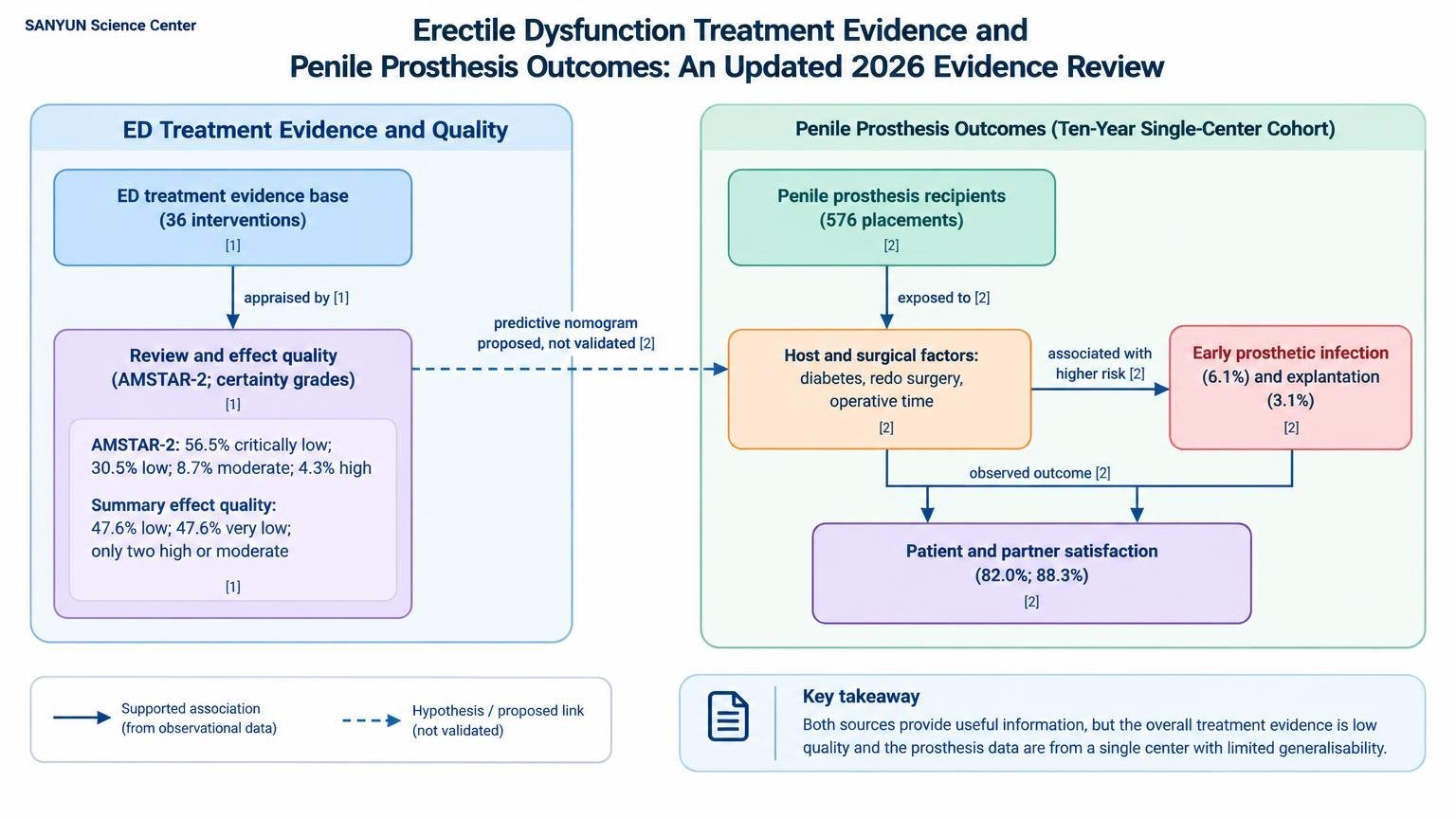
The umbrella review searched PubMed, Web of Science, the Cochrane Library and Embase through October 2025 and extracted 23 published meta-analyses from 1191 screened studies, yielding 42 summary effects across 36 interventions measured with the IIEF, IIEF-5, IIEF-EF and erectile hardness score. Its quality appraisal is the central result: 13 of 23 meta-analyses (56.5%) were critically low on AMSTAR-2, 7 (30.5%) low, 2 (8.7%) moderate and 1 (4.3%) high. At the level of summary effects, only two of 42 were graded high or moderate, while 20 (47.6%) were low and 20 (47.6%) very low. The authors conclude the evidence base is predominantly low or very low quality and call for better-designed single-treatment studies and high-quality head-to-head meta-analyses.
This is not a null result. Statistically significant improvements were observed with both pharmacological and nonpharmacological interventions, but the review cautions that these findings are limited by small patient numbers and the subjective nature of outcome indicators such as symptom scores and hardness ratings. The practical implication is that effect direction is often more secure than effect size, and that comparisons between active treatments are especially weak because few reviews perform rigorous intertreatment comparisons.
The secondary clinical guide adds several modality-specific estimates that illustrate both promise and fragility. It reports that a 2025 Cochrane review of 21 randomized trials (1,357 men) found low-intensity shockwave therapy may improve IIEF-EF scores by roughly 3.9 points short-term and 5.3 points long-term versus sham, with low certainty and several industry-funded trials. It also reports that a 2023 meta-analysis found aerobic exercise improved IIEF-EF by about 2.8 points, and that a 2023 meta-analysis of 8 studies (457 patients) found higher post-treatment IIEF-5 scores with sildenafil than with CPAP (37.7 versus 27.3) in men with ED and obstructive sleep apnea. These are secondary-source summaries; their numbers should be treated as indicative and their comparative claims as hypothesis-generating rather than settled.
Hormonal and metabolic contexts complicate the picture further. The guide reports that in TRAVERSE (5,246 hypogonadal men with preexisting or high cardiovascular risk), transdermal testosterone was noninferior to placebo for major adverse cardiac events (HR 0.96, 95% CI 0.78-1.17) over a mean 21.7 months, with atrial fibrillation, acute kidney injury and pulmonary embolism more common in the testosterone group. It also reports that a 2024 TriNetX analysis of 3,094 non-diabetic, non-hypogonadal men aged 18-50 using semaglutide for weight loss found higher rates of new ED diagnosis or PDE5 inhibitor prescription (1.47 versus 0.32%) and testosterone deficiency (1.53 versus 0.80%) than matched non-users, though absolute rates were low and a database design cannot establish causation. These findings argue for phenotype-specific interpretation rather than a single verdict on any drug class.
| Outcome | Reported result | Population and design | Interpretation |
|---|---|---|---|
| Meta-analysis quality (AMSTAR-2) | 56.5% critically low; 30.5% low; 8.7% moderate; 4.3% high | 23 published meta-analyses on ED treatments, searched to October 2025 | Review-level methodology is generally weak; confidence in pooled estimates is limited |
| Summary effect quality | 47.6% low; 47.6% very low; only two high or moderate | 42 summary effects across 36 interventions | Most treatment effects are fragile to bias and small samples |
| Early prosthetic infection | 6.1% of placements | 576 prosthesis placements, single tertiary center, 2008-2018 | Descriptive local benchmark; not a comparative treatment effect |
| Explant rate | 3.1% | Same ten-year cohort | Most infections were managed without explantation in this series |
| Patient satisfaction | 82.0% | Prosthesis recipients with recorded satisfaction | High satisfaction but denominator and method not stated |
| Partner satisfaction | 88.3% | Partners of prosthesis recipients | High reported partner satisfaction; assessment method not described |
What the Evidence Shows: Prosthesis Infection and Satisfaction
The ten-year cohort provides a usable procedural benchmark. Across 576 placements in 549 men, early prosthetic infection occurred in 35 cases (6.1%), and the explant rate was 3.1%. In univariate analyses, diabetes (P = 0.012), longer operative time (P = 0.032) and reinterventions (P = 0.048) were associated with infection risk, while postoperative ciprofloxacin was inversely associated (P = 0.014). The rifampin/gentamicin-coated 3-piece inflatable prosthesis showed a higher infection risk in univariate analysis (P = 0.019). Multivariable analysis found roughly two-fold higher risk of early infection with diabetes, redo surgery, or coated-device use (all P < 0.03), and the authors note that coated devices had higher infection rates without an increased risk of explantation.
Satisfaction outcomes were favourable: 82.0% of patients described themselves as satisfied and partner satisfaction was 88.3%. These figures carry important caveats. The supplied text does not state the denominator, the response rate or the instrument used, and satisfaction in a retrospective single-center series is vulnerable to selection and recall effects. Men who consented to long-term follow-up and remained in contact may differ from those who did not. The numbers are therefore credible benchmarks for counselling, not precise population estimates or proof of superiority over alternative treatments.
The hypothesis that a nomogram could support preoperative counselling is explicitly conditional. The authors developed a predictive model and state that, after further validation, it could be a useful counselling tool. As presented, it is a single-center derivation without external validation, so it should not yet be used to quantify individual risk in routine practice. It does, however, illustrate the right direction: moving from a list of risk factors to a calibrated, externally tested prediction tool.
Interpretation and Limitations
The umbrella review and the prosthesis cohort answer different questions and should not be merged into a single ranking. The review addresses whether the literature, taken as a whole, supports the effectiveness of treatments across modalities; its answer is that statistically significant effects are common but evidentially fragile, with a majority of included meta-analyses rated critically low and nearly half of summary effects rated very low. The cohort addresses what happened to a defined surgical population at one centre; its answer is that infection clustered around identifiable clinical factors and that satisfaction was high. Neither design supports a causal claim that any specific intervention reduces infection or improves satisfaction relative to another.
Several limitations deserve emphasis. The umbrella review is restricted to published meta-analyses and inherits their methodological flaws; the quality ratings describe review conduct and effect-level certainty, not the truth of every underlying trial. The cohort is retrospective, single-center and drawn from a tertiary referral population, which may concentrate complex or redo cases and limit generalisability. Denominators for some outcomes are not stated, and the coated-device association is especially vulnerable to confounding by indication, since surgeons may preferentially use coated implants in patients perceived to be at higher infection risk.
Statistical versus clinical significance is a recurring theme. A 2.8-point IIEF-EF improvement from aerobic exercise or a 3.9-point short-term shockwave effect may be statistically detectable in a meta-analysis while remaining below the threshold that many men would notice as meaningful, and the minimum clinically important difference is not established in the supplied evidence. Conversely, a 6.1% infection rate is clinically meaningful, but without a comparator it describes rather than compares. The secondary-guide estimates for shockwave therapy, exercise, CPAP and GLP-1 effects should be read as summaries of summaries, with the original trials' certainty ratings and sponsorship patterns doing much of the interpretive work.
Research Outlook
The clearest research priority is comparative rather than additive. The umbrella review's authors explicitly recommend well-designed single-treatment studies and high-quality meta-analyses of intertreatment comparisons. That means randomized or rigorously controlled head-to-head trials with prespecified clinically meaningful endpoints, adequate sample sizes and transparent reporting of sponsorship, rather than further single-arm series or reviews of reviews. For surgical outcomes, the priority is external validation of infection prediction models across centres and device types, with prospective data collection and clear definitions of infection and explantation.
Several mechanistic and clinical questions remain open. The coated-device infection signal requires prospective, indication-adjusted study before any causal interpretation is offered. The interaction between metabolic treatments, testosterone and erectile function appears phenotype-dependent, and the available database and pilot evidence cannot resolve direction of effect. The relationship between ED and cardiovascular risk is well described observationally but does not by itself establish that treating ED modifies cardiac outcomes; that question requires outcome trials, not association studies.
Key Takeaways
- An umbrella review of 23 meta-analyses found 56.5% rated critically low quality on AMSTAR-2 and only two of 42 summary effects graded high or moderate; the ED treatment evidence base is predominantly low or very low quality.
- Statistically significant improvements were reported with both pharmacological and nonpharmacological interventions, but small samples and subjective endpoints limit confidence and do not establish comparative superiority.
- In a ten-year series of 576 prosthesis placements, early infection occurred in 6.1% and explantation in 3.1%, with 82.0% patient and 88.3% partner satisfaction.
- Diabetes, redo surgery and longer operative time were associated with early infection; the coated-device association is confounded by indication and should not be read causally.
- A prosthesis infection nomogram has been proposed but not externally validated, so it is a research direction rather than a clinical tool at this stage.
Questions and Answers
What does the 2026 umbrella review of erectile dysfunction treatments actually find about evidence quality?
It extracted 23 meta-analyses from 1191 screened publications and rated 13 (56.5%) critically low quality on AMSTAR-2, with only one high-quality review. At the summary-effect level, only two of 42 were graded high or moderate, and 20 (47.6%) were low and 20 (47.6%) very low, supporting its conclusion that ED treatment evidence is predominantly low or very low quality.
How common is early penile prosthesis infection and what factors predict it in the ten-year cohort?
Early prosthetic infection occurred in 35 of 576 placements (6.1%), with a 3.1% explant rate. Diabetes, longer operative time and reinterventions were associated in univariate analysis; the multivariable model found roughly two-fold higher risk with diabetes, redo surgery or a rifampin/gentamicin-coated 3-piece inflatable device. The coated-device signal may reflect confounding by indication rather than a harmful coating effect.
How satisfied are men and partners after penile prosthesis implantation?
In the ten-year single-center cohort, 82.0% of patients described themselves as satisfied and partner satisfaction was 88.3%. These are favourable but imprecise benchmarks: the supplied text does not state the denominator, response rate or assessment instrument, and retrospective follow-up may over-represent men with good outcomes.
Do low-intensity shockwave therapy and aerobic exercise really improve erectile function?
A secondary clinical guide reports that a 2025 Cochrane review of 21 randomized trials (1,357 men) found low-intensity shockwave therapy may improve IIEF-EF scores by about 3.9 points short-term and 5.3 points long-term versus sham, with low certainty and industry funding in several trials. It also reports a 2.8-point IIEF-EF gain from aerobic exercise in a 2023 meta-analysis. These are indicative rather than definitive.
Does erectile dysfunction increase cardiovascular risk, and is that association causal?
A source summarising a 2021 umbrella review reports elevated relative risks in men with ED for cardiovascular disease (RR 1.45, 95% CI 1.36-1.54), coronary heart disease (RR 1.50), myocardial infarction (RR 1.55), stroke (RR 1.36) and all-cause mortality (RR 1.25), all P less than 0.001. These are robust observational associations, not proof of causation, and do not show that treating ED alters cardiac outcomes.
Why can't the treatment evidence simply be pooled into a single best erectile dysfunction option?
Because most reviews are methodologically weak and few compare active treatments directly. The umbrella review rated over half of included meta-analyses critically low, found nearly half of summary effects very low quality, and explicitly called for better single-treatment trials and high-quality head-to-head meta-analyses. Differences in populations, endpoints and sponsorship further limit cross-modality ranking.
Conceptual framework: Conceptual framework. The left grouping represents an umbrella review of 23 meta-analyses across 36 ED interventions and its quality appraisal; the right grouping represents a ten-year single-center cohort of 576 prosthesis placements with infection predictors and satisfaction. Arrows show supported associations and one proposed, unvalidated prediction tool. The framework is conceptual, not a tested causal model; both sources are observational and single-center surgical data have limited generalisability.
Academic References & Evidence
- Current treatment for erectile dysfunction: an umbrella review of systematic reviews and meta-analyses. 2026 DOI: 10.6084/m9.figshare.31562993.v1.
- 1. Ten-year experience with penile prosthetic surgery for the treatment of erectile dysfunction: outcomes of a tertiary referral center and predictors of early prosthetic infection..
- Parth Bhavsar. Erectile Dysfunction. 2026
SANYUN Science Center explains published research on men's reproductive and sexual health, connecting scientific evidence with everyday questions while making sources and limitations clear.
Disclaimer: This article is for scientific education and research communication only. It does not provide medical advice, diagnosis, or individualized treatment recommendations, and does not endorse any medication, supplement, device, penile enlargement procedure, or other intervention. Decisions about sexual and reproductive health should be made in consultation with a qualified healthcare professional. Do not delay seeking professional care because of information in this article.
Original Content & Copyright Notice
- This article is prepared for SANYUN Science Center, drawing on published research and publicly available academic literature on men’s sexual and reproductive health. Its editorial explanations and presentation are developed for this platform.
- Copyright in the original editorial content, selection, and arrangement is reserved by SANYUN Science Center to the extent protected by applicable law. Referenced research, quotations, and third-party materials remain subject to the rights of their respective owners. This notice does not claim ownership of scientific facts or third-party research.
- Except where permitted by applicable law or an applicable license, prior written permission is required to reproduce, republish, translate, adapt, redistribute, or commercially reuse protected content. Attribution alone does not grant permission for such reuse.
- For permitted quotation or authorized reuse, clearly identify the source and retain a link to the original article.
- Source: SANYUN Science Center
- Original URL: Retain the original article URL on science.san-yun.com.
- Copyright Holder: SANYUN Science Center, for its own protected editorial content.
- Quotation, excerpts, or authorized reuse must not distort the scientific meaning, omit material limitations or disclaimers, or imply unverified medical claims, product efficacy, or endorsement by SANYUN Science Center.



