




Category: Erectile Dysfunction
Core Research Direction: What is the quality and consistency of systematic review evidence underpinning current erectile dysfunction treatments (PDE5 inhibitors, lifestyle, devices), and how do trial designs and patient populations limit applicability?
Search Intent: How strong is the evidence base behind the erectile dysfunction treatments that guidelines call first-line, and what should readers weigh when interpreting that evidence?
Platform: SANYUN Science Center
Evidence reviewed through: 2026-11-11
Executive Summary
Erectile dysfunction (ED) treatment guidelines describe phosphodiesterase type 5 (PDE5) inhibitors, lifestyle modification and mechanical devices as established options. A question that receives less attention is how strong the underlying evidence actually is. A 2026 umbrella review set out to summarize the effectiveness of current ED treatments and to appraise the quality of that evidence.[1]
The review searched PubMed, Web of Science, the Cochrane Library and Embase for studies published up to October 2025. From 1191 screened studies it extracted 23 published meta-analyses, which together yielded 42 summary effects covering 36 interventions. Effectiveness was measured with the International Index of Erectile Function (IIEF) or its simplified versions and the erectile hardness score (EHS).
The quality picture was poor. Under AMSTAR-2 appraisal, 13 of 23 meta-analyses (56.5%) were rated critically low, 7 (30.5%) low, 2 (8.7%) moderate and 1 (4.3%) high. At the level of individual summary effects, only two of 42 were rated high or moderate quality, while 20 (47.6%) were low and 20 (47.6%) very low. The authors concluded that the evidence base for ED treatments is predominantly of low or very low quality.
Statistically significant improvements were observed for both pharmacological and nonpharmacological interventions, but the authors urged caution because of limited patient numbers and the subjective nature of the outcome instruments. In practical terms, the direction of benefit is reasonably consistent while the precision, comparability and certainty of that benefit remain modest.
Why This Matters
ED is common and treatable, and guidelines place PDE5 inhibitors at the front of pharmacological therapy. Confidence in that recommendation rests less on any single landmark trial than on an accumulation of meta-analyses pooled across many small studies. An umbrella review is therefore a useful stress test: it asks whether the pooled evidence itself was assembled to a high standard, not merely whether pooled effects reached significance.[2]
The distinction matters clinically. A statistically significant mean change on a questionnaire can be real and still be imprecisely estimated, inconsistently measured across trials, or drawn from populations that differ from the patient in front of a clinician. Understanding this layering helps readers interpret guideline language such as first-line without assuming that the evidence beneath it is uniformly robust.
The Biological and Clinical Context of Treatment
An erection depends on coordinated nerve signaling, vascular relaxation and hormonal and psychological input. Sexual stimulation triggers nitric oxide release, which raises cyclic GMP and relaxes penile arterial smooth muscle so that blood fills the corpora cavernosa. PDE5 inhibitors block the enzyme that degrades cyclic GMP, amplifying this natural pathway; they do not initiate an erection without stimulation. This mechanism explains why these drugs are effective in many men but not all, and why response depends on the integrity of the underlying vascular and neural system.
Because ED frequently reflects systemic vascular disease, treatment decisions often overlap with cardiovascular assessment. A narrative clinical guide reports that ED independently predicts cardiovascular disease, coronary heart disease and stroke, citing relative risks of 1.45, 1.50 and 1.36 respectively from a cited umbrella review, and that a 2024 consensus treats ED as a cardiovascular risk-enhancing factor. These figures come from a secondary summary rather than the primary studies, so they are best read as context for why ED warrants medical evaluation rather than as precise individual risk estimates.
What the Evidence Shows
The central finding of the 2026 umbrella review is a mismatch between the breadth of the ED treatment literature and the methodological quality of its syntheses. Twenty-three meta-analyses generated 42 summary effects across 36 interventions, an impressively wide landscape. Yet more than half of the meta-analyses were rated critically low by AMSTAR-2, and almost all summary effects fell into the low or very low categories.
This does not mean the treatments fail. The review explicitly recorded statistically significant improvements in ED with both pharmacological and nonpharmacological interventions. The caveats are about how confidently those improvements can be attributed, generalized and compared: limited numbers of patients in the contributing studies and subjective outcome indicators both weaken certainty.
| Evidence layer | What the 2026 umbrella review found | How to interpret it |
|---|---|---|
| Meta-analyses appraised | 23 meta-analyses; 42 summary effects; 36 interventions | Broad coverage but heterogeneous synthesis units |
| AMSTAR-2 quality of meta-analyses | 13 critically low (56.5%); 7 low (30.5%); 2 moderate (8.7%); 1 high (4.3%) | Most pooled estimates rest on methodologically weak reviews |
| Quality of summary effects | 2 high or moderate; 20 low (47.6%); 20 very low (47.6%) | Even significant pooled effects carry low certainty |
| Direction of effect | Statistically significant improvements with pharmacological and nonpharmacological interventions | Consistency of direction, not certainty of size |
| Stated limitations | Limited patient numbers; subjective outcome indicators | Imprecision and measurement issues limit applicability |
| Authors' recommendation | Well-designed single-treatment studies and high-quality intertreatment meta-analyses are needed | A gap in comparative evidence, not proof of no difference |
Trial Design and Population Limits on Applicability
The characteristics of the trials feeding these meta-analyses illustrate why pooled certainty is hard to achieve. A summary table of 13 randomized trials of PDE5 inhibitors shows wide variation in design, duration, blinding, geography and sample size. One tadalafil trial was a double-blind crossover study lasting 6 weeks in Sweden with 18 participants, while another was a double-blind parallel trial lasting 12 weeks in Spain with 216 participants. A third was an open-label parallel tadalafil trial over 6 months in Egypt with 60 participants. An avanafil trial ran 3 months in Italy with 61 participants, and a trial of PF-00489791 ran 12 weeks across multiple countries with 248 participants.[3]
These examples are not criticisms of individual trials; they are the raw material that meta-analyses must combine. Durations ranging from 6 weeks to 6 months, crossover and parallel designs, open-label and double-blind comparisons, and sample sizes from 18 to 248 all introduce heterogeneity. Blinding matters for a subjective outcome such as erectile function, and open-label designs can inflate perceived benefit. Short durations may not capture durability, while long durations invite dropout and co-intervention.
Population differences compound this. Trial recruitment spanned 1999-2000 to 2022-2023, and baseline severity, comorbidity burden and prior treatment exposure are rarely uniform across such a span. Men with diabetes, cardiovascular disease, post-prostatectomy status or hypogonadism may respond differently from the general ED populations in smaller trials. When meta-analyses pool these groups without adequate subgroup analysis, an average effect can conceal clinically important variation, which is one reason the review calls for better single-treatment studies and high-quality head-to-head meta-analyses.
The outcome instruments add a further layer. The IIEF, IIEF-5, IIEF-EF and EHS are validated but subjective, and effect sizes expressed in points are not directly comparable across instruments or across baseline severity. A change of a few points may be statistically detectable in a large sample yet fall below what an individual man would notice. The umbrella review's caution about subjective outcome indicators is therefore a caution about clinical as well as statistical meaning.
Interpreting Adjacent Evidence Carefully
Beyond the umbrella review, the broader ED literature cited in clinical summaries contains findings of varying strength. A narrative clinical guide reports that aerobic exercise improved IIEF-EF scores by roughly 2.8 points in a cited meta-analysis, and that low-intensity shockwave therapy may improve short-term IIEF-EF scores by about 3.9 points and long-term scores by 5.3 points versus sham in a cited 2025 Cochrane review of 21 randomized trials involving 1,357 men, with low certainty of evidence. These are secondary summaries; the primary publications were not supplied here, and the low certainty rating for shockwave therapy is consistent with the umbrella review's broader message.
The same guide reports that the four available PDE5 inhibitors are effective in roughly 60 to 80 percent of men with ED. That responder range is a useful clinical anchor but should be read as a secondary summary rather than a precise trial-derived estimate, and it does not distinguish among ED severities or causes.
Hormonal and metabolic evidence illustrates how context changes interpretation. In TRAVERSE, transdermal testosterone was non-inferior to placebo for major adverse cardiac events among 5,246 hypogonadal men with elevated cardiovascular risk (HR 0.96, 95% CI 0.78-1.17) over a mean 21.7 months, though pulmonary embolism, atrial fibrillation and acute kidney injury were more frequent in the testosterone arm. A 2026 meta-analysis of 41 randomized trials cited by the same guide corroborated a null MACE signal (OR 0.83, 95% CI 0.52-1.32). These findings address cardiovascular safety of testosterone therapy, not its efficacy as standalone ED treatment, and they arrive through a secondary source.
Metabolic interventions show similarly conditional signals. A cited 2025 controlled pilot study found tirzepatide produced greater weight loss and IIEF-5 improvement than lifestyle alone and raised total testosterone, LH, FSH and SHBG in men with obesity-associated hypogonadism. A cited 2024 TriNetX database analysis found higher rates of new ED diagnoses and testosterone deficiency among non-diabetic, non-hypogonadal men taking semaglutide for weight loss, although adjusted analyses attenuated the signal considerably. A pilot study and an observational database analysis cannot establish causation, and their apparent divergence likely reflects differences in population and baseline gonadal status.
Sleep apnea provides another example of an association that informs evaluation rather than proving treatment effects. A cited 2018 study of 150 men newly diagnosed with moderate to severe obstructive sleep apnea found an ED prevalence of 51 percent. Cross-sectional prevalence of this kind identifies a population worth screening but does not demonstrate that treating sleep apnea reverses ED.
Interpretation and Limitations
The most defensible reading is that the direction of benefit for established ED treatments is supported, while the certainty, magnitude and comparative ranking of that benefit are not. The umbrella review's quality ratings describe the state of the synthesis literature, not the biological plausibility of the treatments. A low AMSTAR-2 rating for a meta-analysis can reflect flawed search strategies, inadequate risk-of-bias assessment, unexplained heterogeneity or small contributing samples; it does not by itself show that the intervention is ineffective.
Several limitations belong to this evidence review rather than to the original studies. The umbrella review's findings are summarized here from a published description rather than from full-text extraction, so details of individual meta-analyses and their contributing trials are not reproduced. The adjacent clinical findings on cardiovascular risk, exercise, shockwave therapy, testosterone and GLP-1 receptor agonists come from a narrative clinical guide that cites primary sources not supplied in this packet; they are presented as secondary summaries and should be verified against the original publications before being used for decision-making.
Another limitation is the absence of head-to-head comparative evidence of high quality. The umbrella review's own recommendation for high-quality meta-analyses of intertreatment comparisons implies that current rankings of treatments rest largely on indirect comparison and expert consensus rather than on robust direct trials. Readers should therefore treat statements that one agent or modality is superior as provisional unless supported by adequately powered randomized comparisons.
Research Outlook
The review's forward-looking recommendation is specific: further well-designed studies on single treatments and high-quality meta-analyses comparing treatments directly are urgently needed. That points toward larger randomized trials with adequate blinding, standardized and clinically meaningful outcome definitions, longer follow-up and prespecified subgroup analyses by ED severity, comorbidity and baseline hormonal status.
For readers tracking this field, the useful signal to watch is not another statistically significant pooled effect but improvements in the methodological quality of the syntheses themselves. Transparent risk-of-bias assessment, registration, and direct comparisons would move the evidence base from low certainty toward moderate or high certainty, which is the change that would most affect how confidently guidelines can rank treatments.
Key Takeaways
- A 2026 umbrella review extracted 23 meta-analyses yielding 42 summary effects across 36 ED interventions, assessing effectiveness with the IIEF family of instruments and the erectile hardness score.
- Most of the evidence base is weak: 13 of 23 meta-analyses were rated critically low by AMSTAR-2, and only two of 42 summary effects were high or moderate quality, with 20 low and 20 very low.
- Statistically significant improvements were seen for pharmacological and nonpharmacological interventions, but limited patient numbers and subjective outcomes warrant caution.
- Included PDE5 inhibitor trials varied widely in design, duration, blinding and sample size, from 18 to 248 participants and 6 weeks to 6 months, complicating pooling and generalization.
- Secondary clinical summaries reporting cardiovascular risk associations, exercise effects, shockwave therapy and testosterone safety are context, not substitutes for the primary evidence.
Questions and Answers
What is an umbrella review and why was one used to assess erectile dysfunction treatments?
An umbrella review summarizes and appraises existing systematic reviews and meta-analyses rather than individual trials. The 2026 ED umbrella review aimed to evaluate the effectiveness of current treatments and the quality of the evidence behind them. It searched four major databases for studies published up to October 2025 and extracted 23 meta-analyses, allowing a bird's-eye view of both treatment breadth and methodological strength.
What did the 2026 erectile dysfunction treatment umbrella review find about evidence quality?
It found the evidence base predominantly low or very low quality. Under AMSTAR-2, 13 of 23 meta-analyses were critically low, 7 low, 2 moderate and 1 high quality. Among 42 summary effects, only two were high or moderate quality, while 20 were low and 20 very low. Statistically significant improvements were still observed for both pharmacological and nonpharmacological interventions.
Does low-quality evidence mean PDE5 inhibitors do not work for erectile dysfunction?
No. Low certainty concerns how confidently benefit is estimated and compared, not whether a treatment works. The umbrella review recorded statistically significant improvements with pharmacological and nonpharmacological interventions, and a secondary clinical guide reports PDE5 inhibitors are effective in roughly 60 to 80 percent of men with ED. The caveats are limited patient numbers, subjective outcome measures and weak synthesis methods, which reduce confidence in effect sizes and rankings rather than eliminating plausible benefit.
How did trial design vary among the erectile dysfunction studies included in the review?
A summary of 13 randomized PDE5 inhibitor trials shows substantial heterogeneity. Designs ranged from a 6-week double-blind crossover tadalafil trial with 18 participants in Sweden to a 12-week double-blind parallel tadalafil trial with 216 participants in Spain and an open-label 6-month tadalafil trial with 60 participants in Egypt. Durations spanned 6 weeks to 6 months, blinding status varied, and sample sizes as small as 18 limit precision.
What are the main limitations of the evidence for erectile dysfunction treatments?
The umbrella review highlights limited patient numbers and subjective outcome instruments such as the IIEF and erectile hardness score. It also rates most included meta-analyses and summary effects as low or critically low quality. This review adds that adjacent clinical findings, including cardiovascular risk associations and exercise or shockwave effects, were drawn from a secondary clinical guide with primary sources not supplied, and that high-quality direct comparisons between treatments are lacking.
What should patients and clinicians understand when guidelines call PDE5 inhibitors first-line for ED?
First-line status reflects a favorable balance of plausible benefit, familiarity and safety rather than uniformly high-certainty evidence. The umbrella review found significant improvements but predominantly low or very low quality evidence, and the four PDE5 inhibitors have not been well compared head-to-head in high-quality syntheses. Practical interpretation favors individualized selection based on onset, duration, food effects, cost and contraindications, while recognizing uncertainty in comparative rankings.
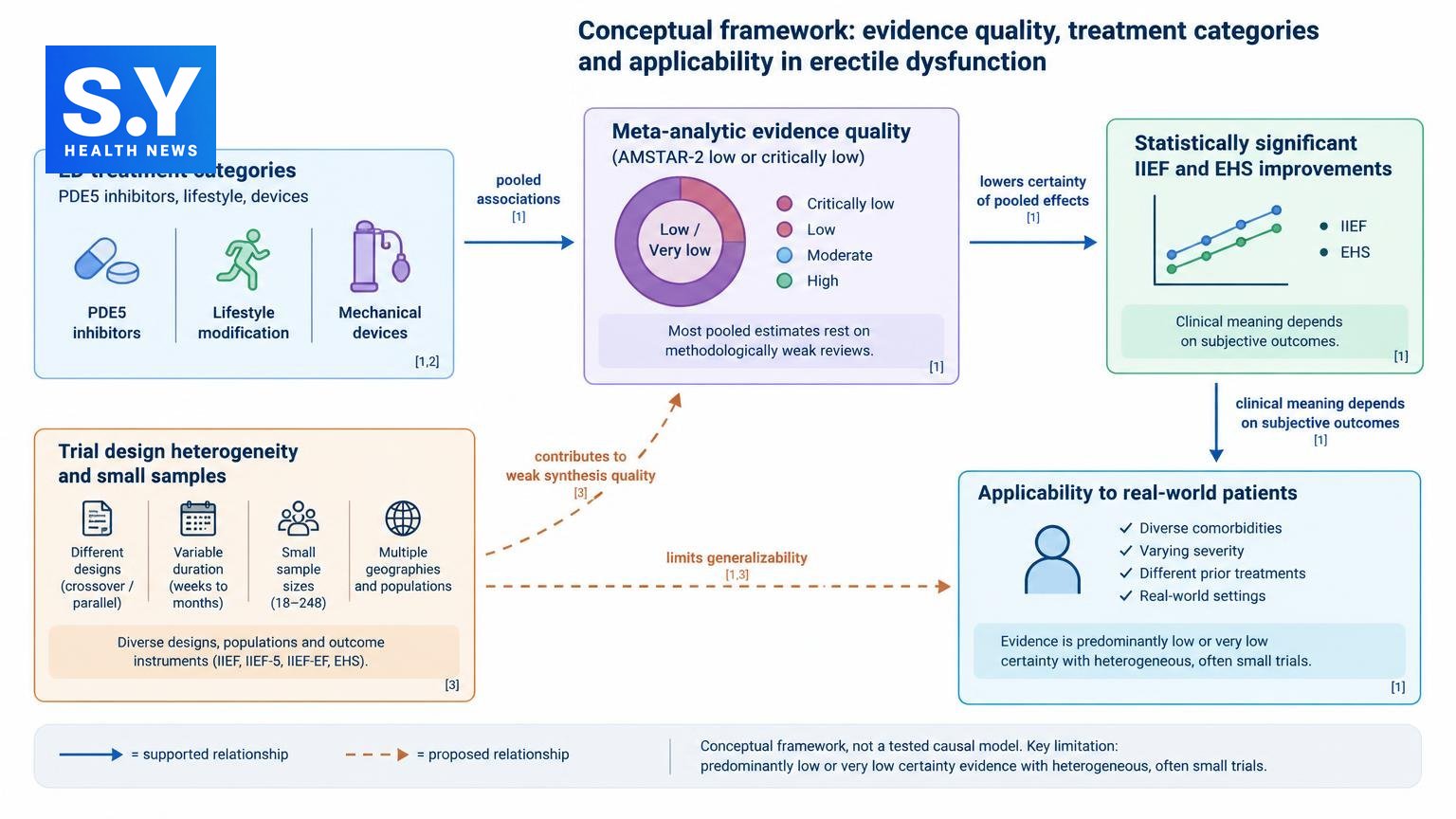
Conceptual framework: Conceptual framework, not a tested causal model. Boxes represent treatment categories, meta-analytic evidence quality, subjective outcome improvements, trial design heterogeneity and real-world applicability. Solid arrows indicate relationships supported as worded by the 2026 umbrella review; dashed relationships are proposed. Key limitation: predominantly low or very low certainty evidence with heterogeneous, often small trials.
Academic References & Evidence
- Current treatment for erectile dysfunction: an umbrella review of systematic reviews and meta-analyses. 2026 DOI: 10.6084/m9.figshare.31562993.v1.
- Parth Bhavsar. Erectile Dysfunction. 2026
- Table 1..
SANYUN Science Center explains published research on men's reproductive and sexual health, connecting scientific evidence with everyday questions while making sources and limitations clear.
Disclaimer: This article is for scientific education and research communication only. It does not provide medical advice, diagnosis, or individualized treatment recommendations, and does not endorse any medication, supplement, device, penile enlargement procedure, or other intervention. Decisions about sexual and reproductive health should be made in consultation with a qualified healthcare professional. Do not delay seeking professional care because of information in this article.
Original Content & Copyright Notice
- This article is prepared for SANYUN Science Center, drawing on published research and publicly available academic literature on men’s sexual and reproductive health. Its editorial explanations and presentation are developed for this platform.
- Copyright in the original editorial content, selection, and arrangement is reserved by SANYUN Science Center to the extent protected by applicable law. Referenced research, quotations, and third-party materials remain subject to the rights of their respective owners. This notice does not claim ownership of scientific facts or third-party research.
- Except where permitted by applicable law or an applicable license, prior written permission is required to reproduce, republish, translate, adapt, redistribute, or commercially reuse protected content. Attribution alone does not grant permission for such reuse.
- For permitted quotation or authorized reuse, clearly identify the source and retain a link to the original article.
- Source: SANYUN Science Center
- Original URL: Retain the original article URL on science.san-yun.com.
- Copyright Holder: SANYUN Science Center, for its own protected editorial content.
- Quotation, excerpts, or authorized reuse must not distort the scientific meaning, omit material limitations or disclaimers, or imply unverified medical claims, product efficacy, or endorsement by SANYUN Science Center.



