




Category: Erectile Dysfunction
Core Research Direction: Quality and strength of the evidence base underlying current erectile dysfunction treatments, including the cardiovascular and mechanistic context that shapes clinical interpretation
Search Intent: How strong is the evidence behind the treatments recommended for erectile dysfunction, and how do cardiovascular risk, mechanism and study-quality limitations affect how those results should be read?
Platform: SANYUN Science Center
Evidence reviewed through: 2026-11-10
Executive Summary
Erectile dysfunction (ED) has a crowded treatment landscape: oral PDE5 inhibitors, intracavernosal and intraurethral medicines, vacuum devices, low-intensity shockwave therapy, lifestyle and behavioural programmes, testosterone in hypogonadal men, and surgery. A 2026 umbrella review asked a narrower and more uncomfortable question than most treatment summaries do: across this whole landscape, how good is the evidence? That review searched the literature up to October 2025, extracted 23 published meta-analyses from 1191 records, and derived 42 summary effects on 36 interventions, measured with the International Index of Erectile Function (IIEF), its short and erectile-function subscales (IIEF-5, IIEF-EF) and the Erectile Hardness Score (EHS).[1]
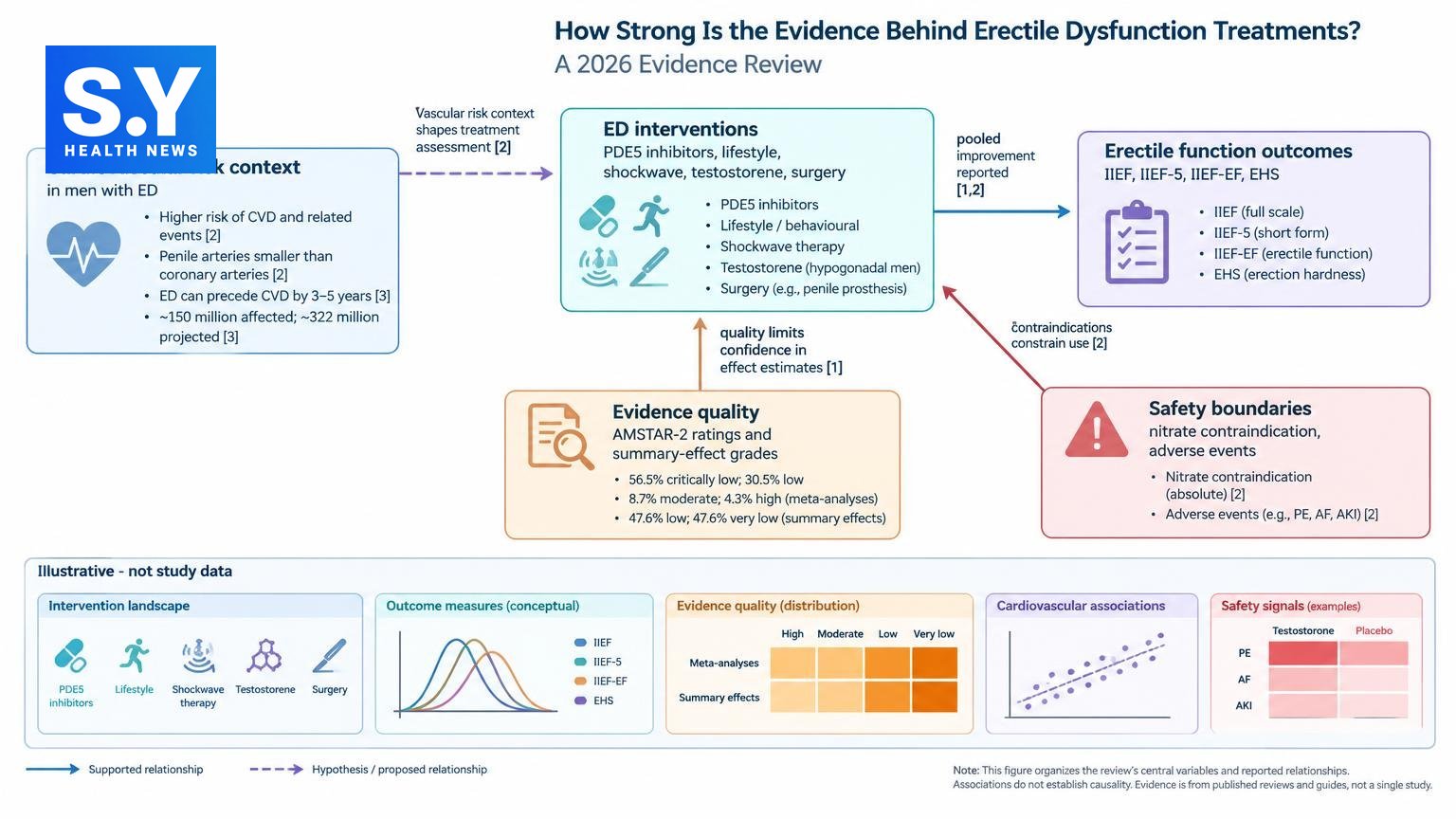
Its quality findings were sobering. Thirteen of the 23 meta-analyses (56.5%) were rated critically low on AMSTAR-2, 7 (30.5%) low, 2 (8.7%) moderate and only 1 (4.3%) high. At the level of summary effects, just one was rated high-quality and one moderate-quality, while 20 (47.6%) were low and 20 (47.6%) very low.
Statistically significant improvements were observed with both pharmacological and non-pharmacological interventions. But the review itself cautions that these findings rest on limited patient numbers and subjective outcome indicators, and concludes that the reliability of the evidence is poor. The practical implication is not that ED treatment fails to work; it is that the size of benefit, the relative ranking of options and long-term outcomes are far less securely established than the volume of published literature implies.
Why This Matters: Cardiovascular Context as a Reading Frame
ED is not only a sexual-health endpoint. In a secondary umbrella-review estimate, men with ED had higher relative risks of cardiovascular disease (1.45, 95% CI 1.36–1.54), coronary heart disease, cardiovascular mortality, myocardial infarction, stroke and all-cause mortality, each with P<0.001.[2]
One mechanistic explanation offered by a physician-authored clinical guide is that penile arteries (reported as 1–2 mm in diameter) are substantially smaller than coronary arteries, so atherosclerotic narrowing may become symptomatic in the penis earlier. The same guide attributes about 70% of ED cases to a vascular component. These figures are cited secondhand and should be treated as an explanatory framework rather than a precise anatomical law.
A separate knowledge hub frames ED as a cardiovascular sentinel event, typically preceding symptomatic cardiovascular disease by 3–5 years, and cites global estimates of 150 million affected men with projections to 322 million by 2025. Prevalence projections and the 3–5 year lag are reported to WHO and EAU sources without underlying study detail in the available text, so they orient the discussion rather than settle it.[3]
Why does this matter for evidence interpretation? Because an outcome measure such as a change in IIEF-EF points captures only part of what a clinician needs. If ED signals systemic vascular risk, then a treatment that improves questionnaire scores without addressing that risk is a partial intervention. The evidence review discussed here grades treatment effects; it does not resolve the longitudinal cardiovascular question.
Biological and Clinical Mechanism
Erection depends on cyclic GMP-mediated smooth muscle relaxation in the penile vasculature downstream of sexual stimulation. PDE5 inhibitors (sildenafil, tadalafil, vardenafil, avanafil) work by blunting the enzyme that clears cGMP, thereby augmenting this relaxation; they do not initiate an erection on their own. They are described as first-line pharmacological treatment and are contraindicated with any nitrate-based medication because of life-threatening hypotension.
That contraindication is stated in absolute terms in the available sources: PDE5 inhibitors are absolutely contraindicated with nitrate medications and recreational nitrites, and the combination can cause severe, potentially fatal hypotension. This is a safety boundary, not a nuance of patient selection.
The mechanism also helps explain why incorrect use drives apparent failure. A clinical guide notes that incorrect use accounts for a large percentage of apparent PDE5 inhibitor treatment failures, with guidelines recommending at least 6 to 8 trials at an optimal dose before failure is concluded. Timing, food effects and the requirement for stimulation are part of the therapeutic protocol, not optional advice.
Causes are mixed rather than singular. One cited review notes ED can be physiological, psychological or both, which is why history-taking spans mental health and physical factors. A knowledge hub contrasts organic ED (gradual, consistent, absent morning erections, older men with vascular risk factors — described as the most common type) with psychogenic ED (sudden, situational, normal morning erections, younger men, anxiety-driven), while noting both can coexist. This is a clinical heuristic, not a validated diagnostic test.[4]
What the Evidence Shows
The umbrella review is the most direct evidence-quality statement in this packet. Its 23 meta-analyses covered 42 summary effects and 36 interventions, and its AMSTAR-2 distribution — 56.5% critically low — is a finding about the review literature itself, not about any single patient sample.
For PDE5 inhibitors, the classic comparative claim is that randomized trials of five agents improved erectile function more than placebo, with broadly similar efficacy and safety profiles among them. That conclusion comes from a 2011 review of Asian studies and is reported secondhand; trial counts, effect sizes and follow-up are not given in the available text.
An aggregate response figure reported in a physician-authored guide is that PDE5 inhibitors are effective in roughly 60–80% of men with ED, with sexual stimulation still required. Because the definition of response and its measurement are not specified, this figure should be read as a broad clinical impression rather than a meta-analytic effect size.
Lifestyle evidence is directionally consistent but modest in magnitude. The packet reports that a healthy diet may lower ED risk or improve symptoms, and that exercise, weight loss and smoking cessation may help. For aerobic exercise specifically, a cited 2023 meta-analysis reported an improvement in IIEF-EF of roughly 2.8 points; confidence intervals, trial count and follow-up duration are not provided in the supplied material.
Low-intensity shockwave therapy illustrates the uncertainty problem clearly. A cited 2025 Cochrane review of 21 randomized trials in 1,357 men found improvements versus sham of roughly 3.9 IIEF-EF points short-term and 5.3 points long-term, but with low certainty of evidence; the source states the AUA still classifies it as investigational.
Testosterone is a different question. In TRAVERSE, 5,246 hypogonadal men with elevated cardiovascular risk received transdermal testosterone or placebo, and testosterone was non-inferior for major adverse cardiac events (HR 0.96, 95% CI 0.78–1.17) over a mean 21.7 months. That is a cardiovascular safety result, not evidence that testosterone alone treats ED. The same trial detected higher rates in the testosterone arm of pulmonary embolism (0.9% vs 0.5%), atrial fibrillation (3.5% vs 2.4%) and acute kidney injury (2.3% vs 1.5%).
Other contexts matter when interpreting individual studies. In a 2018 study of 150 men newly diagnosed with moderate to severe obstructive sleep apnea, 51% also had ED — an association, not a causal finding. After radical prostatectomy, the knowledge hub reports postoperative ED in 50–80% of men. And for refractory cases, inflatable penile prosthesis is described as the most effective option with the highest patient and partner satisfaction, though irreversibility is explicit and satisfaction is not quantified in the supplied text.
Supplement evidence is conspicuously weak. A cited 2011 review found only Panax ginseng, Butea superba and yohimbine had human trial data, and those trials were not robust. A cited 2017 systematic review of 26 supplement studies found that more than 30% showed some ECG changes — a safety signal that deserves caution rather than a strong causal interpretation.
| Treatment area | Evidence base described | Reported signal | Main caution |
|---|---|---|---|
| PDE5 inhibitors | Randomized trials summarized in reviews; guideline-endorsed first-line | Greater improvement than placebo across five agents; broadly similar efficacy and safety profiles | Secondhand reporting without effect sizes; nitrate contraindication |
| Aerobic exercise | Cited 2023 meta-analysis | IIEF-EF improvement of roughly 2.8 points | Confidence intervals, trial count and follow-up not provided |
| Low-intensity shockwave therapy | Cited 2025 Cochrane review; 21 randomized trials; 1,357 men | Roughly 3.9 points short-term and 5.3 points long-term versus sham | Low certainty of evidence; still classified as investigational |
| Testosterone in hypogonadal men | TRAVERSE; 5,246 men with elevated cardiovascular risk | Non-inferior for major adverse cardiac events; HR 0.96 (95% CI 0.78–1.17) over mean 21.7 months | Not an ED treatment result; higher pulmonary embolism, atrial fibrillation and acute kidney injury rates |
| Penile prosthesis | Knowledge-hub summary for refractory ED | Described as most effective with highest patient and partner satisfaction | Irreversible; satisfaction not quantified in supplied text |
| Overall treatment literature | Umbrella review of 23 meta-analyses and 42 summary effects | Significant improvements with pharmacological and non-pharmacological options | 56.5% of meta-analyses critically low; 47.6% of summary effects very low |
Interpretation and Limitations
The central interpretive tension is between statistical significance and clinical meaning. The umbrella review observed statistically significant improvements with both pharmacological and non-pharmacological interventions, yet only two of 42 summary effects reached high or moderate quality. A significant pooled result derived mainly from small trials with subjective endpoints is not the same as a reliable estimate of how much a patient will benefit.
Measurement is part of the problem. IIEF-family scores and the EHS are patient-reported or clinician-rated instruments; they capture symptom burden, not hard clinical outcomes, and they are susceptible to expectancy and unblinding effects. The umbrella review's authors explicitly flag the subjective nature of outcome indicators alongside limited patient numbers.
The review literature also has a comparison gap. The reviewers call for well-designed single-treatment studies and high-quality meta-analyses of intertreatment comparisons, which implies that head-to-head ranking of interventions is currently underpowered. Guideline bodies have responded to this uncertainty with process rather than ranking: the 2018 AUA guideline uses shared decision-making and states that all patients should be informed of all non-contraindicated options, regardless of invasiveness, as potential first-line choices.
Several limitations belong to this article's evidence base rather than to the underlying trials. Much of the clinical detail here comes from secondary guides and knowledge hubs, some of which cite primary reviews only in summary form. The 70% vascular share, the 60–80% PDE5 response range, the 150 million global prevalence figure and the 3–5 year cardiovascular lag are all reported without the underlying study parameters in the available text. They orient interpretation but should not be quoted as precise estimates.
Other qualifications are methodological. The observational cardiovascular risk estimates cannot establish causation, and confounding by shared risk factors such as smoking, diabetes and hypertension is plausible. The sleep apnea prevalence figure comes from a single small cohort. The supplement ECG finding describes a heterogeneous set of 26 studies. And TRAVERSE addresses cardiovascular safety in hypogonadal men, not erectile efficacy.
Emerging areas remain hypothesis-level. The available material states that in obese men with obesity-driven functional hypogonadism, GLP-1 receptor agonists appear to improve sexual function, but the supporting studies are described as pilot or single trials. That is a signal for future research, not a treatment recommendation.
Research Outlook
The clearest research priority is methodological rather than pharmaceutical. The umbrella review's call for better-designed single-treatment trials and high-quality head-to-head meta-analyses points to three needs: larger samples, objective or at least better-blinded endpoints, and longer follow-up that captures durability rather than short-term score shifts.
A second priority is integration with cardiovascular medicine. If ED functions as a marker of vascular risk, trials that report erectile outcomes without cardiovascular stratification will leave a central clinical question unanswered. The observational risk estimates provide the rationale for that integration but not the trial design.
A third is honest communication about what remains investigational. Shockwave therapy is the clearest example: a Cochrane synthesis with low certainty and an investigational guideline status sit awkwardly beside commercial claims. Similar caution applies to supplements, where human trial data are sparse and safety signals exist.
Key Takeaways
- An umbrella review of 23 meta-analyses found that 56.5% were critically low quality on AMSTAR-2, and 47.6% of 42 summary effects were very low quality.
- Statistically significant improvements were seen with pharmacological and non-pharmacological treatments, but the reviewers caution about limited patient numbers and subjective endpoints.
- PDE5 inhibitors remain first-line pharmacological therapy and are contraindicated with nitrates because of potentially fatal hypotension.
- Aerobic exercise showed an IIEF-EF gain of roughly 2.8 points in a cited meta-analysis; low-intensity shockwave therapy showed larger point estimates but low certainty evidence.
- TRAVERSE supports cardiovascular neutrality of testosterone in hypogonadal men (HR 0.96, 95% CI 0.78–1.17) but is not evidence of ED efficacy and showed higher rates of some adverse events.
- ED is associated with higher cardiovascular risk in observational meta-analytic data, which argues for cardiovascular assessment alongside treatment selection.
Questions and Answers
What does the 2026 umbrella review say about the quality of erectile dysfunction treatment evidence?
It found the evidence base predominantly low or very low quality. Of 23 meta-analyses, 13 (56.5%) were rated critically low on AMSTAR-2, 7 (30.5%) low, 2 (8.7%) moderate and 1 (4.3%) high. Among 42 summary effects, one was high-quality and one moderate, while 20 (47.6%) were low and 20 (47.6%) very low.
How effective are PDE5 inhibitors for erectile dysfunction according to the available evidence?
Randomized trials summarized in reviews found five PDE5 inhibitors improved erectile function more than placebo, with broadly similar efficacy and safety profiles. An aggregate clinical figure suggests response in roughly 60–80% of men, but the definition of response is unspecified, and incorrect use accounts for many apparent failures. Nitrates remain an absolute contraindication.
What is the link between erectile dysfunction and cardiovascular disease risk?
Observational meta-analytic data report higher relative risks in men with ED for cardiovascular disease (1.45, 95% CI 1.36–1.54), coronary heart disease, cardiovascular mortality, myocardial infarction, stroke and all-cause mortality. These are associations from observational syntheses and cannot establish causation; shared risk factors such as smoking, diabetes and hypertension may contribute.
Is low-intensity shockwave therapy an established erectile dysfunction treatment?
Not according to the available evidence. A cited 2025 Cochrane review of 21 randomized trials in 1,357 men found improvements versus sham of roughly 3.9 IIEF-EF points short-term and 5.3 points long-term, but with low certainty of evidence, and the AUA still classifies the therapy as investigational rather than standard care.
Does testosterone therapy treat erectile dysfunction, and is it safe for the heart?
TRAVERSE found transdermal testosterone non-inferior to placebo for major adverse cardiac events in 5,246 hypogonadal men with elevated cardiovascular risk (HR 0.96, 95% CI 0.78–1.17) over a mean 21.7 months. That is a cardiovascular safety result, not proof that testosterone alone treats ED; higher rates of pulmonary embolism, atrial fibrillation and acute kidney injury occurred in the testosterone arm.
Why is the evidence for erectile dysfunction treatments weaker than the number of published studies suggests?
Because most pooled estimates rest on small trials with subjective questionnaire endpoints. The umbrella review found 47.6% of summary effects very low quality, and the reviewers call for better-designed single-treatment trials and high-quality head-to-head meta-analyses. Statistical significance in such conditions does not guarantee a reliable estimate of clinical benefit.
Conceptual framework: Conceptual framework. This figure organizes the review's central variables: ED interventions, erectile-function outcome measures, graded evidence quality, cardiovascular risk context and safety boundaries. Supported arrows reflect reported associations or constraints; the cardiovascular-context arrow is proposed. The framework is not a tested causal model.
Academic References & Evidence
- Current treatment for erectile dysfunction: an umbrella review of systematic reviews and meta-analyses. 2026 DOI: 10.6084/m9.figshare.31562993.v1. (preprint)
- Parth Bhavsar. Erectile Dysfunction. 2026
- GMJ News Editorial Team. UK Updates Botulism Clinical Guidance: Recognition and Emergency Management for Three Disease Forms. Georgian Medical Journal. 2026
- TriCountyUrology.org Editorial Team. Erectile Dysfunction Guide: Causes, Treatment Options and Safety.
SANYUN Science Center explains published research on men's reproductive and sexual health, connecting scientific evidence with everyday questions while making sources and limitations clear.
Disclaimer: This article is for scientific education and research communication only. It does not provide medical advice, diagnosis, or individualized treatment recommendations, and does not endorse any medication, supplement, device, penile enlargement procedure, or other intervention. Decisions about sexual and reproductive health should be made in consultation with a qualified healthcare professional. Do not delay seeking professional care because of information in this article.
Original Content & Copyright Notice
- This article is prepared for SANYUN Science Center, drawing on published research and publicly available academic literature on men’s sexual and reproductive health. Its editorial explanations and presentation are developed for this platform.
- Copyright in the original editorial content, selection, and arrangement is reserved by SANYUN Science Center to the extent protected by applicable law. Referenced research, quotations, and third-party materials remain subject to the rights of their respective owners. This notice does not claim ownership of scientific facts or third-party research.
- Except where permitted by applicable law or an applicable license, prior written permission is required to reproduce, republish, translate, adapt, redistribute, or commercially reuse protected content. Attribution alone does not grant permission for such reuse.
- For permitted quotation or authorized reuse, clearly identify the source and retain a link to the original article.
- Source: SANYUN Science Center
- Original URL: Retain the original article URL on science.san-yun.com.
- Copyright Holder: SANYUN Science Center, for its own protected editorial content.
- Quotation, excerpts, or authorized reuse must not distort the scientific meaning, omit material limitations or disclaimers, or imply unverified medical claims, product efficacy, or endorsement by SANYUN Science Center.



