




Category: Erectile Dysfunction
Core Research Direction: Current evidence quality for erectile dysfunction treatments: what umbrella-level synthesis of systematic reviews and meta-analyses shows about effectiveness, certainty of evidence, and applicability to shared decision-making
Search Intent: How reliable is the current evidence base supporting pharmacological and non-pharmacological erectile dysfunction treatments, and what does an umbrella review of meta-analyses reveal about its quality?
Platform: SANYUN Science Center
Evidence reviewed through: 2026-11-25
Executive Summary
A recently published umbrella review set out to do two things at once: summarize the effectiveness of current erectile dysfunction treatments and grade the quality of the evidence supporting them. The design pooled published systematic reviews and meta-analyses rather than running a new trial, which makes it a map of the existing evidence landscape rather than fresh clinical data.[1]
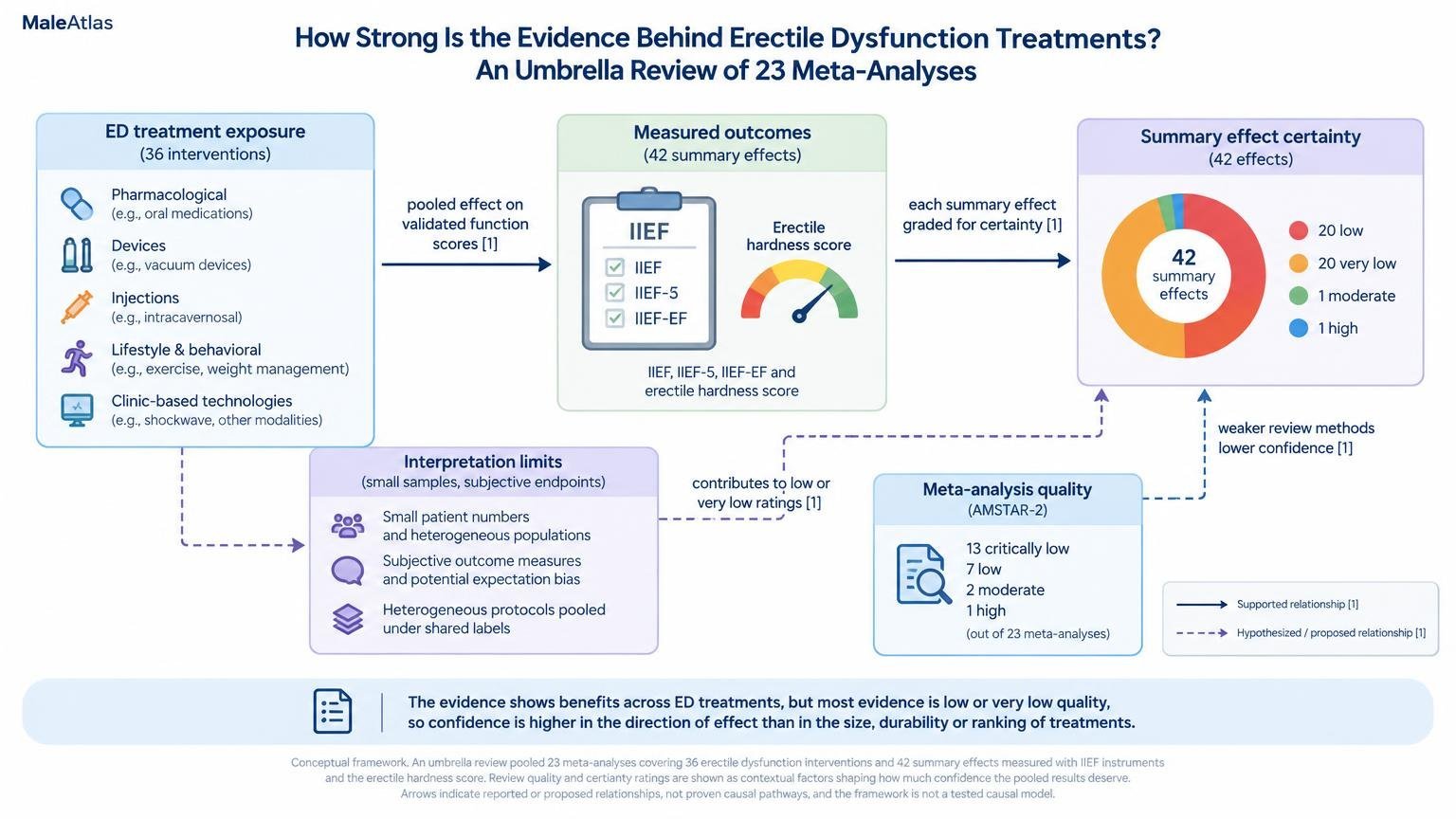
Searches covered PubMed, Web of Science, the Cochrane Library and Embase, including studies published up to October 2025. From 1191 records, 23 published meta-analyses were extracted, producing 42 summary effects on the International Index of Erectile Function or its simplified versions and on the erectile hardness score, spanning 36 interventions.
The headline finding is a contrast between statistical signal and evidentiary strength. Statistically significant improvements were observed with both pharmacological and non-pharmacological interventions, yet the evidence base was predominantly of low or very low quality. On AMSTAR-2, 13 of 23 meta-analyses (56.5%) were critically low quality, 7 (30.5%) low, 2 (8.7%) moderate and 1 (4.3%) high. At the level of individual summary effects, 20 of 42 were low quality and 20 very low, with only one high and one moderate.
The authors describe a treatment landscape that is increasingly diverse but supported by poor reliability, and they call for better-designed single-treatment studies and high-quality meta-analyses comparing treatments directly. For shared decision-making, that means options can be discussed with reasonable confidence about direction of benefit and less confidence about effect size, durability and head-to-head ranking.
Why This Matters
Erectile dysfunction is a common condition with an expanding menu of options, from oral drugs and vacuum devices to injections, surgery, lifestyle programs and clinic-based technologies. Men are often asked to choose among these while being told that the evidence is strong. An umbrella review is useful precisely because it asks whether that assurance holds up across the whole field rather than within one favorable trial.[2]
The distinction matters clinically as well as scientifically. A statistically significant improvement in a symptom score can be real and still be poorly characterized: uncertain in magnitude, inconsistent across studies, or measured with instruments that are partly subjective. The review's authors explicitly caution that the statistically significant improvements seen across treatment types should be interpreted with care because of limited patient numbers and the subjective nature of the outcome measures.
There is a second reason evidence quality deserves attention. Erectile dysfunction frequently coexists with cardiovascular and metabolic disease, so treatment choices sit inside a broader health picture. Guidance that frames every non-contraindicated option as a candidate for shared decision-making depends on honest appraisal of what each option has actually been shown to do.[3]
What an Umbrella Review Actually Measures
An umbrella review sits above ordinary systematic reviews. It collects multiple meta-analyses, extracts their pooled effect estimates, and appraises both the quality of each review and the certainty of each pooled result. That means its unit of analysis is not a patient but a summary effect.
Two appraisal instruments do different jobs. AMSTAR-2 assesses how well a systematic review was conducted: whether the search was adequate, whether risk of bias was handled, whether heterogeneity and publication bias were examined. Certainty ratings applied to each summary effect ask a narrower question: how much confidence should a reader place in this particular pooled estimate? The review reports both, which is why the numbers do not simply mirror each other.
Effectiveness was anchored to the International Index of Erectile Function or its simplified versions and to the erectile hardness score. These are validated patient-reported or clinician-recorded instruments, but they describe symptoms and function rather than a hard biological endpoint. That design choice is practical and common in the field, and it is also part of why the authors flag subjectivity as a limitation.
| Variable | Definition | Interpretation |
|---|---|---|
| Meta-analyses included | Published systematic reviews with pooled estimates of ED treatments, extracted from 1191 records | 23 meta-analyses formed the evidence base of the umbrella review |
| Summary effects | Pooled treatment-versus-comparator estimates across the included meta-analyses | 42 summary effects covered 36 interventions |
| Outcome instruments | IIEF, IIEF-5, IIEF-EF and erectile hardness score | Measure erectile function, satisfaction domains or hardness rather than a biological endpoint |
| Review quality | AMSTAR-2 rating of each included meta-analysis | 13 critically low, 7 low, 2 moderate, 1 high |
| Certainty of summary effects | Rating applied to each of the 42 pooled estimates | 20 low, 20 very low, 1 moderate, 1 high |
| Search window | Databases searched for studies published up to October 2025 | Captures the literature as indexed at that point, not later publications |
What the Evidence Shows About Effectiveness
Both broad families of treatment produced statistically significant improvements. That includes pharmacological approaches and non-pharmacological approaches, which in this literature typically spans behavioral and lifestyle programs, devices and physical modalities. The direction of benefit is therefore supported across the field, which is a meaningful finding in itself.
The strength of that support is the problem. When 40 of 42 summary effects fall into low or very low certainty, a clinician cannot reliably say how large a benefit is, how consistent it will be across patient subgroups, or how it will hold up in longer follow-up. The review's own summary is blunt: the reliability of the evidence is poor.
Fragmentation compounds the issue. Forty-two summary effects spread across 36 interventions means that many options have been pooled only once or twice, often in small bodies of work. The authors note the limited number of patients behind these findings, which reduces precision and makes subgroup conclusions fragile.
The review also highlights what is missing rather than what is wrong. It does not conclude that treatments fail. It concludes that the evidence architecture around them is underbuilt, particularly for comparisons between treatments.
Why Certainty Is So Low
Several mechanisms plausibly drive the low ratings. Many pooled analyses compare an active treatment with placebo or sham in modest samples, which widens confidence intervals and limits precision. Where a meta-analysis itself has methodological shortcomings, the certainty of its pooled estimates falls further, which is why the AMSTAR-2 distribution matters.
Outcome measurement is another lever. Symptom questionnaires are responsive and clinically relevant, but they can be influenced by expectation and by unblinding, especially in trials of devices or procedures where masking is difficult. The authors name the subjective nature of the indicators as a reason for caution.
Intervention heterogeneity is a third factor. Under a single label such as shockwave therapy or injections, the actual devices, dosing schedules and protocols may differ substantially. Pooling dissimilar interventions under one heading can produce a precise-looking estimate that describes no single real-world treatment.
Funding is a related concern documented elsewhere in this literature. A 2025 Cochrane review of low-intensity shockwave therapy rated the evidence low certainty partly because several included trials were industry-funded, mainly by device makers. That pattern does not prove bias, but it does lower confidence.
Illustrating Certainty and Applicability
Consider how the shockwave evidence reads beside the umbrella review. The Cochrane synthesis of 21 randomized trials involving 1,357 men found that low-intensity shockwave therapy may improve short-term IIEF-EF scores by roughly 3.9 points and long-term scores by 5.3 points versus sham, while rating certainty as low. A statistically visible signal and a low certainty rating coexist without contradiction: the direction is plausible, the magnitude is uncertain.
A similar pattern appears in exercise research. A 2023 meta-analysis reported that aerobic exercise improves IIEF-EF scores by about 2.8 points, a modest signal from a low-risk intervention. Whether that magnitude is clinically meaningful for an individual man depends on baseline function and his priorities, not on the p value alone.
The same caution applies to harder endpoints. Reported associations between erectile dysfunction and later cardiovascular events are substantial, with a 2021 umbrella review reporting relative risks of 1.45 for cardiovascular disease, 1.50 for coronary heart disease, 1.50 for cardiovascular mortality, 1.55 for myocardial infarction, 1.36 for stroke and 1.25 for all-cause mortality. These are observational associations that inform risk framing; they are not evidence that any ED treatment reduces cardiac events.
Interpretation, Conflicts and Limitations
The first limitation belongs to the umbrella review method itself. It can only be as good as the meta-analyses it collects, and the review found most of them methodologically weak. Overlapping primary trials across meta-analyses can also double-count the same patients, and the review's extraction counts summary effects rather than unique participants.
The review reports quality ratings and the existence of statistically significant improvements, but the available description does not enumerate effect sizes for each intervention. That constrains what any secondary analysis can say about magnitude, and it means rankings between treatments should not be inferred from this source.
Certainty ratings are also partly judgment calls. A low rating is a warning about confidence, not a declaration of ineffectiveness, and a high rating for one summary effect does not validate the rest of the field. Readers should resist turning the AMSTAR-2 percentages into a single verdict on a specific drug or device.
Applicability is a separate question. Meta-analyses typically include men with organic, psychogenic and mixed ED in varying proportions, with differing baseline severity and comorbidity. A pooled estimate describing a general ED population may translate poorly to a man after prostate surgery, a man with untreated sleep apnea, or a younger man whose difficulty is situational.
Contextual evidence illustrates that variability. In a 2018 study of 150 men newly diagnosed with moderate to severe obstructive sleep apnea, ED prevalence was 51 percent, and erectile function scores rose after three months of CPAP, although the authors could not establish CPAP as a stand-alone ED treatment. A 2023 meta-analysis of 8 studies and 457 patients reported higher post-treatment IIEF-5 scores with sildenafil than CPAP, 37.7 versus 27.3, with combination therapy suggested rather than tested. A 2021 Cochrane review rated CPAP versus no CPAP evidence as very uncertain.
Standard safety boundaries remain unchanged by certainty debates. Phosphodiesterase type 5 inhibitors are absolutely contraindicated with nitrate medications and recreational nitrites, a combination that can cause severe and potentially fatal hypotension. Any discussion of treatment options should keep that constraint explicit, regardless of how the evidence is graded.
Implications for Shared Decision-Making
Shared decision-making does not require certainty. It requires honesty about what is known, what is uncertain, and what matters to the person deciding. This review supports a conversation in which clinicians describe plausible benefit across pharmacological and non-pharmacological options while acknowledging that magnitude, durability and comparative performance are often poorly established.
Practical questions follow from that stance. What outcome does the option target, and was it measured with a validated instrument? How long was follow-up? How many participants contributed? Was the comparison a sham, placebo or another active treatment? A testimonial or a claim of being natural cannot answer those questions, and a directory listing is not evidence.[4]
For newer or heavily marketed modalities, the appropriate posture is investigational candor. Asking whether a proposed use is approved, what human studies support it, what outcome was measured and how it compares with established alternatives is a reasonable standard, and it aligns with the review's call for better single-treatment studies and direct comparisons.
Testosterone deserves separate framing. In men with confirmed hypogonadism and high cardiovascular risk, the TRAVERSE trial of 5,246 men found transdermal testosterone noninferior to placebo for major adverse cardiac events over a mean 21.7 months, with hazard ratio 0.96 and confidence interval 0.78 to 1.17, although atrial fibrillation, acute kidney injury and pulmonary embolism were more common with testosterone. A 2026 observational cohort reported higher cardiac event risk with testosterone use, hazard ratio 1.27, but the same increase appeared in men diagnosed with deficiency, and the authors consider causality unclear.
Metabolic and sleep context belongs in the same conversation. A 2024 database analysis of 3,094 non-diabetic, non-hypogonadal men aged 18 to 50 found higher rates of new ED diagnosis or PDE5 inhibitor prescription, 1.47 versus 0.32 percent, and of testosterone deficiency, 1.53 versus 0.80 percent, among semaglutide users compared with matched unexposed men, while a 2026 narrative review described the overall GLP-1 evidence as inconsistent. These are signals for discussion and monitoring, not grounds for stopping a prescribed medication.
Research Outlook
The review's recommendations are specific. Better-designed studies of single treatments would reduce the ambiguity created by pooling dissimilar protocols under shared labels. High-quality meta-analyses of intertreatment comparisons would answer the question men actually ask: not whether an option works at all, but how it compares with the alternatives.
Improved certainty will also require attention to outcome selection and blinding. Where masking is difficult, sham-controlled designs and objective adjunct measures can reduce the influence of expectation. Longer follow-up would address durability, which is currently underspecified across much of the field.
None of this means waiting. It means treating the current evidence base as informative but provisional, and treating the choice of treatment as a preference-sensitive decision informed by mechanisms, safety and individual context rather than by pooled point estimates alone.
Key Takeaways
- An umbrella review extracted 23 meta-analyses from 1191 records, yielding 42 summary effects across 36 erectile dysfunction interventions.
- Statistically significant improvements appeared with both pharmacological and non-pharmacological treatments, but the authors urge caution because of limited patient numbers and subjective outcome measures.
- On AMSTAR-2, 13 of 23 meta-analyses were critically low quality and only 1 was high quality; at the summary-effect level, 40 of 42 were low or very low certainty.
- The evidence base is predominantly low or very low quality, and the treatment landscape is diverse while the reliability of the evidence remains poor.
- The authors recommend well-designed single-treatment studies and high-quality meta-analyses comparing treatments directly.
- Safety constraints do not soften with low certainty: PDE5 inhibitors remain absolutely contraindicated with nitrates and recreational nitrites.
Questions and Answers
What did the umbrella review of erectile dysfunction treatments actually analyze?
It collected published systematic reviews and meta-analyses rather than running a new trial. Searches covered PubMed, Web of Science, the Cochrane Library and Embase up to October 2025. From 1191 records, 23 meta-analyses were extracted, producing 42 summary effects on the IIEF instruments and erectile hardness score across 36 interventions. It then rated both review quality and certainty of each pooled estimate.
Do erectile dysfunction treatments actually work according to this umbrella review?
Statistically significant improvements were observed with both pharmacological and non-pharmacological interventions, so the direction of benefit is supported across the field. However, the authors caution that these findings should be interpreted carefully because of limited patient numbers and the subjective nature of the outcome measures. The review therefore supports plausible benefit without establishing precise effect sizes or comparative rankings.
How strong is the evidence for erectile dysfunction treatments on AMSTAR-2 and certainty grading?
Weak. Of 23 meta-analyses, 13 (56.5%) were critically low quality, 7 (30.5%) low, 2 (8.7%) moderate and 1 (4.3%) high. At the summary-effect level, 20 of 42 were low quality and 20 very low, with only one high and one moderate. The review concludes the evidence base is predominantly low or very low quality.
Does this evidence apply equally to all men with erectile dysfunction?
Not necessarily. Meta-analyses pool men with organic, psychogenic and mixed erectile dysfunction and differing severity and comorbidity. A pooled estimate may translate poorly to men after prostate surgery, men with untreated sleep apnea, or younger men with situational difficulty. Contextual studies show wide variation; in one cohort of 150 men with moderate to severe sleep apnea, ED prevalence was 51 percent.
What are the limitations of an umbrella review of erectile dysfunction treatment meta-analyses?
It can only be as reliable as the reviews it collects, and most included meta-analyses were methodologically weak. Overlapping primary trials may be counted more than once, and the review counts summary effects rather than unique participants. Certainty ratings are partly judgment calls, and a low rating signals limited confidence rather than proven ineffectiveness.
How should patients use low-certainty evidence when choosing an erectile dysfunction treatment?
Treat the evidence as informative but provisional. Ask what outcome an option targets, whether it was measured with a validated instrument, how long follow-up lasted and how many participants contributed. Shared decision-making can proceed on plausible benefit while acknowledging uncertainty about magnitude, durability and comparisons. Safety boundaries remain firm: PDE5 inhibitors are absolutely contraindicated with nitrates and recreational nitrites.
Conceptual framework: Conceptual framework. An umbrella review pooled 23 meta-analyses covering 36 erectile dysfunction interventions and 42 summary effects measured with IIEF instruments and the erectile hardness score. Review quality and certainty ratings are shown as contextual factors shaping how much confidence the pooled results deserve. Arrows indicate reported or proposed relationships, not proven causal pathways, and the framework is not a tested causal model.
Academic References & Evidence
- Current treatment for erectile dysfunction: an umbrella review of systematic reviews and meta-analyses. 2026 DOI: 10.6084/m9.figshare.31562993.v1.
- Erectile Dysfunction in Tulsa: Comparing Options.
- Erectile Dysfunction.
- 11 Best ED treatment Clinics in Tulsa, Oklahoma (2026).
SANYUN Science Center explains published research on men's reproductive and sexual health, connecting scientific evidence with everyday questions while making sources and limitations clear.
Disclaimer: This article is for scientific education and research communication only. It does not provide medical advice, diagnosis, or individualized treatment recommendations, and does not endorse any medication, supplement, device, penile enlargement procedure, or other intervention. Decisions about sexual and reproductive health should be made in consultation with a qualified healthcare professional. Do not delay seeking professional care because of information in this article.
Original Content & Copyright Notice
- This article is prepared for SANYUN Science Center, drawing on published research and publicly available academic literature on men’s sexual and reproductive health. Its editorial explanations and presentation are developed for this platform.
- Copyright in the original editorial content, selection, and arrangement is reserved by SANYUN Science Center to the extent protected by applicable law. Referenced research, quotations, and third-party materials remain subject to the rights of their respective owners. This notice does not claim ownership of scientific facts or third-party research.
- Except where permitted by applicable law or an applicable license, prior written permission is required to reproduce, republish, translate, adapt, redistribute, or commercially reuse protected content. Attribution alone does not grant permission for such reuse.
- For permitted quotation or authorized reuse, clearly identify the source and retain a link to the original article.
- Source: SANYUN Science Center
- Original URL: Retain the original article URL on science.san-yun.com.
- Copyright Holder: SANYUN Science Center, for its own protected editorial content.
- Quotation, excerpts, or authorized reuse must not distort the scientific meaning, omit material limitations or disclaimers, or imply unverified medical claims, product efficacy, or endorsement by SANYUN Science Center.



