




Category: Erectile Dysfunction
Core Research Direction: Evidence quality and comparative effectiveness of current treatments for erectile dysfunction: what an umbrella review of meta-analyses, the AUA guideline, and cost-utility analyses can and cannot establish
Search Intent: How reliable is the current evidence base for erectile dysfunction treatments, and what do guideline recommendations and cost-utility comparisons actually support?
Platform: SANYUN Science Center
Evidence reviewed through: 2026-11-16
Executive Summary
Questions about erectile dysfunction treatment are often framed as a contest: which drug, device or operation works best. The available synthesis does not settle that contest. A 2026 umbrella review of systematic reviews and meta-analyses searched PubMed, Web of Science, the Cochrane Library and Embase for studies published up to October 2025, extracted 23 meta-analyses and derived 42 summary effects across four erectile-function endpoints and 36 interventions. Its central conclusion was not that treatments fail, but that the evidence supporting them is predominantly low or very low quality.[1]
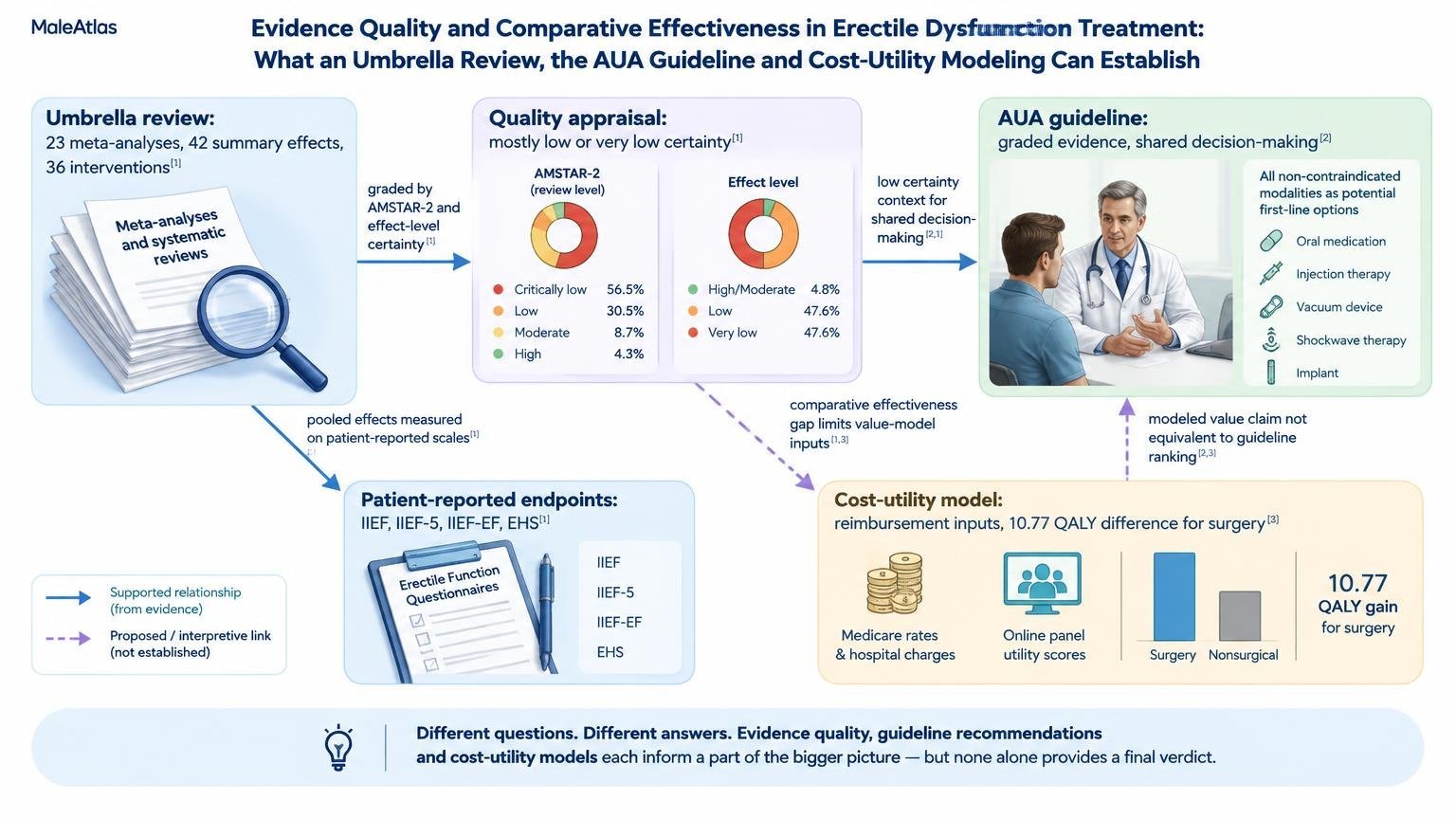
The American Urological Association guideline takes a different route to the same practical problem. It was built on a systematic review of PubMed, Embase and Cochrane literature published between 1 January 1965 and 29 July 2017, graded statements by body-of-evidence strength and made shared decision-making the cornerstone of care, with every non-contraindicated modality presented as a potential first-line option. That is a recommendation about how to choose, not a ranking of comparative efficacy.[2]
A cost-utility analysis comparing surgical and nonsurgical treatment reports that surgery was more cost-effective, with a lower lifetime cost and a 10.77 quality-adjusted life-year gain relative to nonsurgical care. The inputs were Medicare reimbursement rates, hospital charges and utility scores from Amazon Mechanical Turk. Those choices matter more than the headline: the result is a model output conditioned on reimbursement structure and a convenience utility panel, not a randomized demonstration of superior clinical benefit.[3]
- The umbrella review is the most current evidence map in this packet, but 20 of 23 included meta-analyses were rated critically low or low quality on AMSTAR-2.
- At the effect level, 40 of 42 summary effects were graded low or very low quality, so statistical significance and evidentiary strength diverge sharply.
- The AUA guideline's shared-decision framework reflects evidence available through July 2017 and should not be read as a current-year comparative verdict.
Why This Matters
Erectile dysfunction is common, treatable in many men, and entangled with cardiovascular and metabolic health, which makes the credibility of its treatment evidence a mainstream clinical issue rather than a niche academic one. When a patient asks whether a pill, a vacuum device, injections, shockwave therapy or an implant is "best," the honest answer depends on what kind of evidence is being invoked. Guidelines tell clinicians how to structure that conversation. Meta-analyses pool trial results to estimate effects. Cost-utility models convert effects and costs into a single value metric. Each answers a different question, and confusing them produces confident claims that the underlying data cannot carry.
The stakes are practical. A man and his partner are being asked to weigh invasiveness, irreversibility, cost, spontaneity, partner acceptance and uncertainty about benefit. The AUA guideline explicitly asks clinicians to ensure that the man and his partner fully understand the benefits and risk/burdens of each choice. Evidence quality is not an academic footnote in that conversation; it determines how much confidence a clinician can honestly attach to a predicted benefit.
What the Umbrella Review Actually Measured
An umbrella review summarizes existing systematic reviews and meta-analyses rather than individual trials. In this case, 1191 studies were screened, 23 published meta-analyses were extracted, and those yielded 42 summary effects distributed across the International Index of Erectile Function (20 effects), its five-item version (9), its erectile-function domain (6) and the Erectile Hardness Score (7), spanning 36 interventions. That breadth is a strength for mapping a field and a weakness for precision, because the reviews cover heterogeneous populations, comparators, doses and follow-up durations.
Two layers of appraisal were reported. At the review layer, AMSTAR-2 ratings placed 13 of 23 meta-analyses (56.5%) in the critically low category, 7 (30.5%) low, 2 (8.7%) moderate and 1 (4.3%) high. At the effect layer, only two of the 42 summary effects were rated high or moderate quality, while 20 (47.6%) were low and 20 (47.6%) very low. These are distinct judgments: a well-conducted review can summarize poor trials, and a poorly conducted review can summarize good ones. Here both layers were weak.
The review's authors still reported statistically significant improvements in erectile dysfunction for both pharmacological and nonpharmacological interventions, but cautioned that limited patient numbers and subjective outcome indicators constrain interpretation. They described a treatment landscape that is increasingly diverse while the reliability of the evidence remains poor, and called for better-designed single-treatment studies and high-quality meta-analyses of head-to-head comparisons.
Statistical Significance Is Not Clinical Strength
The most important interpretive distinction in this literature is between a pooled estimate reaching statistical significance and that estimate being trustworthy. A meta-analysis can produce a narrow confidence interval around an effect that is inflated by small trials, selective reporting, inconsistent outcome definitions or industry sponsorship. When an umbrella review grades the resulting effect as low or very low quality, it is saying the direction may be right but the magnitude, durability and generalizability are uncertain.
The outcome instruments compound this. Erectile function scores are patient-reported and therefore subjective by design; that does not make them invalid, but it does make blinding, expectation effects and inconsistent score handling more consequential. A change of a few points on a questionnaire may be statistically detectable in a modest sample while remaining below the threshold a given man would notice or consider meaningful. The packet does not provide a minimum clinically important difference, so no such threshold should be asserted here.
| Evidence layer | What it reports | What it can support |
|---|---|---|
| Umbrella review coverage | 23 meta-analyses and 42 summary effects across 36 interventions, from literature published up to October 2025 | A broad map of the treatment literature and its quality distribution |
| Review-level appraisal | 13 critically low, 7 low, 2 moderate, 1 high on AMSTAR-2 | Caution about how much weight to place on pooled reviews |
| Effect-level appraisal | 2 high or moderate, 20 low, 20 very low of 42 summary effects | Recognition that significant pooled results may be fragile |
| AUA guideline basis | Systematic review of literature from 1 January 1965 to 29 July 2017, graded A to C | A structured, graded clinical framework that predates recent trials |
| AUA care model | Shared decision-making; all non-contraindicated modalities as potential first-line options | A process recommendation, not a comparative efficacy ranking |
| Cost-utility model | Medicare rates, hospital charges and Mechanical Turk utility scores; 10.77 QALY gain for surgery | An exploratory value estimate highly sensitive to input assumptions |
The Guideline: A Framework, Not a League Table
The AUA guideline's methodological choices are worth reading closely. Statements were based on body-of-evidence strength graded A, B or C and designated Strong, Moderate or Conditional Recommendations, with additional statements presented as Clinical Principles or Expert Opinions. A strong recommendation can coexist with moderate evidence, and a conditional recommendation can reflect genuine equipoise rather than weak science. Recommendation strength encodes value judgments about benefit, burden and patient preference, not only statistical certainty.
The guideline's most quoted element is its rejection of a rigid stepwise ladder. Using shared decision-making as the cornerstone, it states that all patients should be informed of all treatment modalities that are not contraindicated, regardless of invasiveness or irreversibility, as potential first-line treatments. In practice this means a clinician is not obligated to move a man through pills before discussing injections or a prosthesis; it means the conversation must include the full menu and the trade-offs attached to each item.
Two limits deserve emphasis. First, the guideline's evidence base closes in July 2017, so later randomized trials and later meta-analyses are outside its formal scope. Second, presenting every option as potentially first-line is a statement about permissible choice, not a claim that all options perform equivalently. The guideline does not resolve which intervention produces the largest or most durable effect in a given patient; that is precisely the question the umbrella review found poorly served by head-to-head evidence.
Cost-Utility Modeling: Useful, Fragile and Often Misread
Cost-utility analysis asks whether an intervention delivers health value per unit of cost, usually expressed as cost per quality-adjusted life-year. It is a decision-support tool, not a clinical trial. The analysis summarized here compared surgical with nonsurgical erectile dysfunction treatment, drawing on Medicare reimbursement rates, hospital charges and utility scores from Amazon Mechanical Turk. It reported surgery as more cost-effective, with lower lifetime cost and a 10.77 QALY gain relative to nonsurgical treatment, and concluded that surgery offers better value while nonsurgical options such as PDE5 inhibitors were costlier with less clinical benefit.
Several features should temper that conclusion. Utility scores sourced from an online convenience panel may not represent men with erectile dysfunction, their partners or the general population whose values would normally inform a cost-utility analysis. Medicare reimbursement and hospital charges describe one payer's price structure, not resource cost or patient out-of-pocket burden. A lifetime model requires assumptions about duration of benefit, crossover between treatments, discontinuation and complications, none of which are reported in the supplied summary. And a modeled 10.77 QALY advantage is an output of those assumptions, not an observed outcome in a trial.
There is also a conceptual mismatch between a model that favors surgery on value grounds and a guideline that presents all non-contraindicated options as legitimate first-line choices. The two can coexist: a therapy may be economically efficient in aggregate while remaining inappropriate as a default for an individual man who prefers a reversible, non-surgical option. Value claims should not be translated into treatment mandates. The packet provides no randomized comparative efficacy evidence for surgery versus PDE5 inhibitors, so the model's clinical superiority implication is not independently established here.
Interpretation and Limitations
Three limitations dominate any reading of this evidence base. The umbrella review's synthesis is only as good as its inputs, and its inputs were largely low quality by its own appraisal. Its outcome measures are patient-reported symptom scales rather than hard clinical endpoints such as pregnancy, treatment discontinuation or complication rates. And the number of patients contributing to each summary effect is described as limited, which makes small-study effects and imprecise estimates more likely.
The guideline carries its own temporal limitation. Its literature search ran from 1 January 1965 to 29 July 2017, with publication in 2018. Reading its recommendations as a verdict on treatments studied mainly after that window would misrepresent what it evaluated. Guidelines age in specific ways: the structural advice about shared decision-making tends to remain sound, while statements about specific agents or devices may lag newer randomized data.
The cost-utility analysis adds a third layer of uncertainty. The supplied text is a website summary without full bibliographic details, methods or sensitivity analyses, so the robustness of the 10.77 QALY estimate cannot be judged. It is also not a substitute for comparative effectiveness evidence. A model can rank interventions by modeled value while the underlying comparative trials remain absent; the umbrella review's call for high-quality head-to-head meta-analyses is a direct statement of that gap.
- Treat statistically significant pooled effects as hypothesis-supporting when the effect-level grade is low or very low, not as settled comparative fact.
- Distinguish guideline recommendation strength from treatment efficacy; grade A evidence and a strong recommendation are not the same claim.
- Read cost-utility conclusions as conditional on payer perspective, utility source and model horizon rather than as clinical rankings.
Research Outlook
The umbrella review's closing recommendation is unusually concrete: further well-designed studies of single treatments and high-quality meta-analyses comparing treatments against each other. That ordering matters. Single-treatment trials with adequate sample sizes, prespecified endpoints and consistent use of validated instruments would give future reviewers cleaner inputs. Head-to-head syntheses would then address the question patients actually ask, which is not whether a treatment beats baseline but whether it beats the alternative they are considering.
Several design features would raise evidentiary value: blinded or sham-controlled designs where feasible, reporting of both statistical and clinically meaningful change thresholds, longer follow-up to capture durability and discontinuation, and transparent reporting of funding sources. The review notes that the field's diversity is expanding faster than its reliability, which argues for consolidation before proliferation. Until such work exists, clinicians and patients are making reasonable decisions under uncertainty rather than applying settled comparative rankings.
Key Takeaways
- The most current synthesis in this packet reports that erectile dysfunction treatment evidence is predominantly low or very low quality, despite statistically significant pooled improvements.
- The AUA guideline recommends shared decision-making and full disclosure of all non-contraindicated options as potential first-line treatments, based on literature through July 2017.
- A cost-utility model reporting a 10.77 QALY advantage for surgery relies on Medicare rates, hospital charges and an online convenience utility panel, so its conclusions are model-dependent.
- High-quality head-to-head comparisons between treatments remain the clearest unmet need identified by the umbrella review.
Questions and Answers
What did the 2026 umbrella review of erectile dysfunction treatments find about evidence quality?
It extracted 23 meta-analyses yielding 42 summary effects across 36 interventions and found the evidence base predominantly low or very low quality. On AMSTAR-2, 13 of 23 reviews were critically low and 7 low; at effect level, 40 of 42 summary effects were graded low or very low. Statistically significant improvements were reported, but the authors urged caution.
Does statistical significance in erectile dysfunction meta-analyses mean a treatment is clinically proven?
No. A pooled effect can reach significance while being graded low or very low quality because of small samples, subjective questionnaire endpoints, inconsistent comparators or reporting bias. In this umbrella review, 40 of 42 summary effects carried low or very low grades. Significance indicates the estimate is unlikely under a no-effect assumption, not that the benefit is large, durable or clinically meaningful.
What does the AUA erectile dysfunction guideline actually recommend about first-line treatment choice?
The guideline recommends shared decision-making as the cornerstone of care and states that all patients should be informed of all non-contraindicated modalities, regardless of invasiveness or irreversibility, as potential first-line treatments. It also asks clinicians to ensure the man and his partner understand each option's benefits and risk/burdens. This is a process framework, not a comparative efficacy ranking.
How strong is the evidence behind the cost-utility claim that surgery is more cost-effective for erectile dysfunction?
It is model-based rather than trial-based. The analysis used Medicare reimbursement rates, hospital charges and utility scores from Amazon Mechanical Turk, and reported a 10.77 QALY gain and lower lifetime cost for surgery. Utility values from a convenience online panel and a single payer's prices limit generalizability, and the supplied summary does not report sensitivity analyses or model assumptions.
What are the main limitations of the erectile dysfunction treatment evidence reviewed here?
The umbrella review's inputs were mostly low quality, its endpoints were patient-reported symptom scales and contributing patient numbers were limited. The AUA guideline's literature search ended in July 2017, so newer trials fall outside its scope. The cost-utility analysis is a website summary lacking full methods. None of these sources provides robust randomized head-to-head comparisons between major treatments.
Why do guidelines and cost-utility models reach different impressions about erectile dysfunction treatment?
They answer different questions. Guidelines organize clinical decisions around evidence strength, patient preference and burden, which is why the AUA framework presents all non-contraindicated options as potential first-line choices. Cost-utility models convert modeled effects and prices into value per quality-adjusted life-year under specific payer and utility assumptions. Neither substitutes for head-to-head comparative trials, which the umbrella review identified as lacking.
Conceptual framework: Conceptual framework, not a tested causal model. It maps how an umbrella review of 23 meta-analyses and 42 summary effects, quality appraisal graded mostly low or very low, the AUA guideline's shared-decision framework and a cost-utility model with a reported 10.77 QALY difference relate as distinct evidence layers. Arrows show supported versus proposed interpretive links.
Academic References & Evidence
- Current treatment for erectile dysfunction: an umbrella review of systematic reviews and meta-analyses. 2026 DOI: 10.6084/m9.figshare.31562993.v1.
- Burnett AL; Nehra A; Breau RH; Culkin DJ; Faraday MM; Hakim LS; Heidelbaugh J; Khera M; McVary KT; Miner MM; Nelson CJ; Sadeghi-Nejad H; Seftel AD; Shindel AW. Medline ® Abstract for Reference 12 of 'Surgical treatment of erectile dysfunction'. J Urol. 2018 200(3):633 PMID: 29746858.
- Dr. Orr Shauly. Cost-Utility Analysis Comparing Surgical and Nonsurgical Interventions in the Treatment of Erectile Dysfunction | Dr. Orr Shauly.
SANYUN Science Center explains published research on men's reproductive and sexual health, connecting scientific evidence with everyday questions while making sources and limitations clear.
Disclaimer: This article is for scientific education and research communication only. It does not provide medical advice, diagnosis, or individualized treatment recommendations, and does not endorse any medication, supplement, device, penile enlargement procedure, or other intervention. Decisions about sexual and reproductive health should be made in consultation with a qualified healthcare professional. Do not delay seeking professional care because of information in this article.
Original Content & Copyright Notice
- This article is prepared for SANYUN Science Center, drawing on published research and publicly available academic literature on men’s sexual and reproductive health. Its editorial explanations and presentation are developed for this platform.
- Copyright in the original editorial content, selection, and arrangement is reserved by SANYUN Science Center to the extent protected by applicable law. Referenced research, quotations, and third-party materials remain subject to the rights of their respective owners. This notice does not claim ownership of scientific facts or third-party research.
- Except where permitted by applicable law or an applicable license, prior written permission is required to reproduce, republish, translate, adapt, redistribute, or commercially reuse protected content. Attribution alone does not grant permission for such reuse.
- For permitted quotation or authorized reuse, clearly identify the source and retain a link to the original article.
- Source: SANYUN Science Center
- Original URL: Retain the original article URL on science.san-yun.com.
- Copyright Holder: SANYUN Science Center, for its own protected editorial content.
- Quotation, excerpts, or authorized reuse must not distort the scientific meaning, omit material limitations or disclaimers, or imply unverified medical claims, product efficacy, or endorsement by SANYUN Science Center.



