




Category: Erectile Dysfunction
Core Research Direction: What does the current evidence base show about the effectiveness of treatments for erectile dysfunction, and how reliable is that evidence?
Search Intent: How strong is the evidence behind current erectile dysfunction treatments, and what do the reviews and recent studies actually establish?
Platform: SANYUN Science Center
Evidence reviewed through: 2026-11-20
Executive Summary
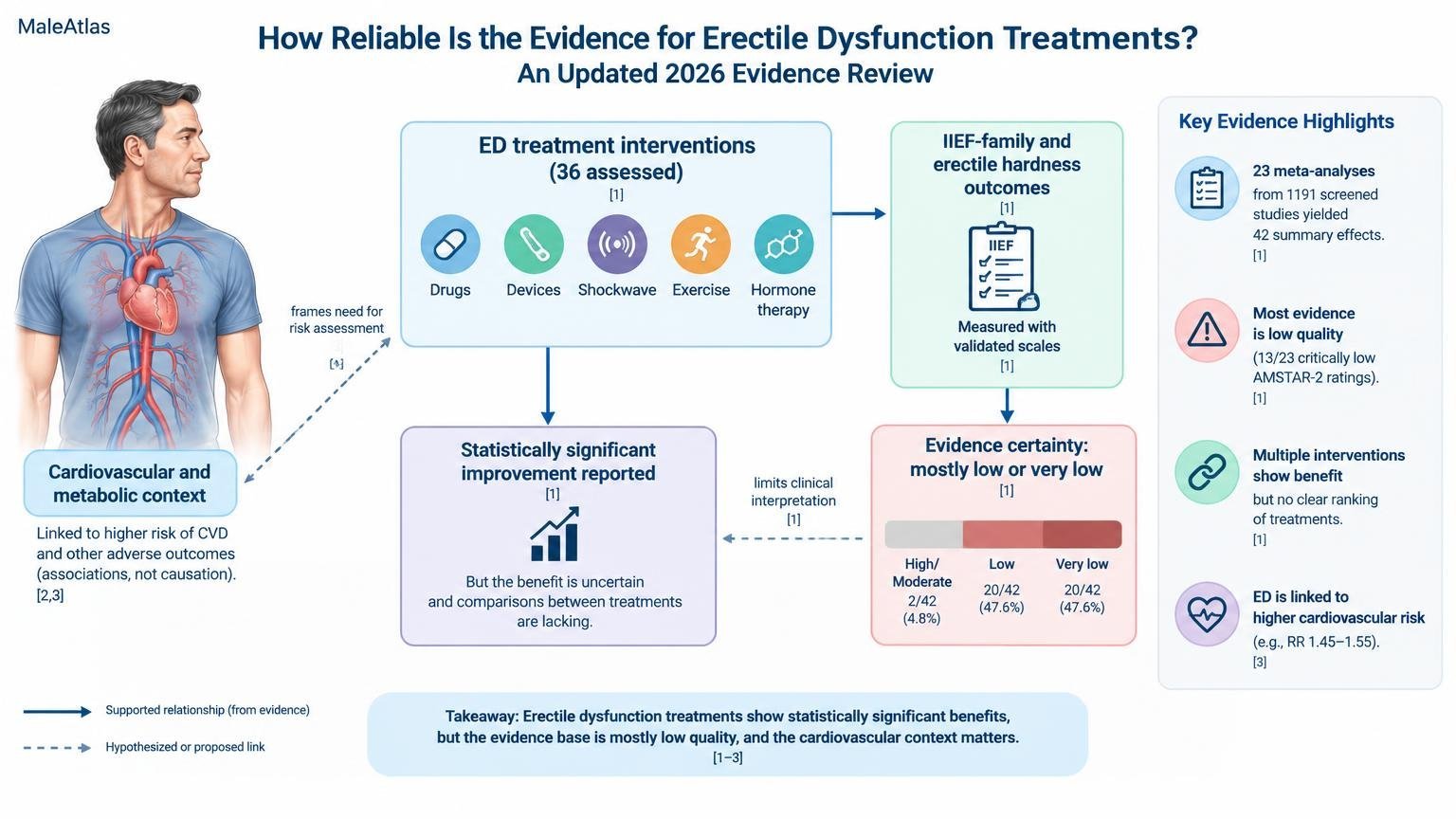
Men asking whether erectile dysfunction treatments work are usually offered a confident answer. The more difficult question is how strong the evidence behind that answer really is. A 2026 umbrella review of systematic reviews and meta-analyses examined this directly, screening 1191 studies and extracting 23 published meta-analyses that produced 42 summary effects across 36 interventions, assessed with the International Index of Erectile Function (IIEF), its short and erectile-function versions, and the erectile hardness score.[1]
The findings cut in two directions. Statistically significant improvements were observed with both pharmacological and nonpharmacological interventions, but the reviewers cautioned that limited patient numbers and subjective outcome measures weaken interpretation. Their overall conclusion was blunt: the treatment landscape is increasingly diverse, yet the reliability of the evidence is poor.
The quality appraisal explains why. Of the 23 meta-analyses, 13 (56.5%) were rated critically low on AMSTAR-2, 7 (30.5%) low, 2 (8.7%) moderate and 1 (4.3%) high. At the level of individual summary effects, only one was rated high quality and one moderate, while 20 (47.6%) were rated low and 20 (47.6%) very low.
- Erectile dysfunction is common with age but is not a normal consequence of aging, and it can signal vascular or neurological disease.[2]
- Across 42 summary effects, evidence certainty was concentrated in the low and very low categories rather than the high category.
- Observational data link erectile dysfunction to later cardiovascular events, which frames treatment as part of broader risk assessment rather than an isolated sexual problem.[3]
Why This Matters
Erectile dysfunction is often framed as a quality-of-life issue that a tablet can solve. That framing understates both its medical meaning and the uncertainty in its treatment literature. A patient-education resource notes that erectile dysfunction becomes more common with age but is not a natural part of aging, and that it can reflect obstructed blood vessels or nerve damage from diabetes.
The cardiovascular signal is substantial. A secondary clinical guide reports that a 2021 umbrella review found men with erectile dysfunction had higher relative risks of cardiovascular disease (RR 1.45), coronary heart disease (RR 1.50), cardiovascular mortality (RR 1.50), myocardial infarction (RR 1.55), stroke (RR 1.36) and all-cause mortality (RR 1.25). These are observational associations, not proof of causation, but they change what a treatment conversation should include.
If the treatments themselves rest on mostly low-certainty evidence, then confident claims about comparative effectiveness deserve scrutiny. That is the central tension this review examines: a crowded therapeutic marketplace supported by an evidence base that has not yet caught up with it.
The Biology Behind the Treatment Targets
An erection is a vascular event requiring coordinated nerve signaling, blood flow, hormonal milieu and psychological state. A secondary clinical guide describes the core pathway: arousal triggers nitric oxide release in penile arteries, nitric oxide activates guanylate cyclase, and cyclic GMP relaxes arterial smooth muscle so blood fills the corpora cavernosa. Phosphodiesterase type 5 inhibitors block the enzyme that degrades cyclic GMP, which is why they require sexual stimulation to be effective.
The guide also describes the artery-size hypothesis: penile arteries are 1 to 2 mm in diameter, roughly one-third the size of coronary arteries, so atherosclerotic plaque may cause symptoms in the penis years before it affects the heart. This remains a proposed explanatory hypothesis rather than an established causal mechanism, but it is consistent with the observational cardiovascular associations described above.
These biological targets explain why treatments are heterogeneous. Drugs act on the nitric oxide–cyclic GMP pathway, vacuum devices act mechanically, shockwave therapy proposes tissue-level effects, exercise acts on endothelial and metabolic function, and testosterone acts chiefly on libido and nitric oxide signaling in men with confirmed deficiency. Each mechanism implies a different expected effect size and a different vulnerability to bias.
What the Umbrella Review Actually Shows
The umbrella review searched PubMed, Web of Science, the Cochrane Library and Embase for studies published up to October 2025. From 1191 screened studies it extracted 23 meta-analyses yielding 42 summary effects on IIEF (n = 20), IIEF-5 (n = 9), IIEF-EF (n = 6) and erectile hardness score (n = 7) across 36 interventions.
The headline result is that statistically significant improvements appeared for both pharmacological and nonpharmacological interventions. This is a broad statement, not a ranking. The review did not establish that one treatment outperforms another, and its authors explicitly called for high-quality meta-analyses of inter-treatment comparisons, which the current literature lacks.
The quality appraisal is the more informative finding. AMSTAR-2 ratings placed 13 of 23 meta-analyses in the critically low category, and only two of 42 summary effects reached high or moderate quality. When almost half of summary effects are graded very low, statistical significance and clinical confidence separate sharply.
| Variable | Source-grounded definition | Interpretation |
|---|---|---|
| Meta-analyses appraised | 23 published meta-analyses extracted from 1191 screened studies | The synthesis rests on 23 reviews rather than unique trials. |
| AMSTAR-2 rating: critically low | 13 of 23 meta-analyses (56.5%) | Most included reviews carry serious methodological concerns. |
| AMSTAR-2 rating: moderate or high | 2 of 23 meta-analyses (8.7% moderate; 4.3% high) | Only a small minority of reviews are methodologically robust. |
| Summary effects rated low or very low | 20 low (47.6%) and 20 very low (47.6%) of 42 | Certainty is concentrated at the bottom of the grading scale. |
| Summary effects rated high or moderate | 1 high and 1 moderate of 42 | Very few outcome estimates support strong clinical claims. |
| Interventions covered | 36 interventions measured with IIEF, IIEF-5, IIEF-EF and EHS | Breadth of options exceeds the depth of comparative evidence. |
Reading the Evidence by Treatment Category
Low-intensity shockwave therapy illustrates the certainty problem well. A secondary clinical guide reports that a 2025 Cochrane review of 21 randomized trials (1357 men) found short-term IIEF-EF gains of roughly 3.9 points and long-term gains of 5.3 points versus sham, but rated the evidence low certainty. The same guide notes that several included trials were industry-funded, mainly by device makers.
Lifestyle intervention has separate support. The guide reports a 2023 Journal of Sexual Medicine meta-analysis finding aerobic exercise improves IIEF-EF scores by about 2.8 points. That is a modest average effect on a validated scale, and it comes from summarized rather than primary data here, but it aligns with the vascular framing of erectile dysfunction.
Testosterone therapy is often misunderstood. In the TRAVERSE trial (n = 5246 hypogonadal men with preexisting or high cardiovascular risk), transdermal testosterone was noninferior to placebo for major adverse cardiac events (HR 0.96, 95% CI 0.78–1.17) over a mean 21.7 months, though atrial fibrillation, acute kidney injury and pulmonary embolism were more common with testosterone. The guide notes testosterone is not effective as standalone erectile dysfunction therapy and mainly augments response in confirmed hypogonadism.
Safety remains a hard boundary rather than an evidence-grading question. The guide states that phosphodiesterase type 5 inhibitors are absolutely contraindicated with nitrate medications and recreational nitrites because the combination can cause severe, potentially fatal hypotension. A 2025 analysis of 53,517 FDA Adverse Event Reporting System reports (2004–2024) identified label-listed side effects plus some nervous-system, cardiovascular and eye signals not on the labels that need further study; spontaneous reporting cannot establish incidence or causation.
Contextual Contributors and Conflicting Signals
Some of the most interesting recent evidence concerns what else is happening in a man's body. In a 2018 study of 150 men newly diagnosed with moderate to severe obstructive sleep apnea, erectile dysfunction prevalence was 51%. Erectile function scores rose after three months of continuous positive airway pressure, but the authors could not determine conclusively whether it works as a stand-alone treatment.
Comparative data in this area conflict. A 2023 meta-analysis of 8 studies (457 patients) reported higher post-treatment IIEF-5 scores with sildenafil than with continuous positive airway pressure (37.7 versus 27.3), with the authors suggesting combination may add benefit. A 2021 Cochrane review rated the evidence for continuous positive airway pressure versus no treatment as very uncertain and found sildenafil may slightly improve erectile function compared with it at 12 weeks. Very uncertain and slightly are doing real work in that sentence.
Glucagon-like peptide-1 receptor agonist evidence is similarly unsettled. A 2025 controlled pilot study in men with obesity-associated hypogonadism found tirzepatide produced greater weight loss and IIEF-5 improvement than lifestyle alone and significantly raised total testosterone, LH, FSH and SHBG. In contrast, a 2024 TriNetX database analysis of 3094 non-diabetic, non-hypogonadal men aged 18–50 taking semaglutide for weight loss found higher rates of new erectile dysfunction diagnosis or phosphodiesterase inhibitor prescription (1.47% versus 0.32%) and testosterone deficiency (1.53% versus 0.80%) than matched unexposed men, though absolute rates were low and causality cannot be inferred.
A 2026 narrative review described GLP-1 receptor agonists as showing promising results in men while case reports suggested possible sexual side effects with tirzepatide, with the authors calling the overall evidence inconsistent. Different populations and designs can produce different directions of effect without either being wrong.
Smoking illustrates the limits of small cross-sectional work. In a survey of 77 male undergraduates, no statistically significant association was found between smoking and erectile dysfunction (chi-square p = 0.082; Fisher p = 0.137; OR 0.84, 95% CI 0.34–2.10), with erectile dysfunction present in 46.7% of smokers and 51.1% of non-smokers. Among smokers, 93.3% had a light smoking index, and among smokers with erectile dysfunction, 50.0% had 4 to 6 years of consumption. A null result in young, lightly exposed men does not overturn the vascular risk associated with long-term heavy smoking.[4]
Interpretation and Limitations
Three distinctions organize this literature. The first is statistical versus clinical significance: a significant IIEF change of a few points may or may not correspond to a difference a man notices or values. The second is association versus causation, which applies to the cardiovascular and metabolic literature and to database analyses of weight-loss drugs. The third is evidence about a review versus evidence about a trial; AMSTAR-2 ratings describe the methodological quality of meta-analyses, not the quality of every underlying study.
The umbrella review itself has boundaries. It synthesizes existing reviews, so overlapping trials may be counted more than once across meta-analyses, and the count of 23 reviews does not equal 23 independent bodies of evidence. Its own conclusions are interpretive. It did not perform primary data collection, and it explicitly called for better single-treatment studies and inter-treatment comparisons.
Much of the treatment-specific detail here arrives through a secondary physician-authored guide rather than the primary trial publications, which adds a layer of interpretation between the reader and the data. The planned hypertension study retrieved in this packet is a protocol only, scheduled for January 2026 to February 2027, with no observed outcomes; it plans to use the IIEF-5 in men aged 35 to 75 and acknowledges selection, information and confounding biases. It cannot yet inform treatment decisions.[5]
Research Outlook
The clearest research priority is not more interventions but better comparisons. The umbrella review authors recommended well-designed studies of single treatments and high-quality meta-analyses comparing treatments against each other, which is precisely what a man choosing among options needs and what the current literature largely lacks.
Several specific gaps stand out. Long-term sham-controlled shockwave data remain low certainty and partly industry-funded. Cardiovascular outcomes of erectile dysfunction therapies, including possible cardioprotective effects discussed in consensus guidance, require adequately powered trials rather than observational signals. The bidirectional metabolic story around GLP-1 receptor agonists needs controlled studies that separate weight loss, testosterone change and erectile function.
Measurement is another frontier. The reliance on IIEF-family instruments and the erectile hardness score is practical, but these are subjective, and the umbrella review flagged subjective outcome indicators as a limitation. Objective or patient-defined meaningful-change anchors would strengthen future syntheses.
Key Takeaways
- An umbrella review of 23 meta-analyses covering 42 summary effects across 36 interventions found significant improvements with pharmacological and nonpharmacological treatments, but rated the overall reliability of the evidence as poor.
- Only 1 of 23 meta-analyses was rated high quality on AMSTAR-2, and only 2 of 42 summary effects reached high or moderate quality.
- Erectile dysfunction is associated with later cardiovascular disease, coronary heart disease, stroke and mortality in observational syntheses, so evaluation should include cardiovascular risk assessment.
- Modest average benefits are reported for aerobic exercise (about 2.8 IIEF-EF points) and low-certainty benefits for shockwave therapy (about 3.9 short-term and 5.3 long-term IIEF-EF points versus sham).
- Phosphodiesterase type 5 inhibitors are absolutely contraindicated with nitrates and recreational nitrites because of potentially fatal hypotension.
Questions and Answers
What did the 2026 umbrella review of erectile dysfunction treatments find?
It screened 1191 studies and extracted 23 meta-analyses producing 42 summary effects across 36 interventions. Statistically significant improvements appeared with both pharmacological and nonpharmacological treatments, but the reviewers concluded the reliability of the evidence is poor, citing limited patient numbers and subjective outcome measures.
How reliable is the evidence behind erectile dysfunction treatments?
Mostly low certainty. On AMSTAR-2, 13 of 23 meta-analyses were critically low quality and only 1 was high quality. Of 42 summary effects, 20 were rated low and 20 very low, with just one high and one moderate. Statistical significance therefore does not equal strong clinical evidence.
Why is erectile dysfunction considered a cardiovascular warning sign?
Observational syntheses report higher relative risks of cardiovascular disease, coronary heart disease, myocardial infarction, stroke and mortality in men with erectile dysfunction. The artery-size hypothesis proposes that smaller penile arteries show plaque effects earlier, though this remains a proposed explanation rather than proven causation.
Does aerobic exercise improve erectile function scores?
A 2023 meta-analysis summarized in a secondary clinical guide found aerobic exercise improves IIEF-EF scores by about 2.8 points on average. That is a modest mean effect from summarized rather than primary data, and it should be interpreted alongside cardiovascular risk assessment rather than as a substitute for it.
What is the evidence for low-intensity shockwave therapy for erectile dysfunction?
A 2025 Cochrane review of 21 randomized trials covering 1357 men found short-term IIEF-EF gains of roughly 3.9 points and long-term gains of 5.3 points versus sham, but rated the evidence low certainty. Several included trials were industry-funded, mainly by device makers, limiting confidence in routine use.
Does smoking cause erectile dysfunction in young men?
Not established by small cross-sectional data. In 77 male undergraduates, no significant association was found between smoking and erectile dysfunction (OR 0.84, 95% CI 0.34–2.10), with 93.3% of smokers having a light smoking index. This does not overturn the vascular risk linked to long-term heavy smoking.
Conceptual framework: Conceptual framework. Population: men with erectile dysfunction across 23 meta-analyses and 42 summary effects. Evidence type: umbrella review plus secondary clinical summaries; associations and certainty grades are shown as reported, and the cardiovascular framing is a proposed interpretive link, not a tested causal model.
Academic References & Evidence
- Current treatment for erectile dysfunction: an umbrella review of systematic reviews and meta-analyses.
- Disfunção Erétil – Saúde Comunitária.
- Erectile Dysfunction. 2026
- Tabaquismo y disfunción eréctil en estudiantes de Abogacía e Ingeniería Ambiental, CUNORI. Revista Científica Internacional. 2026 9(1)
- Gascón Cárceles, Alba. DSpace Colección :. (protocol)
SANYUN Science Center explains published research on men's reproductive and sexual health, connecting scientific evidence with everyday questions while making sources and limitations clear.
Disclaimer: This article is for scientific education and research communication only. It does not provide medical advice, diagnosis, or individualized treatment recommendations, and does not endorse any medication, supplement, device, penile enlargement procedure, or other intervention. Decisions about sexual and reproductive health should be made in consultation with a qualified healthcare professional. Do not delay seeking professional care because of information in this article.
Original Content & Copyright Notice
- This article is prepared for SANYUN Science Center, drawing on published research and publicly available academic literature on men’s sexual and reproductive health. Its editorial explanations and presentation are developed for this platform.
- Copyright in the original editorial content, selection, and arrangement is reserved by SANYUN Science Center to the extent protected by applicable law. Referenced research, quotations, and third-party materials remain subject to the rights of their respective owners. This notice does not claim ownership of scientific facts or third-party research.
- Except where permitted by applicable law or an applicable license, prior written permission is required to reproduce, republish, translate, adapt, redistribute, or commercially reuse protected content. Attribution alone does not grant permission for such reuse.
- For permitted quotation or authorized reuse, clearly identify the source and retain a link to the original article.
- Source: SANYUN Science Center
- Original URL: Retain the original article URL on science.san-yun.com.
- Copyright Holder: SANYUN Science Center, for its own protected editorial content.
- Quotation, excerpts, or authorized reuse must not distort the scientific meaning, omit material limitations or disclaimers, or imply unverified medical claims, product efficacy, or endorsement by SANYUN Science Center.



