




Category: Erectile Dysfunction
Core Research Direction: How strong is the evidence base for current erectile dysfunction treatments, and how should clinicians interpret statistically significant but low-certainty efficacy signals alongside cardiovascular-risk context and specialist-referral triggers?
Search Intent: When men are offered a treatment for erectile dysfunction, how reliable is the underlying evidence, and which clinical features should prompt cardiovascular risk assessment or specialist referral?
Platform: SANYUN Science Center
Evidence reviewed through: 2026-11-11
Executive Summary
Men seeking treatment for erectile dysfunction are offered an unusually broad menu of options, from oral drugs and lifestyle change to shockwave devices and surgery. The more useful question for clinicians is not whether a pooled analysis reports a statistically significant improvement, but how much confidence that improvement deserves. A 2026 umbrella review of systematic reviews and meta-analyses addressing exactly this problem found a diverse treatment landscape supported by predominantly low or very low quality evidence.[1]
That umbrella review screened 1191 studies, extracted 23 published meta-analyses and produced 42 summary effects across four erectile-function instruments, covering 36 interventions. On AMSTAR-2 appraisal, 13 of the 23 meta-analyses (56.5%) were rated critically low quality, 7 (30.5%) low, 2 (8.7%) moderate and one (4.3%) high. At the level of individual summary effects, 20 of 42 (47.6%) were rated low and 20 (47.6%) very low, leaving only two effects rated high and moderate respectively.
This does not mean current treatments fail. It means statistical significance in this literature often rests on small patient numbers and subjective outcome measures, so a positive pooled estimate is a signal to interpret rather than a settled verdict. Cardiovascular context and clear referral triggers matter as much as the size of an efficacy estimate.[2][3][4]
Why the Certainty Question Matters
Erectile dysfunction is common and treatable, and the treatment landscape is expanding rather than contracting. When a field grows faster than its evidence base, patients and clinicians inherit a gap between what is offered and what is well established. The umbrella review's authors describe the treatment landscape as increasingly diverse while characterising the reliability of the evidence as poor, and they call for better-designed single-treatment studies and high-quality meta-analyses comparing treatments head to head.
For a clinician, the practical consequence is a discipline of reading: distinguishing an effect that survived pooling with rigorous methods from one that survived pooling of weaker trials, and distinguishing both from a marketing claim. The rest of this review sets out the mechanism context, what the pooled evidence actually shows, the cardiovascular frame in which treatment decisions sit, and the features that should redirect a consultation toward specialist assessment.
Biological and Clinical Mechanism
An erection is a coordinated vascular event involving nervous, vascular, hormonal and psychological inputs. Sexual arousal triggers nerve signals that release nitric oxide in the penile arteries; nitric oxide activates guanylate cyclase, which produces cyclic GMP, the molecule that relaxes smooth muscle in penile arterial walls and allows blood to fill the corpora cavernosa. This pathway is the shared target of the first-line drug class and the reason a vascular problem elsewhere in the body can present first in the bedroom.
Hormonal status is a second, often intertwined input. One clinical guide reports that low testosterone, defined as total testosterone consistently below 300 ng/dL on two early-morning draws, is found in roughly 20 to 40 percent of men with erectile dysfunction. That figure comes from a narrative guide rather than a primary prevalence study, and it should be read as an approximate clinical estimate rather than a measured population parameter.
Because the same endothelial and atherosclerotic processes that narrow coronary arteries also affect the smaller penile arteries, erectile dysfunction can precede cardiac symptoms. A 2023 umbrella review, cited within the same clinical guide, reported higher relative risks among men with erectile dysfunction for cardiovascular disease (RR 1.45, 95% CI 1.36 to 1.54), coronary heart disease (RR 1.50), cardiovascular mortality (RR 1.50), myocardial infarction (RR 1.55), stroke (RR 1.36) and all-cause mortality (RR 1.25), all with P less than 0.001. These are associations from pooled observational literature; the guide does not describe the adjustment sets, so causal inference is not warranted.
The 2024 Princeton IV Consensus, as summarised in the same guide, formalised the clinical response: any man presenting with erectile dysfunction should undergo cardiovascular risk assessment before starting treatment, and PDE5 inhibitors are framed as cardioprotective rather than merely safe in stable cardiac patients. This is a consensus recommendation summarised secondhand, not a trial result.
What the Evidence Shows
| Evidence layer | What was reported | Interpretation |
|---|---|---|
| Umbrella review scope | 1191 studies screened; 23 meta-analyses; 42 summary effects; 36 interventions | Broad but shallow: many interventions, few robust pooled conclusions |
| Review methodology quality | 13/23 (56.5%) critically low; 7 (30.5%) low; 2 (8.7%) moderate; 1 (4.3%) high on AMSTAR-2 | Most reviews underlying the field's summaries are themselves methodologically weak |
| Summary effect quality | 20 (47.6%) low; 20 (47.6%) very low; only two rated high and moderate | Statistically significant pooled effects mostly carry low certainty |
| Overall conclusion | Predominantly low or very low quality; significant improvements with pharmacological and nonpharmacological interventions, interpreted cautiously | Efficacy signals are real but fragile; limited patients and subjective endpoints |
| Low-intensity shockwave therapy | 21 randomized trials, 1357 men; IIEF-EF about +3.9 points short-term, +5.3 long-term vs sham; low certainty | A concrete example of a positive but low-certainty signal |
| PDE5 inhibitor response | Effective in roughly 60 to 80 percent of men with ED | Guide-level estimate without a primary trial denominator in this packet |
The umbrella review is the anchor for this review because it asks the question clinicians actually face: how good is the evidence across the whole field. Its answer is sobering but not nihilistic. Statistically significant improvements in erectile dysfunction were observed with both pharmacological and nonpharmacological interventions, yet the authors caution that these findings should be interpreted carefully because of the limited number of patients and the subjective nature of outcome indicators.
A concrete illustration of what a low-certainty signal looks like comes from the shockwave literature. A 2025 Cochrane review of 21 randomized trials involving 1357 men found that low-intensity shockwave therapy may improve IIEF-EF scores by roughly 3.9 points in the short term and 5.3 points in the long term versus sham, with low certainty of evidence. A point improvement of that size may be meaningful to an individual, but low certainty means the estimate could plausibly shift with better trials.
For the first-line drug class, one clinical guide states that all four PDE5 inhibitors are effective in roughly 60 to 80 percent of men with erectile dysfunction. That range is a guide-level statement rather than a figure tied to a specific trial denominator in this packet, and it should not be presented to patients as a precise probability.
Apparent treatment failure deserves scrutiny before the drug is abandoned. The same guide notes that most guidelines recommend at least 6 to 8 trials at optimal dose before concluding failure, and that incorrect use, insufficient waiting time, food interactions and unrecognised hypogonadism account for a substantial share of apparent non-response.
Safety reporting adds a different kind of evidence. A 2025 analysis of the FDA Adverse Event Reporting System covering 53,517 reports across two decades found sildenafil generated the most adverse-event reports, followed by tadalafil, vardenafil and avanafil, partly reflecting prescribing volume. Spontaneous reporting cannot establish incidence or causation, but it is a reminder that volume, not just risk, shapes the safety picture.
One safety point is absolute rather than statistical. The guide states that PDE5 inhibitors are absolutely contraindicated with nitrate medications and recreational nitrites, because the combination can cause severe, potentially fatal hypotension. No efficacy discussion supersedes that.
Cardiovascular Context and Risk Stratification
Cardiovascular risk assessment is not an optional preamble to prescribing; per the Princeton IV summary, it precedes treatment. The framework described in the guide sorts men into three tiers. The low-risk tier covers men who are asymptomatic with fewer than three cardiovascular risk factors, controlled hypertension, mild stable angina, NYHA class I to II heart failure and exercise tolerance of at least 5 METs without symptoms; for these men, PDE5 inhibitors may be initiated in primary care with standard counselling.
The high-risk tier is where prescribing must stop and cardiology takes over. Per the same summary, unstable or refractory angina, uncontrolled hypertension, NYHA class IV heart failure, myocardial infarction within 2 weeks, high-risk arrhythmia, obstructive hypertrophic cardiomyopathy and moderate-to-severe valvular disease all warrant deferring sexual activity and PDE5 inhibitor initiation until the cardiac condition is stabilised and reassessed.
Testosterone therapy sits inside this cardiovascular conversation, and the trial evidence is more settled than the observational literature. TRAVERSE, a trial of 5246 hypogonadal men with elevated cardiovascular risk, found transdermal testosterone non-inferior to placebo for major adverse cardiac events (HR 0.96, 95% CI 0.78 to 1.17) over a mean 21.7 months. A 2026 meta-analysis of 41 randomized trials corroborated the null signal (OR 0.83, 95% CI 0.52 to 1.32).
That neutrality is not the same as harmlessness. TRAVERSE reported higher rates in the testosterone arm of pulmonary embolism (0.9% versus 0.5%), atrial fibrillation (3.5% versus 2.4%) and acute kidney injury (2.3% versus 1.5%). The guide's interpretation that an observational cohort reporting HR 1.27 reflects confounding by indication is plausible but is the guide's reasoning, not a separate randomised finding.
Referral Triggers and Their Evidence Status
Guideline-aligned referral summaries are a different evidence type from the pooled efficacy literature, and they should be read as structured clinical reasoning rather than trial data. They nonetheless supply the practical guardrails. Endocrinology referral is advised when hypogonadism is suspected on the basis of low serum testosterone or abnormalities in FSH, LH or prolactin, and when testosterone replacement is being considered; erectile dysfunction with suspected hypogonadism is explicitly listed as a reason for endocrinology referral.
Urology referral follows a different logic. The guideline-aligned answer advises it for a penile structural abnormality or abnormal testicular examination, for a young patient or one with a lifelong history of difficulty obtaining or maintaining an erection suggesting possible primary erectile dysfunction, and for a history of pelvic, perineal or genital trauma. The same source summarises the division of labour: endocrinology for hormonal diagnosis and management, urology for anatomical or trauma-related concerns.[5]
These triggers are broadly consistent across the two summaries and are attributed to British Society for Sexual Medicine and European Association of Urology guidance. They are not derived from the umbrella review, and none of the packet sources provides outcome data showing that referral on these criteria improves sexual or cardiovascular outcomes. They are best understood as consensus-derived safety nets.
Interpretation and Limitations
Several limitations should temper any confident reading. First, the umbrella review is presented through a Figshare dataset record assessed here as a preprint, and the packet does not include its full methods, effect estimates per intervention or heterogeneity analyses. It tells us about the quality of the field more reliably than about the size of any single treatment effect.
Second, many clinical figures in this review are drawn from a narrative physician guide rather than primary trials. The cardiovascular relative risks, the 60 to 80 percent PDE5 inhibitor response range and the 20 to 40 percent hypogonadism prevalence estimate are all quoted secondhand. They are useful orientation, not verified parameters, and the packet does not allow independent checking of their adjustment sets or denominators.
Third, context matters for newer evidence. In a 2025 controlled pilot study, tirzepatide produced greater weight loss and IIEF-5 improvement than lifestyle alone in men with obesity-associated hypogonadism and significantly raised total testosterone, LH, FSH and SHBG; a pilot is hypothesis-generating, not confirmatory. Conversely, a 2024 database analysis found higher rates of new erectile dysfunction diagnoses and testosterone deficiency among non-diabetic, non-hypogonadal men taking semaglutide for weight loss, but the signal attenuated considerably after adjustment.
Fourth, association is not causation throughout the cardiovascular material, and a statistically significant relative risk of 1.45 is not a prediction for an individual man. Conversely, a low-certainty efficacy estimate is not proof of ineffectiveness. The correct posture is calibrated uncertainty: use the intervention landscape, respect the absolute safety contraindications, and let cardiovascular and referral criteria decide who needs more than a prescription.
Research Outlook
The umbrella review's own prescription is straightforward: better-designed studies of single treatments and high-quality meta-analyses comparing treatments against one another. The current literature is rich in interventions and poor in reliable comparisons, which is why 20 of 42 summary effects sit at low quality and another 20 at very low quality.
Two adjacent strands are worth watching. Metabolic and sleep-related contributors are receiving more attention: in one 2018 study of 150 men newly diagnosed with moderate-to-severe obstructive sleep apnea, the prevalence of erectile dysfunction was 51 percent, a cross-sectional association from a single cohort that does not establish causation but does flag a population worth screening. And the regulatory picture around unregulated supplements remains a safety issue rather than an efficacy one; the guide states the FDA has issued roughly 445 tainted-product notices since 2012, most containing undeclared PDE5 inhibitors.
Key Takeaways
- The erectile dysfunction treatment evidence base is broad but weak: 23 meta-analyses and 42 summary effects, with most reviews and most summary effects rated low or very low quality.
- Statistically significant improvements were reported for both pharmacological and nonpharmacological interventions, but the review authors urge caution because of limited patient numbers and subjective endpoints.
- Erectile dysfunction carries pooled associations with cardiovascular disease (RR 1.45, 95% CI 1.36 to 1.54) and stroke (RR 1.36), and current consensus places cardiovascular risk assessment before treatment.
- Absolute contraindications are not statistical: PDE5 inhibitors must not be combined with nitrates or recreational nitrites.
- Referral triggers are consensus-derived rather than trial-proven: endocrinology for suspected hypogonadism, urology for structural, testicular, trauma-related or lifelong primary presentations.
- Newer metabolic evidence remains early-stage: a pilot tirzepatide study and an adjusted observational semaglutide signal should inform hypotheses, not practice certainties.
Questions and Answers
How reliable is the evidence for erectile dysfunction treatments?
Broad but mostly weak. A 2026 umbrella review extracted 23 meta-analyses covering 36 interventions and produced 42 summary effects; 13 reviews (56.5%) were rated critically low on AMSTAR-2 and only one high quality. Of the summary effects, 20 were low and 20 very low quality, so pooled statistical significance rarely equates to high certainty.
What does the umbrella review of erectile dysfunction treatments actually find?
It reports statistically significant improvements in erectile function with both pharmacological and nonpharmacological interventions. However, the authors caution that findings should be interpreted carefully because of limited patient numbers and the subjective nature of outcome measures, and they call for better single-treatment trials and high-quality head-to-head meta-analyses.
Why is erectile dysfunction treated as a cardiovascular warning sign?
Pooled observational data cited in a clinical guide link erectile dysfunction to higher relative risks of cardiovascular disease (RR 1.45, 95% CI 1.36 to 1.54), coronary heart disease (RR 1.50) and stroke (RR 1.36). The 2024 Princeton IV Consensus, as summarised there, recommends cardiovascular risk assessment before starting treatment, treating erectile dysfunction as a risk-enhancing factor.
When should a man with erectile dysfunction be referred to endocrinology or urology?
Guideline-aligned summaries advise endocrinology referral for suspected hypogonadism, low testosterone or abnormal FSH, LH or prolactin, and when testosterone replacement is being considered. Urology referral is advised for penile structural abnormality, abnormal testicular examination, pelvic or genital trauma, or a young or lifelong presentation suggesting primary erectile dysfunction.
How certain is the evidence for low-intensity shockwave therapy for erectile dysfunction?
A 2025 Cochrane review of 21 randomised trials involving 1357 men found shockwave therapy may improve IIEF-EF scores by roughly 3.9 points short-term and 5.3 points long-term versus sham. The certainty of evidence was rated low, so the direction may be real while the magnitude remains uncertain and not established as a universal recommendation.
Is testosterone therapy safe for men with hypogonadism and cardiovascular risk?
The TRAVERSE trial of 5246 hypogonadal men with elevated cardiovascular risk found transdermal testosterone non-inferior to placebo for major adverse cardiac events (HR 0.96, 95% CI 0.78 to 1.17) over a mean 21.7 months, and a 2026 meta-analysis of 41 trials agreed. Small absolute increases in pulmonary embolism, atrial fibrillation and acute kidney injury still warrant counselling.
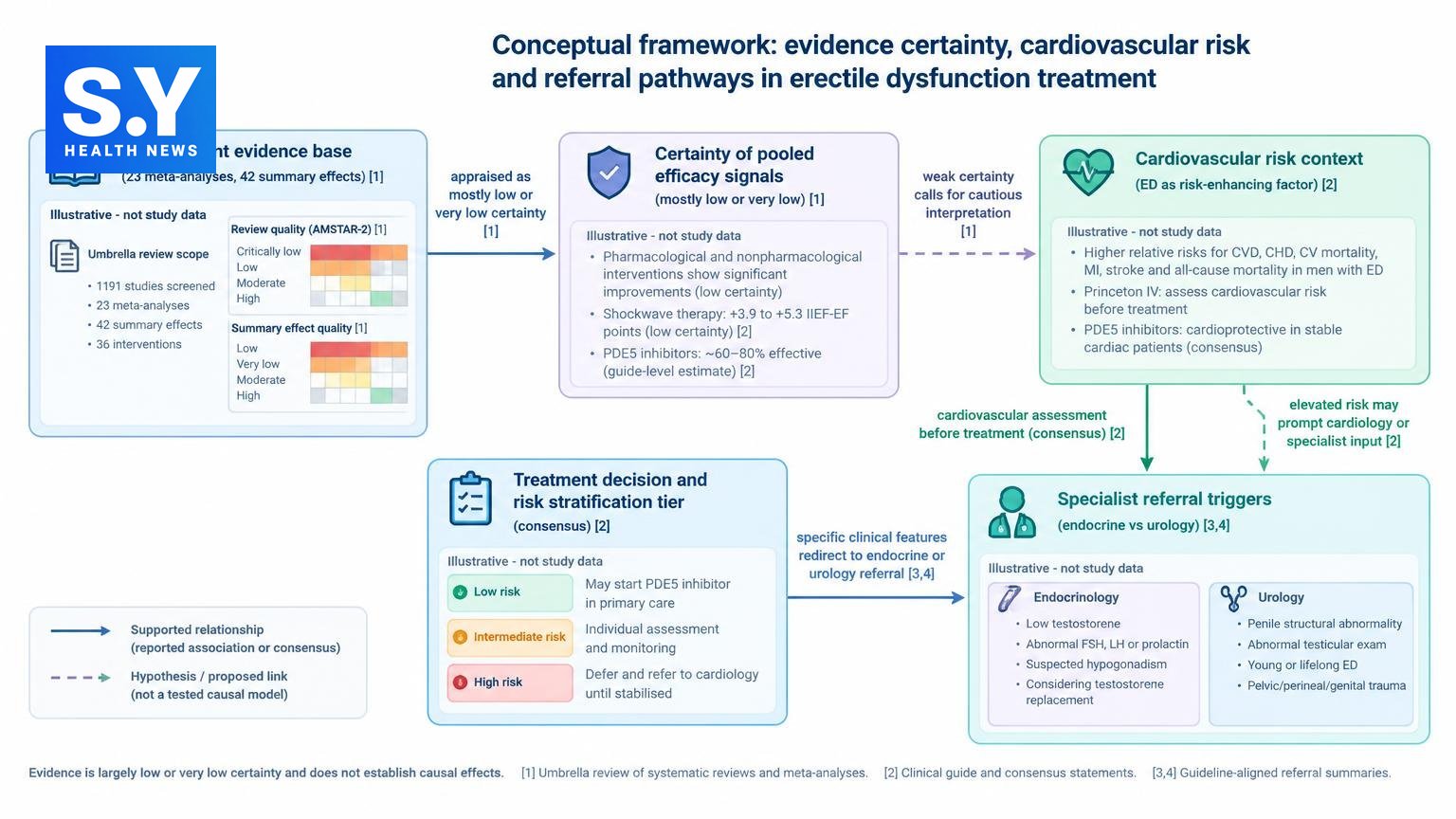
Conceptual framework: Conceptual framework. The diagram shows how appraised certainty of the pooled erectile dysfunction treatment evidence sits alongside cardiovascular risk context and consensus-based referral triggers. Supported links reflect reported associations or consensus recommendations; the link from evidence certainty to treatment decision is a proposed interpretive relationship, not a tested causal model. Evidence is largely low or very low certainty and does not establish causal effects.
Academic References & Evidence
- Current treatment for erectile dysfunction: an umbrella review of systematic reviews and meta-analyses. Figshare. 2026 DOI: 10.6084/m9.figshare.31562993.v1. (preprint)
- Parth Bhavsar. Erectile Dysfunction. 2026
- Kola Tytler. Referring a Patient for Specialist Assessment of Male: Guideline-align. 2025
- Kola Tytler. Hypogonadism: When to Refer: Guideline-aligned Answer | iatroX. 2025
- Kola Tytler. Referring a Patient With Hypogonadism: Guideline-aligned Answer | iatr. 2025
SANYUN Science Center explains published research on men's reproductive and sexual health, connecting scientific evidence with everyday questions while making sources and limitations clear.
Disclaimer: This article is for scientific education and research communication only. It does not provide medical advice, diagnosis, or individualized treatment recommendations, and does not endorse any medication, supplement, device, penile enlargement procedure, or other intervention. Decisions about sexual and reproductive health should be made in consultation with a qualified healthcare professional. Do not delay seeking professional care because of information in this article.
Original Content & Copyright Notice
- This article is prepared for SANYUN Science Center, drawing on published research and publicly available academic literature on men’s sexual and reproductive health. Its editorial explanations and presentation are developed for this platform.
- Copyright in the original editorial content, selection, and arrangement is reserved by SANYUN Science Center to the extent protected by applicable law. Referenced research, quotations, and third-party materials remain subject to the rights of their respective owners. This notice does not claim ownership of scientific facts or third-party research.
- Except where permitted by applicable law or an applicable license, prior written permission is required to reproduce, republish, translate, adapt, redistribute, or commercially reuse protected content. Attribution alone does not grant permission for such reuse.
- For permitted quotation or authorized reuse, clearly identify the source and retain a link to the original article.
- Source: SANYUN Science Center
- Original URL: Retain the original article URL on science.san-yun.com.
- Copyright Holder: SANYUN Science Center, for its own protected editorial content.
- Quotation, excerpts, or authorized reuse must not distort the scientific meaning, omit material limitations or disclaimers, or imply unverified medical claims, product efficacy, or endorsement by SANYUN Science Center.



