




Category: Erectile Dysfunction
Core Research Direction: Evidence synthesis of current erectile dysfunction management: PDE5 inhibitor first-line therapy, testosterone in confirmed hypogonadism, the cardiovascular risk implications of ED, and the uncertain status of regenerative and device-based options such as low-intensity shockwave therapy
Search Intent: What does the best available evidence support for treating erectile dysfunction in adults today, and how strong is the evidence for each option from first-line PDE5 inhibitors to investigational shockwave and regenerative therapies?
Platform: SANYUN Science Center
Evidence reviewed through: 2026-11-03
Executive Summary
Erectile dysfunction (ED) is common, often vascular in origin, and frequently undertreated. Across the reviewed sources, oral phosphodiesterase type 5 (PDE5) inhibitors remain the standard first-line pharmacological option, with the choice among sildenafil, tadalafil, vardenafil and avanafil individualized by onset, duration, food interaction and cost. The four agents are described as effective in roughly 60–80% of men with ED, although that range is a secondary summary rather than a pooled estimate with a stated outcome definition.[1]
Testosterone is not a general substitute for PDE5 inhibitors. It is positioned as an option for men who have both ED and laboratory-confirmed low testosterone, sometimes alongside a PDE5 inhibitor. The long-running controversy over testosterone and cardiovascular events was substantially narrowed by a large randomized trial reported as non-inferior to placebo for major adverse cardiac events in hypogonadal men at elevated cardiovascular risk, while small absolute increases in several other adverse events deserve discussion.[2]
ED should also be treated as a cardiovascular risk marker. A 2023 umbrella review of prior meta-analyses, summarized in one reviewed guide, associated ED with higher relative risks of cardiovascular disease, coronary heart disease, myocardial infarction, stroke and all-cause mortality. These are observational relative estimates, not proof of causation and not individual absolute risk, so vascular assessment belongs inside ED care rather than beside it.[3]
Regenerative and device-based options sit on a different evidentiary tier. Low-intensity shockwave therapy is classified as investigational by the American Urological Association and is not FDA-approved for ED, and the best pooled estimate carries low certainty. Platelet-rich plasma is described as experimental, stem-cell therapy remains in clinical research, and regulators warn about unapproved regenerative products marketed outside trials.
Why Erectile Dysfunction Is More Than a Sexual Symptom
The clinical stakes are twofold. Untreated ED impairs quality of life, confidence and relationships, and it is often the complaint that finally brings a man into care. At the same time, a presentation of ED is an opportunity to detect and modify cardiovascular risk, because the small penile arteries may show the effects of endothelial dysfunction and atherosclerosis earlier than larger coronary vessels. One reviewed guide states that roughly 70% of ED cases have a vascular component and cites the 1–2 mm caliber of penile arteries relative to coronary arteries as a reason disease appears there first. Those figures come from a secondary clinical summary and should be read as contextual estimates rather than primary epidemiologic data.
The AUA guideline, as summarized in one reviewed source, advises counseling men that ED is a risk marker for underlying cardiovascular disease. The 2023 umbrella review went further by quantifying the association across several outcomes. Together these support a simple practical rule: new or persistent ED deserves a vascular history and, where risk factors are present, basic risk-factor assessment rather than a prescription alone.
The field also contains a growing market of unproven options. Shockwave devices, platelet-rich plasma injections, stem-cell clinics and unregulated supplements are marketed directly to men, sometimes with claims that outrun the evidence. Distinguishing established, guideline-endorsed care from investigational, experimental or illegal products is a practical safety skill, not an academic exercise.
The Mechanism Behind Erections and PDE5 Inhibitors
An erection is a neurovascular event. Sexual arousal triggers nitric oxide release in penile arteries; nitric oxide activates guanylate cyclase, raising cyclic GMP, which relaxes cavernosal smooth muscle and allows blood to fill the corpora cavernosa. PDE5 inhibitors block the enzyme that degrades cyclic GMP, amplifying this pathway during sexual stimulation. They do not initiate an erection on their own, which is why adequate stimulation, correct timing and an adequate dose matter so much in practice.
Because the same endothelial and atherosclerotic processes that affect coronary arteries also affect smaller penile arteries, ED can precede cardiac symptoms. This artery-size hypothesis is a plausible mechanistic explanation for the observed associations, but it remains a conceptual model rather than a directly proven causal pathway in any given patient. The meta-analytic risk estimates reviewed here are observational associations and cannot establish that ED causes cardiovascular events.
Testosterone contributes to libido and modulates nitric oxide signaling but is not the primary driver of erection mechanics. In men with confirmed hypogonadism, replacement can improve libido and may augment PDE5 inhibitor response. It is not expected to restore erections in men with normal testosterone, nor to overcome severe vascular or neuropathic disease on its own.
What the Evidence Shows for Established Treatments
First-line pharmacotherapy. The reviewed material describes all four PDE5 inhibitors as broadly effective in roughly 60–80% of men with ED, with differences mainly in onset, duration, food interaction and cost rather than in fundamental efficacy. A 2025 FDA Adverse Event Reporting System analysis cited in one source found sildenafil generated the most adverse-event reports, followed by tadalafil, vardenafil and avanafil, a pattern partly explained by prescribing volume rather than differential toxicity. PDE5 inhibitors are absolutely contraindicated with nitrate medications and recreational nitrites because the combination can cause severe, potentially fatal hypotension.
A meaningful proportion of men do not respond to PDE5 inhibitors, particularly those with diabetes-related nerve damage or prior prostate surgery, and this nonresponse drives research into newer options. Before concluding failure, guidelines summarized in one source recommend at least 6–8 trials at optimal dose, with attention to timing, food effects and sexual stimulation. Unrecognized hypogonadism is another correctable contributor, which is why morning testosterone measurement is recommended in men with ED.
Testosterone. In the 2023 TRAVERSE trial of 5,246 hypogonadal men with elevated cardiovascular risk, transdermal testosterone was non-inferior to placebo for major adverse cardiac events over a mean 21.7 months (HR 0.96, 95% CI 0.78–1.17). The same trial detected higher rates of pulmonary embolism (0.9% vs 0.5%), atrial fibrillation (3.5% vs 2.4%) and acute kidney injury (2.3% vs 1.5%) in the testosterone arm. These are small absolute differences but relevant to shared decision-making. Testosterone remains indicated only for confirmed hypogonadism, not as general ED therapy.
Cardiovascular risk. The 2023 umbrella review reported that men with ED had higher relative risks of cardiovascular disease (RR 1.45, 95% CI 1.36–1.54), coronary heart disease (RR 1.50), cardiovascular mortality (RR 1.50), myocardial infarction (RR 1.55), stroke (RR 1.36) and all-cause mortality (RR 1.25), all with P<0.001. These are relative risks pooled across prior meta-analyses; individual absolute risk depends on age, blood pressure, lipids, glucose, smoking and family history.
Lifestyle and exercise. A 2023 Journal of Sexual Medicine meta-analysis cited in one source found aerobic exercise improved IIEF-EF scores by roughly 2.8 points. Whether such a change crosses the threshold of clinical meaningfulness for an individual man is uncertain and may depend on baseline severity; the source notes larger gains in severe ED. Exercise should be understood as adjunctive and risk-modifying, not a replacement for evaluation of persistent ED.
Investigational and Experimental Options
Low-intensity shockwave therapy. The 2025 Cochrane review of 21 randomized trials (1,357 men) found low-intensity shockwave therapy may improve short-term IIEF-EF scores by roughly 3.9 points and long-term scores by 5.3 points versus sham, with low certainty of evidence. An early report followed 20 men with mild or moderate ED and found improvement in 15, while stating more research is needed on who benefits and how long any response lasts. The AUA classifies the modality as investigational and it is not FDA-approved for ED, so it should be framed as a discussion point with realistic expectations, not standard care.
Regenerative and topical options. Platelet-rich plasma is described by the AUA as experimental for ED and is not FDA-approved. Stem-cell therapy remains investigational and should be limited to clinical trials. The FDA warns that unapproved regenerative products are often illegally marketed and has received reports of blindness, tumor formation and infections. Separately, a non-medicated over-the-counter gel was authorized by the FDA in June 2023 for men aged 22 and over through the De Novo device pathway; in a 24-week open-label home-use study, 62% of users improved their erectile function score by more than the minimum meaningful amount, but the study was not designed to compare the gel with pills. A sildenafil oral film represents a formulation change for an established drug rather than a new mechanism.[4]
Other established options. When PDE5 inhibitors are unsuitable or insufficient, vacuum erection devices, intracavernosal injections, intraurethral alprostadil and penile implants remain standard alternatives. Penile implants are described as having patient and partner satisfaction rates over 90% but are irreversible and reserved for treatment-refractory cases. NIDDK notes that oral, injected and urethral ED medicines can be associated with an erection lasting more than four hours, and oral medicines with vision or hearing loss, requiring immediate care. Unregulated supplements marketed as natural sexual enhancers have repeatedly been found to contain hidden ingredients.
| Treatment option | Role in current care | Key reported evidence | Main practical caveat |
|---|---|---|---|
| PDE5 inhibitors (sildenafil, tadalafil, vardenafil, avanafil) | Standard first-line pharmacotherapy | Effective in roughly 60–80% of men with ED | Absolutely contraindicated with nitrates and recreational nitrites; reassess after 6–8 optimal-dose trials |
| Testosterone therapy | Option only for confirmed hypogonadism, sometimes alongside a PDE5 inhibitor | TRAVERSE: HR 0.96 (95% CI 0.78–1.17) for major adverse cardiac events over mean 21.7 months; higher pulmonary embolism, atrial fibrillation and acute kidney injury rates in the testosterone arm | Not general ED therapy; monitor and discuss secondary safety signals |
| Aerobic exercise | Adjunctive lifestyle and vascular-risk intervention | IIEF-EF improvement of roughly 2.8 points in a 2023 meta-analysis | Clinical meaningfulness varies by baseline severity |
| Low-intensity shockwave therapy | Investigational; not FDA-approved for ED | Possible 3.9-point short-term and 5.3-point long-term IIEF-EF gains versus sham, low certainty; early 20-man report found improvement in 15 | Discussion point with realistic expectations; not standard care |
| Platelet-rich plasma and stem cells | Experimental or investigational | No established efficacy; FDA warnings about unapproved regenerative products | Limit to clinical trials; avoid paying for unproven protocols |
| Non-medicated over-the-counter gel | FDA-authorized device (June 2023) for men aged 22 and over | 62% of users improved beyond the minimum meaningful amount in a 24-week open-label study | Not compared with pills; does not replace evaluation of new ED |
Interpretation and Limitations
The evidence base is uneven. PDE5 inhibitor efficacy rests on decades of use and guideline endorsement, but the specific 60–80% range cited here comes from a secondary clinical guide without a stated outcome definition or trial set. The cardiovascular risk estimates are observational and relative; they do not quantify absolute risk for an individual and cannot prove causation. An umbrella review pools prior meta-analyses, which can inherit overlapping populations and publication bias.
For testosterone, TRAVERSE provides the strongest randomized cardiovascular safety signal summarized here, but it enrolled hypogonadal men with elevated cardiovascular risk and followed them for a mean of 21.7 months. It does not establish safety beyond that horizon, nor does it support testosterone use in men with normal levels. The secondary adverse-event differences are small in absolute terms and should be communicated without alarmism. A 2026 meta-analysis cited in the same source corroborated the neutral major adverse cardiac event signal, while observational cohorts suggesting higher risk more likely reflect confounding by indication.
For shockwave therapy, the Cochrane findings are explicitly low certainty, and the 20-man early report is far too small to guide practice. The gap between statistically detectable IIEF-EF changes and clinically meaningful benefit for an individual patient remains unresolved, and the absence of insurance coverage adds a cost consideration that the trials do not address. For the over-the-counter gel, the 62% responder figure derives from an open-label study without a pill comparator, so it cannot establish relative efficacy, and it was authorized as a device rather than approved as a drug.
A broader limitation is that much of the material synthesized here comes from secondary clinical summaries and news-style guides rather than primary trial publications. Details of populations, outcome instruments and follow-up are therefore incomplete in places, and some quoted items are search-result excerpts without accompanying efficacy data. Readers should treat specific numbers as reported summaries and consult primary literature or guideline documents when precision matters.
Research Outlook
Research is moving along two tracks. The first is better phenotyping: distinguishing vasculogenic, neurogenic, hormonal and psychological contributors so that treatments can be matched to mechanism rather than tried in sequence. The second is newer therapeutics. A 2025 controlled pilot study found tirzepatide produced greater weight loss and IIEF-5 improvement than lifestyle intervention alone and significantly raised total testosterone, LH, FSH and SHBG in men with obesity-associated hypogonadism, but it was a pilot and requires confirmation. A 2024 database analysis found higher rates of new ED diagnoses and testosterone deficiency among non-diabetic, non-hypogonadal men taking semaglutide for weight loss, though adjusted analyses attenuated the signal considerably, illustrating how confounding complicates observational signals in this area.
Sleep apnea is another underrecognized contributor. In a 2018 study of 150 men newly diagnosed with moderate to severe obstructive sleep apnea, ED prevalence was 51%. Single-cohort prevalence in a sleep-clinic sample does not generalize to all men with ED, but it supports asking about snoring, daytime sleepiness and sleep quality during evaluation. Other research directions include new drug targets acting on guanylate cyclase and nitric oxide signaling, and better-designed trials of regenerative approaches with standardized protocols and long-term follow-up.
Regulatory clarity will matter as much as new data. The FDA authorization of a non-medicated topical gel as a device rather than a drug, the approval of a sildenafil oral film as a formulation variant, and warnings about unapproved regenerative products show that the pathway by which a product reaches the market shapes how its evidence should be interpreted. Men and clinicians need plain-language distinctions between approved drugs, authorized devices, guideline-endorsed options, investigational therapies and illegal products.
Key Takeaways
- PDE5 inhibitors remain first-line pharmacotherapy for ED; all four agents are described as effective in roughly 60–80% of men, and apparent failure should be reassessed after at least 6–8 optimal-dose trials before escalating.
- Testosterone therapy is appropriate only for confirmed hypogonadism, not as general ED treatment; TRAVERSE found non-inferior major adverse cardiac event rates versus placebo (HR 0.96, 95% CI 0.78–1.17) but higher rates of pulmonary embolism, atrial fibrillation and acute kidney injury in the testosterone arm.
- ED is a cardiovascular risk marker; a 2023 umbrella review reported relative risks of 1.45 for cardiovascular disease, 1.50 for coronary heart disease, 1.55 for myocardial infarction and 1.36 for stroke in men with ED, all observational associations rather than causal estimates.
- Low-intensity shockwave therapy is investigational and not FDA-approved for ED; a 2025 Cochrane review found possible IIEF-EF gains versus sham of roughly 3.9 points short-term and 5.3 points long-term, with low certainty of evidence.
- Platelet-rich plasma is experimental and stem-cell therapy remains in trials; the FDA warns about unapproved regenerative products, and unregulated sexual-enhancement supplements have repeatedly contained hidden ingredients.
- PDE5 inhibitors are absolutely contraindicated with nitrates and recreational nitrites, and an erection lasting more than four hours or vision or hearing loss after oral ED medicines requires immediate medical care.
Questions and Answers
How do PDE5 inhibitors such as sildenafil and tadalafil actually produce an erection?
They block the enzyme that breaks down cyclic GMP, the molecule that relaxes penile arterial smooth muscle when nitric oxide is released during arousal. They amplify the natural pathway but do not trigger an erection without sexual stimulation, so timing, dose and stimulation all matter. The four agents are described as effective in roughly 60–80% of men with ED, and they must never be combined with nitrates or recreational nitrites.
Does the TRAVERSE trial mean testosterone therapy is safe for the heart?
It substantially reduces the concern for hypogonadal men. In 5,246 men with elevated cardiovascular risk, transdermal testosterone was non-inferior to placebo for major adverse cardiac events over a mean 21.7 months (HR 0.96, 95% CI 0.78–1.17). However, higher rates of pulmonary embolism (0.9% vs 0.5%), atrial fibrillation (3.5% vs 2.4%) and acute kidney injury (2.3% vs 1.5%) appeared in the testosterone arm, so the safety picture is neutral overall rather than uniformly reassuring.
Is low-intensity shockwave therapy an established treatment for erectile dysfunction?
No. The AUA classifies it as investigational and it is not FDA-approved for ED. A 2025 Cochrane review of 21 randomized trials covering 1,357 men found possible IIEF-EF improvements of roughly 3.9 points short-term and 5.3 points long-term versus sham, but with low certainty of evidence, and a very small early report of 20 men cannot guide practice. Treat it as a discussion point with realistic expectations.
Can erectile dysfunction be an early warning sign of heart disease?
Yes, ED is recognized as a cardiovascular risk marker. A 2023 umbrella review of prior meta-analyses reported higher relative risks in men with ED for cardiovascular disease (RR 1.45, 95% CI 1.36–1.54), coronary heart disease (RR 1.50), myocardial infarction (RR 1.55) and stroke (RR 1.36), all with P<0.001. These are observational relative estimates, not proof of causation or an individual absolute risk, but they justify vascular risk assessment when ED appears.
Are platelet-rich plasma and stem-cell injections approved for erectile dysfunction?
Neither is approved for ED. Platelet-rich plasma is described by the AUA as experimental and stem-cell therapy remains investigational, so both should be limited to clinical trials. The FDA warns that unapproved regenerative products are often illegally marketed and has received reports of blindness, tumor formation and infections. Paying for such protocols outside a trial carries risk without established benefit.
What should a man do if PDE5 inhibitors do not seem to be working?
First check the fundamentals: adequate sexual stimulation, correct timing, avoiding a large fatty meal with sildenafil or vardenafil, and an adequate dose. Guidelines recommend at least 6–8 trials at optimal dose before concluding failure. Unrecognized low testosterone, diabetes-related nerve damage or prior prostate surgery can also contribute. Bring the medicine list and a clear account of what happened to a clinician rather than self-adjusting the dose.
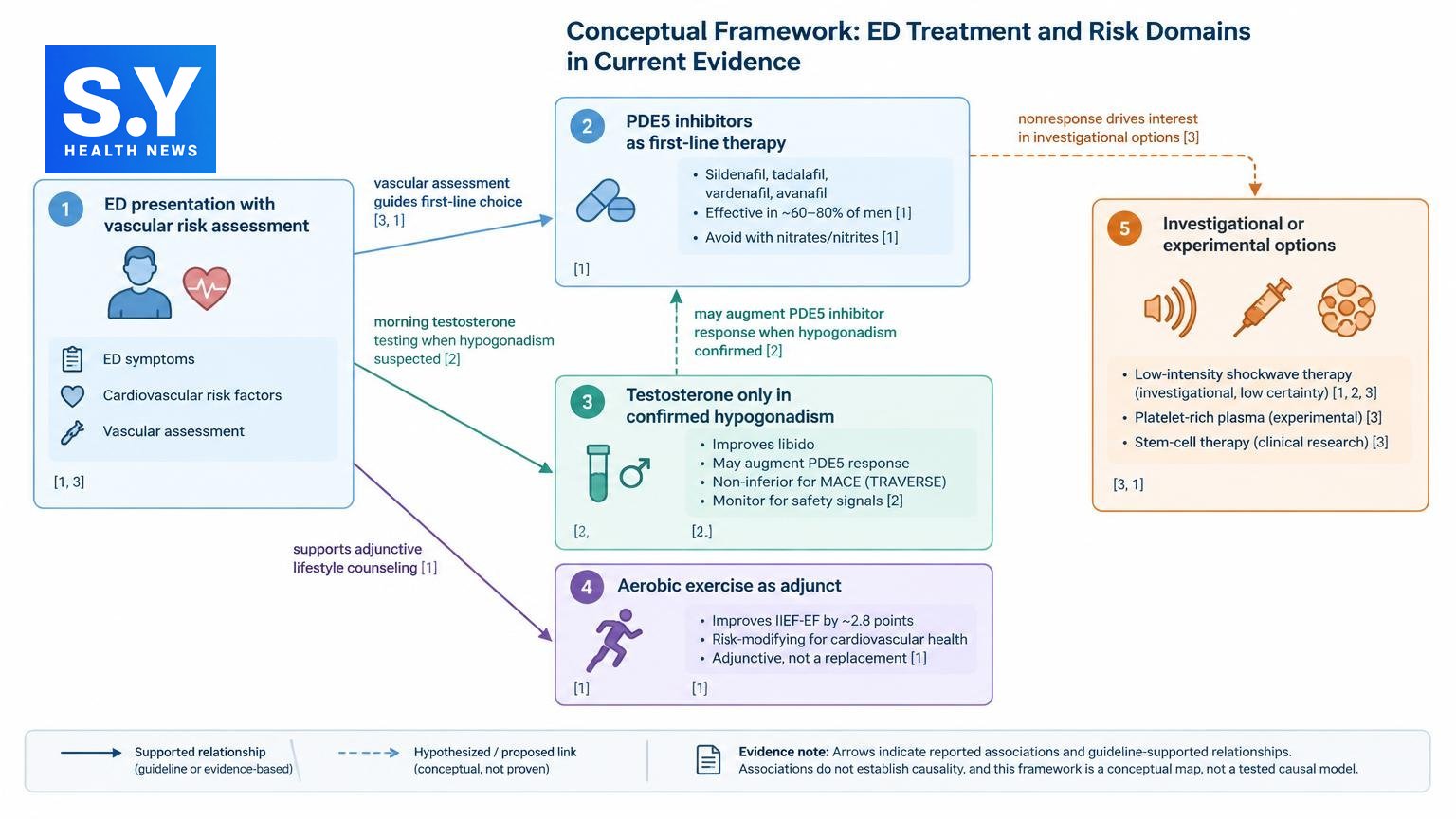
Conceptual framework: Conceptual framework of the treatment and risk domains discussed in this evidence review. Arrows show reported guideline-supported relationships, including a proposed pathway from PDE5 inhibitor nonresponse to investigational options; the framework is a conceptual map, not a tested causal model.
Academic References & Evidence
- Erectile Dysfunction.
- Latest ED Treatments 2026: Pills, Gels and Your Options.
- New ED Treatments in 2026: What Works and What Is in Trials.
- Search Results.
SANYUN Science Center explains published research on men's reproductive and sexual health, connecting scientific evidence with everyday questions while making sources and limitations clear.
Disclaimer: This article is for scientific education and research communication only. It does not provide medical advice, diagnosis, or individualized treatment recommendations, and does not endorse any medication, supplement, device, penile enlargement procedure, or other intervention. Decisions about sexual and reproductive health should be made in consultation with a qualified healthcare professional. Do not delay seeking professional care because of information in this article.
Original Content & Copyright Notice
- This article is prepared for SANYUN Science Center, drawing on published research and publicly available academic literature on men’s sexual and reproductive health. Its editorial explanations and presentation are developed for this platform.
- Copyright in the original editorial content, selection, and arrangement is reserved by SANYUN Science Center to the extent protected by applicable law. Referenced research, quotations, and third-party materials remain subject to the rights of their respective owners. This notice does not claim ownership of scientific facts or third-party research.
- Except where permitted by applicable law or an applicable license, prior written permission is required to reproduce, republish, translate, adapt, redistribute, or commercially reuse protected content. Attribution alone does not grant permission for such reuse.
- For permitted quotation or authorized reuse, clearly identify the source and retain a link to the original article.
- Source: SANYUN Science Center
- Original URL: Retain the original article URL on science.san-yun.com.
- Copyright Holder: SANYUN Science Center, for its own protected editorial content.
- Quotation, excerpts, or authorized reuse must not distort the scientific meaning, omit material limitations or disclaimers, or imply unverified medical claims, product efficacy, or endorsement by SANYUN Science Center.



