




Category: Erectile Dysfunction
Core Research Direction: Critical appraisal of the evidence base for erectile dysfunction treatments (pharmacological, non-pharmacological and combined), focusing on methodological quality of meta-analyses, effect sizes on validated erectile function instruments (IIEF, IIEF-EF, IIEF-5, EHS), heterogeneity/publication bias, and long-term functional outcomes after prostatectomy.
Search Intent: How strong is the evidence that current erectile dysfunction treatments actually work, and how much erectile function recovers long-term after prostatectomy?
Platform: SANYUN Science Center
Evidence reviewed through: 2026-11-08
Executive Summary
Erectile dysfunction treatment studies often do not justify strong confidence in any single intervention, and long-term sexual function after prostatectomy does not appear to return fully to baseline. A recent umbrella review screened 1191 studies and included 23 published meta-analyses, which together produced 42 summary effects on the International Index of Erectile Function (IIEF), IIEF-5, IIEF-EF and the Erectile Hardness Score (EHS) across 36 interventions. The authors rated 13 of the 23 meta-analyses (56.5%) as critically low quality on AMSTAR-2, 7 (30.5%) as low, 2 (8.7%) as moderate and only 1 (4.3%) as high. At the outcome level, 20 of 42 summary effects (47.6%) were low quality and 20 (47.6%) very low.[1]
Statistically significant improvements were observed with both pharmacological and non-pharmacological interventions, but the umbrella review authors cautioned that these findings should be interpreted carefully because of limited patient numbers and the subjective nature of patient-reported outcome measures. More than half of the summary effects (57.1%) showed high heterogeneity, and only a minority of meta-analyses assessed publication bias, with a substantial proportion showing evidence of it. Separately, a prospective observational study of 800 patients who underwent prostatectomy in southern Brazil between 2018 and 2023 found that, after an early postoperative decline, sexual and erectile functions improved gradually but did not fully return to preoperative levels by the end of follow-up.[2][3]
Why This Matters
Erectile dysfunction is common, and the range of proposed treatments has expanded well beyond phosphodiesterase type 5 inhibitors to include stem cell therapy, platelet-rich plasma, low-intensity shockwave therapy, acupuncture and combined approaches. The umbrella review found that the treatment landscape is increasingly diverse, yet the reliability of the evidence is poor. For clinicians and patients, this creates a specific problem: a statistically significant improvement on a questionnaire does not automatically translate into a clinically meaningful or durable benefit, and the confidence that can be placed in any given summary effect varies widely.
The post-prostatectomy setting adds another layer. Surgery for prostate cancer is a major cause of erectile dysfunction, and patients often want to know how much function will recover and over what timeframe. The Brazilian cohort provides longitudinal patient-reported data over seven postoperative time points, including assessments up to postoperative day 1090, but the excerpt available does not report the magnitude of the residual deficit or the proportion of patients who recovered to a meaningful degree. This gap matters for counseling and for planning rehabilitation.
How Erectile Function Is Measured in Trials
The umbrella review used the IIEF or its simplified versions and the EHS as endpoints. The IIEF is a multidimensional patient-reported instrument; the IIEF-5 is a short form often used in clinical settings; the IIEF-EF is the erectile function domain score; and the EHS is a single-item rating of hardness. These instruments capture the patient's subjective experience, which is clinically relevant but also susceptible to placebo response, recall bias and variation in interpretation across populations and languages. The review authors noted that sole reliance on these patient-reported outcomes, while excluding objective physiological measures, may amplify between-study differences.
Statistical significance on these scales is usually expressed as a standardized mean difference (SMD) or a mean change. An SMD of 0.82, for example, is a moderate-to-large effect in conventional terms, but its clinical meaning depends on the baseline score, the minimal clinically important difference for the instrument and the population studied. The umbrella review reported that platelet-rich plasma therapy up to 6 months had the largest IIEF improvement, with an SMD of 0.82 (95% CI 0.42–1.21), but rated the evidence quality as low. This illustrates a recurring pattern: the largest point estimates often come from the weakest evidence.
What the Umbrella Review Found Across Treatment Categories
For the IIEF, the umbrella review reported that, compared with placebo, all pharmacological treatment groups significantly improved IIEF scores except 3-month stem cell therapy and apomorphine. Among non-pharmacological interventions, electromagnetic field therapy and low-intensity pulsed ultrasound showed statistically significant effects, but the evidence quality was very low. In combined treatment, platelet-rich plasma plus low-intensity shockwave therapy significantly improved IIEF, with low evidence quality. These findings are best read as hypothesis-generating rather than as a basis for prioritizing one treatment over another.
For the IIEF-EF, pharmacological treatments including stem cell therapy, antioxidant supplementation and avanafil significantly improved scores, with stem cell therapy up to 6 months showing the largest effect but very low evidence quality. Low-intensity shockwave therapy improved IIEF-EF at 3 months or less, again with very low evidence quality. For the IIEF-5, all assessed pharmacological treatments significantly improved scores compared with placebo or vitamin controls, with stem cell therapy up to 6 months again showing the largest effect but very low evidence quality; acupuncture showed a significant positive effect among non-pharmacological interventions; and low-intensity shockwave therapy plus a PDE5 inhibitor showed a positive treatment effect. For the EHS, stem cell therapy and antioxidants significantly improved scores, and low-intensity shockwave therapy improved EHS at 3 months or more, all with very low evidence quality.
A notable inconsistency is that only stem cell therapy showed significant improvement across all four endpoints, but 3-month stem cell therapy had no clear positive effect on IIEF, low-intensity shockwave therapy at 3 months or less had no clear positive effect on IIEF-EF, and shockwave therapy at 3 months or more had no clear positive effect on IIEF-5. These time-window-dependent findings suggest that the choice of endpoint and follow-up duration materially affects conclusions, and they caution against generalizing a summary effect across instruments or timeframes.
Methodological Quality, Heterogeneity and Publication Bias
The umbrella review's central contribution is not a new effect estimate but a quality audit of the existing evidence base. Using AMSTAR-2, the authors rated 56.5% of included meta-analyses as critically low quality and 30.5% as low, leaving only 8.7% moderate and 4.3% high. At the level of individual summary effects, graded with GRADE, only one was high quality and one moderate, while 47.6% were low and 47.6% very low. This means that most of the statistically significant findings rest on evidence that is at high risk of bias or imprecision.
Heterogeneity was substantial: more than half of summary effect estimates (57.1%) showed high heterogeneity. High heterogeneity indicates that the included studies did not agree on a single underlying effect, which may reflect differences in populations, dosing, duration, outcome definitions or concomitant treatments. The review also reported that only a minority of meta-analyses assessed publication bias, and among those that did, a substantial proportion showed significant publication bias. Small positive studies are more likely to be published, and when they dominate a literature, summary effects can be inflated. The authors themselves acknowledged that a limited number of included studies, mostly low-quality evidence, high heterogeneity and potential publication bias weaken the reliability of conclusions.
| Domain | Reported finding | Implication for interpretation |
|---|---|---|
| Meta-analysis quality (AMSTAR-2) | 13 of 23 meta-analyses (56.5%) critically low; 7 (30.5%) low; 2 (8.7%) moderate; 1 (4.3%) high | Most pooled estimates are built on methodologically weak reviews |
| Outcome-level evidence quality (GRADE) | 20 of 42 summary effects (47.6%) low; 20 (47.6%) very low; only 2 high or moderate | Statistical significance rarely equates to high certainty |
| Heterogeneity | 57.1% of summary effects showed high heterogeneity | A single pooled number may mask divergent study results |
| Publication bias | Assessed in only a minority of meta-analyses; a high proportion showed significant bias | Positive findings may be overrepresented in the literature |
| Largest reported IIEF effect | Platelet-rich plasma up to 6 months: SMD 0.82 (95% CI 0.42–1.21), low-quality evidence | A moderate-to-large point estimate with low certainty |
| Post-prostatectomy recovery | Sexual and erectile functions declined early and improved gradually, but did not fully return to preoperative levels | Recovery is incomplete for many patients; long-term support is needed |
Long-Term Functional Outcomes After Prostatectomy
The Brazilian cohort enrolled 800 patients who underwent prostatectomy at a private hospital in southern Brazil between 2018 and 2023 and assessed functional outcomes at seven postoperative time points: T0, T30, T90, T180, T365, T720 and T1090. Before surgery, patients already showed moderate impairment in sexual function while other domains were relatively preserved. At 30 days postoperatively, all domains declined, particularly urinary incontinence and sexual function, followed by gradual recovery over time. However, a full return to preoperative levels was not achieved, especially for sexual and erectile functions.
The study also compared surgical approaches. Robotic surgery was associated with better functional outcomes and shorter hospital stays, while laparoscopic surgery showed more consistent late-stage recovery. This is an observational comparison, and differences in surgeon experience, patient selection, tumor characteristics and institutional protocols could confound the association. The authors concluded that long-term follow-up and targeted functional rehabilitation are important, particularly for preserving sexual quality of life. That conclusion is a plausible interpretive position, but the study design does not test whether any specific rehabilitation intervention improves long-term outcomes.
Proposed Mechanisms and Their Limits
The umbrella review describes several proposed mechanisms, but these are mechanistic hypotheses rather than findings tested within the review itself. Antioxidants are proposed to scavenge free radicals and inhibit oxidative-stress pathways, modulating endothelial nitric oxide synthase uncoupling and increasing nitric oxide bioavailability. Stem cell therapy is proposed to act mainly through paracrine release of vascular endothelial growth factor, insulin-like growth factor-1 and basic fibroblast growth factor, promoting endothelial repair and nerve regeneration. Micro-energy therapies, including low-intensity shockwave, electromagnetic field and low-intensity pulsed ultrasound, are proposed to improve local circulation, stimulate nerve regeneration and suppress inflammation. The mechanism of acupuncture remains unclear and may involve stimulation of nerve endings and modulation of central neurotransmitter systems.
These mechanistic narratives can make a treatment seem biologically rational, but plausibility is not efficacy. The review authors noted that most included studies enrolled participants based solely on an ED diagnosis without controlling for common comorbidities, which limits interpretation and prevents firm conclusions about which specific mechanism, if any, is responsible for an observed effect. Until trials are designed to test mechanistic hypotheses and to control for comorbidities, the pathways described above should be treated as explanatory proposals, not as established causal explanations for clinical benefit.
Interpretation and Limitations
The umbrella review has several strengths: it searched multiple major databases, covered studies up to October 2025, included 23 meta-analyses across 36 interventions and applied formal quality-rating tools. Its limitations are equally important. It included only published meta-analyses, which may exclude relevant primary trials or unpublished data; it restricted outcomes to four patient-reported measures; and it could not control for the comorbidities of the underlying populations. Its conclusions are therefore a summary judgment about the quality of the existing evidence base, not a definitive verdict that any particular treatment is ineffective.
The post-prostatectomy cohort adds longitudinal patient-reported data over seven time points up to 1090 days, but the available excerpt does not report effect sizes, confidence intervals or the proportion of patients who achieved a clinically meaningful recovery. It is a single-center observational study from a private hospital in southern Brazil, and the surgical-approach comparison is vulnerable to confounding. The finding that erectile function does not fully return should be interpreted as a description of this cohort's trajectory, not as a universal prognosis for all patients after prostatectomy.
An important cross-cutting limitation is the reliance on patient-reported outcomes. These instruments are appropriate because erectile dysfunction is defined by the patient's experience, but they are vulnerable to response shift, placebo effects and differences in interpretation. The umbrella review authors explicitly cautioned that statistically significant improvements should be interpreted carefully given limited patient numbers and subjective outcome indicators. That caution applies equally to the post-prostatectomy recovery data, which were also patient-reported.
Research Outlook
The umbrella review authors recommend further well-designed studies of single treatments and high-quality meta-analyses of comparisons between treatments. They also call for standardized objective measurement tools to bridge the gap between subjective clinical experience and objective biological indicators, and for research that moves toward more precise, individualized care. For the post-prostatectomy population, what is needed is longer-term follow-up with quantified recovery trajectories, identification of predictors of incomplete recovery and trials of rehabilitation strategies that are tested rather than assumed to be beneficial. The currently available evidence does not establish that any specific rehabilitation intervention preserves or restores erectile function after surgery.
Key Takeaways
- Most meta-analyses of erectile dysfunction treatments are of low or critically low methodological quality: 56.5% were rated critically low and 30.5% low on AMSTAR-2.
- At the outcome level, 47.6% of summary effects were low quality and 47.6% very low, with only two of 42 rated high or moderate.
- Statistically significant improvements were reported across pharmacological and non-pharmacological interventions, but the authors caution that these should be interpreted carefully given limited patient numbers and subjective outcome measures.
- High heterogeneity affected 57.1% of summary effects, and publication bias was assessed in only a minority of meta-analyses, with a substantial proportion showing significant bias.
- In a prospective cohort of 800 post-prostatectomy patients, sexual and erectile functions declined early and recovered gradually but did not fully return to preoperative levels.
- Proposed mechanisms for antioxidants, stem cells, micro-energy therapies and acupuncture are hypotheses, not established explanations for clinical benefit.
Questions and Answers
What do the IIEF, IIEF-EF, IIEF-5 and EHS measure in erectile dysfunction trials?
The IIEF is a patient-reported questionnaire assessing erectile function and related domains; the IIEF-EF is its erectile function domain score; the IIEF-5 is a short version; and the EHS is a single-item rating of erection hardness. The umbrella review used these four instruments as endpoints. Because they rely on self-report, they capture the patient's experience but are susceptible to placebo response and differences in interpretation across studies.
How strong is the evidence that erectile dysfunction treatments improve IIEF scores?
An umbrella review of 23 meta-analyses found that most evidence is low or very low quality. Of 42 summary effects, 20 were low quality and 20 very low; only one was high and one moderate. Statistically significant improvements were reported for many pharmacological and non-pharmacological interventions, but the authors cautioned that limited patient numbers and subjective outcome measures mean these findings should be interpreted carefully.
Which erectile dysfunction treatment had the largest reported effect on IIEF scores?
In the umbrella review, platelet-rich plasma therapy up to 6 months showed the largest IIEF improvement, with a standardized mean difference of 0.82 (95% CI 0.42–1.21). However, the evidence quality was rated low, and the finding comes from pooled analyses that may be affected by heterogeneity and publication bias. A large point estimate with low certainty should not be read as proof of superior clinical effectiveness.
Does erectile function fully recover after prostatectomy?
In a prospective cohort of 800 patients who underwent prostatectomy in southern Brazil between 2018 and 2023, sexual and erectile functions declined at 30 days and then improved gradually over seven time points up to day 1090, but did not fully return to preoperative levels. The available report does not quantify the residual deficit or the proportion of patients who recovered meaningfully, so the finding describes this cohort's trajectory rather than a universal prognosis.
What are the main limitations of the umbrella review on erectile dysfunction treatments?
The review included only published meta-analyses, restricted outcomes to four patient-reported instruments and could not control for comorbidities in the underlying studies. More than half of summary effects showed high heterogeneity, and publication bias was assessed in only a minority of meta-analyses. The authors acknowledged that a limited number of studies, mostly low-quality evidence and potential publication bias weaken the reliability of conclusions.
Are stem cell therapy and low-intensity shockwave therapy proven treatments for erectile dysfunction?
They are not proven in the sense of high-certainty evidence. The umbrella review reported that stem cell therapy showed significant improvement across all four endpoints, but 3-month stem cell therapy had no clear positive effect on IIEF, and its evidence quality was very low. Low-intensity shockwave therapy improved IIEF-EF at 3 months or less and EHS at 3 months or more, but evidence quality was also very low. These findings are hypothesis-generating.
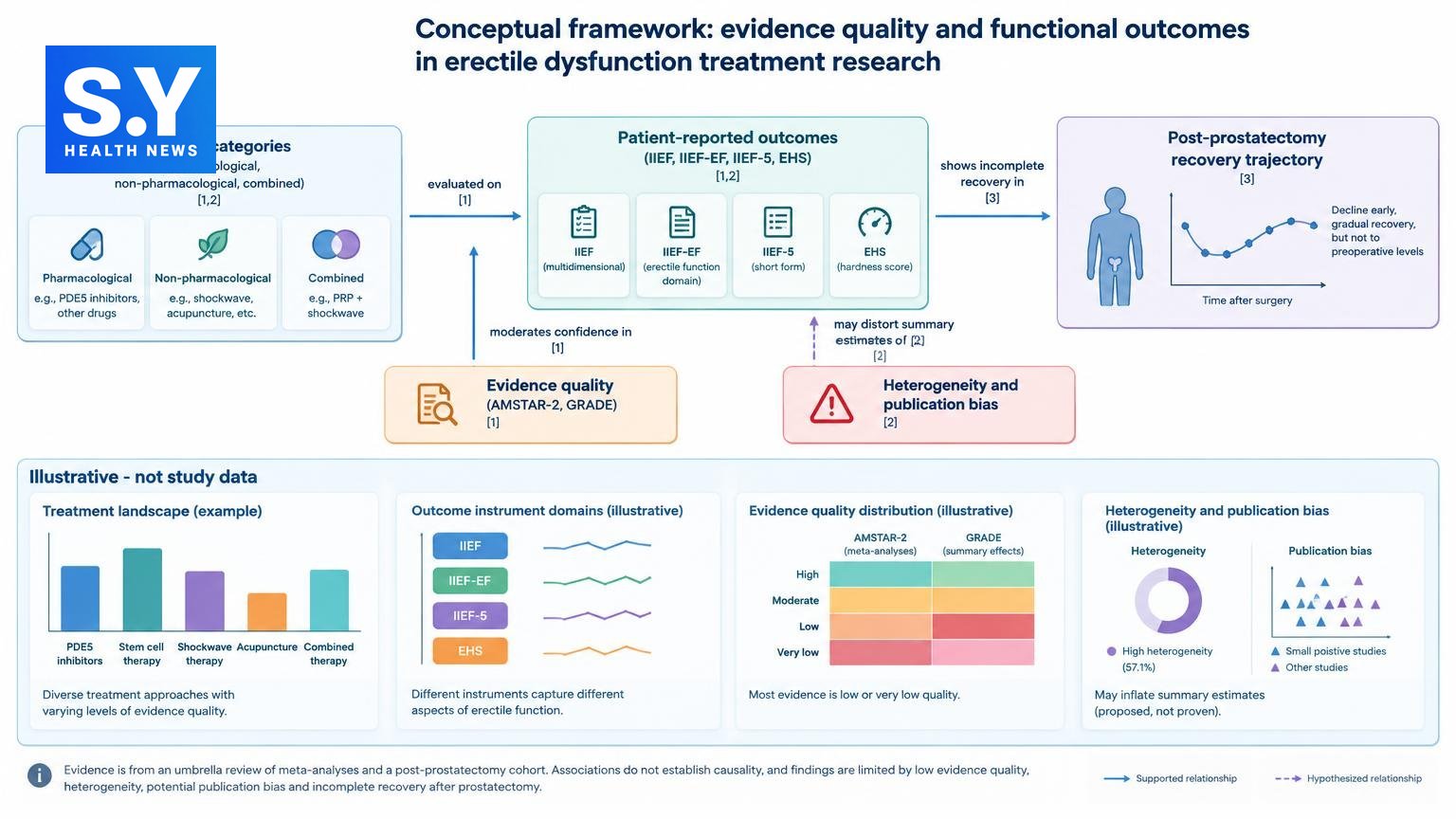
Conceptual framework: Conceptual framework. This figure organizes the article's key constructs: treatment categories, patient-reported outcome instruments, evidence quality, heterogeneity and publication bias, and the post-prostatectomy recovery trajectory. Arrows indicate evaluated relationships; the influence of heterogeneity and publication bias on summary estimates is proposed rather than proven. The framework is a conceptual aid, not a tested causal model or a claim of clinical efficacy.
Academic References & Evidence
- Current treatment for erectile dysfunction: an umbrella review of systematic reviews and meta-analyses. 2026 DOI: 10.6084/m9.figshare.31562993.v1.
- 勃起功能障碍(ED)治疗方案疗效证据的总体评估:一项伞状综述的系统回顾与元分析. The Aging Male. 2026
- Jonas Michel Wolf; Arthur Pille; Lucas Felipe Kist; Rafaela Munari da Silva; Mauricio Santiago Soper; Samanta Brangel Pereira; Mariana Allende dos Santos; Marilze Alves Quessada; Helena Petek; Mariana Lorenzi; André Kives Berger; Eduardo Franco Carvalhal; Juçara Gasparetto Maccari; Mohamed Parrini Mutlaq; Luiz Antônio Nasi. Longitudinal Assessment of Functional Outcomes in… : International Journal of Urological Nursing. International Journal of Urological Nursing. 2026 20(2) DOI: 10.1111/ijun.70054.
SANYUN Science Center explains published research on men's reproductive and sexual health, connecting scientific evidence with everyday questions while making sources and limitations clear.
Disclaimer: This article is for scientific education and research communication only. It does not provide medical advice, diagnosis, or individualized treatment recommendations, and does not endorse any medication, supplement, device, penile enlargement procedure, or other intervention. Decisions about sexual and reproductive health should be made in consultation with a qualified healthcare professional. Do not delay seeking professional care because of information in this article.
Original Content & Copyright Notice
- This article is prepared for SANYUN Science Center, drawing on published research and publicly available academic literature on men’s sexual and reproductive health. Its editorial explanations and presentation are developed for this platform.
- Copyright in the original editorial content, selection, and arrangement is reserved by SANYUN Science Center to the extent protected by applicable law. Referenced research, quotations, and third-party materials remain subject to the rights of their respective owners. This notice does not claim ownership of scientific facts or third-party research.
- Except where permitted by applicable law or an applicable license, prior written permission is required to reproduce, republish, translate, adapt, redistribute, or commercially reuse protected content. Attribution alone does not grant permission for such reuse.
- For permitted quotation or authorized reuse, clearly identify the source and retain a link to the original article.
- Source: SANYUN Science Center
- Original URL: Retain the original article URL on science.san-yun.com.
- Copyright Holder: SANYUN Science Center, for its own protected editorial content.
- Quotation, excerpts, or authorized reuse must not distort the scientific meaning, omit material limitations or disclaimers, or imply unverified medical claims, product efficacy, or endorsement by SANYUN Science Center.



