




Category: Erectile Dysfunction
Core Research Direction: What does the current evidence tell us about the effectiveness and limitations of established and emerging erectile dysfunction treatments, and how should clinical context and evidence quality shape interpretation?
Search Intent: What do reviews and clinical studies actually show about the efficacy, safety, and evidence quality of established versus investigational erectile dysfunction therapies?
Platform: SANYUN Science Center
Evidence reviewed through: 2026-11-01
Executive Summary
Erectile dysfunction (ED) is common, heterogeneous, and increasingly treated within a crowded marketplace of established pharmacology and aggressively promoted regenerative interventions. The central question for this review is not whether ED treatments produce statistically significant effects — several apparently do — but whether the evidence behind those effects is strong enough to support the claims made for them, and how clinicians should weigh trial design, outcome subjectivity, and evidence quality when advising patients. An umbrella review published in 2026 that synthesized studies available through October 2025 extracted 23 published meta-analyses from 1,191 studies, yielding 42 summary effects across three erectile function indices and the erectile hardness score, covering 36 interventions.[1]
That review offers a sobering structural finding: when all 23 meta-analyses were appraised with AMSTAR-2, 13 (56.5%) were rated critically low quality, 7 (30.5%) low, 2 (8.7%) moderate, and only 1 (4.3%) high. At the level of individual summary effects, only two were rated high or moderate quality, while 20 (47.6%) were low and 20 (47.6%) very low. The review authors concluded that statistically significant improvements in ED were observed with both pharmacological and nonpharmacological interventions, but that these findings warrant caution because of limited patient numbers and the subjective nature of outcome indicators.
This is the interpretive frame for the rest of the article. Positive trials exist and should not be dismissed, but the reliability of much of the underlying evidence is poor, and the therapeutic landscape is diverse without being correspondingly well characterized. Clinicians and patients therefore need to separate three questions that are often conflated: does an intervention show a measured effect, is that effect clinically meaningful, and how confident can anyone be that the effect is real and reproducible.
Why This Matters
ED is frequently discussed as a sexual complaint, but it behaves clinically as a systemic signal. A comparative review in sexual medicine describes ED as potentially the first symptomatic expression of cardiometabolic disease, medication effects, endocrine disturbance, or chronic psychological stress rather than a stand-alone disorder. That framing matters for treatment selection: an intervention that improves erection scores without addressing an underlying vascular, endocrine, or psychological driver may produce modest short-term gains while leaving the more important clinical problem unexamined.[2]
A second reason for caution is that response to first-line pharmacotherapy is neither universal nor durable in practice. A narrative review in sexual medicine reports discontinuation rates for conventional PDE5 inhibitors as high as 50%, attributed to unrealistic expectations, comorbidities, partner factors, and unmet needs. That figure should be read carefully because it comes from a narrative synthesis without a derivation or primary citation in the supplied text, but the direction is consistent with everyday clinical experience: a drug can be effective in trials and still fail in the context of a man's life.[3]
The same review notes that some men respond incompletely to PDE5 inhibitors and that ED often has mixed vascular, endocrine, neurologic, or psychogenic drivers requiring broader evaluation. Guideline recommendations summarized in that review identify anxiety, depression, and partner relationship factors as important predictors of ED severity and persistence. These are not peripheral considerations; they shape whether any treatment will be taken, continued, and judged satisfactory.
Biological and Clinical Mechanism
The dominant mechanistic account of erection centers on nitric oxide release, cyclic GMP signaling, and smooth muscle relaxation in the penile vasculature. PDE5 inhibitors act downstream of this cascade by slowing cGMP breakdown, which is why they require sexual stimulation to produce an effect rather than causing erections directly. This mechanistic clarity is one reason PDE5 inhibitors became the reference standard and why adjuncts that feed the same pathway, such as the nitric oxide precursor L-arginine, have been tested as add-ons.[4]
Mechanistic plausibility, however, does not guarantee clinical superiority. The L-arginine trial illustrates the distinction between a rational mechanism and a marginal result. In a randomized controlled study with two parallel groups, men with organic ED received either sildenafil 50 mg every other day or sildenafil every other day plus daily L-arginine. Efficacy was assessed with the IIEF-5 at baseline and after 8 weeks. Across treatment, IIEF-5 improved from 15.3 (SD 2.5) to 19.2 (SD 2.3), a statistically significant change (p<0.0001). The between-group difference favored the combination modestly, 19.8 versus 18.5, with p=0.05 — a result that sits exactly at the conventional significance boundary.
Adverse effects were broadly similar between groups, except that gastritis was more common with the combination. No adverse-event rates were given in the available abstract text, so the practical magnitude of that difference cannot be assessed from the supplied material. The appropriate reading is that adding L-arginine produced a small, borderline statistical advantage in a single trial whose sample size and randomization details are not available in the source text — not that combination therapy is established as superior.
What the Evidence Shows
The umbrella review provides the clearest available map of the treatment landscape. Its 42 summary effects were distributed across the IIEF (n=20), IIEF-5 (n=9), IIEF-EF (n=6), and erectile hardness score (n=7), spanning 36 interventions. That breadth is itself a finding: the field contains many candidate treatments, evaluated with heterogeneous instruments, which makes cross-intervention comparison difficult and raises the risk of selective emphasis on whichever endpoint performed best.
| Evidence layer | What was measured | Reported result | Interpretation |
|---|---|---|---|
| Umbrella review scope | Meta-analyses and summary effects | 23 meta-analyses from 1,191 studies; 42 summary effects; 36 interventions | Broad but heterogeneous evidence base |
| Meta-analysis quality (AMSTAR-2) | Methodological quality of included reviews | 13 critically low (56.5%); 7 low (30.5%); 2 moderate (8.7%); 1 high (4.3%) | Most pooled reviews are methodologically weak |
| Summary effect quality | Quality grading of 42 effects | 2 high/moderate; 20 low (47.6%); 20 very low (47.6%) | Few effects rest on strong evidence |
| Direction of effect | Pharmacological and nonpharmacological interventions | Statistically significant improvements reported | Significance is not clinical adequacy; small samples and subjective outcomes limit confidence |
| Sildenafil vs sildenafil plus L-arginine | IIEF-5 at baseline and 8 weeks | Overall 15.3 to 19.2 (p<0.0001); combination 19.8 vs 18.5 (p=0.05) | Small borderline between-group advantage in one trial |
The umbrella review's authors describe the treatment landscape as increasingly diverse while the reliability of the evidence remains poor. They recommend further well-designed studies on single treatments and high-quality meta-analyses of intertreatment comparisons. That recommendation is itself a commentary on the current state: the field lacks the head-to-head, adequately powered comparisons that would let clinicians choose between options on evidence rather than on availability, cost, or marketing.
Regenerative and device-based therapies occupy a particularly contested space. According to the authors of a multi-platform evaluation of chatbot counseling, major professional societies classify low-intensity shockwave therapy and stem cell therapy as investigational and platelet-rich plasma as experimental, and do not recommend routine clinical use. A community urologist interviewed in trade press used similar language, describing shockwave as investigational and PRP as experimental, and recommended standard-of-care options including oral medications, injections, penile prosthesis, and vacuum devices while noting that alternative therapies are not yet standard of care.[5][6]
The same urologist described platelet therapy and shockwave treatment as not validated. These are expert opinions rather than trial data, and they should be weighted accordingly, but they converge with the society classifications and with the umbrella review's overall quality assessment. The reasonable synthesis is that some men may experience benefit from investigational modalities, that supportive short-term signals exist for some of them, and that the evidence does not yet establish routine use.
Where Patients Get Their Information
A distinct but clinically relevant body of evidence concerns how patients encounter claims about emerging ED therapies before they reach a clinician. A cross-sectional evaluation collected 144 chatbot responses — six patient-style questions per therapy (low-intensity shockwave, PRP, stem cell therapy) across four platforms and two repeated sessions, queried on June 6 and 8, 2025. Safety and side effects were addressed in only 56 of 144 responses (38.9%). Reference to major urologic or sexual medicine society guidelines appeared in just 21 of 144 responses (14.6%). Only 34 of 144 responses (23.6%) mentioned approved alternatives such as oral PDE5 inhibitors, vacuum devices, injections, implants, or lifestyle changes.
Most responses, 116 of 144 (80.6%), did identify regenerative therapies as investigational or not FDA-approved for clinical use, which is a genuine strength. But the completeness picture is uneven. Responses about low-intensity shockwave therapy acknowledged evidence limitations less often (50.0%) than those about PRP (89.6%) and stem cell therapy (85.4%). The study authors suggest that model framing may track the visibility of published literature more closely than society recommendations — a caution that applies equally to commercial direct-to-consumer promotion.
This evidence does not measure patient outcomes; it measures counseling completeness. Its value lies in documenting the informational environment in which treatment decisions are made. A man who arrives at a consultation having absorbed incomplete, optimistically framed content about an unproven therapy is not making an informed choice, and the clinical conversation has to repair that gap before shared decision-making can begin.
Interpretation and Limitations
Several interpretive cautions apply across the evidence reviewed here. First, statistical significance and clinical meaning are not interchangeable. The L-arginine trial's between-group difference of 1.3 IIEF-5 points reached p=0.05; whether that difference is perceptible to a patient, and whether it persists beyond 8 weeks, is not established by the available data. Second, the IIEF instruments are patient-reported and therefore susceptible to expectation effects, which is precisely why the umbrella review authors flagged the subjective nature of outcome indicators as a limitation.
Third, evidence quality and evidence direction must be reported separately. The umbrella review found statistically significant improvements with both pharmacological and nonpharmacological interventions, yet most of the underlying meta-analyses were rated critically low or low quality, and most summary effects were low or very low quality. A reader who takes only the first half of that sentence will overestimate certainty; a reader who takes only the second will underestimate the plausibility of benefit. Both halves are needed.
Fourth, the sources vary widely in evidentiary status. The umbrella review is a formal synthesis; the L-arginine study is a single randomized trial with incomplete reporting in the available text; the trade-press commentary is expert opinion; the narrative sexual medicine review is illustrative case material, including a single adapted case in which ED improved without ED-specific treatment after thyroidectomy restored thyroid function and normalized testosterone. That case is useful for teaching the principle that reversible endocrine causes exist, but it is not evidence that thyroid surgery treats ED in general.
Fifth, diagnostic uncertainty is itself a limitation on treatment evaluation. The narrative review states that Rigiscan is no longer the gold standard for assessing organic ED because of high cost and limited sensitivity and specificity. When the reference standard for classifying patients is imperfect, trials that enroll "organic ED" populations are more heterogeneous than their labels suggest, which dilutes measurable treatment effects and complicates generalization.
Finally, the review process here has limits. This article interprets published sources supplied in a defined packet; it is not a new systematic review, does not re-extract data from primary trials, and cannot verify claims that the secondary sources themselves report secondhand. Where a figure appears only in a secondary educational guide or a narrative review, that provenance is stated, and the figure should be treated as indicative rather than definitive.[7]
Research Outlook
The most actionable research priority identified by the umbrella review is not a new molecule but better study architecture: well-designed trials of single treatments and high-quality meta-analyses comparing treatments against one another. The current literature is rich in interventions and poor in reliable comparisons, which means patients and clinicians are often choosing between options whose relative merits have not been rigorously established.
A second priority concerns outcome measurement and reporting. Because the IIEF family and hardness scores are subjective, trials benefit from prespecified minimal clinically important differences, adequate follow-up, and transparent reporting of between-group rather than within-group change. The L-arginine trial reported both, which is a methodological strength relative to studies that report only pre-post improvement, but its between-group result sat at the significance boundary and its sample characteristics were incompletely described in the available text.
A third priority is the informational ecosystem. The chatbot evaluation shows that even when AI systems correctly label regenerative therapies as investigational, they frequently omit safety, cost, guidelines, and approved alternatives. As patients increasingly arrive with AI-generated expectations, research that characterizes and improves that counseling quality has direct clinical relevance, even though it does not itself test any ED treatment.
For investigational modalities specifically, the field needs longer follow-up, standardized protocols, and clarity about which patient subgroups might plausibly benefit. Until those data exist, the society positions described in the chatbot study — investigational for shockwave and stem cell therapy, experimental for PRP — remain the appropriate default framing, with clinical use confined to research contexts where possible.
Key Takeaways
- The evidence base for ED treatments is broad but methodologically weak: 13 of 23 meta-analyses were critically low quality and only 2 of 42 summary effects were rated high or moderate.
- Statistically significant improvements have been reported for both pharmacological and nonpharmacological interventions, but small samples and subjective endpoints limit confidence.
- In one randomized trial, adding daily L-arginine to sildenafil produced a small borderline advantage (19.8 vs 18.5 on IIEF-5, p=0.05) at 8 weeks, with more gastritis in the combination group.
- Shockwave therapy and stem cell therapy are classified as investigational and PRP as experimental by major societies, and routine clinical use is not recommended.
- Chatbot counseling on these therapies often omits safety (38.9%), guideline references (14.6%), and approved alternatives (23.6%), shaping patient expectations before clinical contact.
- Real-world PDE5 inhibitor discontinuation is reported as high as 50%, reflecting expectations, comorbidities, partner factors, and unmet needs rather than drug inefficacy alone.
Questions and Answers
How do PDE5 inhibitors work for erectile dysfunction, and what does the evidence say about their effectiveness?
PDE5 inhibitors slow the breakdown of cyclic GMP in penile smooth muscle, supporting erection when sexual stimulation triggers nitric oxide release. The umbrella review found statistically significant improvements in erectile function with pharmacological interventions, but most summary effects were low or very low quality, and only a minority of meta-analyses were rated moderate or high on AMSTAR-2. Effectiveness in trials therefore does not guarantee strong evidence for every claim made clinically.
Does adding L-arginine to sildenafil improve erectile function more than sildenafil alone?
One randomized trial compared sildenafil 50 mg every other day with sildenafil plus daily L-arginine over 8 weeks. Overall IIEF-5 rose from 15.3 to 19.2, and the combination group scored 19.8 versus 18.5 for sildenafil alone, with p=0.05 — a borderline result. Gastritis was more common with the combination. This is a single small trial, so it supports further study rather than a firm recommendation for routine combination use.
How strong is the overall evidence base for erectile dysfunction treatments?
It is weaker than the number of published studies suggests. In an umbrella review of 23 meta-analyses, 13 (56.5%) were rated critically low quality on AMSTAR-2, and only one was high quality. At the summary-effect level, 20 of 42 were rated low and 20 very low, leaving only two high or moderate. The authors describe the treatment landscape as diverse but the reliability of the evidence as poor.
Are shockwave therapy, platelet-rich plasma and stem cell therapy recommended for erectile dysfunction?
Major professional societies classify low-intensity shockwave therapy and stem cell therapy as investigational and platelet-rich plasma as experimental, and do not recommend routine clinical use. A community urologist interviewed in trade press used comparable language and described standard-of-care options as oral medications, injections, penile prosthesis, and vacuum devices. Some short-term signals exist, but heterogeneity, small samples, and limited long-term safety data prevent a routine-use recommendation.
Why do so many men stop using PDE5 inhibitors, and what does that mean for treatment evaluation?
A narrative review reports discontinuation rates for conventional PDE5 inhibitors as high as 50%, linked to unrealistic expectations, comorbidities, partner factors, and unmet needs. The estimate lacks a derivation in the supplied text and should be treated cautiously, but it illustrates a broader point: trial efficacy and real-world persistence are different outcomes. Some men also respond incompletely or have mixed vascular, endocrine, neurologic, or psychogenic drivers requiring wider evaluation.
How reliably do AI chatbots counsel patients about emerging erectile dysfunction therapies?
A cross-sectional evaluation of 144 chatbot responses found that 80.6% identified regenerative therapies as investigational or not FDA-approved, but only 38.9% addressed safety, 14.6% referenced society guidelines, and 23.6% mentioned approved alternatives. These findings concern counseling completeness, not patient outcomes, and do not establish whether any therapy works. They do suggest patients may arrive at clinical encounters with incomplete, optimistically framed expectations.
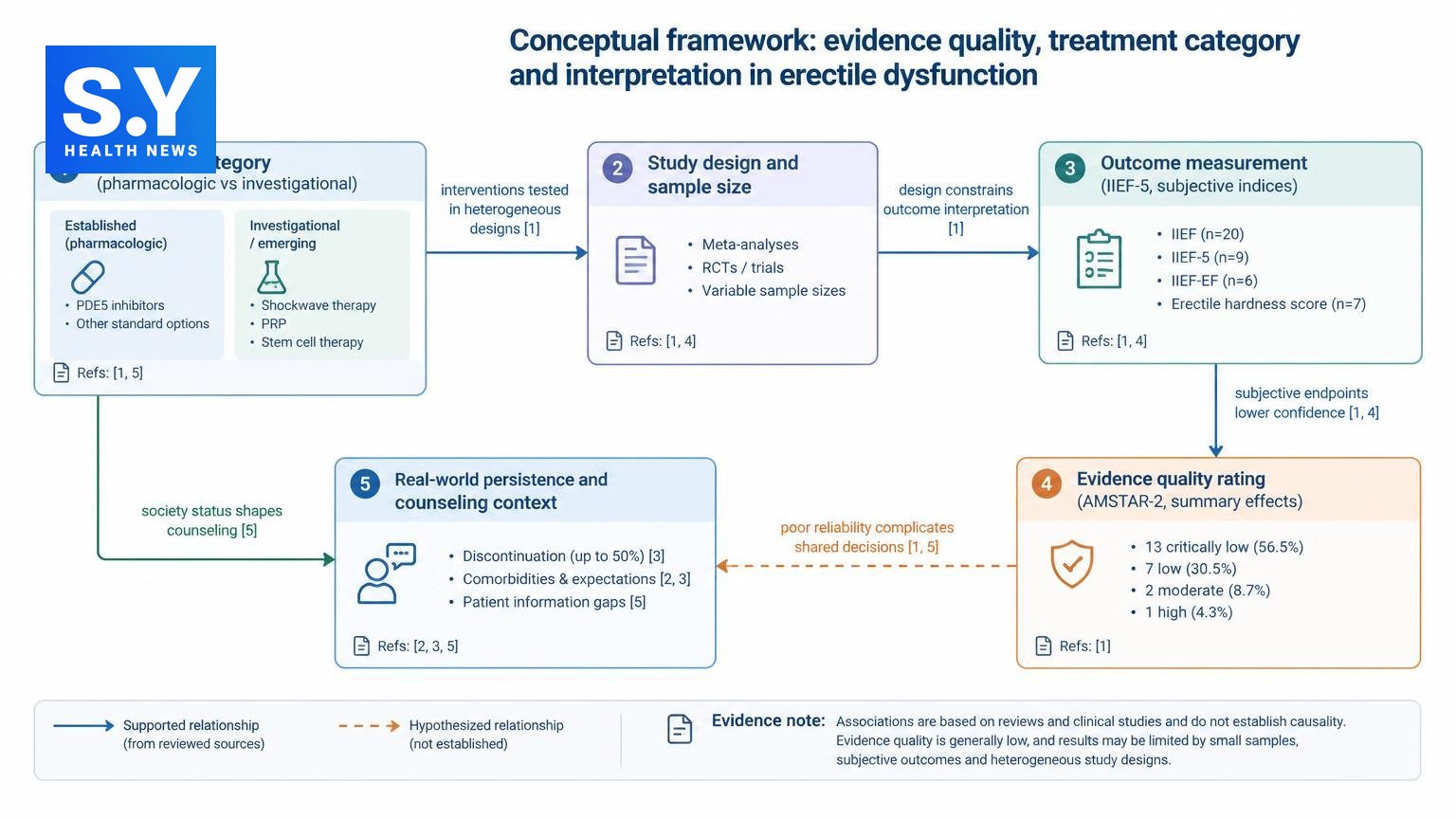
Conceptual framework: Conceptual framework for interpreting ED treatment evidence. Nodes represent treatment category (pharmacologic versus investigational), study design and sample size, outcome instruments, formal evidence-quality ratings, and real-world persistence and counseling context. Solid relations reflect associations described in the reviewed sources; the dashed relation indicates a proposed, not established, influence of evidence quality on shared decision-making. The framework is an interpretive aid, not a tested causal model.
Academic References & Evidence
- Current treatment for erectile dysfunction: an umbrella review of systematic reviews and meta-analyses. DOI: 10.6084/m9.figshare.31562993.v1.
- Idrees Ibrahim Azrag. Bridging Perspectives: A Comparative Study of Erectile Dysfunction Treatments in Western Medicine and Traditional Chinese Medicine. DOI: 10.5772/intechopen.1016101.
- 综述:基于叙事的性医学:通过患者故事与临床病例合集优化真实世界中5型磷酸二酯酶抑制剂治疗勃起功能障碍的临床管理. The Aging Male
- El Wakeel, Lamia; F. A. Fouad; M. D. Saleem; M. Saber-Khalaf. Efficacy and tolerability of sildenafil/L-arginine combination relative to sildenafil alone in patients with organic erectile dysfunction. Andrology. 2019 DOI: 10.1111/andr.12671.
- Completeness and guideline concordance of artificial intelligence chatbot responses to patient questions on regenerative therapies for erectile dysfunction: a multi-platform analysis.
- Karen Nash. What do you tell your patients about all the new erectile dysfunction treatments being advertised to the public? | Urology Times. Urology Times. 2022 50(10)
- Erectile Dysfunction.
SANYUN Science Center explains published research on men's reproductive and sexual health, connecting scientific evidence with everyday questions while making sources and limitations clear.
Disclaimer: This article is for scientific education and research communication only. It does not provide medical advice, diagnosis, or individualized treatment recommendations, and does not endorse any medication, supplement, device, penile enlargement procedure, or other intervention. Decisions about sexual and reproductive health should be made in consultation with a qualified healthcare professional. Do not delay seeking professional care because of information in this article.
Original Content & Copyright Notice
- This article is prepared for SANYUN Science Center, drawing on published research and publicly available academic literature on men’s sexual and reproductive health. Its editorial explanations and presentation are developed for this platform.
- Copyright in the original editorial content, selection, and arrangement is reserved by SANYUN Science Center to the extent protected by applicable law. Referenced research, quotations, and third-party materials remain subject to the rights of their respective owners. This notice does not claim ownership of scientific facts or third-party research.
- Except where permitted by applicable law or an applicable license, prior written permission is required to reproduce, republish, translate, adapt, redistribute, or commercially reuse protected content. Attribution alone does not grant permission for such reuse.
- For permitted quotation or authorized reuse, clearly identify the source and retain a link to the original article.
- Source: SANYUN Science Center
- Original URL: Retain the original article URL on science.san-yun.com.
- Copyright Holder: SANYUN Science Center, for its own protected editorial content.
- Quotation, excerpts, or authorized reuse must not distort the scientific meaning, omit material limitations or disclaimers, or imply unverified medical claims, product efficacy, or endorsement by SANYUN Science Center.



